
Gemini-Powered Siri Is a New Search Surface: What SMEs Should Do Before They Lose the Click
Apple is turning Siri into an AI answer layer that can pull “up-to-date information from the web” inside Spotlight and across devices. That changes how customers discover brands, how often they click, and how you measure success. Here’s a practical playbook for SMEs and agencies—plus how AYSA monitors, prepares, requests approval, and executes the changes that improve AI search visibility.

By Marius Dosinescu (AYSA.ai)
Apple just moved search closer to the user and farther from your website.
At WWDC, Apple introduced a new Siri experience that can pull “up-to-date information from the web” and generate answers—then made it available inside Spotlight on iPad and Mac, where people already type their questions. That’s not a cosmetic UI tweak. It’s a distribution shift: a new default answer surface sitting between customer intent and your site.
This is the part most businesses miss: the biggest risk isn’t that “Apple is building a search engine.” The biggest risk is that customers get what they need without ever opening Safari, and you don’t even know you were considered—because measurement for assistant answers is still unclear.
The goal of this editorial is practical: understand what changed, why it matters for SMEs and agencies, and what to do now—before “AI answers” quietly become the new front page of the web.
Primary research reference: Search Engine Journal’s coverage of Apple’s Gemini-powered Siri and the open questions around links, Crawling controls, and measurement: What Apple’s Gemini-Powered Siri Means For Search Visibility.
Concise Summary
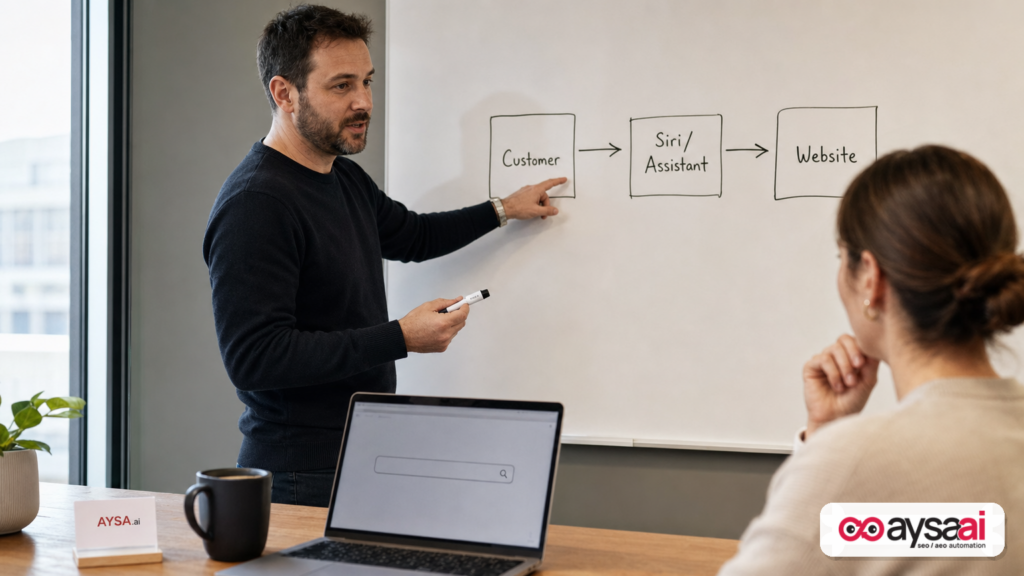
- Apple is turning Siri into an AI answer layer that can use the web to generate responses—and it’s embedded into Spotlight and system-wide actions.
- Apple’s public messaging leaves open questions about how often sources will be linked, how Attribution works, and what analytics will show.
- This creates a new “visibility” game: being interpreted and cited by assistants may matter as much as ranking and Clicks.
- SMEs should prioritize: clean entity signals (who you are), structured content (what you offer), consistent policies/pricing/location info, and technical access.
- AYSA’s role: monitor AI Search visibility, prepare changes that improve machine-readability and trust signals, request approval, then execute accepted changes safely.
Key Takeaways (Business-First)

- Search is becoming “answer-first.” If assistants solve the query, the visit never happens—and neither does your pixel, your retargeting, or your email capture.
- Spotlight is now a search battlefield. For many Mac/iPad users, Spotlight already replaced “open browser + Google.” Now it can replace even more of that journey.
- AI visibility is not the same as SEO traffic. You can be “present” in answers and still see no referral data.
- Execution beats theory. The winners won’t be the brands with the most AI hot takes; they’ll be the ones with clean data, accurate pages, and fast iteration cycles.
Table of Contents

- What Changed: Siri Becomes an AI Answer Layer (Not Just a Voice Assistant)
- How We Got Here: From Search Boxes to Default Assistants
- Distribution Wins: Why Default Placement Beats “Best Model”
- The Second Answer Layer: What This Means for Clicks and Demand
- Spotlight + Siri: The New “Typed Query” Interface
- Visual Intelligence: Camera-Based Queries That Don’t Look Like Search
- Safari’s AI Features: When Software Visits Your Site Instead of People
- Applebot Rules and Opt-Outs: What We Know (and What We Don’t)
- The Measurement Gap: Why Your Analytics Won’t Tell the Full Story (Yet)
- A Practical Playbook for SMEs: How to Earn Mentions, Citations, and Trust
- Concrete SME Scenario: Local Clinic vs. the “Answer Without Click”
- What Agencies Should Rethink: Deliverables, Reporting, and Retainers
- Where AYSA Fits: Monitoring + Approved Execution (Not Random “AI SEO” Guesswork)
- What to Do Next (Action List)
- Sources and Further Reading
What Changed: Siri Becomes an AI Answer Layer (Not Just a Voice Assistant)
For years, Siri was mostly an interface to device functions: timers, texts, basic facts, and (often) frustration. The WWDC shift described in the SEJ reporting is different: Apple is positioning Siri as a conversational assistant with “broad world knowledge” that can use the web for fresh answers, then continue the interaction with follow-up questions.
From a visibility perspective, that’s a new surface area for discovery:
- Web answers: Siri can pull up-to-date information from the web and generate a response.
- Placement: Siri sits inside Spotlight on iPad and Mac—where users already type queries.
- Context: Siri is designed to act across apps and use on-screen context.
- Visual Intelligence: a camera-driven mode that turns the physical world into queries.
Even if you ignore the “AI” buzz, the business meaning is simple: customers can now complete more of the discovery and decision process in a system UI layer—without the normal browser funnel that SEO and paid search have optimized for 20 years.
That doesn’t kill websites. But it changes what a website is for. Increasingly, your site becomes:
- a knowledge base assistants learn from and cite,
- a verification layer (policies, pricing, availability),
- a conversion endpoint only when the assistant can’t safely finish the job.
This is why I keep repeating a principle at AYSA: AI search visibility is not a single ranking. It’s a set of interpretations made by machines on the way to a decision.
How We Got Here: From Search Boxes to Default Assistants
It’s tempting to frame Apple’s move as sudden. It isn’t. It’s the continuation of a broader pattern:
- Search engines moved from “10 blue links” to blended results, featured snippets, knowledge panels, and now AI Overviews.
- Mobile UX made “quick answers” the default expectation—especially for informational queries.
- Large language models made it possible to answer messy, multi-part questions conversationally.
SEJ’s article highlights that Apple’s Gemini partnership has been discussed for some time and is now a shipping product. The strategic arc matters: Apple doesn’t need to “beat Google” at search to change outcomes for your business. It only needs to insert an answer layer into common workflows.
And Apple already owns the most valuable workflow: the device itself.
Distribution Wins: Why Default Placement Beats “Best Model”
If you’re an SME, here’s the truth: customers don’t care which model is under the hood. They care what’s easiest.
The SEJ coverage includes an important observation from industry reaction: this partnership is a bet on distribution. That’s the right framing. In the last decade, the winning interface was the one that:
- was pre-installed,
- was one swipe/keystroke away,
- was “good enough” most of the time.
Apple has that with Spotlight and Siri. There’s no “user acquisition” problem here. People won’t have to download a new app or change a habit. They’ll just notice that the same search box they already use can answer more questions.
For marketers, this is what changes your planning:
- You can’t assume that web traffic is the only proxy for visibility.
- You can’t assume that SEO tactics that moved rankings automatically move assistant answers.
- You can assume that assistants will prefer content that is structured, consistent, and easy to verify.
The Second Answer Layer: What This Means for Clicks and Demand
Google has already been moving toward answer-first experiences (AI Overviews, AI Mode, and many years of “instant answers”). Apple’s move adds a second answer layer—one that can intercept the query before the browser.
SEJ notes third-party research suggesting many searches end without a click and that AI platforms are becoming measurable referrers for some sites—while also emphasizing that none of that measures Siri specifically. That’s the right caution: we should treat Siri as a new surface with unknown mechanics until testing and reporting mature.
Still, directionally, the incentives are clear:
- Assistants reduce the need for “research clicks.”
- Clicks that remain become later-stage (pricing, booking, checkout, verification).
- Brands that win are the ones assistants can confidently describe without hedging.
This is where many SMEs get hurt: they’ve built marketing around “top-of-funnel content traffic,” then monetize later with email, ads, or retargeting. When the assistant answers the top-of-funnel question, that pipeline shrinks unless you have other demand capture mechanisms.
The fix isn’t panic. The fix is treating your website as the canonical truth your entire digital presence depends on—because assistants will reward consistency and punish confusion.
Spotlight + Siri: The New “Typed Query” Interface
Spotlight is underrated in SEO discussions because it doesn’t look like “search marketing.” But it already captures intent: users type app names, calculations, quick questions, and file searches. Apple embedding Siri AI there matters because it changes the user’s default behavior:
- Before: Spotlight → open browser → search → click site.
- After: Spotlight → ask → get answer (maybe link, maybe not).
For publishers and informational businesses, this is a direct threat to the “quick answer” category: definitions, comparisons, troubleshooting, simple lists, and basic how-tos.
For service businesses (clinics, hotels, contractors), the risk shows up in a different way: assistants may answer the pre-qualification questions (“Do you treat X?”, “What’s the check-in time?”, “Is parking free?”). That reduces calls and form fills that used to be generated by those questions—unless you intentionally make that information assistant-friendly and ensure the assistant answers correctly.
Visual Intelligence: Camera-Based Queries That Don’t Look Like Search
Text search has a visible interface: the query and the result. Camera-based search is different: the user points at something and expects an answer.
SEJ highlights Apple’s Visual Intelligence capability as part of the rollout. This matters most for:
- Local businesses: storefronts, menus, signage, operating hours.
- Ecommerce brands: products in the wild, packaging, ingredients, usage instructions.
- Hospitality: rooms, amenities, landmarks, points of interest.
From an execution standpoint, camera-based queries increase the value of “Entity Clarity.” If the assistant identifies your product or business, it needs a clean, unambiguous source of truth to answer:
- What is it?
- Who makes it?
- What are the specs/ingredients/compatibilities?
- Where can I buy/book it?
- What policies apply?
In other words: the unglamorous stuff—product data, structured info, consistent brand footprints—is now the growth lever.
Safari’s AI Features: When Software Visits Your Site Instead of People
SEJ notes Safari changes that matter because they treat websites as places software visits on the user’s behalf. Two examples mentioned:
- “Notify me” style monitoring for page changes (e.g., price drops, restocks).
- Password upgrading automation that navigates websites for the user.
This is a preview of “agentic” behavior: tools that browse and take actions rather than simply retrieving information. For SMEs, this creates operational questions that have nothing to do with keyword research:
- How does your site behave when a tool repeatedly checks a page?
- Do your anti-bot rules block legitimate automated user agents and break real user experiences?
- Do you have stable HTML patterns that allow safe automation without harming security?
Apple hasn’t publicly explained (in the SEJ context) how these automated visits will identify themselves in analytics. That uncertainty is exactly why businesses should start separating security bot management from assistant access policy—and review both intentionally.
Applebot Rules and Opt-Outs: What We Know (and What We Don’t)
One of the most actionable parts of the SEJ reporting is that Apple updated an Applebot support page that describes how crawled data may be used when AI models generate output—and what controls site owners can set.
There are three strategic questions every business should answer:
1) Do you want Apple’s systems to use your content for AI-generated answers?
Opt-out controls (like nosnippet and specific Applebot-related directives described in the SEJ summary) are not purely technical. They’re business decisions. If you block too aggressively:
- You might reduce your ability to be cited in assistant answers.
- You might reduce discoverability in Apple’s surfaces (depending on what you block).
- You might keep traffic today but lose demand tomorrow.
If you allow too freely:
- You may contribute content that answers the question without sending traffic.
- You may have fewer levers to protect premium content models.
There is no universal right answer. But there is a wrong approach: doing nothing and assuming it doesn’t matter.
2) Are you accidentally blocking the wrong agent?
SEJ notes that if robots.txt doesn’t mention Applebot but has Googlebot rules, Applebot may follow Googlebot instructions. This is exactly the kind of “small technical detail” that quietly changes your visibility profile across platforms.
SMEs often inherit robots.txt from a developer years ago. It’s common to find:
- staging disallow rules accidentally on production,
- overly broad blocks on
/blog/or query parameter URLs, - conflicts between bots and CDNs/WAF rules.
You don’t need to become a robots.txt expert. You do need to audit it now, because assistants depend on crawling.
3) Are you paywalling or gating content in a way machines can understand?
SEJ references that paywalled pages can be treated differently depending on structured data signals (as described in Apple’s support guidance). For publishers and knowledge businesses, the key is consistency: if you gate content, do it in a way that’s explicit and intentional, not accidental.
The Measurement Gap: Why Your Analytics Won’t Tell the Full Story (Yet)
Here’s the uncomfortable part: you may not be able to measure Siri answer visibility in a clean, platform-provided way for some time.
SEJ’s coverage is direct: Apple hasn’t described an equivalent of Search Console for Siri answers—no impression reporting, no citation reports, and unclear referrer behavior. That matters because it changes how marketing teams prove ROI.
Practically, this means you need two measurement modes at once:
Mode 1: What you can measure today (imperfect, but useful)
- Branded demand signals: increases in brand-name searches, direct visits, or “near brand” queries.
- Conversion rate shifts: fewer visits but higher intent (typical when answer layers filter top-of-funnel clicks).
- Lead quality changes: fewer basic questions, more appointment-ready inquiries.
- Local behavior: calls, direction requests, booking starts (where applicable).
None of these prove Siri exposure directly, but they’re what businesses can use to steer decisions while waiting for clearer instrumentation.
Mode 2: What you should prepare for (as the ecosystem catches up)
- Assistant citation tracking: where your pages are referenced in AI answers.
- Answer accuracy auditing: whether assistants describe your business correctly.
- Bot/agent analytics: distinguishing “agent visits” from human visits.
This is where AYSA’s philosophy matters: when measurement is incomplete, you focus on controllables—content quality, technical access, structured signals, and fast iteration.
A Practical Playbook for SMEs: How to Earn Mentions, Citations, and Trust
If you run a small or mid-sized business, you don’t need a “Siri optimization hack.” You need to become the easiest business for an assistant to understand and recommend without risk.
Assistants are conservative by design. They will hedge or generalize when information is missing. Your job is to remove ambiguity.
1) Make your “source of truth” pages obvious
Assistants will draw from what they can crawl. Create and maintain pages that answer common pre-purchase questions clearly:
- Pricing (or at least pricing ranges and what affects cost)
- Availability and lead times
- Shipping/returns (ecommerce)
- Service area (local services)
- Insurance/payment accepted (clinics)
- Hours, parking, accessibility (local)
- Warranty/support (products & SaaS)
Most SME sites bury these in PDFs, images, or outdated blog posts. That’s fine for humans; it’s risky for assistants.
2) Structure the information so machines can reuse it
“Structured for AI” is not magic. It usually means:
- Clear headings (questions as H2/H3)
- Lists, tables, and consistent patterns
- Internal links to related policies and detail pages
- Schema markup where appropriate (organization, products, FAQs, locations)
Many teams obsess over schema as a checkbox. The real win is consistency: the same facts (hours, address, pricing rules, product specs) should match across your site.
3) Fix “small trust gaps” that cause assistants to hedge
Assistants often avoid strong claims when they see uncertainty. Common SME trust gaps include:
- No last-updated signals on critical pages (policies, pricing)
- Conflicting info across pages (“We ship in 1–2 days” vs “Ships in 5–7 days”)
- Thin location pages with no unique details
- Missing author/company context for advice content
When assistants hedge, customers hesitate. When customers hesitate, they choose a brand with clearer answers.
4) Reduce dependence on “quick answer” blog traffic
Not all content is equal anymore. If your growth strategy depends on informational posts that can be summarized in three sentences, assume those clicks are at risk.
Instead, invest in content that assistants can’t fully replace:
- Original comparisons with real constraints and recommendations
- Interactive tools, calculators, configurators
- Unique inventories (availability by location, real-time stock)
- Detailed guides that lead to a clear next step (book, buy, request quote)
5) Decide your AI access policy—intentionally
Based on the SEJ reporting, Apple provides controls through crawler directives and snippet behavior. Your leadership team should decide:
- Which sections of the site you want eligible for assistant answers
- Which sections you want indexed but not used for answer generation
- Which premium content you want protected
Then implement those decisions cleanly—without breaking general discoverability.
If you want help operationalizing this kind of work, start with AYSA’s AI search visibility approach here: AI Search Visibility.
Concrete SME Scenario: Local Clinic vs. the “Answer Without Click”
Let’s make this real with a scenario I’ve seen play out across industries.
Business: a local dermatology clinic with multiple providers and limited appointment availability.
Old behavior: a user searches “does this rash look like eczema” or “best treatment for adult acne.” They click 2–3 articles, then eventually land on the clinic’s blog, read, and book.
New behavior (answer-layer world): the user asks an assistant in Spotlight: “Is this eczema? What should I do?” The assistant provides general guidance, suggests seeing a dermatologist if symptoms persist, and may list a few local options—or none. The user may never read the clinic’s blog post.
So what can the clinic do that’s actually within its control?
Step 1: Build assistant-friendly “service truth” pages
- Conditions treated (plain language + medical terms)
- What to expect during the visit
- Pricing/insurance/payment clarity
- Provider bios and credentials (why trust you)
- Location-specific hours, parking, accessibility
Step 2: Remove contradictions and fill missing details
If one page says “same-week appointments” and another says “2–3 week wait,” the assistant may avoid recommending you. Consistency is a ranking factor in the new world—just not in the old “position #3” sense.
Step 3: Create a “decision path” the assistant can’t complete alone
You can’t win by forcing clicks. You win by making the next step obvious:
- Online booking with visible availability
- Clear “urgent vs non-urgent” guidance
- Simple intake forms and FAQs
Even if the assistant answers the initial question, customers still need action. Your job is to be the easiest, clearest action.
What Agencies Should Rethink: Deliverables, Reporting, and Retainers
If you run an agency, this shift pressures your business model in three ways.
1) Reporting will get messier before it gets cleaner
Clients are trained to expect a dashboard that ties keyword rankings to clicks to conversions. In a world where assistants answer without clicking, your reports must evolve:
- Less obsession over rank trackers
- More emphasis on content accuracy, entity signals, and conversion readiness
- More qualitative auditing of how assistants represent the brand
The SEJ piece calls out the “measurement gap” explicitly. Agencies should treat that as permission to stop overselling precision.
2) Content deliverables must shift from volume to utility
Publishing 20 thin blog posts a month will look increasingly like a tax, not a strategy. Agencies need to sell:
- content systems (updates, governance, consistency),
- structured content libraries (FAQs, comparisons, service pages),
- technical readiness (crawlability, performance, structured data),
- conversion systems (book, buy, contact, trust signals).
3) Execution speed becomes a competitive advantage
In AI search, the half-life of a tactic is short. Agencies that can’t implement changes quickly will struggle. This is where “recommendations-only” SEO breaks down.
AYSA was designed for this reality: we monitor, prepare changes, ask for approval, and then execute accepted changes—so strategy turns into shipped work, not a backlog of tickets. Learn more about our automation approach here: AI SEO Tools.
Where AYSA Fits: Monitoring + Approved Execution (Not Random “AI SEO” Guesswork)
When the ecosystem shifts, everyone sells a playbook. The problem is that most playbooks fail at the same place: execution.
Here’s the AYSA view:
- Monitoring: You need early signals that AI search surfaces are changing your demand, your visibility, and your brand representation. That’s why monitoring is a product, not a one-time audit. Start here: AYSA Monitoring.
- Preparation: The work is rarely “write a new blog post.” It’s usually: fix pages, strengthen structured signals, update policies, consolidate duplicates, improve internal linking, clarify pricing/availability, and remove contradictions.
- Approval: SMEs need control. Agencies need governance. “Let the AI change your site” is not acceptable. AYSA prepares recommended changes and asks for approval first.
- Execution: Once approved, AYSA executes changes so improvements ship continuously—without waiting for quarterly rebuilds.
This model matters more in a Siri/Spotlight world because the unknowns are real:
- We don’t yet have a clear Siri citation console (per SEJ’s reporting).
- We don’t know how links/referrers will behave at scale.
- Rollouts are staged and region-limited at first, which can distort early data.
When visibility is harder to measure, the best strategy is to systematically improve the inputs assistants depend on: accessible content, structured information, and trustworthy brand signals.
If you want to understand how AYSA approaches “AI visibility” as an execution system—not a buzzword—start with our overview: AI Search Visibility. If you’re evaluating whether it fits your business, pricing is transparent here: AYSA Pricing.
What to Do Next (Action List)
If you do nothing else this month, do these steps in order.
- Audit your robots.txt and meta snippet behavior. Confirm what you’re allowing or blocking for Applebot and snippet usage. Don’t make changes blindly—decide policy first.
- Identify your top 20 “assistant questions.” The questions customers ask before buying, booking, calling, or subscribing. Make sure each has a clear, canonical page answer on your site.
- Fix contradictions across your site. Pricing, availability, shipping, service area, hours, warranty—these are the facts assistants must get right.
- Strengthen structured content and internal linking. Make it easy for machines to find authoritative pages and understand relationships (services ↔ locations ↔ policies).
- Update and timestamp critical pages. Especially policies and pricing guidance. Freshness signals reduce assistant hedging.
- Prepare a measurement plan that doesn’t depend on referrers. Monitor branded demand, conversion rate changes, lead quality, and local actions.
- Set up ongoing monitoring and execution. One-time optimization won’t keep up with platform shifts. Start with AYSA monitoring: AYSA Monitoring, then iterate.
For more tactical posts from the AYSA team, visit the blog: AYSA Blog.
Sources and Further Reading
- Search Engine Journal (research input): What Apple’s Gemini-Powered Siri Means For Search Visibility
- Search Engine Journal category hub (context on ongoing coverage): SEO on Search Engine Journal
Note: The SEJ source references an updated Applebot support page and other ecosystem data points, but those primary links were not included in the supplied research context. Where a primary source isn’t provided here, I’ve avoided quoting or asserting implementation-level details beyond what SEJ summarized.
Closing Perspective
Apple didn’t just “add AI to Siri.” It made a default answer interface more capable, then placed it where typed intent already lives. That’s the definition of a distribution move—and distribution moves change marketing economics fast.
SMEs that win won’t be the ones chasing the newest acronym. They’ll be the ones that treat their website as the canonical, structured, consistently updated source of truth—then execute improvements continuously.
That’s the work AYSA was built to do: monitor what matters, prepare the right fixes, request approval, and execute—so you stay visible in the answer-first era.
Continue the AI search topic inside AYSA.
Use these pages to connect the article with AI SEO tools, AI visibility monitoring, AI Overviews and approved website execution.
Turn this topic into a website action plan.
Use these AYSA hubs to move from reading to technical fixes, AI visibility monitoring, research, glossary context and approval-first SEO execution.

