
Tennessee’s “Search Blacklist” Law Changes the Rules: A Practical Playbook for Small Businesses (and the SEOs Who Support Them)
A new Tennessee law gives small businesses a formal path to demand explanations when search visibility drops or reviews disappear. Google has responded with guidance that quietly shifts the burden to business owners: verify in Search Console and fully manage your listings. Here’s what changed, why it matters, and how to operationalize monitoring and recovery with AYSA.ai’s approved execution model.

Search has always been a power imbalance for small businesses. You can do everything “right,” wake up one morning, and discover your visibility is down, your reviews look different, and your phone isn’t ringing the way it did last week.
Tennessee’s new law—SB 2262—doesn’t magically make Google rank you higher. But it does change the accountability conversation by giving certain small businesses a formal right to demand an explanation when they believe they’ve been “blacklisted,” including when a large portion of their reviews disappear. In response, Google published Tennessee-specific guidance that—intentionally or not—highlights a critical operational reality: if you want notifications and faster clarity, you need to have your digital properties verified and managed in Google’s systems.
This editorial is a practical playbook: what changed, what it means in plain English, how to reduce your risk, how to respond when something breaks, and how AYSA.ai fits as an execution system that monitors, prepares changes, asks for your approval, and then implements what you accept—so you can move from panic to process.
Concise summary
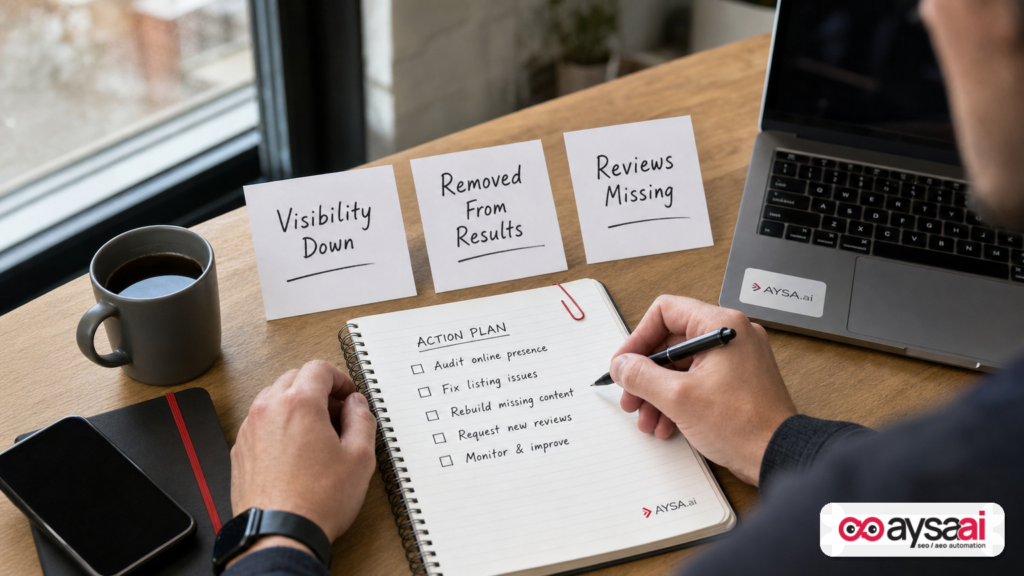
- Tennessee SB 2262 gives qualifying small businesses (generally 50 or fewer employees) a legal pathway to request an explanation from a search engine when they believe they’ve been “blacklisted,” including major review removals.
- “Blacklisting” in the law includes reduced visibility, removal from results, or deletion/removal of 25%+ of reviews (as defined in the law’s language discussed in the source).
- Google’s guidance for Tennessee emphasizes: verify your website in Google Search Console and claim/manage business listings that appear on Search, including Google Business Profile.
- The real operational takeaway: You need Monitoring and a repeatable response plan across your website, local listings, and reviews—because “search visibility” is a system, not a snapshot.
- AYSA.ai helps turn that system into an operating rhythm: monitor signals, identify likely causes, prepare fixes, request approval, and execute accepted changes on your site.
Key takeaways (for owners and operators)

- Verification is leverage. If you haven’t verified Search Console and claimed your listings, you’re fighting blind.
- Reviews are now a governance issue, not just marketing. Losing a large portion of reviews can materially change buyer trust—so you need auditability and a plan.
- “Google did something” is rarely the whole story. Many visibility drops are triggered by site changes, Indexing problems, policy enforcement, listing edits, duplicates, or data inconsistencies.
- Speed matters. The longer you wait to diagnose, the more revenue and momentum you risk losing.
- Execution discipline beats SEO advice. The difference between recovery in days vs. months is often a consistent monitoring loop plus approved, trackable changes.
Table of contents

- Why this matters now: search power, small business vulnerability, and the new legal pressure
- What Tennessee SB 2262 actually changes (in plain English)
- Google’s guidance: the quiet shift of responsibility to business owners
- The operational problem: visibility is a system, not a snapshot
- What can go wrong (and how it usually looks in real life)
- A concrete SME scenario: the 48-hour visibility drop that could cost a month of revenue
- What to monitor weekly (website, listings, reviews) so you’re not surprised
- The 5-day response window mindset: build your internal playbook
- Review removals: why they happen, what you can document, and how to reduce risk
- What agencies should rethink: retainers, scope, and “explanation requests”
- Where AYSA.ai fits: monitoring + approved execution for SEO/AEO/GEO
- What to do next (action list)
- Sources and further reading
Why this matters now: search power, small business vulnerability, and the new legal pressure
For most small businesses, Google isn’t a “channel.” It’s infrastructure.
If you’re a clinic, hotel, florist, home-services company, local restaurant, or multi-location brand under 50 employees per location (or as a whole), Google Search and Google Maps can function like a switchboard. When visibility is healthy, demand is predictable. When visibility breaks, your team starts asking the same questions:
- “Did we get penalized?”
- “Did we get removed?”
- “Did a competitor report us?”
- “Why are our reviews missing?”
- “Who do we contact—and how do we get an answer quickly?”
Tennessee SB 2262 sits right in that anxiety. The law is part of a broader societal push for more transparency and accountability from large technology platforms—especially when their decisions can materially affect a small business’s survival.
But the bigger business lesson isn’t “a law will save you.” The lesson is: if you rely on a platform for demand, you need operational controls—monitoring, documentation, and a playbook for escalation.
And as search evolves—especially with AI-powered experiences (AI Overviews, AI-assisted discovery, and more conversational interfaces)—it’s likely that “visibility” will become even more multi-surface: classic rankings, Local pack, knowledge panels, review snippets, and AI citations. If your brand inputs aren’t stable, the outputs won’t be either.
If you want a deeper view of how AI affects discoverability and what “visibility” means across modern search, start here: AYSA.ai AI Search Visibility.
What Tennessee SB 2262 actually changes (in plain English)
Based on the reporting in Search Engine Journal, Tennessee’s SB 2262 (effective July 1, 2026 per the source) gives certain small businesses new protections when they believe they’ve been “blacklisted” by a search engine. The law’s definition (as reported) is broad and includes three kinds of outcomes:
- Reduced visibility or accessibility of the business website in an online search engine
- Removal of a business website or search result from an online search engine
- Deletion/removal of 25%+ of reviews associated with the small business on the online search engine
Two nuances matter for operators:
- This isn’t only about ranking #1 vs. #3. The law’s framing includes “visibility,” “accessibility,” and “removal.” That’s a wider set of outcomes than what most small businesses think of as “SEO.”
- Reviews are explicitly in scope. If a large portion of your reviews vanish (25%+ per the source), the law treats it as part of the same accountability category.
The source also notes an important change from the law’s original drafting: a requirement for search engines to proactively notify businesses about blacklisting was removed in an amendment. Instead, the version that passed authorizes a business that believes it has been blacklisted to contact the search engine and request a response—within five business days—explaining and justifying the action and outlining how to appeal or be restored/re-indexed.
That five-day window is not only a legal timeline—it’s an operational standard you can adopt internally. More on that later.
Primary note: We’re relying on the provided source summary and excerpted text, not the statute’s full text. If you’re operating in Tennessee and this is business-critical, have counsel review the statute directly.
Source reference: Search Engine Journal coverage of Google’s Tennessee “blacklist” guidance.
Google’s guidance: the quiet shift of responsibility to business owners
Google’s response, as reported, was to publish Tennessee-specific guidance telling businesses what to do to ensure they receive the notifications Google is required to send under the law.
In practice, Google’s playbook is straightforward:
- Verify your website in Google Search Console
- Claim and manage other business listings on Google that appear on Search (e.g., Google Business Profile)
Google also describes benefits of Search Console alerts in areas like spam and policy violations, legal removals, and security issues (per the source excerpt).
Here’s the practical editorial interpretation:
Google is formalizing the “you need to be verified” reality. If your site is not verified in Search Console, you’re less likely to see critical signals early (manual actions, security warnings, indexing anomalies, policy flags). If you don’t manage your local presence, you may not be able to prove what changed, when it changed, and why it changed.
For a small business, this is both good and frustrating:
- Good: There’s a clear checklist to become “reachable” and “notifiable.”
- Frustrating: It places the operational burden on you—setup, verification, and ongoing management.
Search Console is an official Google product. If you’re not using it, start at the primary documentation: Google Search Console.
For local businesses, your listing foundation typically starts with Google Business Profile: Google Business Profile.
The operational problem: visibility is a system, not a snapshot
Most SMEs treat search visibility like a report card: check rankings, check traffic, maybe check reviews, move on.
But Tennessee’s law—and Google’s response—should push you to treat visibility like an operational system with inputs and outputs:
- Inputs: your website content, technical health, structured data, location pages, policy compliance, security posture, listings accuracy, review velocity and authenticity signals
- Outputs: rankings, local pack presence, map visibility, review star display, rich results, AI citations, branded knowledge panels
- Control layer: monitoring + documentation + change management + escalation path
If you don’t have the control layer, you’re stuck in reactive mode. And when you’re reactive, you often do the worst possible thing: change five variables at once (“let’s rewrite everything, change the theme, switch URLs, and delete pages”) which makes diagnosis harder.
This is where execution systems matter. AYSA.ai is built around a simple operational truth: you can’t scale search growth—or stabilize it—if every fix is manual, ad-hoc, and hard to approve. AYSA monitors, prepares proposed site changes, asks for approval, and then executes the changes you accept.
What can go wrong (and how it usually looks in real life)
When business owners say “Google blacklisted me,” they’re describing an outcome, not a cause. The cause can range from totally benign to legitimately serious.
Outcome 1: “We dropped everywhere overnight”
Common patterns that can produce this outcome include:
- Indexing disruptions: site accidentally blocked via robots.txt, noindex tags applied, or canonical changes
- Major site migrations: URL changes without proper redirects or sitemap updates
- Security issues: hacked pages, malware warnings
- Algorithmic re-evaluation: quality signals shift, thin pages removed from prominence
Search Console is the first place to look for official signals, which is exactly why Google emphasizes verification.
Outcome 2: “Our brand shows, but our location vanished from Maps / local pack”
Local visibility can change even when “SEO” looks stable. Typical causes include:
- Google Business Profile changes (edits, category changes, address/service-area updates)
- Duplicate listings or inconsistent NAP (name/address/phone) across directories
- Suspensions or re-verification requirements
This is why a local search strategy can’t be only about the website. It’s also entity management.
Outcome 3: “We lost a bunch of reviews”
Large review reductions can happen for different reasons, including:
- Policy enforcement (fake/spam reviews removed)
- Platform normalization (duplicate reviews, suspicious patterns)
- Profile merges or listing issues
Important: you shouldn’t assume malicious intent. But you also shouldn’t assume it’s “normal.” If reviews are a meaningful part of your conversion engine, treat them like an asset that requires monitoring and documentation.
Outcome 4: “Only certain pages disappeared”
This often points to:
- Technical issues on specific templates (location pages, product pages)
- Content quality issues (duplicate, thin, or doorway-like pages)
- Internal linking and crawl path problems
In every case, the best response is disciplined: isolate changes, verify signals, and implement fixes with traceability.
A concrete SME scenario: the 48-hour visibility drop that could cost a month of revenue
Let’s make this real without inventing numbers.
Imagine a 12-person home services company in Nashville—HVAC, plumbing, roofing, pest control, it doesn’t matter. They’re not “internet businesses.” They’re schedule businesses. Their week is bookings, dispatch, estimates, and follow-ups.
On Monday morning, the owner notices:
- The Google Business Profile still exists, but the business no longer appears in the top local results for “emergency AC repair.”
- The website still loads, but the “service area” pages seem to have disappeared from search.
- A chunk of reviews look missing compared to last week.
What happens next in many companies is chaos:
- The receptionist calls “the web guy.”
- The web guy blames “Google updates.”
- Someone buys more ads to compensate.
- Someone else starts editing the site, changing titles, deleting pages, rewriting content.
In 48 hours, you can accidentally destroy your ability to diagnose the real cause.
A better approach is operational:
- Check Search Console for manual actions, security issues, coverage/indexing problems, and messages.
- Check whether recent site changes (theme, plugins, redirects, robots, CMS settings) align with the timeline.
- Check Google Business Profile status for warnings, suspensions, or pending verification.
- Document review count changes and the date window; capture evidence for your internal record.
- Make one change at a time and validate impact.
This is exactly the kind of scenario where an “approved execution” system helps. Instead of random edits, you create a controlled queue of fixes—technical, content, structured data, internal linking—review them, approve them, then deploy them with a record of what changed and when.
If you want to understand how AYSA supports this operating rhythm, start with: AI SEO Tools.
What to monitor weekly (website, listings, reviews) so you’re not surprised
The biggest mistake I see in SMB search is treating monitoring as “analytics.” Analytics is useful, but it’s a lagging indicator. You also need leading indicators—the signals that something is about to break.
1) Website monitoring (Search Console-first)
At minimum, ensure Search Console is set up and that the right people receive notifications.
- Ownership verification is complete
- Preferred domain version is consistent (https, www/non-www)
- Sitemaps are submitted and valid
- Messages are monitored (not ignored)
Official product overview: Google Search Console.
2) Local listing monitoring (Google Business Profile)
- Profile ownership and manager roles are correct
- Business name, address/service area, phone, hours are accurate
- Categories and services reflect reality (not keyword stuffing)
- Duplicate listings are identified and addressed
Start here: Google Business Profile.
3) Reviews monitoring (counts, velocity, and anomalies)
You don’t need fancy dashboards. You need consistency:
- Track review counts weekly (per location if multi-location)
- Note sudden drops or spikes
- Keep internal records of review request campaigns (so you can contextualize velocity)
Why this matters under SB 2262: when a major portion of reviews disappears, you want to know when it happened and how much changed—before you even begin the explanation request process.
How AYSA helps monitoring become a habit
AYSA.ai’s monitoring is designed to make this operational, not theoretical. The goal is to detect issues early, then guide you through fixes with approvals and execution—without turning your business into a full-time SEO department.
Explore: AYSA Monitoring.
The 5-day response window mindset: build your internal playbook
The law (as described in the source) requires a response from the search engine within five business days after a business requests an explanation. That doesn’t mean your business should wait five days to act.
Instead, use “five days” as a framework for your internal response plan:
Day 0 (same day): Stabilize and document
- Stop untracked edits to the website and listings
- Record what you’re seeing (search queries, affected pages, review counts)
- Pull a timeline of recent site changes (deploys, plugins, CMS updates)
Day 1: Diagnose with primary signals
- Search Console checks: messages, manual actions, security, indexing/coverage
- Local checks: GBP status, pending edits, verification prompts
Day 2: Prepare fixes (don’t spray-and-pray)
- Identify the smallest set of changes likely to resolve the issue
- Prioritize reversible fixes (technical toggles, template corrections, redirect fixes)
Day 3: Implement with traceability
Execution should be logged: what changed, when, by whom, and why.
This is where AYSA’s model matters: it prepares changes, requests approval, and then executes accepted fixes, preserving accountability. Learn more: AYSA AI SEO tools.
Day 4: Validate impact
- Confirm indexing changes
- Track impressions/click patterns returning (or not)
- Re-check review counts and listing presence
Day 5: Escalate with organized evidence
If you decide to request an explanation under the law (or pursue platform support channels), do it with a clean packet:
- Business info (exact legal name, address/service area, URLs)
- Timeline of observed changes
- Specific examples (queries, pages, review count changes)
- Confirmation of Search Console verification and GBP ownership
Even outside Tennessee, this discipline improves outcomes because it reduces ambiguity. Ambiguity slows everything down.
Review removals: why they happen, what you can document, and how to reduce risk
Reviews are one of the most emotionally charged parts of local search. Owners take it personally when reviews disappear—and sometimes they should. But you’ll get further by treating reviews like an operational asset with governance.
The uncomfortable reality: not all reviews are equal
Platforms fight spam and manipulation constantly. That means legitimate businesses can be caught in the enforcement net, especially if review collection practices create patterns that look suspicious (for example, many reviews arriving from the same network or device environment).
We can’t validate specific causes in any one case without primary platform data. But we can recommend behaviors that reduce risk:
- Avoid incentivizing reviews in ways that violate platform policies
- Spread review requests naturally over time
- Use consistent customer follow-up, not bursts that look artificial
- Maintain clean listing data (duplicates and merges can complicate review attribution)
What to document (without obsessing)
- Weekly review count per location
- Dates of any major customer follow-up campaigns
- Notes on listing changes (ownership, address edits, category shifts)
The point is not to litigate every missing review. The point is to maintain enough recordkeeping to spot anomalies and explain your timeline when needed.
What agencies should rethink: retainers, scope, and “explanation requests”
If you run an agency—or you’re the “marketing person” inside a small company who functions like an agency—Tennessee’s law is a signal. Not only about legal rights, but about client expectations.
Clients want two things when visibility breaks:
- Speed: “Tell me what happened.”
- Confidence: “Tell me what to do next.”
That creates a set of agency implications:
1) Your deliverable is now an operational response, not a PDF
Ranking reports won’t calm a founder whose bookings dropped. Agencies need an incident response process: who checks Search Console, who checks GBP, who triages technical issues, and who communicates with the client.
2) Retainers should include monitoring + response readiness
Not every client will need an emergency response every month—but the ones who do will judge you entirely on that week.
3) Execution needs to be scalable and governed
In a crisis, agencies often push changes quickly. But quick changes without approvals can create liability and client distrust.
AYSA’s approved execution model is designed for this: propose changes, capture approvals, execute changes, and keep an audit-friendly record. This helps agencies move faster and stay aligned with client governance.
Relevant AYSA pages for agencies and operators:
Where AYSA.ai fits: monitoring + approved execution for SEO/AEO/GEO
Let me be direct: most small businesses don’t fail at search because they lack ideas. They fail because they lack execution capacity and change management.
That’s what Tennessee’s situation exposes. When visibility is threatened, your advantage isn’t “knowing SEO.” Your advantage is:
- Seeing the problem early
- Knowing what likely caused it
- Fixing it quickly
- Proving what changed and when
AYSA.ai is built to support exactly that operational loop:
1) Monitor the signals that matter
Instead of treating search as a monthly report, you establish ongoing monitoring across key visibility inputs. Start here: AYSA Monitoring.
2) Prepare fixes and improvements (SEO + AEO/GEO ready)
Search is becoming more AI-mediated. That means your content and structure must be understandable not only to classic ranking systems but also to AI summarization and citation behaviors.
AYSA supports execution across modern search needs; learn more: AI Search Visibility.
3) Ask for approval before anything changes
Small businesses often have compliance constraints (medical, legal, financial) or brand requirements. “Approved execution” is not bureaucracy; it’s how you scale without breaking trust.
4) Execute accepted changes on the website
Ideas don’t recover visibility—implemented fixes do. AYSA closes the loop from recommendation to deployment, with a governance step in the middle.
If you’re evaluating whether AYSA is a fit, pricing and packaging are here: AYSA Pricing.
What to do next (action list)
This is the practical checklist I’d want every Tennessee small business (and every agency supporting them) to complete—regardless of whether you ever need to invoke SB 2262.
1) Verify and configure Google Search Console
- Verify site ownership
- Add key staff emails for notifications
- Submit sitemap(s)
- Create a simple weekly habit to check messages and indexing health
Official: Google Search Console.
2) Claim and govern your Google Business Profile
- Confirm ownership
- Audit business details for accuracy
- Document who can edit the listing
Official: Google Business Profile.
3) Create a “visibility incident” SOP
- Who investigates
- Where signals are checked (Search Console, GBP, site change log)
- Who can approve site/listing changes
- How you document review count changes
4) Implement monitoring that’s built for action
If your monitoring can’t quickly translate into fixes, it’s not monitoring—it’s reporting.
- Set up AYSA monitoring: AYSA Monitoring
- Align monitoring to both classic search and AI search surfaces: AI Search Visibility
5) Adopt approved execution for website changes
Don’t let emergencies force reckless edits. Use a system that prepares changes, asks for approvals, and executes only what you accept.
Start here: AI SEO Tools.
Sources and further reading
- Search Engine Journal: Google Publishes Tennessee Search “Blacklist” Guidance (research input for this editorial)
- Google Search Console: About (primary product documentation)
- Google Business Profile (primary product entry point)
- AYSA.ai: AI Search Visibility
- AYSA.ai: Monitoring
- AYSA.ai: AI SEO Tools
- AYSA.ai: Pricing
- AYSA.ai: Blog
Continue the AI search topic inside AYSA.
Use these pages to connect the article with AI SEO tools, AI visibility monitoring, AI Overviews and approved website execution.
Turn this topic into a website action plan.
Use these AYSA hubs to move from reading to technical fixes, AI visibility monitoring, research, glossary context and approval-first SEO execution.

