
Your 2019 Content Framework Is Costing You in 2026: How to Rebuild for AI Overviews, AI Mode & Real Buyer Intent
Frameworks aren’t failing because you “did SEO wrong.” They’re failing because search changed. Here’s how to audit outdated playbooks, rebuild content for AI Overviews and AI Mode, and use AYSA to monitor, prepare, approve, and execute the changes that actually move revenue.

By Marius Dosinescu (AYSA.ai)
There’s a quiet reason so many “best practices” from 2019 feel unreliable in 2026: they were built for a different dataset, a different search experience, and a different definition of success.
In 2019, the dominant mental model was still “rank a page, earn a click, convert the visitor.” In 2026, more queries are intercepted by AI summaries, conversational modes, and multi-step journeys that start with an answer layer and only sometimes end in a site visit. The result is a new kind of failure mode: you can be technically correct by old standards—and still lose outcomes.
This editorial is inspired by Greg Jarboe’s argument that content frameworks age out when we treat them as finished products instead of living models built on evolving evidence. His piece is worth reading in full: The Content Framework That Worked In 2019 Is Now Working Against You (Search Engine Journal).
But here’s what I want to do differently: not just agree with the idea, but operationalize it for small and mid-sized businesses, ecommerce teams, clinics, local services, and agencies who need a plan they can execute—without chasing every shiny tactic.
Concise summary

- Frameworks expire because search behavior and AI answer layers change what “good content” looks like.
- Snippet-first content (short answers designed to win featured snippets) can underperform in AI Overviews because it leaves no reason to click.
- Winning in AI Search requires content that is easy to cite, easy to verify, and still valuable after the summary.
- SMEs need a cadence (monitor → diagnose → update → approve → execute → measure), not a one-time content calendar.
- AYSA fits as an execution system: it monitors, prepares changes, asks for approval, and executes accepted updates—turning strategy into shipped improvements.
Key takeaways (print this)
- Your content framework is a snapshot, not a law. If it doesn’t have an update mechanism, it will become a liability.
- AI search changes incentives. The best page is often the one that helps a user do the next step, not the one that repeats the summary.
- Authority is now “structured trust.” Claims need sourcing, definitions need consistency, and pages need a citeable structure.
- Traffic is a lagging indicator. Watch lead quality, branded demand, assisted conversions, and which pages get referenced or revisited.
- Execution speed matters. If it takes 6–10 weeks to deploy a content fix, you’re competing with businesses iterating weekly.
Table of contents

- What changed: from “10 blue links” to answer layers, citations, and follow-up journeys
- Why great frameworks expire (and why smart marketers still defend them)
- Why “featured snippet-style” content can underperform in AI Overviews
- The new definition of value: what users need after the summary
- A practical rebuild: the “Living Framework” approach (with a 90-day cadence)
- The Living Framework Audit: what to review on your site this week
- An SME scenario: a local clinic that ‘ranked fine’ but lost calls anyway
- What agencies and in-house teams must rethink (deliverables, reporting, and approvals)
- What can go wrong: the new failure modes in AI search
- Measurement that still works (and what to stop obsessing over)
- Where AYSA fits: monitoring, preparing changes, approvals, and execution
- What to do next: a 14-day action list
- Sources and further reading
What changed: from “10 blue links” to answer layers, citations, and follow-up journeys
In the “blue links” era, search behavior was straightforward:
- Google showed a list of pages.
- You clicked one.
- The page either helped or it didn’t.
That’s where most 2019 frameworks came from: Keyword mapping, topic clusters, E-A-T/EEAT-inspired credibility work, Snippet optimization, and content templates designed to capture the click.
In 2026, the top of the results page is often an answer layer. Even if a user Clicks afterward, they arrive with a different mindset:
- They’ve already seen a summary (sometimes a very good one).
- They’re looking to validate, compare, decide, or act—not to be introduced to the basics.
- They are more skeptical of fluff because the overview already removed the easy filler.
This shifts the competitive surface area. You’re no longer only competing to rank. You’re competing to be:
- Referenced (cited or used as a source)
- Chosen (clicked when the user wants depth)
- Trusted (believed enough to contact, purchase, or subscribe)
And this is the part many businesses miss: AI didn’t merely compress content. It exposed which content was only ever useful because the user hadn’t yet seen a summary.
If your 2019 framework produced content that primarily answered “what is X?” in the first 10 seconds, you might have accidentally built a library of pages that are now easy for AI to summarize—and hard for humans to justify clicking.
Jarboe’s central point is that frameworks age because datasets grow. That lens matters because it removes blame and replaces it with responsibility: your old framework was likely correct for the world it was built in—but it may now be incomplete.
Why great frameworks expire (and why smart marketers still defend them)
Frameworks are not bad. Frameworks are how humans make sense of complex systems. They’re also how teams scale work:
- They create shared language (“top-of-funnel vs. bottom-of-funnel,” “pillar + cluster,” “jobs-to-be-done”).
- They create repeatable deliverables (templates, checklists, SOPs).
- They reduce decision fatigue (what to write, how to structure it, what to measure).
The problem is not that you have a framework. The problem is when the framework becomes identity:
- “This is how we do SEO.”
- “This format always wins snippets.”
- “We publish 4 posts a month and it works.”
When the environment changes, frameworks must change. But businesses resist because changing frameworks is expensive:
- You must retrain writers, SEOs, editors, and approvers.
- You must update templates and internal documentation.
- You must risk being “wrong in public” as you revise prior advice.
Jarboe describes that trap directly: practitioners get stuck when they fall in love with the framework, rather than staying curious about new evidence. That applies to content marketers and SEOs—and to founders, too. Founders especially love tidy models: “the 5 things you must do,” “the 7 pages every site needs.”
But AI search is a forcing function. It’s telling us, loudly, that the old tidy models are often missing a critical component: what happens after the summary.
Why “featured snippet-style” content can underperform in AI Overviews
Let’s name the 2019 tactic that shows up everywhere:
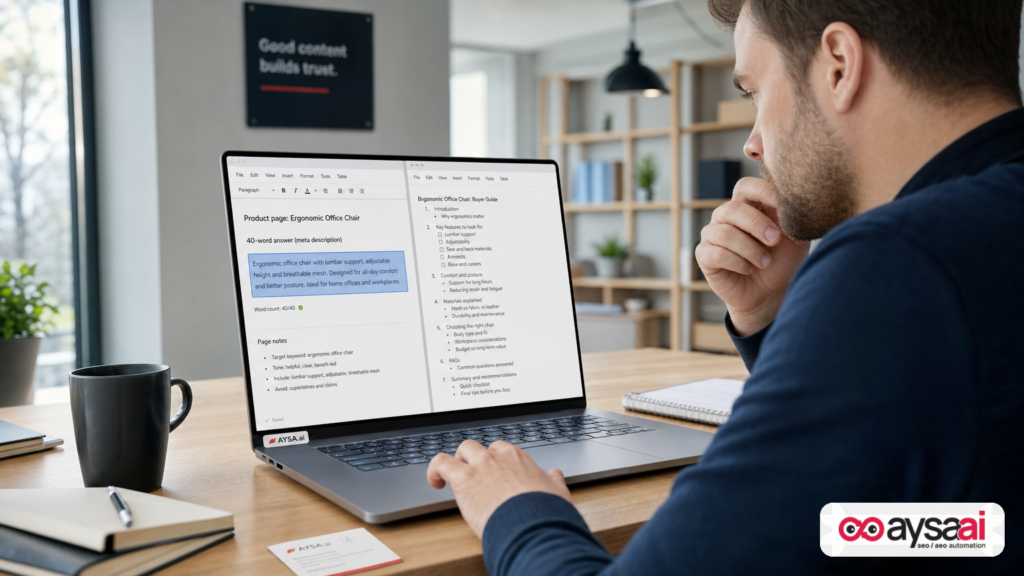
- A bolded definition or a Short answer (often 40–60 words) at the top.
- Then a few subheadings with shallow explanations.
- Maybe a generic FAQ at the end.
This was not irrational. It was a rational response to featured snippets and “position zero.” If you could answer a query cleanly, Google might feature you, and the click-through rate could be excellent.
But in an AI Overview world, a page engineered to be the entire answer becomes a paradox: it’s perfect for extraction and summarization, and therefore gives the user little reason to click.
Jarboe makes a sharp observation: AI Overviews don’t necessarily reward the page that already said everything. They reward the page that is still valuable after the user has seen a summary. That means your “best snippet paragraph” may now be your worst conversion strategy—because it trained your team to compress, simplify, and conclude too early.
This doesn’t mean you should stop being clear. It means you should stop being final.
The new job of the page
Instead of “answer the query,” the job is increasingly:
- Define the concept quickly (so AI and humans know you’re relevant).
- Differentiate with specifics (so you’re not interchangeable).
- Enable action (so the click has a payoff).
- Prove trust (so the user believes you more than the summary).
If your content ends at definition, it will be summarized and replaced. If it continues into proof, nuance, and action, it earns the click and the lead.
The new definition of value: what users need after the summary
To rebuild frameworks, you need to rebuild your definition of “value.” In practice, post-summary value tends to fall into a few buckets. These are not theoretical; they’re the things users still need when AI gives them the basics.
1) Decision support (comparison, tradeoffs, edge cases)
AI is good at generalities. Buyers pay for specifics. The moment someone is deciding between options, they need:
- Constraints (budget, timeline, compliance, location)
- Tradeoffs (pros/cons in their context)
- Edge cases (when the general advice fails)
Example: If you sell waterproof hiking boots, the query “best waterproof boots” might get summarized. But a buyer still needs: “waterproof for what—snow, river crossings, city rain, hot climates?” That’s a click-worthy differentiator.
2) Proof (verifiable claims, sources, real-world process)
In an AI era, “trust me” content gets weaker. You need proof structures:
- Clear author/brand accountability
- Updated timestamps where meaningful
- Explicit sourcing for key claims
- Methodology when you recommend anything
I’m intentionally not adding new statistics here, because the only numeric claims we can responsibly reference in this context are the ones Jarboe cited about LinkedIn behavior (shared in the SEJ source). For the rest, the point stands without numbers: AI increases scrutiny. People want to know where information came from.
3) Action enablement (checklists, calculators, templates, next steps)
The most robust “after-summary” value is tangible:
- A checklist you can follow
- A template you can copy
- A decision tree
- A pricing or scoping guide
This is where SMEs can win. Big publishers can generate summaries. But a business with real operations can publish the process that makes the summary useful.
4) Local and situational context (what changes by location, regulation, season)
Generic content is easiest to summarize. Situational content is harder. If your business operates in a specific context—local service areas, state laws, seasonal demand, B2B procurement, industry compliance—those situational details are where you earn distinctiveness.
Search Engine Journal’s navigation links in the provided source context highlight how many sub-disciplines exist (local SEO, technical SEO, mobile, Link Building, etc.). The same idea applies to content: if you write “one-size-fits-all,” you’re competing in the most commoditized layer.
A practical rebuild: the “Living Framework” approach (with a 90-day cadence)
Here is the central operational shift I recommend for 2026: stop building frameworks as finished lists. Build them as living systems with an update cadence.
A living framework has four properties:
- It declares scope: what it covers and what it doesn’t.
- It declares freshness: “as of now” rather than “complete list.”
- It assigns ownership: who updates it and how often.
- It connects to execution: updates become shipped changes, not slide decks.
The 90-day cadence (simple enough to actually do)
Most SMEs can’t run weekly research sprints. But most can run a quarterly cycle. A 90-day cadence looks like this:
- Monitor (ongoing): watch for visibility shifts, content decay, and performance anomalies.
- Diagnose (weeks 1–2): identify which pages and which assumptions are outdated.
- Update (weeks 3–6): revise content structures, not just paragraphs.
- Approve (weeks 4–7): align stakeholders (brand, legal, product, founder).
- Execute (weeks 5–8): publish changes, improve internal linking, apply schema, fix technical blockers.
- Measure (weeks 9–12): review results; document what changed and what you learned.
The outcome isn’t “we published X posts.” The outcome is: “our framework is more accurate and our site reflects it.”
This is also where many teams fail—because they don’t have an execution engine. They have ideas, tickets, and a backlog. That’s why approved execution matters (more on AYSA below).
The Living Framework Audit: what to review on your site this week
If you want to update your 2019 framework without rebuilding your entire marketing department, do this audit. It’s designed for business owners and lean teams.
Step 1: Identify your “framework pages”
These are pages that encode your old model. Usually they are:
- “X types of…” posts
- “X steps to…” posts
- Ultimate guides with templated structures
- Glossary definitions that are too final
Pick 10 pages that historically drove the most organic entry traffic or links. Even if you can’t verify link counts in this context, you can usually identify them by internal analytics and Search Console.
Step 2: Rewrite the opening for AI-era intent
Don’t remove clarity. Remove premature closure. A good AI-era intro has:
- A crisp definition
- One sentence on why it matters (in business terms)
- A “what this page covers” scannable list
- A promise of what’s beyond the summary (tools, steps, comparisons, examples)
In other words: keep the reader, don’t just feed the extractor.
Step 3: Add a “decision layer”
For every framework page, add a section that answers: “How do I choose the right option for my situation?”
That can be:
- A table of tradeoffs
- A decision tree
- 3–5 scenarios (“If you’re a clinic… if you’re ecommerce… if you’re B2B SaaS…”)
This is the fastest way to make content more valuable than an overview.
Step 4: Add or improve citeable structure
AI systems and humans both benefit from structure. Practical improvements include:
- Descriptive H2/H3 headings that can stand alone
- Short definitional blocks followed by deeper sections
- FAQ sections that reflect real objections (not generic filler)
- Internal links to supporting pages (definitions → processes → product/service pages)
If you want to go deeper on AI-era visibility, start here: AYSA AI Search Visibility.
Step 5: Replace “complete lists” with “living lists”
This is directly aligned with Jarboe’s advice: don’t present snapshots as conclusions.
Concretely:
- Change language from “the only X you need” to “the X we see most often (and what changes over time).”
- Add “as of” markers where appropriate.
- Add a short “what changed recently” section for pages in fast-moving categories.
That small editorial shift does two things: it protects you from being wrong later, and it makes updates easier to justify internally.
Step 6: Build a lightweight monitoring loop
Most SMEs don’t need 12 tools. They need one monitoring loop that makes issues visible and actionable.
AYSA’s approach is built around that reality: AYSA Monitoring helps you watch the site, flag what’s drifting, and prepare changes you can approve.
An SME scenario: a local clinic that ‘ranked fine’ but lost calls anyway
Here’s a realistic scenario (no invented stats, just a pattern we see often in the market):
A multi-provider local clinic has pages like:
- “What is [treatment]?”
- “[Treatment] cost”
- “[Treatment] vs [alternative]”
In 2019, their top priority was ranking and capturing featured snippets. So they wrote snippet-first intros and broad, general explanations. It worked.
In 2026, the clinic owner says: “We’re still ranking, but calls are down.”
What happened?
- The AI layer answered “what it is” and “typical recovery time” in the results.
- Users who clicked wanted specifics: candidacy criteria, local pricing ranges (or at least what affects cost), what the first appointment looks like, insurance questions, risks, and how to choose a provider.
- The clinic’s pages were still accurate, but they were not decisive. They didn’t help users choose the clinic.
The fix isn’t “write more words.” The fix is to add post-summary value:
- “Am I a candidate?” checklist
- “Questions to ask your provider” list (this builds trust even if it reduces immediate conversion)
- Clear process steps for booking and first visit
- Internal links to provider bios, location pages, and relevant policies
This is the new competition. Not “who defines the term best,” but “who guides the decision with the least friction and the most trust.”
What agencies and in-house teams must rethink (deliverables, reporting, and approvals)
Agencies and in-house SEO teams are often trapped by legacy deliverables:
- “We publish X articles per month.”
- “We optimize metadata and headings.”
- “We track rankings for Y keywords.”
Those aren’t useless. They’re incomplete.
Shift deliverables from outputs to compounding assets
In AI search, compounding assets usually look like:
- Living guides that get updated
- Structured hubs with internal linking that reflects real decision paths
- Proof pages (methodology, sourcing, comparisons, case logic)
If an agency’s deliverable is “10 new posts,” but none of them become the kind of citeable, decisive resource AI and humans rely on, you’re building a content graveyard.
Update reporting: show the business what’s actually happening
When AI intercepts more queries, reporting must include:
- Which pages are still driving qualified actions
- Which pages lost clicks but still influence branded demand
- Which topics now require deeper decision support
If you only report rankings and sessions, you may incorrectly “optimize” toward content that is easy to summarize, not content that wins customers.
Fix the approval bottleneck
Most teams don’t fail because they can’t think of improvements. They fail because changes don’t ship:
- Copy sits in Google Docs.
- SEO tickets sit in Jira.
- Developers deprioritize “marketing changes.”
This is why I’m bullish on approved execution as a model. Not “AI that changes your site without consent,” but “AI that prepares the work, asks for approval, then executes accurately.”
That’s the direction we’ve taken with AYSA.
What can go wrong: the new failure modes in AI search
When teams update frameworks, they often overcorrect. Here are the most common AI-era failure modes to avoid.
Failure mode 1: Chasing AI with thin “AI-targeted” pages
Some teams respond by generating more pages that look like they were written for a machine: sterile, repetitive, overly summarized, and generic.
This is a trap. AI doesn’t reward genericness forever. Even if it did, humans don’t buy from genericness.
Failure mode 2: Overstuffing “trust signals” without real proof
Adding “expert reviewed” labels or vague authority claims without substance can backfire. A better approach is simple:
- Cite reputable sources when you make factual claims.
- Explain how you know what you know (process, methodology, experience).
- Keep the content updated when the world changes.
Failure mode 3: Forgetting internal linking and site structure
In 2019, you could sometimes get away with standalone posts. In 2026, standalone posts are harder to justify because AI already provides the standalone answer.
Your site must behave like a system:
- Definitions link to deeper guides.
- Guides link to comparisons.
- Comparisons link to product/service pages.
- Everything links back to “how to take the next step.”
Failure mode 4: Treating AI visibility as separate from SEO
AEO/GEO conversations can become siloed (“we need AI optimization now!”). In reality, the fundamentals still matter:
- Crawlability and indexation
- Clear entities and consistent terminology
- Good information architecture
- Helpful content that matches intent
AI search adds new constraints, but it doesn’t remove the old ones. It raises the bar on coherence and usefulness.
Measurement that still works (and what to stop obsessing over)
When search changes, measurement confusion follows. Here’s the practical truth for SMEs: you still need visibility metrics, but you can’t worship them.
Keep: measures tied to business outcomes
- Qualified leads (not just form fills—leads that match your target)
- Calls, bookings, quote requests, cart checkouts
- Revenue or pipeline influence (where you can measure it)
- Branded search demand (directional, not perfect)
Use carefully: traffic and rankings
Traffic can fall while outcomes improve if your content attracts fewer low-intent clicks and more ready-to-act users. Rankings can remain stable while clicks fall if an answer layer absorbs demand.
So: track them, but interpret them in context.
Stop obsessing over: “publishing velocity” as a vanity KPI
Publishing more is not the same as improving your system. In an AI era, a smaller number of living, updated, decision-supporting assets can outperform a flood of new posts.
If you want a practical library of AI-powered SEO support resources, start with: AYSA AI SEO Tools and the AYSA blog.
Where AYSA fits: monitoring, preparing changes, approvals, and execution
Most businesses don’t have a strategy problem. They have an execution problem.
Here’s the loop I see repeatedly:
- A founder learns “AI changed search.”
- A marketer audits and finds 50 pages that need updates.
- A writer drafts improvements.
- Approvals stall.
- Implementation stalls even longer.
- By the time updates ship, the environment has changed again.
AYSA is designed to break that loop by acting as an execution system for SEO/AEO/GEO:
- Monitor the site and detect what’s drifting or underperforming (Monitoring).
- Prepare recommended website changes (content, internal links, structured improvements) in a way a human can review.
- Ask for approval before making changes—so you keep governance, brand voice, and compliance intact.
- Execute accepted changes so improvements ship instead of sitting in a backlog.
That “approved execution” model matters more in 2026 because iteration is the strategy. A living framework is only living if it actually gets updated in production.
If you’re evaluating whether this operational model fits your team size and constraints, the clearest starting point is pricing and scope: AYSA Pricing.
How AYSA supports living frameworks (practically)
Think of your framework as the rules for what “good” looks like. AYSA helps you enforce and evolve those rules by:
- Surfacing which legacy pages are most exposed to AI summarization
- Highlighting content decay risk (outdated claims, missing sections, weak decision support)
- Making updates a repeatable workflow: prepared → reviewed → approved → executed
This is the difference between “we should update our content” and “we updated 15 priority pages this quarter and saw improvement in lead quality.”
What to do next: a 14-day action list
This is a short, realistic plan for SMEs and lean marketing teams.
Days 1–2: Identify the frameworks you’re still defending
- List your top 10 “evergreen” pages and templates.
- Mark which ones were created or last materially updated in 2019–2021.
- Circle the ones with snippet-style intros.
Days 3–5: Redesign one page for “after-summary value”
- Add a decision layer (table, scenarios, checklist).
- Add proof structures (sources, methodology, process).
- Improve internal linking to next-step pages.
Days 6–9: Build a mini living framework doc (one page)
- Write the new purpose: “We create pages that remain valuable after AI summaries.”
- Define 3–5 required sections for key page types.
- Set an update cadence (quarterly).
Days 10–14: Set up monitoring + execution discipline
- Choose your monitoring approach (tooling + cadence).
- Decide who approves content and who approves technical changes.
- Pick a system that can ship updates reliably (this is where AYSA can fit).
If you want to start from the AI search angle and work backward into execution, begin here: AI Search Visibility.
Sources and further reading
- Search Engine Journal: The Content Framework That Worked In 2019 Is Now Working Against You (primary research input for this editorial)
- Search Engine Journal: SEO section (contextual reference)
- Search Engine Journal: Google Algorithm Updates history (contextual reference)
- Search Engine Journal: Local SEO (contextual reference for situational content)
- Search Engine Journal: Link Building (contextual reference for authority building)
AYSA resources referenced
Note on sourcing: This editorial intentionally avoids introducing new numeric claims beyond what is described in the provided SEJ source context. Where readers need more definitive, primary-source confirmation about specific AI search behaviors or product rollouts, we recommend validating against official platform documentation. That documentation was not included in the supplied research context for this request, so it is not cited here.
Continue the AI search topic inside AYSA.
Use these pages to connect the article with AI SEO tools, AI visibility monitoring, AI Overviews and approved website execution.
Turn this topic into a website action plan.
Use these AYSA hubs to move from reading to technical fixes, AI visibility monitoring, research, glossary context and approval-first SEO execution.

