Ads in AI Mode: Why Google’s New Ad Surface Makes SEO More Important
Google is testing ads in AI Mode, where ads can appear inside AI-generated responses. For SMEs, the implication is clear: SEO, feeds, product data and website proof now support paid visibility too.
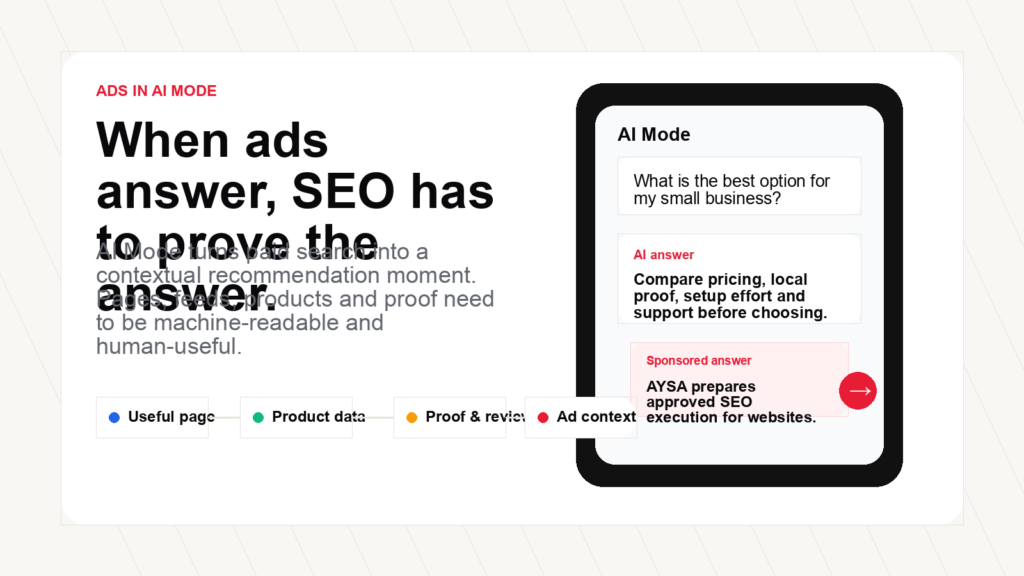
Summary: Google has announced that it is testing ads in AI Mode. In Google’s own wording, the brand does not only show up; it can answer. That sentence matters. It means paid search is moving from a list of sponsored links toward contextual recommendations inside AI-generated responses, powered by systems such as AI Max and Performance Max.
For SMEs, this is not only a Google Ads story. It is an SEO, AEO and Website Execution story. If ads are matched against the user query, the AI answer context, landing-page relevance, product feeds, creative assets and business data, then the website layer becomes the foundation for both organic and paid visibility in AI Search.
Ads are becoming contextual answers.
What Google announced: ads that “answer” inside AI Mode
Google’s Accelerate announcement for Ads in AI Mode is short, but strategically important. Google says it is testing new ad formats in AI Mode that close the gap from discovery to decisions, powered by Gemini. The key benefits listed by Google include built-in relevance, ads that reason and conversations that convert.
The language is careful. Google says the formats are clearly labeled as ads, but integrated directly into AI-generated responses. It also says these formats are powered by AI Max and Performance Max and can adapt creative while explaining why a product is the best answer to a question.
That is a very different mental model from old search ads. Old paid search was Keyword, ad, landing page. AI Mode is closer to question, reasoning context, recommendation, proof, action. The ad is no longer only adjacent to the answer. In some formats, it can be part of the answer experience.
Google Ads Help already explains a similar direction for ads in AI Overviews. Google says ads may be eligible above, below or within AI Overviews; that both the user query and AI Overview content can be considered; and that ads must be relevant to both the query and the generated context. It also states that existing Search, Shopping and Performance Max campaigns can be eligible where supported.
AI Mode is not identical to AI Overviews. But the logic is clearly related: ads move into AI-powered exploration moments, not only classic query-result pages.
Why this matters for SMEs: the ad is no longer the whole message
For a small business, the old paid-search operating model was uncomfortable but understandable: choose keywords, write ads, send clicks to a landing page, watch cost per lead and try to improve Conversion rate. AI Mode makes that model less linear. The user can describe a problem, compare options, ask follow-up questions, refine constraints and see a recommendation-like answer before clicking anything.
That means the ad may become one layer inside a bigger answer. A hotel is no longer competing only for “hotel Bucharest airport.” It may compete for “quiet hotel near Otopeni with late check-in, parking, breakfast and easy invoice for a business trip.” A pediatric clinic is not only competing for “private pediatric clinic Bucharest.” It may compete for “clinic for a toddler with recurring fever, online booking, calm doctors, good parent reviews and easy parking.” A software company is not only competing for “SEO automation tool.” It may compete for “SEO software for a small business owner who does not want to hire an agency.”
In all three cases, the ad cannot carry all the proof by itself. The landing page, reviews, Google Business Profile, product or service data, pricing clarity, content, FAQ blocks, schema and trust signals help the system understand whether the business deserves to appear in that answer context. This is why I think AI Mode ads will punish vague websites. Not immediately, not perfectly, but directionally.
SMEs often separate paid search and SEO because that is how agencies, tools and reporting dashboards were sold for years. One team manages ads. Another writes content. Someone else updates the website. Nobody owns the source of truth. Ads in AI Mode pushes against that separation. The website becomes the source material for both organic and paid discovery, so the business needs one operating model, not five disconnected tasks.
Why this makes SEO more important, not less
A shallow reaction would be: “If ads are inside AI Mode, SEO is dead.” I think that is exactly backwards. Ads in AI Mode make the quality of the website, feed, product data and content layer more important because the ad has to make sense inside a richer context.
Google’s AI Overview ads documentation says ads are matched not only to the user query but also to the content of the AI Overview. It also recommends broad match or keywordless targeting, smart bidding, and investment in high-quality creative on websites. For retailers, Google specifically recommends keeping feeds up to date, reviewing product descriptions, pricing, promotions, shipping and returns, verifying information and providing enough high-quality images and videos.
Those are not only ad operations. They are SEO and website operations:
- clear product descriptions;
- accurate pricing and offers;
- shipping and returns information;
- high-quality images and videos;
- landing pages that answer intent;
- structured product and business data;
- consistent entity information;
- helpful content that explains why a product or service is the right next step.
In other words, Google’s ad systems increasingly need the same things AI search needs: clear, trustworthy, machine-readable, human-useful website information.
This is why we have been arguing across AYSA’s recent articles that the future is not “SEO versus ads.” The future is a connected visibility layer where organic content, paid campaigns, product feeds, local profiles, reviews, technical SEO and measurement all feed each other. We wrote about this in Qualified Future Conversions and in Demand Gen in Google Maps. Ads in AI Mode is the same story, pushed one step further.
AI Max and Performance Max: why control moves to the website layer
Google Ads Help describes AI Max for Search campaigns as a suite of targeting and creative enhancements, including improved search term matching, text customization and final URL expansion. Google says AI Max can use content from your domain, landing pages, existing ads, keywords and assets to generate customized assets based on context. Google also explains that Final URL expansion can send traffic to the most relevant URLs on your domain when that is likely to improve performance.
This has a huge implication: your website becomes part of your ad targeting and creative system. If your website is clear, organized and trustworthy, AI Max has better raw material. If your website is messy, outdated, thin or full of duplicate pages, automation has worse raw material.
For SMEs, this matters more than most people realize. Many small businesses do not have carefully engineered campaign structures, clean landing pages, segmented service pages and perfect product feeds. They often have a website that grew organically over years: old pages, duplicated service descriptions, outdated offers, vague product pages, weak categories, missing FAQ sections, slow templates and inconsistent business information.
In a manual world, a good specialist could compensate by tightly controlling keywords, ads and landing pages. In an AI Max / Performance Max / AI Mode world, the system has more autonomy. That means the website needs stronger governance. You do not want Google’s AI choosing a weak page, remixing poor copy or using outdated content because the site never got cleaned up.
This is why I see SEO execution as a control layer. Not control in the sense of manually forcing every ad placement, but control in the sense of making sure the source material is good enough for automation.
Keyword, ad, landing page.
The advertiser mostly controls the query target, ad copy and destination page. SEO supports quality, but paid search can often operate separately.
Question, context, proof, action.
The ad must fit the AI-generated answer context. Website clarity, product data, feed quality and business proof become strategic inputs.
For ecommerce, feeds become SEO assets
Google’s AI Overview ads guidance is very explicit for retailers: keep feeds up to date, review product descriptions, pricing, promotions, shipping, returns and product attributes, verify information and provide enough quality images and videos.
This is not only Merchant Center hygiene. It is ecommerce SEO in the AI search era. Product feeds, product pages, structured data, reviews, category pages, comparison content and shipping/returns information all tell the system what the product is, who it is for, when it is relevant and whether it is trustworthy.
If a user asks AI Mode a complex shopping question, the system needs to understand the task. “Best compact washing machine for a small apartment with low noise and quick delivery” is not a simple keyword. It combines product type, constraints, feature preference, living context and buying friction. A weak feed that only has title, price and image gives less context. A strong feed and product page can support the match.
For ecommerce sites, this means the SEO team and paid team should collaborate on:
- product titles that are clear without being spammy;
- descriptions that explain use cases, not only specs;
- category pages that help users compare options;
- review and rating visibility;
- shipping, returns and availability clarity;
- image quality and product media;
- structured data consistency;
- Merchant Center feed completeness;
- internal links between guides, categories and products.
This is also where AI search and agentic commerce begin to overlap. We have covered related shifts in Ecommerce SEO in the AI Search Era and in our article on agentic commerce. If agents and AI answers become part of product discovery, product data quality becomes a growth asset, not a back-office chore.
A practical playbook for SMEs preparing for Ads in AI Mode
You do not need to panic. You also should not ignore this. Ads in AI Mode are still early, and availability, reporting and controls will evolve. But the preparation work is already useful today for SEO, Ads, AI visibility and conversion rate.
1. Audit your landing pages as AI source material
Ask a simple question: if Google’s AI had to understand this page and decide when it is relevant, would it get a clear answer?
Check whether each important page explains:
- what the product or service is;
- who it is for;
- what problem it solves;
- what makes it different;
- price, location or eligibility details where relevant;
- proof, reviews, examples or case studies;
- the next action.
If the page is vague, automation will not magically understand it. It may still spend money, but it will not have the best possible signal.
2. Clean your website structure
AI Max can use landing pages and final URL expansion. That means your URL universe matters. Old pages, duplicate service pages, thin categories, expired offers and outdated product pages can create confusion. Use URL exclusions where needed, but do not rely only on exclusions. Fix the site.
A clean structure helps both SEO and ads:
- one strong page for each important service or category;
- clear internal links between related pages;
- canonical URLs that make sense;
- no outdated pages in important journeys;
- no accidental indexation of weak pages;
- fast mobile performance.
3. Improve product and business data
For ecommerce, feed quality is critical. For local and service businesses, Google Business Profile, service pages, schema, reviews and contact information are the equivalent business feed. The AI layer needs clean facts.
That includes:
- accurate names, categories, locations and services;
- current prices, availability and policies;
- shipping, returns or booking information;
- high-quality visuals;
- review generation and response workflows;
- consistent entity information across the site and external profiles.
4. Connect measurement to real business value
AI Mode ads will not solve poor measurement. If you optimize for cheap leads, you may get cheap leads. If you optimize for real business value, you need better event quality, enhanced conversions, CRM data, offline conversion imports or at least a practical way to distinguish qualified leads from noise.
This connects directly to Qualified Future Conversions. The future of paid search is not only “show me more conversions.” It is “show me better future customers.” SEO can support that by attracting, educating and qualifying demand before the final paid click happens.
5. Build content for questions, not only keywords
AI Mode is designed for richer questions. That means content should cover decision criteria, comparisons, constraints and next steps. A page optimized only for “best SEO tool” may not help when the user asks: “What should a small business use if they do not have an SEO specialist and need approved website execution?”
That is the new content challenge: answer the real job behind the query. We covered query expansion in How Google AI Mode Expands Queries Beyond Keywords. Ads in AI Mode makes that article even more relevant because paid visibility can now live inside that expanded answer context.
What should change on the website before budget changes?
The temptation will be to ask, “How much budget should we move into AI Mode?” That is not the first question I would ask. The first question is whether the business has enough structured, useful, current information for AI-driven advertising to work with.
Before increasing budget, I would review five practical layers.
Landing-page promise
Does the page make a specific promise, or does it sound like every other business in the category? AI systems are better at matching specific needs to specific evidence than matching generic claims to generic ads. A page that says “we offer quality services” gives little signal. A page that explains availability, service area, proof, pricing logic, process, constraints and next steps gives much more.
Offer and eligibility clarity
Many ads fail because the user clicks and then discovers the offer is not for them. AI Mode may make this more visible. If the business only serves certain cities, requires a minimum budget, sells only B2B, has delivery limitations or offers bookings only during certain hours, that information should be clear on the page and in relevant structured data or profiles.
Content around the buying decision
AI answers often help users compare. That means comparison content, buyer guides, “how to choose” pages, use-case pages and decision criteria can support both SEO and paid discovery. For AYSA, for example, we do not want to be understood only as an “SEO tool.” We want the market to understand the difference between reports, agencies, chat AI and approved website execution. That takes content, not only ads.
Technical trust
Slow pages, broken links, messy redirects, duplicate content, thin categories and outdated pages are no longer only “SEO issues.” They become automation-quality issues. If AI Max or Performance Max can use URLs and page content as inputs, then a weak URL universe can create weak matching, weak creative and weak user journeys.
Measurement quality
The final layer is measurement. If AI Mode creates more assisted discovery, the conversion path may become harder to read. Businesses need better signals: qualified leads, booked calls, paid orders, repeat purchases, CRM outcomes, offline conversions and revenue where possible. Otherwise the campaign optimizes for whatever is easiest to count, not necessarily what matters.
The risks: less transparency, more automation, higher source-quality demands
There are real risks. Google’s Ads in AI Overviews documentation says advertisers cannot directly target ads only inside AI Overviews, cannot opt out of serving ads in AI Overviews, and do not currently get segmented reporting when ads show within Search AI Overviews. Ads in AI Mode will likely raise similar questions as formats evolve: where exactly did the ad show, what context triggered it, which page or feed data supported it, and how should performance be separated from classic search?
Advertisers should not blindly assume every AI placement is profitable. AI surfaces may create new intent, but they may also blur reporting. SMEs especially need guardrails:
- watch search term and insight reports where available;
- review final URLs and landing-page performance;
- use URL exclusions where necessary;
- keep brand controls and exclusions in mind;
- separate experiments where possible;
- validate lead quality, not just conversion count;
- monitor organic visibility and brand search movement alongside paid spend.
The answer is not to reject automation. The answer is to prepare better inputs and watch outcomes more intelligently.
My opinion: AI ads will expose weak websites faster
I do not see Ads in AI Mode as a magic performance channel. I see it as a stress test for the entire digital presence of a business. If the website has weak content, vague service pages, outdated product data, poor reviews, unclear pricing, missing business details and no measurement discipline, AI-powered ads may simply automate the same confusion at a larger scale.
The opposite is also true. A business with clear pages, strong topical coverage, useful comparisons, clean feeds, good reviews, strong internal links, fast pages and a realistic measurement setup has more to give the system. It gives Google, users and AI layers more evidence. That does not guarantee performance. Nothing in search or ads does. But it improves the quality of the inputs.
This is the practical bridge between SEO and paid media in 2026. SEO is not only ranking work. It is source-quality work. It makes the website easier to understand, cite, recommend, match and convert. Paid media then uses that source quality in more places: classic ads, Shopping, Performance Max, Demand Gen, local surfaces, AI Overviews and now AI Mode.
That is why the future SME stack should not be “one ads dashboard and one SEO report.” It should be an execution system that continuously improves the website, measures outcomes and keeps the business ready for both search and AI-assisted discovery.
Where AYSA fits: approved execution for the AI ads era
AYSA is not a Google Ads management platform. But AYSA becomes very relevant when Google Ads starts depending more heavily on the same website signals that SEO and AI visibility depend on.
If AI Mode ads use context, landing pages, product data, creative assets and business information, then the website must be continuously improved. That is exactly where many SMEs struggle. They do not have time to audit every page, rewrite product descriptions, fix internal links, add FAQ-ready sections, improve local pages, clean old URLs, update content and monitor AI visibility every week.
AYSA’s role is to turn those signals into approved work. It can monitor the website, identify SEO and AI visibility opportunities, prepare recommended changes, ask for approval and execute accepted work inside the website workflow. That can support paid campaigns indirectly by improving the page and content layer behind the ads.
For example, AYSA can help prepare:
- better product and category descriptions;
- clearer service landing pages;
- FAQ sections that answer real buyer questions;
- internal links between buying guides and product/service pages;
- technical fixes that improve crawlability and page experience;
- AI visibility improvements for topics where the brand is weak;
- structured page improvements that make offers easier to understand.
My opinion is that Ads in AI Mode is not the death of SEO. It is the moment when SEO becomes harder to separate from paid media, content operations, product data and measurement. The businesses that win will be the ones with cleaner websites, better data, stronger content, faster execution and enough governance to keep AI automation pointed in the right direction.
If your ads now have to answer, your website has to prove.
AYSA helps SMEs improve the SEO, AEO, product and landing-page layer behind AI search and paid discovery, then execute approved changes inside the website workflow.
Sources and further reading
- Google Accelerate: Ads in AI Mode
- Google Ads Help: About ads and AI Overviews
- Google Ads Help: About AI Max for Search campaigns
- Google Ads Help: Set up AI Max in Google Ads
- Google: Dynamic Search Ads are upgrading to AI Max
- Google Search Central: AI optimization guide
- AYSA: How Google AI Mode Expands Queries Beyond Keywords
- AYSA: Qualified Future Conversions and SEO measurement
- AYSA: Ecommerce SEO in the AI Search Era
Continue the AI search topic inside AYSA.
Use these pages to connect the article with AI SEO tools, AI visibility monitoring, AI Overviews and approved website execution.
Turn this topic into a website action plan.
Use these AYSA hubs to move from reading to technical fixes, AI visibility monitoring, research, glossary context and approval-first SEO execution.