
Demand Gen in Google Maps: Why Local Ads Now Depend on Local SEO
Google Maps inventory in Demand Gen changes the local growth conversation: creative ads can create demand, but Google Business Profile quality, reviews, pages and local SEO decide whether that demand converts.
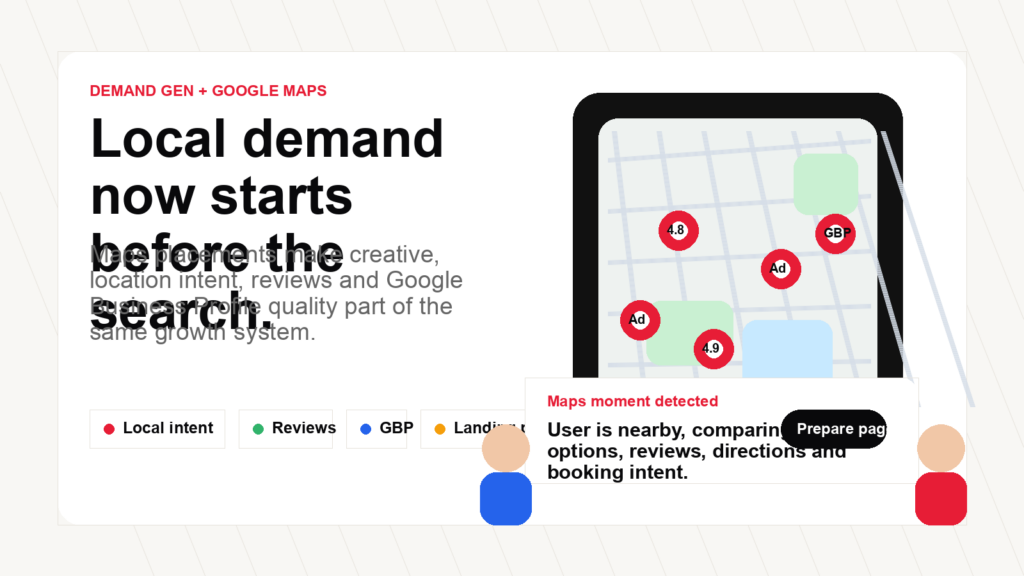
Summary: Google Maps is becoming more important for paid discovery, not less. Google has been expanding Demand Gen channel controls, and industry coverage has reported Maps inventory and promoted pins as part of the Demand Gen conversation. For local businesses, this matters because Maps is not a passive directory. It is a decision surface where people compare location, reviews, directions, opening hours, photos, booking options and trust before they act.
The SEO lesson is simple: if Demand Gen can create demand inside Google Maps, Local SEO becomes the conversion infrastructure behind that demand. A weak Google Business Profile, poor reviews, thin local pages, missing service details or a slow website can waste the paid opportunity. A strong local presence can turn the same impression into directions, calls, bookings and future brand searches.
What changed: Demand Gen moves closer to local intent
Demand Gen campaigns were originally understood by most advertisers as Google’s visual, social-style campaign type across surfaces such as YouTube, Discover and Gmail. Google’s own help documentation describes Demand Gen as a campaign type built to reach potential customers across Google’s visual-first surfaces and move them toward consideration or action.
But the important recent development is channel control. Google’s Demand Gen channel controls allow advertisers to choose where ads appear across supported channels instead of leaving every surface blended together. Search Engine Land reported that Google expanded Demand Gen channel controls to include Google Maps, giving advertisers more control over intent-driven placements. Search Engine Roundtable also reported that Maps inventory was available in beta for Demand Gen and could serve on promoted pins inventory when users browse the map, use Directions view or look at place details.
That changes the local marketing conversation. Demand Gen is not only about “showing a nice image to a broad audience.” In Maps, it can appear much closer to the moment when someone is deciding where to go, who to call, which clinic to book, which restaurant to visit, where to park, which hotel to trust or which store is nearby.
This is why the update is not only a Google Ads story. It is a local SEO story. A Maps ad can create attention, but the decision still happens through local signals: profile completeness, reviews, photos, distance, category, opening hours, services, website link, booking flow and the perceived credibility of the business.
Why this matters for SMEs
Small and medium businesses often separate paid ads from local SEO. The ads person runs campaigns. The SEO person updates pages. The owner checks calls, bookings and sales. Google Maps forces these worlds together because the user sees a business in a local context, not in a clean funnel slide.
Imagine a user looking for a pediatric clinic, airport parking, car rental, flowers, a dental clinic, a private hotel, a restaurant or a repair service. The paid placement may get attention. But immediately after that, the user checks trust. Are the reviews good? Is the location convenient? Does the business look active? Are photos real? Are the opening hours clear? Is there a direct booking option? Does the website answer the important questions? Are there recent reviews that match the user’s concern?
If the answer is weak, Demand Gen spend can become expensive curiosity. People notice the business, then choose somebody else. If the answer is strong, Maps becomes a bridge between awareness and action.
This is especially important in local verticals where trust and convenience dominate:
- Medical clinics: patients compare reviews, location, booking, doctors, availability and credibility.
- Parking and car rental: users care about proximity, pricing, shuttle service, airport access and reliability.
- Florists: users care about delivery area, freshness, real photos, opening hours and reviews.
- Hotels and hospitality: users compare ratings, distance, availability, amenities and booking confidence.
- Local services: people want proof that the business is real, nearby and responsive.
Demand Gen in Maps can put the business in front of those users earlier, but local SEO decides whether the business deserves the action.
The local SEO layer behind Maps ads
Google Business Profile is the first layer. Google’s own Business Profile help says businesses can advertise from Google Maps and showcase themselves to users interested in their storefront on Maps and other Google properties. It also explains that ads can appear when customers search for businesses or explore a local area, and that Google matches those actions to the business location.
That means the profile is not cosmetic. It is part of the experience. A business running Maps-related ads should treat the profile as a conversion page.
The local SEO layer includes:
- accurate name, address, phone and service area;
- correct primary and secondary categories;
- opening hours and special hours;
- services, products or booking options;
- high-quality photos that match the real business;
- review generation and Review response workflows;
- local landing pages that answer practical questions;
- Structured data where it matches visible content;
- consistent citations and business information across the web;
- clear internal links between location, service and informational pages.
None of this is glamorous. It is operational. But in Maps, operational clarity is marketing. Users are close to action. They need confidence quickly.
Pay for visibility, lose the decision.
The ad appears in Maps, but the profile is incomplete, reviews are weak, the page is generic and users cannot understand why they should choose the business.
Turn Maps attention into action.
The profile, reviews, photos, service page, booking flow and local content all support the user’s decision at the moment of local intent.
The Maps moment: why this is different from a normal display impression
A display impression can happen while a user reads news, watches a video or scrolls a feed. A Maps impression happens inside a different mindset. The user is spatially oriented. They are comparing locations. They may be close to the business. They may be planning a route. They may be checking whether a place is open or whether it looks credible enough to visit.
That is why Maps inventory should not be judged like a generic awareness channel. It has local intent embedded in the interface. Even when the user is not searching your exact category, the environment is local and action-oriented.
For SEO, this means the business needs to support several micro-decisions:
- Can I trust this place? Reviews, photos, ratings, responses and business details matter.
- Is it convenient? Distance, directions, parking, opening hours, booking and phone availability matter.
- Does it solve my specific need? Services, categories, product details and local landing pages matter.
- What happens next? Website clarity, booking flow, calls and directions matter.
That is local SEO. Not as a checklist, but as decision support.
How to measure Demand Gen in Maps without fooling yourself
Measurement is tricky because Maps creates both online and offline actions. Google Ads Help explains local actions conversions such as calls and direction requests for physical stores. Google also has store visit conversions for eligible advertisers, designed to help measure how online ads influence offline visits. The Google Ads store report can show location-specific actions such as phone calls, website visits, driving directions and store visits where available.
For SMEs, this means you should not measure only Clicks. A Maps campaign may influence:
- clicks to call;
- directions requests;
- website visits from the profile;
- bookings;
- store visits where eligible;
- branded searches after exposure;
- review growth and profile engagement;
- organic local pack performance over time.
But you also need to be careful. A direction request is not always a customer. A call is not always a sale. A website visit is not always qualified. The same point from our article on Qualified Future Conversions applies here: better marketing requires better business signals, not just more surface conversions.
Local businesses should connect Maps actions to real outcomes where possible. Did the call become a booking? Did the booking happen in the right service category? Did the user ask for a profitable service? Did paid exposure increase branded local searches? Did reviews improve conversion confidence?
What can go wrong if Maps ads run ahead of local SEO
The risky version of this strategy is easy to imagine. A business turns on a campaign, appears in Maps, gets a little more visibility and then wonders why the results are inconsistent. The problem is not necessarily the ad format. The problem may be that the business is paying to expose a weak local presence.
Here are the most common failure modes:
- Weak profile trust: the profile has few photos, stale reviews, unanswered complaints or missing service details.
- Wrong category signals: the business is not categorized in a way that matches how people search or compare options.
- Generic website page: the Maps click goes to a homepage or broad service page instead of a page that answers local intent.
- Inconsistent information: opening hours, phone number, address, booking links or service areas differ across Google, the website and citations.
- Bad mobile experience: the user clicks from Maps on mobile, but the page is slow, cluttered or hard to act on.
- No review workflow: the business has no operational process for collecting real, recent customer reviews.
- No business-quality tracking: the business tracks calls or clicks, but not whether those calls became real bookings or sales.
These are not “advanced SEO” problems. They are basic business execution problems. But because they sit inside the local search surface, they become SEO problems too.
Examples by vertical: how Maps demand should connect to pages
Let’s make it more practical.
A pediatric clinic should not send users from Maps to a generic “medical services” page. A parent comparing options needs pediatric services, doctors, availability, appointment process, parking, reviews, location, emergency vs routine guidance and booking clarity. If Demand Gen in Maps creates attention, the local page has to reduce fear and confusion.
An airport parking business needs distance to terminal, shuttle frequency, security, pricing, reservation process, cancellation rules, operating hours and real location clarity. If the profile says one thing and the website says another, users will hesitate. We discussed this kind of intent in SEO for car rental and airport parking.
A florist needs delivery coverage, cut-off times, real arrangement photos, phone/WhatsApp clarity, same-day options, local trust and reviews. A Maps ad can put the florist in front of someone nearby, but the website must prove that the order can be delivered correctly and on time.
A hotel or hospitality business needs amenity details, location context, parking, local attractions, booking clarity, policies and a clean mobile experience. Maps attention is valuable only if the user can move from curiosity to confidence.
A restaurant needs menus, hours, booking, reviews, photos, directions, parking or delivery details. A promoted local moment may create interest, but the profile and page have to answer the practical questions quickly.
The common pattern is that Maps does not remove the need for SEO. It exposes whether your local SEO is useful.
A practical playbook for SMEs
If you are a small or medium business, you do not need to overcomplicate this. Before testing Demand Gen in Maps or any local paid visibility, fix the foundation.
1. Audit your Google Business Profile like a landing page
Look at your profile as if you were a customer. Is the primary category correct? Are the services useful? Do photos feel real? Are reviews recent? Are opening hours accurate? Is the website link going to the best page? Is the phone number correct? Are there unanswered reviews that make the business look inactive?
If the profile is weak, paid Maps visibility will expose that weakness faster.
2. Create local landing pages that answer practical questions
A local landing page should not be a generic city page with a keyword inserted. It should answer what a real customer needs before choosing you. For a parking business near the airport, that may include distance to terminal, shuttle details, price model, security, booking steps and cancellation policy. For a clinic, it may include doctors, appointment process, urgent vs routine care, location, parking and insurance/payment information.
That content helps organic search, AI answers and paid users at the same time.
3. Build a review workflow
Reviews are not decoration. They are local proof. Businesses should ask for reviews at the right moment, not randomly. For example, a parking service can request a review after the customer completes the service. A clinic can use a QR code or post-visit request where appropriate and compliant. A florist can ask after delivery when the buyer or recipient experience is fresh.
The goal is not fake review volume. The goal is real, recent, useful social proof.
4. Use creative that matches local reality
Demand Gen is visual. But in Maps, visual creative should not feel disconnected from the location. Use real service context, real photos, practical benefits and clear reasons to choose the business. A generic stock image may get attention, but it rarely builds local trust.
For local businesses, strong creative often means: the place, the service, the outcome, the convenience, the trust signal.
5. Watch for wasted spend
Demand Gen is not a replacement for Search campaigns, Performance Max, local search ads or organic local SEO. It is another surface. Test it carefully. Segment where possible. Watch channel performance, local actions, lead quality, phone quality, branded search movement and real business outcomes.
Do not assume Maps inventory is automatically high intent. It is local context, but the campaign still needs strong targeting, creative, budget control and conversion measurement.
6. Build a weekly local visibility routine
Local SEO fails when nobody owns the routine. The profile is updated once, then forgotten. Reviews arrive, but nobody answers them. Service pages are created, but never improved. Search Console shows impressions, but nobody turns them into better content. Ads run, but the landing page stays the same.
A simple weekly routine can change that:
- check Google Business Profile actions and review trends;
- review Search Console queries for local pages;
- identify pages with impressions but weak clicks;
- check calls, booking quality and sales notes;
- update one local page or FAQ section;
- answer reviews and extract customer language;
- test whether paid clicks land on the most useful page.
This is exactly the kind of work that sounds small but compounds. It is also the kind of work most SMEs do not have time to do manually every week.
How this connects to AI search and answer engines
Maps visibility is not isolated from AI search. Google AI Mode, AI Overviews, answer engines and local search all need clean business information. A business that has consistent categories, clear services, strong local pages, structured facts and trustworthy reviews is easier to understand than a business with scattered, outdated or thin information.
When users ask AI systems local questions, the answer often depends on source clarity. “Best clinic near me with online booking,” “airport parking with shuttle and security,” “same-day flower delivery in Bucharest,” or “hotel with parking near the old town” are not just keywords. They are tasks. The website and profile need to make the answer extractable.
That means local SEO in 2026 should prepare for three surfaces at once:
- Classic search: local pack, organic listings, service pages and category pages.
- Maps: profile actions, directions, calls, photos, reviews and promoted local visibility.
- AI search: answers that synthesize business facts, reviews, location context and service detail.
Demand Gen in Maps is another sign that local discovery is becoming more blended. The business that wins is not the one that buys the most impressions. It is the one that makes every impression easier to trust.
Where AYSA fits: local SEO execution for the Maps era
AYSA’s view is that local visibility is becoming an execution problem. Google is adding more AI and more paid surfaces. Users are searching in Maps, Search, AI Mode, answer engines and social platforms. Businesses cannot afford to wait three months for someone to notice that the profile is incomplete, the landing page is weak or the reviews are not being managed.
AYSA can help by monitoring local SEO signals, preparing approval-ready improvements and executing accepted changes inside the website workflow. For a local business, that can include:
- improving local service pages;
- adding clearer booking, pricing, location or process details;
- finding pages with impressions but weak CTR;
- preparing FAQ and answer-ready content;
- building internal links between service, location and informational pages;
- monitoring Google Business Profile and local visibility opportunities;
- connecting SEO work with paid campaign landing-page quality.
The point is not that AYSA replaces Google Ads. It helps prepare the website and local content layer that paid campaigns need in order to perform. If Demand Gen in Maps creates demand, AYSA helps make sure the business has the local SEO foundation to convert it.
That is the future of local growth: not “ads or SEO,” but a connected system where paid discovery, Google Business Profile, local pages, reviews, technical SEO and AI visibility work together.
Running local ads without fixing local SEO is expensive guesswork.
AYSA helps SMEs turn Maps visibility, local search and AI discovery into approved website improvements: better pages, clearer trust signals and execution inside your website workflow.
Sources and further reading
- Google Ads Help: About Demand Gen campaigns
- Google Ads Help: Channel controls in Demand Gen campaigns
- Search Engine Land: Google adds Maps to Demand Gen channel controls
- Search Engine Roundtable: Google Ads Demand Gen Maps channel
- Google Business Profile Help: Advertise your business on Google
- Google Ads Help: About local actions conversions
- Google Ads Help: About store visit conversions
- Google Ads Help: View the store report
- AYSA: Qualified Future Conversions and SEO measurement
- AYSA: SEO for car rental and airport parking
Continue the AI search topic inside AYSA.
Use these pages to connect the article with AI SEO tools, AI visibility monitoring, AI Overviews and approved website execution.
Turn this topic into a website action plan.
Use these AYSA hubs to move from reading to technical fixes, AI visibility monitoring, research, glossary context and approval-first SEO execution.

