
SEO for Airport Car Rental and Parking Services: Local Search, Booking Intent and Trust
A practical SEO guide for airport car rental and parking services: local visibility, airport landing pages, booking intent, Google Business Profile, reviews, pricing clarity, structured data and AI search.
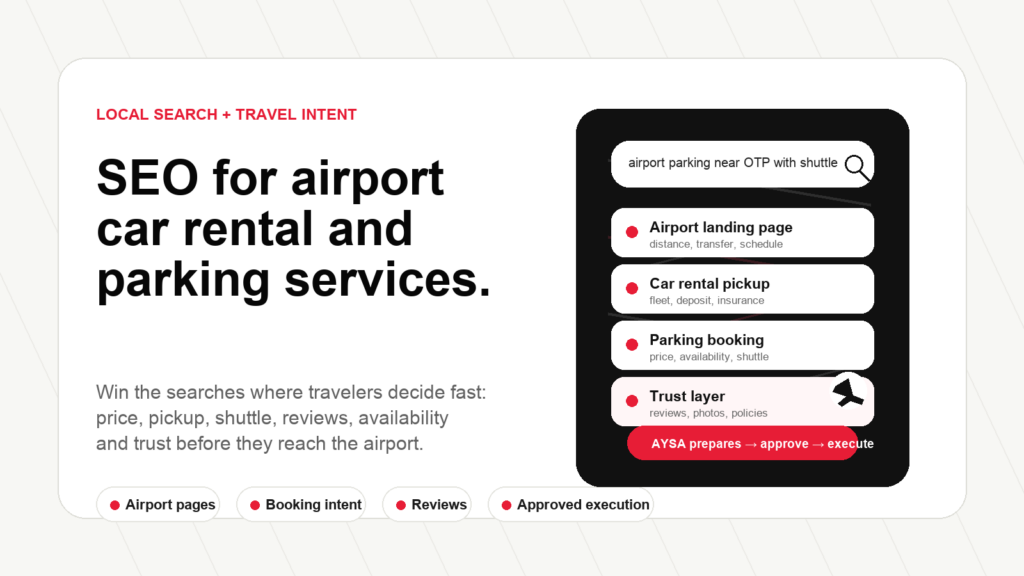
Executive summary: SEO for airport car rental and parking services is a high-intent search problem. The user is rarely “researching for fun.” They are comparing options before a flight, after landing, before a business trip, before a holiday or during a stressful logistics moment. They care about price, distance from the terminal, shuttle frequency, opening hours, pickup process, deposit, insurance, security, cancellation, reviews and whether the service will actually work at 04:30 in the morning.
The winning SEO strategy is not only “rank for car rental” or “airport parking.” It is to build a trust-and-booking operating model: airport-specific landing pages, clear pricing, booking-friendly service pages, Google Business Profile accuracy, review proof, photos, Structured data, fast mobile performance, local authority and AI-readable answers. AYSA fits this market because the work is repetitive, operational and approval-sensitive: the system can monitor demand, prepare updates, flag missing trust details, suggest pages and execute approved changes inside the website workflow.
Why airport car rental and parking SEO is different
Car rental and airport parking are not normal local services. They sit at the intersection of travel, logistics, ecommerce and local search. The user is often under time pressure. They may be booking from a phone, comparing options quickly, searching from another city or country, or trying to avoid a bad surprise before a flight. That changes what SEO needs to accomplish.
A restaurant can win a user with appetite and photos. A florist can win with emotion and delivery trust. An airport parking or car rental business wins with operational clarity. The page must answer: how far are you from the terminal, how do I get there, is there a shuttle, how often does it run, what happens if my flight is delayed, what documents do I need, what is the deposit, what insurance is included, what are the real extra fees, is the parking guarded, are keys kept by the customer, and can I book online now?
The commercial intent is strong, but trust friction is also strong. Travelers fear hidden fees, late transfers, unclear pickup instructions, blocked deposits, unavailable cars, bad reviews and missed flights. Search visibility therefore depends on more than keywords. It depends on trust signals, page clarity, local proof and a booking experience that does not create anxiety.
In my opinion, this is exactly the type of market where classic SEO agencies often struggle to keep pace. The work is not only strategy. It is execution: update airport pages, refresh pricing notes, improve FAQs, add internal links, monitor reviews, fix 404s after campaign changes, update seasonal travel content, keep Google Business Profile accurate, improve Page speed and respond to competitor movement. This is operational SEO.
The search intent around airports
Airport-adjacent services have several search intents, and each one needs a different page type. A user searching “airport parking near me” is not the same as a user searching “long term parking near OTP airport,” “cheap airport parking with shuttle,” “rent a car Bucharest airport,” “automatic car rental airport,” or “car rental no deposit near airport.”
Immediate local intent is common: “airport parking near me,” “car rental near airport,” “parking Otopeni airport,” “rent a car airport.” These searches often happen on mobile. The user needs a fast answer and a simple path to booking. Local Pack Visibility, Google Business Profile and mobile UX matter heavily.
Comparison intent is also strong: “best airport parking,” “airport parking prices,” “long term airport parking,” “car rental insurance included,” or “airport car rental deposit.” These pages should help the user compare criteria without hiding the details. The more transparent the page, the more credible the service.
Brand and reputation intent appears when users search a provider by name plus “reviews,” “complaints,” “phone,” “location,” “shuttle,” or “parking address.” If the business has weak branded search results, outdated profiles or unclear review responses, trust can collapse before the booking starts.
Travel scenario intent includes searches like “parking for early morning flight,” “airport parking for 7 days,” “car rental for family trip,” “van rental airport,” “business car rental airport,” or “parking with transfer to terminal.” These are excellent content opportunities because they connect directly to real customer problems.
A good SEO system maps these intents into pages and page sections: main airport page, airport parking page, long-term parking page, short-term parking page, car rental airport page, fleet pages, insurance/deposit page, pickup instructions page, FAQs and support pages. This is not content for content’s sake. It is search architecture.
Local SEO and Google Business Profile
Google says local results are influenced by relevance, distance and prominence. For airport services, all three are decisive. Relevance means Google and users understand exactly what the business provides: airport parking, car rental, shuttle, long-term parking, vehicle classes, hours and location. Distance is complex because the user may be near the airport, in another city or planning before travel. Prominence comes from reviews, links, mentions and broader trust signals.
Google Business Profile should not be treated as a small directory listing. It is often a primary conversion surface. The profile should include accurate categories, address, hours, special hours, phone number, website, photos, services, booking links where available and review responses. For airport parking, details like parking availability, security, shuttle, entry process and photos can reduce anxiety. For car rental, users want vehicle photos, pickup location, service hours and contact clarity.
Profiles must be maintained during holidays and peak travel periods. If the business is open during unusual hours, that should be visible. If the shuttle runs on demand, explain it. If pickup requires calling on arrival, make that obvious. If the office is off-airport, explain the transfer clearly.
The website should mirror and expand the profile. A user who clicks from Google Maps should land on a page that confirms the same information and answers the next questions. If the profile says “airport parking,” the page should not be a generic homepage. It should explain the airport parking service.
Airport landing pages must answer logistics, not just keywords
A strong airport landing page should be built around operational clarity. The page should show airport served, distance to terminal, transfer method, estimated transfer time, shuttle frequency, opening hours, booking process, address, map, pricing model, cancellation policy, support contact and reviews. If the business serves more than one airport, each important airport deserves its own useful page.
The page title and heading should match the real user intent. “Airport Parking near Henri Coanda International Airport” or “Car Rental at Bucharest Otopeni Airport” is clearer than a vague title like “Services.” But the page content should not become a doorway page. It must include real, location-specific details.
Airport pages also need strong CTAs. A traveler should not have to hunt for booking. The primary CTA should be visible: book parking, reserve a car, call, WhatsApp, check availability or get directions. Secondary CTAs can include pricing, fleet, FAQs and pickup instructions.
For AI search, airport pages should include concise answer blocks. Example: “How far is the parking from the airport?” “Is shuttle transfer included?” “Can I park for seven days?” “What happens if my flight is delayed?” These are useful for users and easier for answer systems to extract.
SEO for airport car rental services
Airport car rental pages should reduce uncertainty around vehicle availability, pickup, documents, deposits, insurance and hidden costs. Many users are skeptical because car rental is known for confusing conditions. A provider that explains the process clearly can earn trust before price comparison begins.
Useful car rental SEO pages include fleet category pages, airport pickup pages, long-term rental pages, business rental pages, family travel pages, automatic transmission pages, van rental pages, insurance explanation pages and deposit/payment requirement pages. These pages should link together naturally.
The fleet page should not only list cars. It should explain car classes, luggage capacity, passenger capacity, transmission, fuel policy, mileage rules, deposit, insurance options, age requirements and what happens if the exact model is unavailable. This is where SEO and conversion overlap.
Structured data can help search engines understand business details where appropriate, but it must reflect visible content. If the page includes local business information, product-like offers or FAQ content, the markup should match what users can see. Do not add markup as a hidden SEO trick.
Car rental providers should also optimize branded and support searches. A page for “pickup instructions” or “airport pickup guide” can reduce customer friction and support calls. It can also rank for long-tail searches that competitors ignore.
SEO for airport parking services
Airport parking SEO is strongly connected to booking confidence. Users compare price, security, distance, shuttle, opening hours, indoor/outdoor parking, key policy, cancellation and reviews. A parking page that hides these details may still get traffic, but it will lose high-intent users.
The most important pages are usually: main airport parking page, long-term parking, short-term parking, parking with shuttle, guarded parking, covered parking if available, pricing, directions, FAQ and booking policy. If the business serves several airports or terminals, create genuinely useful pages for each.
Pricing transparency is a competitive advantage. If the exact price changes by dates or availability, explain how pricing works and provide a booking tool. If there are transfer fees, late fees or overstay rules, make them clear. Travelers dislike surprises. Search engines also benefit from clear structured information.
Photos matter. Users want to see the parking area, entrance, shuttle vehicle, office, lighting, security and access route. Real photos can reduce anxiety more effectively than generic stock imagery.
Reviews should be connected to operational themes: punctual shuttle, safe parking, friendly staff, no hidden fees, easy booking, fast transfer, helpful support during flight delays. These themes should influence page copy without fabricating claims.
Trust, reviews and policies are ranking-adjacent conversion assets
Trust signals are not only “nice to have.” In airport services, they directly affect whether the user books. A traveler may pay slightly more for a provider that clearly explains where to go, how pickup works and what happens if the flight is delayed. The opposite is also true: unclear pages create fear.
Review management should be ethical and systematic. Ask customers after successful service, make the review process easy, respond professionally and use feedback to improve service pages. Google’s local ranking guidance notes the importance of complete business information and reviews in local visibility. That does not mean chasing reviews mechanically; it means building a real feedback loop.
Policies should be visible: cancellation, no-show, delayed flights, deposit, insurance, damage, parking key handling, shuttle, support hours and emergency contact. If these details are buried in terms and conditions, users may not trust the service.
Authority also matters. Local airport guides, travel blogs, hotel partnerships, business travel resources, local press, tourism pages and relevant publisher mentions can all support credibility. AYSA’s integration with Adverlink can help surface controlled authority-building opportunities, but any extra spend or placement should require approval.
Technical SEO for booking-focused airport service websites
Technical SEO matters because these websites often rely on booking forms, maps, calendars, fleet filters, tracking scripts and mobile interactions. If the page is slow or the booking form is confusing, the user leaves. If search engines cannot crawl the important content, visibility suffers.
Common issues include slow mobile pages, heavy booking widgets, unoptimized images, broken redirects from old campaign URLs, duplicate location pages, thin fleet pages, missing canonical tags, crawlable filter parameters, poor internal linking and unclear sitemap hygiene.
Mobile performance is especially important. Airport users are often on phones. They may be in a taxi, in a hotel, at the airport or planning quickly. Pages should load fast, show core information immediately and make booking easy.
Structured data should be used carefully. Local business markup can describe the business, location, contact and opening hours. FAQ markup should only be used where visible FAQ content exists and where it is appropriate. Product or offer markup should reflect visible price and availability details if used. The goal is clarity, not artificial markup inflation.
AEO, GEO and AI search for airport services
AI-assisted search changes how users compare services. A user might ask: “What should I compare when choosing airport parking near Bucharest?” or “Is off-airport parking worth it if there is a shuttle?” or “What documents do I need to rent a car at the airport?” These are not simple keyword queries. They are decision questions.
To be visible in answer engines and AI summaries, the website must provide clear, extractable answers. The business should explain pricing, transfer, process, policies, location, reviews, vehicle options, parking conditions and support. Vague marketing copy is less useful than precise information.
Google’s guidance around AI features continues to emphasize helpful, reliable content and technically accessible pages. That aligns perfectly with airport services: answer the real questions, make pages crawlable, use structured data responsibly and keep information accurate.
AYSA can help by identifying pages that receive impressions but do not answer the query well, preparing FAQ sections, improving internal links, flagging missing policy information and monitoring AI visibility gaps. The important part is that execution remains approved. The agent prepares; the business owner controls what gets published.
A 90-day SEO execution plan for car rental and airport parking
Days 1-15: Build the business and location profile. Map services, airports, cities, pickup points, transfer rules, opening hours, parking types, vehicle classes, pricing logic, policies, review themes and top competitors. Connect Google Search Console, Analytics and Google Business Profile where available.
Days 16-30: Fix the conversion foundation. Improve the homepage, airport landing page, pricing section, booking CTA, contact information, directions page, review visibility and policy pages. Make sure the most important details are visible above the fold on mobile.
Days 31-45: Build commercial pages. Create or improve pages for airport parking, long-term parking, shuttle parking, guarded parking, airport car rental, fleet categories, insurance/deposit, business rental and family travel. Link them together clearly.
Days 46-60: Add answer-ready content. Build FAQ and guide content around pickup, flight delays, early morning flights, deposits, insurance, parking duration, shuttle frequency, terminal transfer and cancellation. Keep answers concise and practical.
Days 61-75: Strengthen authority and reviews. Improve review request workflows, respond to reviews, add real photos, identify local travel partnerships and surface relevant publisher opportunities. Do not buy random links; build relevant authority.
Days 76-90: Monitor and improve. Track rankings, impressions, CTR, booking conversion, review themes, technical errors, broken links and competitor movement. Refresh pages that get impressions but weak clicks. Prepare approved changes continuously.
Where AYSA fits
AYSA is useful for airport car rental and parking providers because the SEO work is continuous and operational. The business owner should not have to manually inspect Search Console, compare competitors, rewrite landing pages, fix metadata, build FAQs, track seasonal demand and monitor technical problems every week.
AYSA can learn the business, monitor search and website signals, prepare airport-specific updates, identify missing trust details, improve service pages, suggest internal links, prepare AEO-ready answers, surface authority opportunities and ask for approval before changes go live. That is the difference between an SEO dashboard and an SEO execution agent.
Turn airport search intent into approved website execution.
AYSA monitors your website, prepares SEO, AEO and AI visibility actions, asks for approval and executes accepted changes inside your website workflow.
Sources and further reading
Continue the AI search topic inside AYSA.
Use these pages to connect the article with AI SEO tools, AI visibility monitoring, AI Overviews and approved website execution.
Turn this topic into a website action plan.
Use these AYSA hubs to move from reading to technical fixes, AI visibility monitoring, research, glossary context and approval-first SEO execution.

