
SEO for Floristry: A Practical Search Visibility Guide for Flower Shops
A deep practical guide to SEO for florists and flower shops: local SEO, delivery pages, seasonal intent, product SEO, reviews, images, authority building and AI visibility.
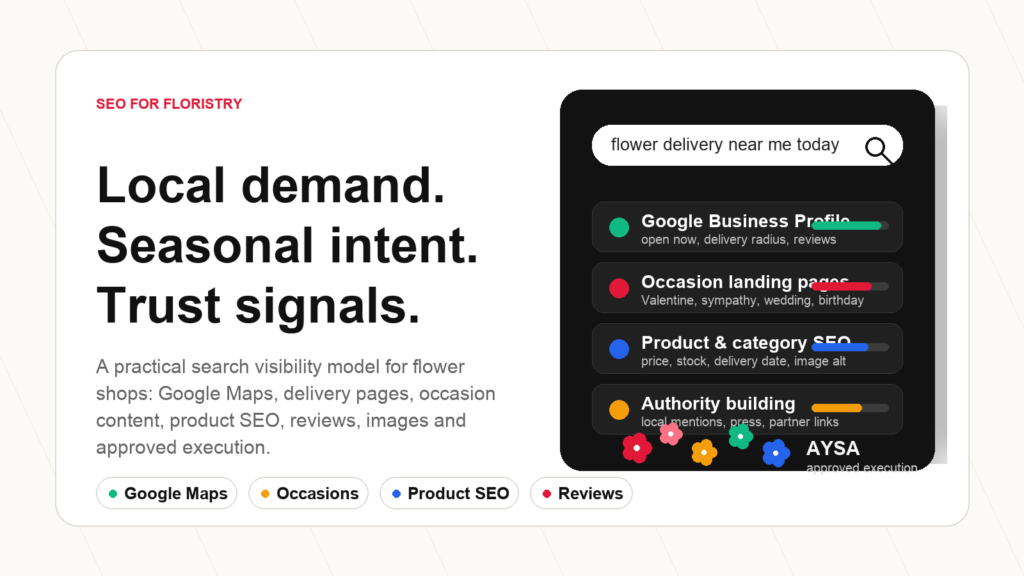
Executive summary: SEO for floristry is not the same as SEO for a normal ecommerce store. A flower shop sells products, but the Search intent is often urgent, local, emotional and seasonal. People do not only search for “roses.” They search for “same day flower delivery near me,” “funeral flowers today,” “wedding florist in Bucharest,” “birthday bouquet for mom,” “red roses delivery Valentine’s Day,” or “what flowers should I send after surgery.” A florist website must therefore combine local visibility, ecommerce product SEO, occasion-led content, image quality, reviews, delivery trust and seasonal execution.
The opportunity is large because many florists still treat SEO as a few category pages plus Google Business Profile. The better model is an operating system: know the market, map the real search intents, build local and occasion pages, improve product data, collect reviews, strengthen authority, monitor seasonal changes, prepare updates and execute the approved work quickly. That is where AYSA fits: not as another reporting tool, but as an approved SEO execution layer for businesses that cannot spend every week manually managing search.
Why floristry SEO is different
Floristry is one of the clearest examples of why SEO cannot be reduced to Keyword Stuffing, plugin settings or generic blog publishing. A florist sells products, but the buyer is usually driven by context: a birthday, a funeral, a wedding, a hospital visit, a business opening, an apology, an anniversary, Valentine’s Day, Mother’s Day, International Women’s Day or a last-minute “I need flowers today” moment.
That context changes what a useful page must do. A normal ecommerce page can focus on specifications, price and delivery. A flower page must also reduce emotional uncertainty: is this bouquet appropriate, will it arrive on time, does it look premium, can I add a message, will it be fresh, is the florist real, are there reviews, can I call someone, can the shop handle the occasion, and what happens if the recipient is not at home?
Floristry SEO also has a strong local layer. Even an online florist must prove delivery coverage, local trust, freshness and operational reliability. A national marketplace can compete on inventory and brand. A local florist can compete on speed, neighborhood relevance, human service, custom arrangements and trust. Search visibility should reflect those advantages.
In my opinion, the biggest mistake florists make is treating SEO as a list of static keywords: “flori,” “buchete flori,” “livrare flori,” “trandafiri,” “florarie online.” Those terms matter, but they do not capture the real buying journey. A better SEO strategy maps the emotional job behind the search. A person buying funeral flowers needs reassurance and tact. A person buying wedding flowers needs inspiration and proof. A person buying same-day flowers needs delivery confidence. A person searching for “what flowers for new baby” needs guidance.
That is why SEO for floristry must be built around intent clusters, not only product categories. You need pages for products, occasions, locations, delivery promises, care advice, trust signals and visual examples. You also need a workflow that keeps those pages updated, because the flower market changes with seasons, inventory, holidays, weather, events and local demand.
The search intents behind flower purchases
Before building pages, a florist must understand that not all flower searches are equal. Some searches are informational, some are local, some are urgent, some are emotional, and some are clearly transactional. A strong SEO strategy separates them and creates the right page type for each.
Transactional searches include queries like “order roses online,” “same day flower delivery,” “birthday flowers delivery,” “funeral wreath delivery,” or “wedding bouquet florist.” These deserve commercial pages with clear offers, delivery details, product grids, trust signals and simple CTAs.
Local searches include “florist near me,” “flower shop in [city],” “flower delivery [neighborhood],” or “florarie [city].” These searches are often influenced by Google Business Profile, reviews, proximity, local relevance and page clarity. A florist should not create low-quality doorway pages, but real location or delivery-area pages can be useful when they explain coverage, timing, fees and local service details.
Occasion searches include “flowers for anniversary,” “flowers for apology,” “flowers for funeral,” “flowers for new baby,” “wedding flower arrangements,” or “corporate flower gifts.” These pages should guide the buyer. The goal is not only to rank; it is to help someone choose without feeling lost.
Care and meaning searches include “how to keep roses fresh,” “what flowers mean sympathy,” “how long do tulips last,” or “best flowers for hospital visit.” These are not always immediate purchase searches, but they build topical authority, help users and create Internal linking opportunities back to products and occasion pages.
Branded searches are equally important. If someone searches for your shop name, your result, Google Business Profile, reviews, photos and site links must make the business look alive and trustworthy. Many small florists lose conversions because their Branded Search presence looks incomplete, outdated or inconsistent.
For AEO and AI search, intent clarity becomes even more important. When an AI system summarizes options, it needs clear signals: what you sell, where you deliver, what occasions you serve, why customers trust you, what makes you different and what next step a user should take. A vague florist website is harder to cite, compare or recommend.
Google Business Profile is a revenue page, not a directory listing
For flower shops, Google Business Profile is often one of the most important organic acquisition surfaces. Google’s own support documentation encourages businesses to complete and maintain profile information such as hours, address, phone, website, category and photos. For local businesses, that is not administrative housekeeping; it is conversion infrastructure.
A florist profile should be accurate, current and active. The primary category should reflect the business. Hours must be correct, especially around holidays. The website URL should send users to the most useful landing page, not always the homepage. Photos should be real, current and representative of the shop’s work. Services and products should describe the actual offer. Posts can be useful around key seasonal campaigns.
Reviews matter because flowers are trust-sensitive. A buyer cannot smell freshness through a screen. They cannot see the final arrangement before it leaves the shop. They need proof that other people received what they ordered. Review quality, recency and response behavior all shape confidence.
The profile and website should work together. If the profile says “same-day delivery,” the website should explain cutoff times. If the profile highlights weddings, the website should show wedding examples. If reviews praise fast delivery, the site should make delivery promises visible. If customers mention custom bouquets, the site should explain custom order options.
One mistake I see often is that florists treat Google Business Profile as a set-and-forget object. In practice, it should be monitored like a sales channel. Questions, reviews, photos, holiday hours, service changes and local competitor movement all matter. AYSA can support this kind of work by monitoring signals, preparing updates and reminding the business owner what needs approval.
Delivery and location pages must be useful, not doorway pages
Delivery-area SEO is powerful for florists, but it is also easy to do badly. A weak approach creates hundreds of near-duplicate pages that say “flower delivery in X” with no real local detail. That is risky and unhelpful. A strong approach creates useful pages for meaningful locations where the florist can genuinely deliver and where the page helps the buyer understand the service.
A good delivery page should answer practical questions: do you deliver here, what is the delivery window, what are the fees, what is the same-day cutoff, what happens if the recipient is unavailable, can you deliver to offices, hospitals, restaurants, churches, event venues or funeral homes, and what products are best suited for that location or occasion?
For example, a page for “flower delivery in Bucharest” should not be the same as a page for “flower delivery in Bragadiru.” One may emphasize city-wide coverage, business deliveries and apartment logistics. The other may emphasize local speed, nearby neighborhoods and lower delivery complexity. A florist with real operational knowledge can turn that into useful content.
Internal linking is important here. Location pages should link to relevant occasion pages, product categories and trust pages. A user looking for same-day delivery may also need birthday bouquets, sympathy flowers or premium roses. Search engines also use internal links to understand page relationships and importance.
Do not build location pages for places you cannot serve well. It may create short-term traffic, but it produces bad user experience and weak trust. In floristry, a delivery promise is part of the product. If the promise is unclear, the page is not ready.
Seasonal SEO is where many florists win or lose
Floristry has a calendar-driven demand curve. Valentine’s Day, Mother’s Day, International Women’s Day, Christmas, Easter, graduation season, wedding season and local holidays can dramatically change what people search for. The National Retail Federation reported record expected Valentine’s Day spending in 2026, with flowers remaining one of the classic gift categories. The exact numbers will vary by market, but the strategic point is stable: seasonal demand must be prepared before the season arrives.
A florist that starts building Valentine’s Day pages one week before the event is already late. Search engines need time to discover, crawl and understand pages. Users need time to compare. Internal teams need time to update products, photos, delivery rules and capacity. Seasonal SEO is not a last-minute banner; it is a content and operations plan.
Seasonal pages should be evergreen enough to reuse and refresh every year. Instead of deleting and recreating “Valentine’s Day flowers,” maintain a strong URL and update it with current products, delivery cutoffs, photos, FAQs, availability and internal links. The same applies to Mother’s Day, wedding season and Christmas arrangements.
Seasonal intent also varies. Valentine’s Day buyers may search for roses, romantic bouquets and same-day delivery. Mother’s Day buyers may search for elegant bouquets, delivery to parents, premium arrangements or affordable gifts. Funeral flower searches need careful tone, clarity and trust. Wedding flower searches need inspiration, examples and consultation pathways.
AYSA’s role here is valuable because seasonal SEO is repetitive and time-sensitive. The agent can monitor upcoming demand, identify pages that need refresh, prepare titles and content updates, propose internal links, flag products that should be featured, and ask for approval before execution.
Product and category SEO for flower shops
Google’s ecommerce documentation emphasizes helping search engines understand product pages, structured data, availability and shopping-related information. For florists, this matters because product pages often carry weak data: vague titles, duplicate descriptions, missing availability, thin descriptions, poor image attributes and unclear delivery rules.
A flower product page should not only say “Red roses bouquet.” It should explain size, stem count or approximate composition where relevant, occasion fit, freshness expectations, delivery options, care guidance, substitutions policy, add-ons and what the customer can personalize. If the bouquet changes seasonally, the page should be honest about possible flower substitutions.
Product structured data can help search engines understand price, availability, ratings and product details where eligible. Google’s product structured data documentation is clear that markup should reflect visible content. That means do not add structured data for information users cannot see. If price, availability or reviews are included in markup, they should be present and accurate on the page.
Category pages are just as important. A category like “Birthday Flowers” should not be a raw product grid. It should explain what to choose, who the flowers are for, delivery options, price ranges, personalization and related occasions. The introduction should be useful, not stuffed. FAQs can help where they answer real buyer questions.
For florists using WooCommerce or similar platforms, product variations can create SEO complexity. Filters, sorting URLs, out-of-stock products, duplicate category paths and thin product pages can create crawl waste. A florist should control indexation carefully: useful categories and products should be indexable; low-value filter URLs should usually not be.
Image SEO and visual trust
Flowers are visual. Image quality is not decoration; it is part of the buying decision. Google’s image SEO documentation recommends using descriptive filenames, relevant surrounding text, appropriate alt text, high-quality images and structured pages. For florists, these basics are often underused.
Every important product and occasion page should use real, high-quality images. If possible, use images of actual arrangements created by the shop, not generic stock photos. Alt text should describe the image naturally: “pink peony and rose bouquet for anniversary delivery” is more useful than “IMG_4821” or “flowers.” Do not overstuff alt text with keywords. Accessibility and clarity come first.
Image performance also matters. Large uncompressed photos can destroy mobile speed and Largest Contentful Paint. Florist sites often suffer because they upload beautiful but massive photos. The right workflow uses optimized dimensions, modern formats where appropriate, lazy loading below the fold and a fast image delivery setup.
Visual trust can also support AI search. If a page clearly shows bouquet types, arrangement styles, delivery context and occasion fit, it becomes easier for users and systems to understand what the business actually offers. A vague gallery is less useful than an organized visual experience.
Reviews are not just reputation; they are content signals
Reviews help users decide whether a florist can be trusted with an emotional purchase. A strong review system should be ethical, consistent and easy. Ask after successful delivery, not randomly. Make it simple to leave a review. Respond professionally. Learn from recurring complaints. Use real feedback to improve service pages.
Florists should not fake reviews, incentivize reviews in ways that violate platform policies, or pressure customers. The goal is not to manipulate. The goal is to create a steady feedback loop from real service experiences.
Reviews can also reveal SEO opportunities. If customers repeatedly mention “fast delivery,” “beautiful wedding bouquet,” “sympathy arrangement,” “helpful staff,” “fresh flowers” or “easy online ordering,” those are not just compliments. They are language from the market. The website should reflect real customer language where appropriate.
AYSA can help by monitoring review themes, identifying repeated phrases and suggesting updates to relevant pages. The business owner still approves the changes, but the system reduces manual analysis.
Content that actually helps flower buyers
A florist blog should not be a random collection of “top 10 flowers” articles. Content should support real buying decisions and topical authority. Useful content includes flower care guides, occasion guides, local delivery advice, wedding planning resources, sympathy etiquette, corporate gifting ideas, seasonal flower availability and comparison content.
For example, a page about “best flowers for a hospital visit” should explain scent sensitivity, size, vase needs, hospital policies, cheerful colors and when flowers may not be appropriate. A page about “funeral flowers vs sympathy flowers” should explain tone, delivery location, timing and message etiquette. A page about “wedding flowers in Bucharest” should explain seasonality, budget, consultation steps, venue logistics and examples.
This kind of content helps classic SEO, but it also helps AEO. Answer engines need clear, structured, citation-friendly information. A good florist page should include concise answers, examples, criteria and internal links. It should be written for humans first, but organized so machines can understand it.
Quality content starts with a harder question: what would make this page the most useful result for a specific user, at a specific stage of the journey, in a specific market? For floristry, that means combining emotion, logistics and trust.
Technical SEO problems florist websites often have
Many florist websites are built on WordPress, WooCommerce, Shopify or custom ecommerce systems. The most common technical SEO problems are not mysterious: slow mobile pages, oversized images, duplicate products, unhelpful filter URLs, weak internal linking, missing canonical rules, outdated sitemap entries, out-of-stock pages, broken redirects after redesigns and plugin bloat.
Mobile performance is especially important because many flower purchases happen quickly. Someone may be on the phone, searching for same-day delivery, comparing two shops and making a decision in minutes. If the site is slow, confusing or unstable, the conversion is lost.
Internal linking is also often weak. A product page should link to its occasion, category and delivery area where relevant. An occasion page should link to products and related guides. A location page should link to delivery policies and appropriate categories. A care guide should link back to products it supports. This is how topical authority becomes usable, not just theoretical.
Florists should also be careful with discontinued products. If a bouquet is no longer available, decide whether to redirect, keep the page with alternatives, or mark it out of stock. Do not leave hundreds of dead product pages with no plan. Those pages can waste crawl budget and frustrate users.
AYSA can monitor many of these issues continuously: broken URLs, missing metadata, weak page titles, thin categories, missing internal links, sitemap drift, technical warnings and pages with impressions but weak CTR. The important point is execution. A report is not enough. Someone needs to prepare fixes, approve them and apply them.
Authority building for florists
Authority for florists should be earned in ways that make business sense. Local media mentions, wedding venue partnerships, event planner directories, charity events, corporate gifting pages, community sponsorships, local guides and relevant publisher placements can all support visibility when they are legitimate and relevant.
This is where the language matters. We should not talk about “buying links” as if SEO were a shortcut market. The better concept is authority building: creating or approving relevant references that help the web understand the business. For a florist, useful references might come from wedding blogs, local event guides, business directories, local press, venue partners, gift guides and industry publications.
AYSA’s integration with Adverlink is relevant here because authority building is normally slow and operationally messy. Businesses do not want to email dozens of publishers, manage spreadsheets, negotiate placements and track delivery. A controlled workflow can surface relevant publisher opportunities, explain the context and cost, request approval and track delivery. Extra authority actions should require explicit approval before spending.
Authority does not replace quality. A weak site with paid mentions is still weak. But a useful florist website with strong local pages, good products, real reviews and relevant references is much easier to trust.
AEO, GEO and AI search for floristry
Search is no longer only a list of blue links. Google’s AI features and answer engines increasingly synthesize information. Google’s own AI optimization guidance still points back to fundamentals: create helpful, reliable, people-first content, make pages accessible to crawlers, use structured data that matches visible content, and provide clear context.
For florists, AI search raises practical questions. If a user asks, “What should I compare when choosing a florist for same-day delivery?” or “What flowers should I send to a new mother?” the answer may mention criteria, not only brand names. To be included or cited, a florist must provide clear information: delivery areas, timing, pricing, product categories, occasion expertise, reviews, policies and helpful guidance.
AI visibility does not mean writing for robots. It means making the business easier to understand. A florist should have pages that clearly answer who it serves, where it delivers, what it offers, how orders work, what occasions it handles, why people trust it and what action the user should take next.
This is where AYSA’s approved execution model matters. AI search optimization is not a one-time checklist. It requires monitoring, content updates, internal links, technical cleanup, authority signals and structured information. AYSA can prepare the work continuously and ask the business owner to approve important changes.
A 90-day SEO execution plan for a florist
Days 1-15: Build the SEO profile. Define the business model, delivery areas, top products, seasonal priorities, customer segments, margins, important occasions and competitors. Connect Google Search Console, Analytics and Google Business Profile data where available. Audit the site for technical issues, product gaps and local visibility weaknesses.
Days 16-30: Fix local and conversion foundations. Update Google Business Profile, confirm categories, hours, photos and service details. Improve contact and delivery pages. Create or improve the main flower delivery page. Add clear policies for same-day delivery, substitutions, payment, delivery fees and recipient unavailable scenarios.
Days 31-45: Build commercial pages. Improve top category pages: roses, bouquets, birthday flowers, sympathy flowers, wedding flowers, corporate flowers and same-day delivery. Add useful copy, FAQs, internal links, product visibility and structured data where appropriate.
Days 46-60: Build seasonal and occasion coverage. Refresh or create evergreen seasonal pages for Valentine’s Day, Mother’s Day, Women’s Day, Christmas, weddings and local events. Build pages early enough for crawling and ranking. Add product links and delivery deadlines.
Days 61-75: Improve content and authority. Publish useful guides: flower care, meanings, occasion etiquette, wedding planning and local gifting ideas. Identify relevant publisher, wedding, venue and local partnership opportunities. Ask for approval before any paid authority action.
Days 76-90: Monitor and iterate. Track rankings, impressions, CTR, indexed pages, reviews, top products, seasonal queries and AI visibility opportunities. Update pages that receive impressions but do not convert. Add internal links. Fix technical issues. Prepare the next seasonal campaign.
This is not a one-person manual checklist. It is exactly the kind of repeated operational work that most small businesses struggle to maintain. A florist can know flowers extremely well and still not have time to manage SEO every week. AYSA exists for that gap: less SEO work, more organic growth.
Where AYSA fits
AYSA is not a generic chatbot that gives a florist a list of suggestions and leaves the owner to copy-paste changes. The product direction is an AI SEO execution agent: it learns the business, monitors website and Google signals, prepares SEO, AEO and AI visibility actions, asks for approval and executes accepted changes inside the website workflow.
For florists, that means AYSA can help identify delivery pages that need stronger local detail, category pages with weak content, product pages missing useful metadata, seasonal pages that should be refreshed, review themes that should inform copy, internal links that should be added, technical issues that hurt crawlability, and authority opportunities that require approval.
The business owner does not need to become an SEO specialist. They need to make business decisions: approve the changes that make sense, reject what does not fit the brand and keep the website moving. That is the difference between an SEO report and an SEO operating system.
Turn floristry search demand into approved website execution.
AYSA monitors your website, prepares SEO, AEO and AI visibility actions, asks for approval and executes accepted changes inside your website workflow.
Sources and further reading
- Google Search Central: Ecommerce SEO
- Google Search Central: Product structured data
- Google Search Central: Image SEO best practices
- Google Search Central: Local business structured data
- Google Business Profile Help: improve local ranking and business information
- Google Search Central: AI features and your website
- National Retail Federation: Valentine’s Day spending expectations
Continue the AI search topic inside AYSA.
Use these pages to connect the article with AI SEO tools, AI visibility monitoring, AI Overviews and approved website execution.
Turn this topic into a website action plan.
Use these AYSA hubs to move from reading to technical fixes, AI visibility monitoring, research, glossary context and approval-first SEO execution.

