
Qualified Future Conversions: Why Google Ads Measurement Now Depends on SEO
Qualified Future Conversions is an ads measurement idea, but the lesson for SEO is bigger: future revenue depends on better signals, better pages and better organic demand.
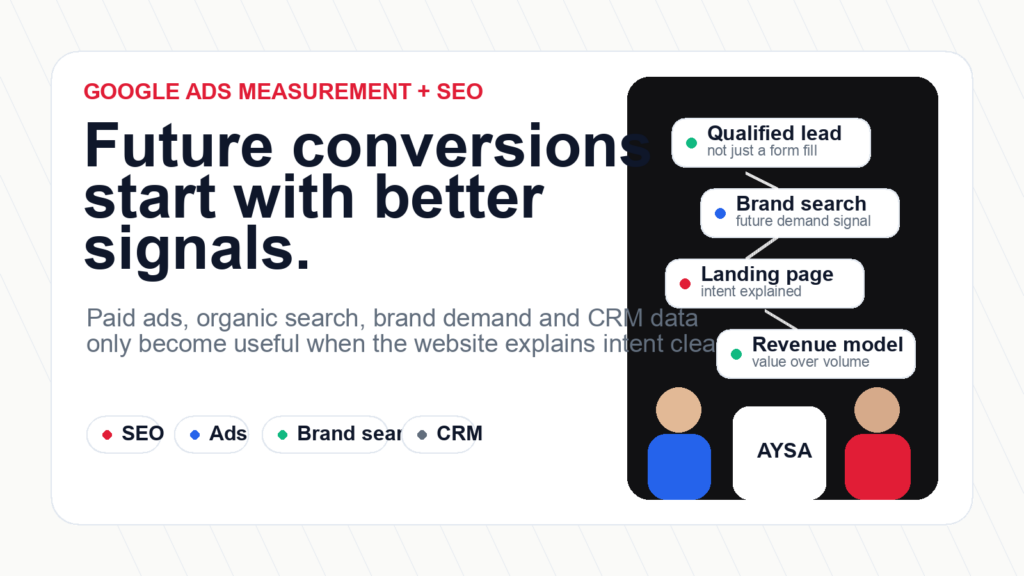
Summary: “Qualified Future Conversions” is being discussed after Google Marketing Live 2026 as a new way to connect today’s upper-funnel marketing activity with future business outcomes, using signals such as brand searches and predictive measurement. Even if the phrase sounds like paid media language, the strategic lesson is deeply connected to SEO: the future customer often starts before the conversion, before the form, before the checkout and sometimes before the brand search.
For SMEs, the real question is not “Ads or SEO?” The question is whether the business is building enough useful demand, trustworthy pages, clear content, strong landing pages, clean measurement and approval-ready execution to help both paid and organic systems understand what a valuable future customer looks like.
Future conversions start with better signals.
First, the name: “Quality” or “Qualified” Future Conversions?
The phrase the user asked about was “Quality Future Conversions.” The term appearing in several Google Marketing Live 2026 recaps is Qualified Future Conversions. That distinction matters because “quality” is a broad marketing aspiration, while “qualified” points toward a more specific measurement problem: not all conversions, leads or assisted interactions are equally valuable.
Industry coverage of Google Marketing Live 2026 described Qualified Future Conversions as a predictive measurement signal intended to connect upper-funnel investment with future sales, including signals such as branded searches. Google’s own official measurement messaging around the event focused on a broader and safer foundation: stronger first-party data, causal experiments, Meridian GeoX, Marketing Mix Modeling, upgraded tagging and a more unified view of growth.
That is how I would explain it to a business owner: Google is not only asking advertisers to track “someone filled a form.” It is pushing the market toward better data about what kind of attention, query, visit, lead, sale or repeat customer is actually valuable over time.
This is why the subject belongs on an SEO website, not only inside a Google Ads dashboard. SEO creates future demand. SEO shapes brand searches. SEO improves landing pages. SEO builds the content and authority that make a visitor trust a business before they ever become a measurable conversion. If Google’s ad systems increasingly care about future value, the organic layer becomes part of the measurement layer.
Why this is an SEO topic, not just an ads topic
Paid media people often think in campaigns. SEO people often think in pages. Business owners think in revenue, phone calls, appointments, purchases, subscriptions and repeat customers. Qualified future conversion thinking forces those worlds to meet.
Consider a private clinic, a florist, a car rental company near an airport, a hotel, a SaaS product or a B2B agency. The visitor may not convert the first time. They may search a broad question, read a guide, compare options, come back through a brand query, click an ad, ask ChatGPT, check Google Maps, read reviews, and only then book or buy. If your measurement system only credits the final paid click, it underestimates the organic work that created trust. If your SEO strategy only celebrates traffic, it ignores whether that traffic became a qualified commercial opportunity.
Google’s official Attribution documentation makes a related point in paid media terms: last-click measurement ignores earlier interactions, while data-driven attribution uses account data to estimate contribution across the conversion path. That idea is not new, but AI makes it more urgent. The journey is getting longer, messier and more assisted by models, agents and recommendation systems.
SEO is therefore no longer only about “rankings.” It is also about producing the website signals that help people and machines understand:
- what the business does;
- who it serves;
- why it is credible;
- what a good customer looks like;
- which pages are commercial, informational or support-oriented;
- which topics create future demand;
- which content assists brand searches, direct visits and paid conversions later.
That is the bridge between SEO and Qualified Future Conversions. The conversion may be reported in Google Ads, but the signal may have been created by organic content, brand visibility, reviews, technical quality, Internal linking and page usefulness.
The official measurement direction from Google
Google’s May 2026 measurement article for Google Marketing Live says the AI era requires better data connections and clearer understanding of what drives growth. The article frames measurement as the foundation for growth and highlights data strength, causal signals and better investment decisions across the media mix.
Several details are important for SMEs:
- Data strength: Google wants advertisers to connect cleaner data sources, improve tagging and reduce fragmented measurement.
- Enhanced conversions: Google Ads can use hashed first-party customer data to improve conversion measurement in a privacy-safe way.
- Attribution: Google’s data-driven attribution model distributes conversion credit based on account data instead of giving everything to the last click.
- Value-based bidding: Google Ads can optimize toward conversion value, not only conversion count, when a business supplies meaningful values.
- Meridian and GeoX: Google is investing in marketing mix modeling and causal experimentation to understand what media actually drives incremental outcomes.
None of those ideas work well if the business sends poor signals. A lead form submitted by a student, a competitor, a spam bot, a price-only buyer and a high-value customer may all look like “one conversion” unless the business closes the loop. A phone call that becomes a sale, a booking that cancels, a newsletter signup that later buys, a Branded Search after a YouTube impression, and an organic visit after an AI answer all need better context.
This is where many SMEs struggle. They install Google Analytics, Google Tag Manager, Meta Pixel, maybe a call tracking tool, maybe a CRM, maybe WooCommerce events, then assume the system understands the business. It usually does not. The machine can optimize only toward the signals it receives.
More leads, lower cost.
Success is measured by surface conversions: form fills, Clicks, calls and campaign-level CPA. SEO is treated as a separate traffic channel.
More valuable future customers.
Success connects SEO demand, brand search, landing-page quality, paid reach, CRM outcomes and future revenue signals.
Why landing pages and SEO content become signal infrastructure
A paid campaign can bring a visitor to a page, but the page has to do the trust work. It has to explain the offer, answer objections, show proof, match Search intent, load quickly, work on mobile, make the next step clear and avoid confusing the user. That is SEO work as much as CRO work.
When landing pages are thin, generic or disconnected from the buyer journey, campaigns may still spend money, but the data becomes noisy. The system learns from weak interactions. If a campaign sends users to a page that does not answer the question, the Conversion rate drops. If it uses a form that captures unqualified leads, the algorithm may learn to find more of the wrong people. If the business optimizes for cheap leads instead of profitable customers, automation becomes dangerous.
In my opinion, this is one of the biggest mistakes in SME marketing: treating SEO pages and ads pages as separate worlds. The best page for the business is often the page that helps both systems:
- it ranks or becomes discoverable for relevant organic demand;
- it supports AI answers by being clear, factual and useful;
- it gives Google Ads a stronger landing page experience;
- it helps users qualify themselves before contacting the business;
- it gives tracking systems cleaner events and intent signals.
We made a similar argument in Why Ecommerce SEO Traffic Does Not Convert: traffic is not the victory. Useful, trust-building, purchase-oriented journeys are the victory.
A practical SME playbook for better future conversion signals
You do not need an enterprise analytics department to act on this. You do need discipline. For a small or medium business, the goal is to create a simple measurement and SEO operating system that can answer: what work creates valuable customers over time?
Here is a practical playbook.
1. Define what a qualified customer means
Do not let every conversion have the same value. A car rental lead for a three-day airport booking is not the same as a student asking for “best price.” A private clinic appointment request is not the same as a generic newsletter signup. An ecommerce repeat customer is not the same as a one-time low-margin purchase.
Define qualification in business language first:
- qualified lead;
- booked appointment;
- completed purchase;
- high-margin order;
- repeat purchase;
- phone call longer than a meaningful threshold;
- quote request with real budget/location/service fit;
- brand search followed by conversion later.
Then map those definitions into tracking, CRM fields, offline conversion imports or internal reporting. If you cannot measure all of it today, start with the top two or three outcomes that matter.
2. Fix the website pages that create noisy leads
Many businesses blame ads when the page is the problem. A weak page attracts low-intent users, fails to qualify, hides prices, misses location details, lacks proof, has unclear service descriptions or loads slowly. Google Ads may be the channel that exposes the weakness, but the weakness sits inside the website.
SEO can help by improving the page around intent. For example:
- add clear service scope;
- show who the offer is for and who it is not for;
- answer pricing or budget questions where possible;
- add local details for location-based services;
- include trust signals and proof;
- improve internal links to supporting pages;
- use structured data only where it matches visible content;
- remove confusing duplicate pages that compete with each other.
This is not “SEO copy.” This is business clarity.
3. Connect organic demand to paid measurement
Paid teams often undercount SEO because SEO does not appear as the final click. SEO teams often overclaim because they ignore paid amplification. The practical answer is to watch the overlap.
Track branded search demand, organic landing pages, assisted journeys, paid landing pages, AI visibility, product/service pages and CRM outcomes together. When a campaign creates awareness, branded search may rise later. When SEO content builds trust, paid remarketing or brand search may convert better. When AI answers mention a brand, direct and branded traffic may move in ways classic attribution does not fully explain.
Google’s Meridian documentation explicitly mentions controlling for organic demand using search query volume data in MMM. That is a big signal about where measurement is going: organic search demand is not background noise. It is part of the model.
4. Use enhanced conversions and value-based bidding carefully
Enhanced conversions and value-based bidding are not magic buttons. Google explains that enhanced conversions supplement existing conversion tracking with hashed first-party data. Google also explains that Maximize conversion value bidding works best when the advertiser defines meaningful values and has conversion tracking set up properly.
For SMEs, that means setup quality matters. If the business sends the wrong values, duplicates conversions, tracks micro-actions as primary goals or fails to import offline outcomes, the algorithm optimizes toward a distorted version of success.
The key question is simple: are you teaching the system what a good customer looks like, or only what an easy click looks like?
5. Build content that creates future qualified demand
Some pages convert now. Other pages create the future conversion. A guide, comparison page, case study, glossary definition, FAQ, local guide or product education article may not convert immediately, but it can shape the decision, create trust and trigger branded searches later.
This matters even more in AI search. Users may ask longer questions, compare options inside AI Mode, get advice from answer engines and only later visit a website. If your content is not clear, useful and retrievable, you may disappear from the research stage before the paid click ever happens.
That is why we connect this article to our recent piece on Google Pomelli and Marketing Live 2026: AI is moving into creative, campaigns, shopping, measurement and search journeys at the same time. Businesses that treat content, SEO and ads as disconnected departments will move slower.
What this changes for SEO teams and agencies
Qualified future conversion thinking also changes the way SEO work should be sold and judged. The old report format usually says: rankings improved, impressions increased, traffic went up, technical issues were fixed. Those are useful signals, but they are not the business outcome. A CEO or founder eventually asks a harder question: did this work create more valuable customers?
That question is uncomfortable because SEO often creates value indirectly. A strong guide may influence a buyer who later searches the brand. A local landing page may make the phone call more qualified. A technical cleanup may make a large set of pages crawlable, which later improves paid landing-page performance because the site becomes faster and clearer. A comparison article may reduce wasted sales conversations by explaining who the product is not for. None of this fits neatly into “position 3 for keyword X.”
In my opinion, the next generation of SEO reporting has to include four layers:
- Visibility: rankings, impressions, AI mentions, answer-engine presence and branded search demand.
- Quality: pages that answer the right intent, reduce confusion and attract better-fit users.
- Execution: what changed on the website, when it changed and whether the business approved it.
- Commercial signal: qualified leads, booked calls, revenue, assisted conversions, repeat purchases and CRM outcomes.
This does not mean every SEO consultant must become a media mix modeling expert. It means SEO work should stop pretending that traffic is the end of the story. If Google Ads, GA4, CRM data and AI visibility are all moving toward better signal quality, SEO has to participate in that conversation. Otherwise SEO becomes a content factory disconnected from revenue.
How organic search can influence future paid performance
There are several practical ways organic search can improve paid performance over time. First, strong SEO pages increase brand familiarity. A user who reads a helpful guide may not buy today, but when they later see an ad, the brand is less cold. Second, organic pages can reveal intent patterns that paid teams should test: repeated Search Console queries, high-impression pages with weak CTR, questions from AI search and comparison topics can all become ad copy, landing-page improvements or new campaign structure.
Third, SEO can reduce wasted paid spend. If a business has a useful page that explains price, service area, eligibility, delivery rules, appointment conditions or product fit, the wrong users self-filter earlier. That can reduce low-quality form fills and sales conversations. Fourth, SEO can improve the landing pages used by paid campaigns. Faster pages, clearer headings, better internal links, visible proof, FAQ sections and stronger content hierarchy all help users decide.
The point is not that SEO replaces ads. The point is that future conversion quality is a system problem. Ads buy attention. SEO organizes demand. Content qualifies intent. Technical SEO makes the site accessible. Measurement connects the result back to business value. When one layer is weak, the whole system learns from weaker data.
The risks: when automation optimizes the wrong future
The danger of predictive measurement is not that it exists. The danger is that businesses may trust it without improving the inputs. If a system predicts future conversions based on weak signals, it can become confidently wrong.
Common risks include:
- Lead inflation: campaigns generate many form fills but few real sales.
- Brand confusion: users search the brand after seeing ads, but the website does not clarify the offer.
- Bad page experience: slow pages, unclear CTAs and thin content reduce both SEO and paid performance.
- Wrong event hierarchy: micro-conversions become primary goals and distort bidding.
- Missing offline data: the system cannot distinguish a high-quality lead from a dead lead.
- Channel silos: SEO, ads, CRM and analytics teams optimize different versions of reality.
This is why I do not see Qualified Future Conversions as a reason to abandon SEO. I see it as another argument that SEO must become more operational. The website has to produce better signals continuously: better content, better internal links, better technical health, better entity clarity, better landing pages and better approval workflows.
Where AYSA fits: from signal chaos to approved execution
AYSA was built because most SMEs do not fail at SEO because they lack tools. They fail because recommendations are hard to prioritize and execute consistently. The same is true for measurement. A business can have Google Ads, GA4, Search Console, Tag Manager, Meta Pixel and a CRM, but still not know what to do next.
Our point of view is simple: the future of marketing belongs to businesses that can turn signals into approved actions. If ads data shows weak conversion quality, the answer may be SEO page work. If Search Console shows impressions without clicks, the answer may be title, intent and snippet work. If AI visibility is weak, the answer may be clearer entity content and stronger topical coverage. If leads are unqualified, the answer may be better page qualification, pricing clarity, location detail or service structure.
AYSA can help monitor the website, detect SEO, AEO and AI visibility opportunities, prepare approval-ready improvements and execute accepted changes inside the website workflow. That does not replace Google Ads. It strengthens the environment in which Google Ads operates.
In practice, this means AYSA can help with:
- finding pages that bring traffic but not qualified intent;
- improving landing pages for clearer commercial value;
- mapping content to buyer questions and future demand;
- monitoring branded and non-branded visibility;
- preparing SEO/AEO-friendly content that supports paid campaigns;
- fixing technical issues that hurt page experience and crawlability;
- connecting organic visibility work to business outcomes.
Qualified Future Conversions may be an ads measurement concept. But the real business lesson is broader: future customers are created by the whole system. Ads can accelerate demand. SEO can create and organize demand. Content can qualify demand. Measurement can reveal which demand matters. The businesses that win will be the ones that make those layers work together.
Tired of paying for leads that do not turn into real customers?
AYSA helps SMEs improve the website layer behind SEO, AI visibility and paid performance: clearer pages, better intent, stronger internal links and approved execution inside the website workflow.
Sources and further reading
- Google: Turn your data into decisions for growth in the AI era
- Google Ads Help: About enhanced conversions
- Google Ads Help: About attribution models
- Google Ads Help: About Maximize conversion value bidding
- Google for Developers: Meridian Marketing Mix Models
- Google: Marketing Live 2026 updates
- Invoca recap mentioning Attributed Branded Searches and Qualified Future Conversions
- AYSA: Google Pomelli and Marketing Live 2026
- AYSA: Why ecommerce SEO traffic does not convert
Continue the AI search topic inside AYSA.
Use these pages to connect the article with AI SEO tools, AI visibility monitoring, AI Overviews and approved website execution.
Turn this topic into a website action plan.
Use these AYSA hubs to move from reading to technical fixes, AI visibility monitoring, research, glossary context and approval-first SEO execution.

