Why Ecommerce SEO Traffic Does Not Convert: Rankings, Trust and Buying Intent
Most online stores do not need more random SEO traffic. They need pages that match buying intent, reduce trust friction and turn organic visits into revenue.
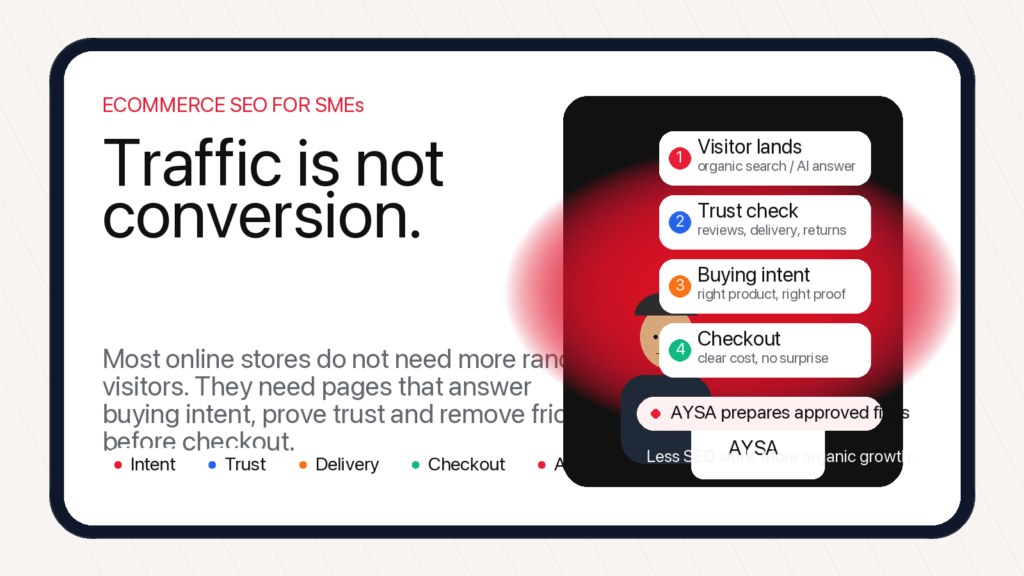
Executive summary: Ecommerce SEO traffic does not automatically become revenue. In many online stores, the real problem is not visibility. The real problem is the gap between ranking, buying intent, trust, product clarity, delivery anxiety, returns, reviews, mobile experience and checkout friction. A visitor may arrive from Google, an AI answer, a product comparison or a Category page and still leave because the page does not help them decide.
My view is direct: the next phase of ecommerce SEO is not “publish more content and wait.” It is buying-intent execution. Search traffic must land on pages that answer objections, prove trust, explain availability, show delivery and return conditions, structure product data correctly, and make the next step obvious. AYSA fits this shift because it is designed to monitor the website, identify missing buying signals, prepare approved changes and help execute them inside the website workflow.
The uncomfortable truth: traffic is not the same as demand
Every ecommerce owner has seen the same pattern. Organic traffic grows, Impressions look better, rankings improve for a few keywords, but revenue does not move enough. The agency says the SEO trend is positive. The dashboard shows visibility. The store owner opens the bank account and sees a different reality.
This is not always the agency’s fault, and it is not always the store owner’s fault. Ecommerce has become harder. Search journeys are fragmented across Google, AI Overviews, ChatGPT, TikTok, marketplaces, comparison sites, review platforms, price aggregators and social proof. Users do not move in a straight line from query to product to checkout. They compare. They hesitate. They ask AI systems to summarize options. They check delivery. They read reviews. They look for return policies. They abandon carts because a small doubt becomes bigger than the desire to buy.
That is why I do not like the old question: “How do we get more SEO traffic?” A better question is: what kind of organic visitor is arriving, what decision are they trying to make, and what stops them from buying?
An online store can rank for informational keywords and still fail commercially. It can get impressions for products it does not explain well. It can have category pages that list products but do not guide choice. It can have blog posts that attract readers who are not ready to buy. It can have product pages with weak images, no review context, unclear stock, hidden delivery cost, thin descriptions and a checkout that creates anxiety at the worst possible moment.
In classic SEO, the win was often framed as visibility. In modern ecommerce SEO, visibility is only the opening move. The deeper win is to connect visibility with buying intent, trust and execution. That is where many stores leak value.
Old ecommerce SEO lens
Rank category pages, publish more articles, track Clicks and hope the store converts the visitors.
- Traffic-first planning
- Keyword lists without page intent
- Thin product and category content
- Conversion problems left to “the website”
Execution lens
Match the page to the decision, answer objections, show proof, improve technical clarity and execute approved changes.
- Buying intent mapped to pages
- Trust and delivery questions answered
- Structured product data and feeds
- Continuous improvement after approval
What the data tells us: shoppers leave more often than they buy
It is tempting to say “99% of visitors do not buy.” Sometimes that is true for a store, a channel or a campaign. But I would not present it as a universal ecommerce law. Conversion rates vary by industry, country, device, brand strength, price point, product type, seasonality, traffic source and funnel quality.
What is true is that ecommerce has a large natural drop-off. Baymard Institute’s long-running cart abandonment research places the average documented cart abandonment rate at around 70%. That means even shoppers who got far enough to place items in a cart often leave before purchasing. The reasons Baymard has studied over time are familiar to any store owner: extra costs, account creation, slow delivery, lack of trust, complicated checkout, unclear total cost, return concerns and payment friction.
That matters for SEO because many organic visitors are even colder than cart visitors. They may be researching, comparing, checking alternatives or trying to understand which product fits their situation. If the page only says “buy this product” but does not help them decide, the store loses the visitor long before checkout.
Google’s ecommerce documentation points in the same direction from a search perspective. Google recommends that ecommerce websites make product information accessible through clear pages, structured data and, where relevant, Merchant Center feeds. Product snippets and merchant listings depend on information such as price, availability, ratings, shipping and returns. These are not decorative details. They are decision details.
OpenAI’s shopping documentation also reinforces the shift. ChatGPT shopping results can surface product information, prices, reviews and merchant details, depending on available data and sources. Whether the traffic comes from Google or from an AI assistant, the direction is obvious: machines need clean product information, and humans need confidence.
So the store owner’s problem is not “SEO did not work.” The more precise problem is: SEO brought attention, but the page did not carry enough buying context to turn attention into action.
Search intent is not the same as buying intent
Search intent is the classic SEO classification: informational, navigational, commercial, transactional, local and so on. It is useful, but it is not enough for ecommerce. Buying intent is more specific. It asks: what must this person believe, understand and feel safe about before they buy?
A query like “best running shoes for flat feet” is commercial, but the buying intent is not just “show running shoes.” The user needs comparison, fit guidance, pain context, return policy, size confidence, reviews from similar users and possibly expert advice. A query like “flower delivery Bucharest today” is transactional, but the buying intent includes same-day cutoff time, delivery zones, product freshness, payment options, customer support and trust that the bouquet will look like the photo.
For AI search, this becomes even more important. A user can ask: “I need a private pediatric clinic in Bucharest for a toddler with recurring fever, good reviews, easy parking and online booking. What should I compare?” That is not a keyword. It is a decision brief. The answer needs criteria: medical relevance, availability, reviews, location, parking, booking, emergency suitability, doctor profile and trust signals. A website that only has a generic page called “Pediatrics” is weak. A website that answers the real comparison criteria is stronger.
Ecommerce SEO must move in the same direction. Category pages should not simply list products. They should help the buyer choose. Product pages should not simply repeat manufacturer descriptions. They should reduce uncertainty. Buying guides should not be generic. They should connect product attributes with real use cases. Internal links should not be random. They should move the user from research to comparison to purchase.
Where ecommerce SEO traffic leaks before conversion
When organic visitors arrive and do not buy, the leak is usually not one single problem. It is a stack of small unresolved doubts. Here are the most common ones I see.
1. The page answers the keyword, but not the decision
A page can rank because it mentions the right words, but fail because it does not answer the real buying question. Many category pages say “we sell X” and then show a product grid. They do not explain how to choose, what matters, who each product is for, what price differences mean, what delivery limitations exist or how to avoid a wrong purchase.
This is especially damaging for products with comparison anxiety: electronics, health-related products, home improvement, flowers for specific occasions, gifts, fashion sizes, car rental, parking, insurance, B2B software and any category where the buyer fears making a bad decision.
2. Product pages are too thin
Thin product pages are still everywhere. They have a title, a price, two photos and a short description copied from the supplier. That may technically be a page, but it is not a decision asset. It does not create confidence. It does not help AI systems understand the product deeply. It does not differentiate the store.
A useful product page should answer practical questions: what is included, who it is for, what it works with, dimensions, delivery, warranty, returns, care instructions, stock, materials, compatibility, alternatives and common objections. If the product is local or service-based, add location, timing, booking, staff, process and trust signals.
3. Delivery and returns are hidden too late
Many stores hide delivery price, delivery time, return conditions and payment details until late in the checkout. This creates anxiety. Users do not like surprises at the end of the buying journey. AI assistants also need this information to compare options.
If shipping, returns, pickup, booking, warranty or cancellation rules matter, they should appear where the decision happens: category pages, product pages, comparison guides and checkout. Do not force users to hunt for operational details.
4. Reviews exist, but they are not integrated into the decision
Reviews are not only stars. They are language from real customers. They reveal objections, use cases and trust signals. Many stores collect reviews but do not use them well. They show a rating widget but do not summarize what buyers praise, what concerns appear and how the store responds.
For SEO and AI visibility, reviews can also strengthen entity context. They help connect the brand with products, locations, service quality and customer experience. But the review layer must be authentic, visible and useful, not manipulated.
5. Category pages are treated like inventory, not guidance
Category pages are often the highest SEO opportunity in ecommerce, yet many are just product grids. A strong category page should explain the category, recommend subcategories, answer common buying questions, expose filters that make sense, link to related guides and help users choose without leaving the page.
This does not mean adding 2,000 words of SEO text below the products. That old pattern is often useless. The content must be placed where it helps: short introductory guidance, comparison modules, FAQs, buying criteria, related internal links and product grouping that supports decision-making.
6. Technical friction damages trust and crawling
Slow pages, layout shifts, broken filters, duplicate URLs, bad canonical tags, poor mobile usability, messy pagination, broken internal links and missing structured data do not only hurt rankings. They also hurt the experience. A buyer who sees a slow, unstable site subconsciously trusts it less.
Technical SEO is conversion work when the technical issue affects user confidence, product discovery or checkout flow. A slow mobile product page is not just a Core Web Vitals issue. It is lost revenue.
7. Checkout solves the wrong problem
Many checkout optimizations focus only on fields and buttons. Those matter, but the bigger question is whether the user arrives at checkout with enough confidence. If delivery cost, return policy, product fit, payment trust and support are unclear before checkout, the checkout becomes a place where doubts explode.
Why AI search raises the bar for ecommerce pages
AI search changes the buyer journey because it can compare options before the user clicks. Instead of searching “best office chair” and opening ten tabs, a user can ask an assistant to compare options by budget, back pain, return policy, delivery time and reviews. The assistant may summarize the market, mention brands and cite sources. If your website does not provide the right facts, it may be invisible in that comparison.
Google’s AI optimization guidance does not tell site owners to abandon SEO fundamentals. It says the opposite: make sure content is crawlable, indexable, useful, clear, well-structured and aligned with Google Search essentials. This is important. AI search is not a magic layer above the web. It still depends on accessible content and source quality.
For ecommerce, the machine-readable layer matters more than ever. Product structured data, Merchant Center feeds, availability, price, shipping and returns are part of the visibility system. But the human-readable layer matters too. AI systems need content they can extract, summarize and trust. Product pages that are only image grids and vague copy are weak candidates.
The practical conclusion is simple: ecommerce websites must become easier for both humans and machines to understand. That means clean product data, useful content, strong internal linking, visible trust signals, technical health and continuous updates.
The ecommerce page model that converts better organic traffic
If I were rebuilding an ecommerce SEO page in 2026, I would not start with keyword density. I would start with decision architecture.
First, define the buying task. What is the user trying to decide? Are they choosing a size, a service, a location, a delivery time, a product variant, a gift, a subscription or a provider?
Second, map the objections. What could stop the purchase? Price, trust, delivery, return policy, compatibility, quality, support, reviews, payment, availability or unclear process?
Third, build the proof layer. Use reviews, real photos, delivery guarantees, expert notes, comparison tables, brand story, warranty, customer support and third-party references where appropriate.
Fourth, structure the page for extraction. Use clear headings, concise answers, bullet lists, product attributes, comparison blocks, visible FAQs and schema that matches the visible content.
Fifth, connect related pages. Link category pages to buying guides, product pages to alternatives, articles to categories, glossary terms to explanations and support pages to checkout questions.
Sixth, monitor and improve continuously. Organic search is not a one-time project. AI search, Google updates, competitor pages, product inventory and customer expectations change. The page must evolve.
The page answers the real decision, not only the keyword.
Query to page fit
Reviews, policies, support, author or brand signals reduce doubt.
Confidence layer
Delivery, returns, stock, booking and total cost are visible early.
Friction reduction
Structured data, feeds, headings and internal links make the page extractable.
AI/search readiness
Where AYSA fits: from SEO traffic to approved buying-intent execution
This is where AYSA’s operating model becomes useful. A normal SEO tool can show rankings, impressions, audits and alerts. That is valuable, but it often stops before execution. The owner still needs to decide what to fix, write the copy, update pages, adjust internal links, check structured data, improve category guidance and track whether the change helped.
AYSA is designed around a different workflow: monitor, prepare, approve, execute. For ecommerce, that means the agent can identify pages with impressions but weak CTR, products with thin descriptions, categories without buying guidance, missing internal links, technical issues, schema opportunities, delivery or return information gaps, and content opportunities that support topical authority.
The important part is not that AYSA says “you have a problem.” Many tools do that. The important part is that AYSA prepares the work for approval. A business owner does not need to become a technical SEO specialist. The agent can explain the issue in plain language, prepare the suggested change and ask for approval before applying it inside the website workflow.
For example, if a category page gets impressions but converts poorly, AYSA can prepare a better intro, add buying criteria, propose internal links to related guides, identify missing FAQs, suggest structured data improvements and surface authority-building opportunities. If a product page has traffic but weak buying signals, AYSA can prepare a richer product explanation, clarify delivery/returns, add comparison language and connect it to related pages.
In my opinion, this is the future of ecommerce SEO for SMEs. The market is too dynamic for static reports and manual implementation. Store owners need systems that learn the business, watch the website, prepare work and keep improving execution without forcing them to live inside SEO dashboards.
A practical checklist for stores with SEO traffic but weak sales
- Separate traffic by intent. Do not judge all organic visitors together. Compare informational, category, product, local and brand traffic.
- Review top landing pages. Ask whether each page helps the buyer make a decision or only matches a keyword.
- Audit delivery, returns and payment clarity. Put critical operational details before checkout, not only inside checkout.
- Improve category pages. Add buying criteria, subcategory guidance, FAQs and useful internal links.
- Rewrite thin product pages. Add real attributes, use cases, comparisons, objections, care details, compatibility and proof.
- Use reviews as decision data. Surface authentic themes from reviews, not only star ratings.
- Fix technical friction. Prioritize mobile speed, crawlability, canonical tags, structured data, redirects and broken internal links.
- Prepare for AI search. Make product information extractable, structured, current and easy to compare.
- Track changes as execution. SEO improvements should become approved website actions, not forgotten recommendations.
Tired of organic traffic that does not turn into revenue?
AYSA helps ecommerce teams monitor search and AI visibility, prepare buying-intent improvements, request approval and execute accepted changes inside the website workflow.
Sources and further reading
- Baymard Institute: Cart Abandonment Rate Statistics
- Google Search Central: Ecommerce SEO documentation
- Google Search Central: Product structured data
- Google Search Central: AI features and your website
- OpenAI Help Center: Improved shopping results from ChatGPT Search
- AYSA: Ecommerce SEO in the AI Search Era
- AYSA: Ecommerce AI Search Citations and Product Pages
- AYSA: Thin Content Across Similar Product Pages
- AYSA: Product Feeds, ChatGPT Shopping and OpenAI Search
Continue the AI search topic inside AYSA.
Use these pages to connect the article with AI SEO tools, AI visibility monitoring, AI Overviews and approved website execution.
Turn this topic into a website action plan.
Use these AYSA hubs to move from reading to technical fixes, AI visibility monitoring, research, glossary context and approval-first SEO execution.