
Google Pomelli and Marketing Live 2026: AI Campaign Creation Is Becoming the New Default
Google Pomelli, Asset Studio, Ask Advisor and AI Mode ads point to a new marketing stack where brand data, product data, website clarity and approved execution matter more than manual campaign busywork.
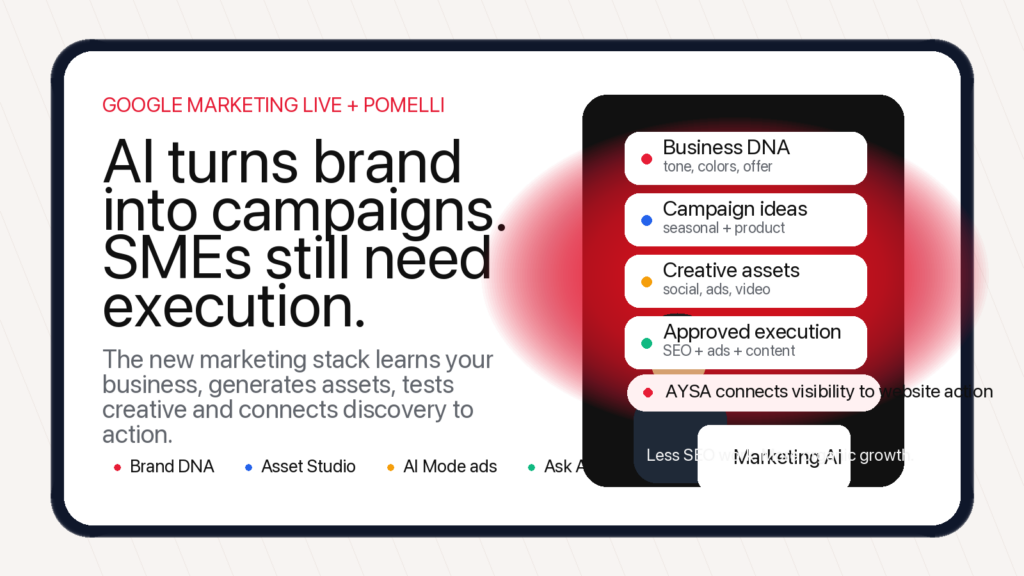
Executive summary: Google Pomelli and the Google Marketing Live 2026 announcements are not isolated AI product demos. They show the same direction from different angles: marketing is moving from manual asset production and dashboard work toward connected AI systems that understand the business, generate creative, launch campaigns, read performance data and help turn intent into action.
For SMEs, this is both good news and a warning. Good news because the cost of producing campaign ideas, product images, ad assets and performance recommendations is going down. Warning because AI tools are only as good as the business context they can read. If your website, product data, service pages, reviews, landing pages and analytics are weak, AI may simply automate weak marketing faster.
My view: the next competitive advantage will not be “using AI” in a generic way. Everybody will use AI. The advantage will be having a website and business system that AI can understand, trust, cite, recommend, advertise and improve continuously. That is where SEO, AEO, product data, brand identity, creative automation and Approved Execution start becoming one operating model.
What Pomelli is, in plain business language
Pomelli is a Google Labs experiment for creating brand-consistent marketing content with AI. Google introduced it to help small and medium-sized businesses create on-brand content. In its newer version, Google says Pomelli can help build what it calls a business identity or “Business DNA” from existing materials, uploaded product documents, product photos or a conversation with the agent. Once that brand identity is defined, Pomelli can generate brand books and even design websites in a few Clicks.
The important part is not only the interface. The important part is the workflow. Pomelli is not asking a business owner to become a designer, prompt engineer, ad strategist and brand manager at the same time. The direction is: provide the business context, let the agent understand the brand, then generate useful marketing outputs from that context.
That is a very different model from the old way many SMEs handled marketing. The old model looked like this: hire someone for copy, hire someone for design, ask someone else to resize the assets, upload them into ad platforms, wait for performance, interpret dashboards, brief another round, repeat. It works if you have time, budget and experienced people. It breaks when you are a small business owner trying to sell flowers, run a clinic, manage an ecommerce store, promote a local service or keep a hotel full while also doing operations every day.
Pomelli is interesting because Google is clearly trying to reduce that operational friction. It starts from business identity. That matters. Generic AI creative is easy to produce and easy to ignore. Brand-aware AI creative has a chance to be useful because it can preserve tone, product style, colors, positioning and campaign consistency.
But there is a hidden dependency here. A tool like Pomelli needs good inputs. If the business has poor product descriptions, weak website structure, unclear service pages, inconsistent images, vague positioning and no useful proof, the AI has less to work with. AI can generate. It cannot magically repair a business identity that is not documented anywhere.
Old campaign workflow
The owner briefs multiple people, moves assets between tools and waits for manual execution.
- Brand notes in a document
- Product photos in folders
- Copy written separately
- Campaigns launched after many handoffs
AI-assisted workflow
The business context becomes reusable input for creative, campaigns and performance learning.
- Business DNA
- Brand-consistent assets
- Campaign ideas
- Faster testing and iteration
What Google Marketing Live 2026 actually announced
Google Marketing Live 2026 was not only about one product. It was a broader picture of where Google wants ads, commerce, analytics and creative production to go in the AI era. The announcements around Pomelli, Asset Studio, Ask Advisor, AI Mode ads, Merchant Center and Universal Commerce Protocol all point in the same direction: Google wants marketing systems to become more conversational, more automated, more connected and more action-oriented.
Asset Studio becomes a creative production layer inside Google Ads
Google describes Asset Studio as a one-stop place for developing creative assets in Google Ads. The important detail is that it understands marketing briefs, brand guidelines, website context and goals, then generates assets across creative themes and asset types. Google also says marketers can refine assets using natural language, and that Gemini Omni will be integrated for video assets.
For SMEs, this changes the economics of creative testing. A small business may not be able to produce dozens of campaign variations every month with a professional creative team. If the platform can generate image, video and creative variants from a consistent brand brief, the business can test more ideas without turning every campaign into a production project.
But again, the quality of the inputs matters. A bad landing page, vague positioning and weak product data will not become strong marketing just because the asset is prettier. The creative layer is becoming easier. The strategic layer still matters.
Ask Advisor turns Google’s marketing stack into an AI collaborator
Google also introduced Ask Advisor, a cross-product AI agent designed to work across Google Ads, Google Analytics and Google Marketing Platform, with Merchant Center joining the lineup. Google’s example is simple: a marketer can ask for new customers for a product, and Ask Advisor can pull product details from Merchant Center to set up a campaign in Google Ads.
This is not just a support chatbot. It is part of a trend toward agentic marketing operations. The AI reads connected data, understands goals, recommends actions and can move work forward. That is exactly the direction SMEs need, because most business owners do not want another dashboard. They want to know what to do next and have the work done safely.
AI Mode ads turn Search into a more conversational commercial journey
Google’s announcement about new ad formats for the AI era of Search is one of the most important signals. Google says it is testing new ad experiences built with Gemini, including Conversational Discovery ads and Highlighted Answers in AI Mode. It also says AI-powered Shopping ads can use Gemini to pull relevant products and write a custom explainer about why a product may fit a user’s need.
That is a big change. Search ads were already intent-based. But AI Mode ads move closer to guided recommendations. The user is no longer only typing a short Keyword like “espresso machine.” The user may describe a need, a constraint, a lifestyle, a budget and a use case. The system then interprets that context and decides which products or services are relevant enough to explain.
For a business, that means your product or service must be understandable in richer language. Short descriptions, missing attributes, weak category pages and poor landing-page explanations become bigger problems. If the AI needs to explain why your offer fits a specific user, your website and product data must give it real material.
Universal Commerce Protocol pushes shopping closer to agentic checkout
Google’s shopping announcements also matter because they connect discovery to transaction. Google discussed Universal Cart, Universal Commerce Protocol and Agent Payments Protocol, describing a future where shoppers can check out across retailers and services like Search and Gemini, while retailers remain the merchant of record.
This matters beyond ecommerce. Google also mentioned expansion into categories such as hotel booking and local food delivery. That tells us the direction is not limited to product feeds. Search, AI Mode, Maps, commerce and booking flows are getting closer together. The websites that win will not only be “SEO optimized.” They will be structured, trusted, machine-readable and ready for transactions.
Measurement becomes the control system
Google also emphasized measurement. In its lead-up article for Marketing Live, Google argued that measurement is the foundation for growth in the AI era and announced updates around Data Manager, Google tag upgrades, Meridian GeoX and Meridian Studio. The practical message is clear: as AI automates more campaign work, businesses need cleaner data connections and better causal understanding of what is actually working.
That should sound familiar to anyone who has tried to run SEO, PPC, social and marketplace campaigns at the same time. Numbers rarely match perfectly. Attribution is messy. Organic traffic can influence paid performance. AI answers can reduce clicks but increase assisted discovery. The answer is not blind trust in a dashboard; it is better measurement governance.
The bigger signal: your website becomes the source of truth for AI marketing
The common thread across Pomelli, Asset Studio, Ask Advisor, AI Mode ads, Merchant Center AI insights and Universal Commerce Protocol is this: AI needs a reliable business representation. It needs to know who you are, what you sell, what makes you different, which products or services matter, which claims are safe, what users ask, how you measure results and what actions are allowed.
For years, many businesses treated the website as a brochure. Then they treated it as a lead-generation asset. Then ecommerce teams treated it as a catalog. In the AI era, the website becomes something more important: a structured operating layer that teaches machines what the business is and how it should be represented.
This is why SEO, AEO and creative AI are no longer separate conversations. A page that is clear for Google Search is also more useful for AI Mode. A product description that is rich enough for conversational shopping can also improve product feed quality. A service page that explains process, pricing, location, proof and FAQs can support organic search, AI answers, lead agents and paid campaign explainers. A strong internal linking structure helps both crawlers and AI systems understand relationships.
In other words, the future is not “ads versus SEO” or “AI versus content.” The future is a connected business context. The business that documents itself clearly will have more surfaces where AI can understand it. The business that stays vague will pay more for weaker automation.
What this means for SMEs
For small and medium-sized businesses, the biggest mistake is to see Pomelli and Google Marketing Live as “cool AI tools for ads.” They are more than that. They are a preview of how marketing work will be compressed. Tasks that used to require several specialists will increasingly be handled by connected AI systems. That does not mean strategy disappears. It means weak strategy becomes more visible.
1. Creative bottlenecks will shrink
SMEs often struggle to produce enough high-quality creative. They reuse the same banners, product images, headlines and landing-page angles for too long. Tools like Pomelli and Asset Studio can help generate more variations, test ideas faster and keep assets closer to the brand. This is especially valuable for ecommerce, local services, clinics, hotels, restaurants, florists, car rental businesses and niche B2B companies.
2. Website quality will matter more, not less
The more AI reads your website, the more your website needs to be clear. If a business wants AI-powered Shopping ads or AI Mode explainers to present its offer correctly, the source material must be strong. That includes product names, product attributes, category descriptions, service descriptions, reviews, location pages, FAQs, structured data and landing-page proof.
3. Business owners will still need control
AI can generate campaigns, but not every campaign should be launched. AI can write product descriptions, but not every description is accurate. AI can suggest offers, but not every offer makes margin sense. The future is not blind autopilot. The future is controlled automation: the system prepares work, explains the reasoning, asks for approval and executes accepted changes.
4. “Good enough” content will become expensive
Generic content used to be a waste of time. In the AI era it can become a direct performance problem. If your content is vague, AI may not understand your positioning. If your product data is shallow, AI may not recommend you. If your service page lacks practical details, AI may choose a competitor with clearer information. The cost of weak content is no longer only lower rankings; it can be lower eligibility across AI surfaces.
5. Measurement must include organic, paid and AI visibility together
A user may discover a product through AI Mode, compare it in Search, see a Shopping ad, visit the website, return through organic search and convert later. If measurement is fragmented, the business may make bad decisions. Google’s emphasis on data strength and measurement reflects this reality. SMEs do not need enterprise-level measurement complexity, but they do need clean tracking, consistent events and a habit of asking what actually produced revenue.
The risks: what AI marketing tools will not fix by themselves
There is a lot to like in the new Google direction, but business owners should not romanticize it. AI tools can speed up marketing, but speed without quality can hurt. The easiest thing in the world is to generate more mediocre assets. The hard thing is to build an operating model where the AI works from trustworthy business context.
The first risk is brand flattening. If every business uses the same AI tools with shallow prompts, many campaigns will start looking and sounding the same. SMEs need to document their real difference: founder story, customer pain, local knowledge, product quality, delivery model, service process, reviews, guarantees, pricing logic, constraints and proof.
The second risk is wrong claims. AI can generate confident language that sounds good but is not accurate. A clinic cannot make medical claims casually. A financial service cannot invent outcomes. An ecommerce store cannot promise delivery times it cannot meet. A hotel cannot imply amenities it does not have. Approval workflows matter.
The third risk is wasted spend. Better creative does not automatically mean better economics. If tracking is broken, campaigns can look better than they are. If the landing page is weak, paid clicks still fail. If SEO demand is misunderstood, paid campaigns may chase the wrong intent. AI can optimize within the wrong strategy.
The fourth risk is dependency on platform outputs. Google’s tools can help, but a business should not let any one platform become the only source of brand knowledge. Your website, content, analytics, first-party data, product data and authority signals should remain under your control. Platforms can amplify your business context, but you should own the context.
Where AYSA fits in this new AI marketing stack
AYSA is not an ad creative generator like Pomelli or Asset Studio. AYSA’s role is different: it helps prepare the website and SEO/AEO execution layer that AI marketing increasingly depends on. If Google’s direction is “AI can build campaigns from your brand, website, product data and goals,” then the obvious question is: who keeps the website and business context strong enough for that AI to use?
That is the gap AYSA is built around. AYSA learns the business, monitors SEO, AEO and AI visibility opportunities, prepares website improvements, asks for approval and executes accepted changes inside the website workflow. It is not only about showing reports. It is about moving from research to approved execution.
For example, before a business runs AI-powered campaign assets, AYSA can help improve the landing pages those campaigns point to. It can detect pages that receive impressions but do not answer the query well. It can prepare better titles, descriptions, internal links, FAQs and content sections. It can identify technical issues that reduce crawlability or indexability. It can surface authority-building opportunities when the brand needs stronger external trust. It can help make product and service pages more answer-ready for AI search.
That matters because the new marketing stack is becoming circular. Search behavior informs content. Content informs AI answers. AI answers shape paid opportunities. Paid campaigns generate data. Data informs website improvements. Website improvements improve both organic and paid performance. Manual execution cannot keep up with that loop for most SMEs.
In my opinion, the winner will not be the business with the most tools. The winner will be the business with the best execution loop: monitor, prepare, approve, execute, measure, improve. Pomelli and Google’s AI marketing announcements show the creative and advertising side of that loop. AYSA focuses on the website and search execution side.
A practical checklist for SMEs after Pomelli and Google Marketing Live
If you run a small or medium-sized business, do not start by asking, “Which AI tool should I try?” Start by asking, “Is my business easy for AI systems to understand and represent correctly?” Use this checklist.
- Clarify your business identity. Document what you sell, who you serve, what makes you different, your tone of voice, your locations, your proof and your constraints.
- Improve key landing pages. Make service, product, category and location pages specific, useful and comparison-ready.
- Clean your product or service data. For ecommerce, review product titles, attributes, descriptions, images, availability and categories. For services, review service scope, pricing guidance, process, reviews and booking details.
- Make content answer-ready. Add practical sections, examples, criteria, FAQs and internal links where they genuinely help users.
- Fix technical blockers. Improve crawlability, indexability, speed, canonical tags, redirects, mobile rendering and structured data where appropriate.
- Strengthen authority. Build relevant publisher mentions, reviews, local citations, partner references and customer proof.
- Connect measurement. Make sure Google Analytics, Google Ads, Merchant Center and important website events are configured correctly.
- Use approval workflows. Let AI prepare work, but keep business control over claims, offers, publishing and spend.
- Measure across organic, paid and AI search. Do not treat channels as isolated boxes. Users move between them.
Pomelli is a strong signal that AI can make campaign creation easier. Google Marketing Live 2026 is a stronger signal that the entire marketing workflow is becoming more agentic. But the foundation remains business clarity. The machine cannot represent what the business has not made clear.
Tired of turning SEO, content and campaign ideas into another manual to-do list?
Make your website ready for AI-driven marketing.
AYSA monitors your website, prepares SEO, AEO and AI visibility actions, asks for approval and executes accepted changes inside your website workflow, so your business context becomes easier for search engines, AI systems and campaign tools to understand.
Sources
- Google Labs: Pomelli
- Google: New AI capabilities are now available in Pomelli
- Google Ads & Commerce: Asset Studio brings new multimodal capabilities to Google Ads
- Google Ads & Commerce: Meet Ask Advisor, your new AI-powered collaborator
- Google Ads & Commerce: A new generation of ads for the AI era of Search
- Google Shopping: UCP features and AI tools for retailers
- Google Ads & Commerce: Turn your data into decisions
- AYSA: How Google AI Mode Expands Queries Beyond Keywords
- AYSA: Ecommerce SEO in the AI Search Era
- AYSA: Google Universal Cart, UCP and AP2
Continue the AI search topic inside AYSA.
Use these pages to connect the article with AI SEO tools, AI visibility monitoring, AI Overviews and approved website execution.
Turn this topic into a website action plan.
Use these AYSA hubs to move from reading to technical fixes, AI visibility monitoring, research, glossary context and approval-first SEO execution.

