
Agentic Commerce SEO: How UCP Changes Ecommerce Visibility, Trust and Execution
A practical AYSA analysis of agentic commerce SEO: Google UCP, Merchant Center, product data, trust signals and what ecommerce SMEs should prepare next.
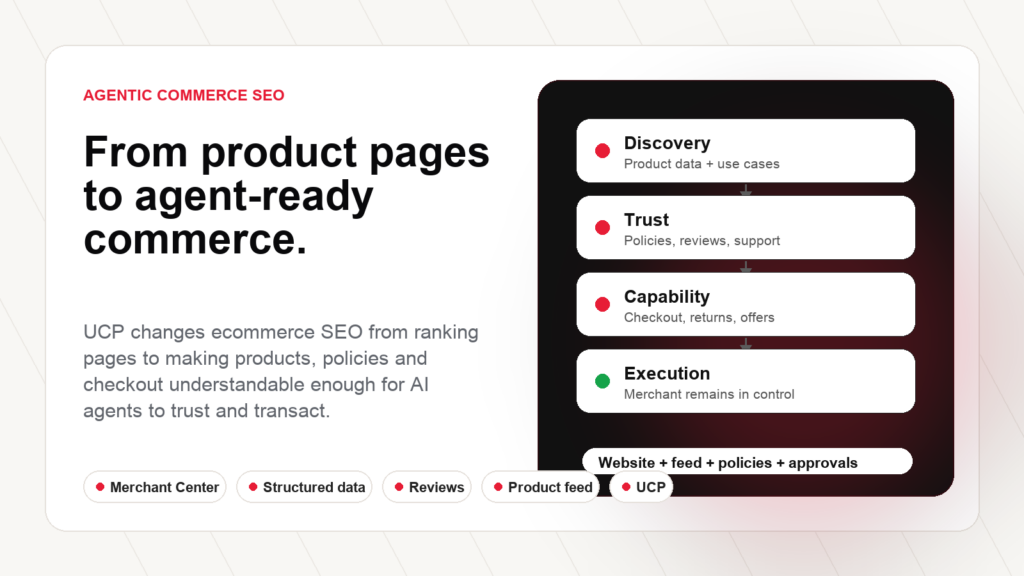
Executive summary: Agentic commerce changes Ecommerce SEO from “rank this product page” to “make this business, product, policy and checkout flow understandable enough for AI agents to trust, recommend and complete a task.” Google’s Universal Commerce Protocol, AI Mode shopping flows and the wider rise of agentic buying mean ecommerce visibility will increasingly depend on product data quality, merchant trust, structured information, feed accuracy, review proof, policy clarity and execution speed.
This article builds on Aleyda Solis’ analysis of UCP and agentic commerce SEO, Google’s developer documentation on the Universal Commerce Protocol, Merchant Center foundations and Google’s AI Optimization guidance. The AYSA perspective is direct: ecommerce SEO can no longer live only in articles, category pages and title tags. It must become an operational system that keeps product, content, technical and trust data ready for humans, search engines and AI agents.
What agentic commerce means
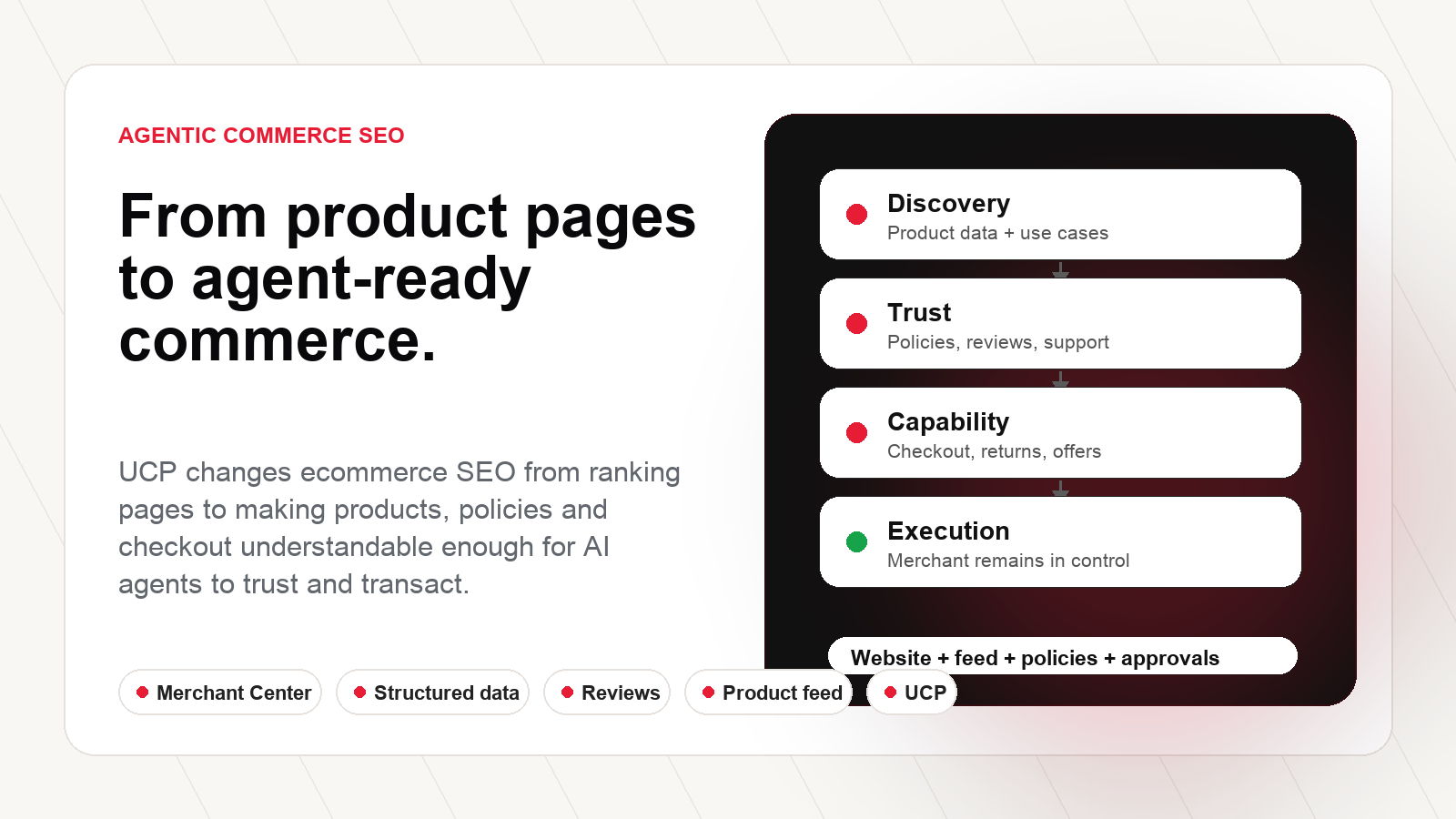
Agentic commerce is the next step after search, recommendations and comparison shopping. Instead of a user manually opening ten tabs, reading product pages, checking return policies and filling forms, an AI assistant may increasingly help interpret the need, compare options, filter products, evaluate trust, ask follow-up questions and eventually initiate a transaction or checkout flow.
This does not mean the website disappears. It means the website has to become readable by more than a human visitor. It must expose accurate product data, clear policies, inventory, pricing, shipping, return rules, support details, reviews, structured content and trust signals in ways that search engines and AI systems can understand.
For ecommerce SEO, this is a major change. Traditional ecommerce SEO focused on category pages, product pages, internal links, filters, canonical rules, schema, speed, content and backlinks. Those remain important. But the agentic layer adds another question: can an AI assistant understand enough about the merchant and product to recommend it confidently and help complete the action?
That question is not theoretical. Google has already been moving search toward more task-completion surfaces: product grids, shopping results, merchant panels, AI Overviews, AI Mode and checkout-related experiments. As we wrote in our article on agent-ready websites and UCP, the direction is clear: websites must be ready for agents, not only crawlers.
Why UCP matters
Google’s Universal Commerce Protocol is designed to help merchants and agents interact more safely and consistently during commerce tasks. The developer announcement describes UCP as an open protocol that can standardize how agents and merchants communicate around shopping actions. In plain language, this is about making commerce actions less improvised and more structured.
For SEO people, UCP matters because it shows where discovery is heading. The agent does not only need a product title and a Meta description. It needs to understand capabilities: Can this merchant sell this product? Is it in stock? Can it ship here? What is the return policy? What payment or checkout path exists? What happens after purchase? Is the merchant legitimate? Can the agent safely help the user move forward?
Aleyda Solis frames this as a new SEO layer: commerce visibility will depend on how well the merchant communicates data, availability, policies and trust signals to search and agentic systems. That is a useful framing because it moves the discussion beyond “AI will steal traffic.” The more practical question is: will your store be eligible, understandable and trustworthy enough to be included in these new journeys?
UCP does not replace Merchant Center, product feeds, Structured data or classic SEO. It sits in the same strategic direction: cleaner product data, better merchant information and more machine-readable commerce infrastructure.
The SEO shift for ecommerce
The old ecommerce SEO model often worked like this: identify keywords, optimize category pages, add Product schema, fix canonical issues, improve speed, build links, write guides and measure rankings. That is still a valid foundation. But agentic commerce requires a broader operating model.
The first shift is from page optimization to product ecosystem optimization. A product is no longer only a URL. It is a set of attributes, images, availability, price, reviews, delivery rules, return rules, category relationships, comparison criteria and support information.
The second shift is from ranking to recommendation readiness. Ranking shows whether a page can appear. Recommendation readiness asks whether an AI system has enough confidence to mention, compare or suggest the product. This includes the clarity of the product data, the authority of the store, the quality of reviews, the transparency of policies and the consistency of information across the web.
The third shift is from static content to continuous maintenance. Product feeds break. Prices change. Stock changes. Pages go out of date. Reviews accumulate. Shipping rules change. Google updates shopping experiences. AI answers change. A store that treats SEO as a quarterly audit will be too slow.
The fourth shift is from traffic-only measurement to task outcome measurement. A user may research inside AI Mode, compare products in Google, visit the store later, search the brand directly or complete a checkout through a future agentic flow. Ecommerce teams need to track rankings, clicks and revenue, but also product visibility, feed quality, merchant trust, AI presence, conversion path friction and approved execution.
Merchant readiness: the new competitive layer
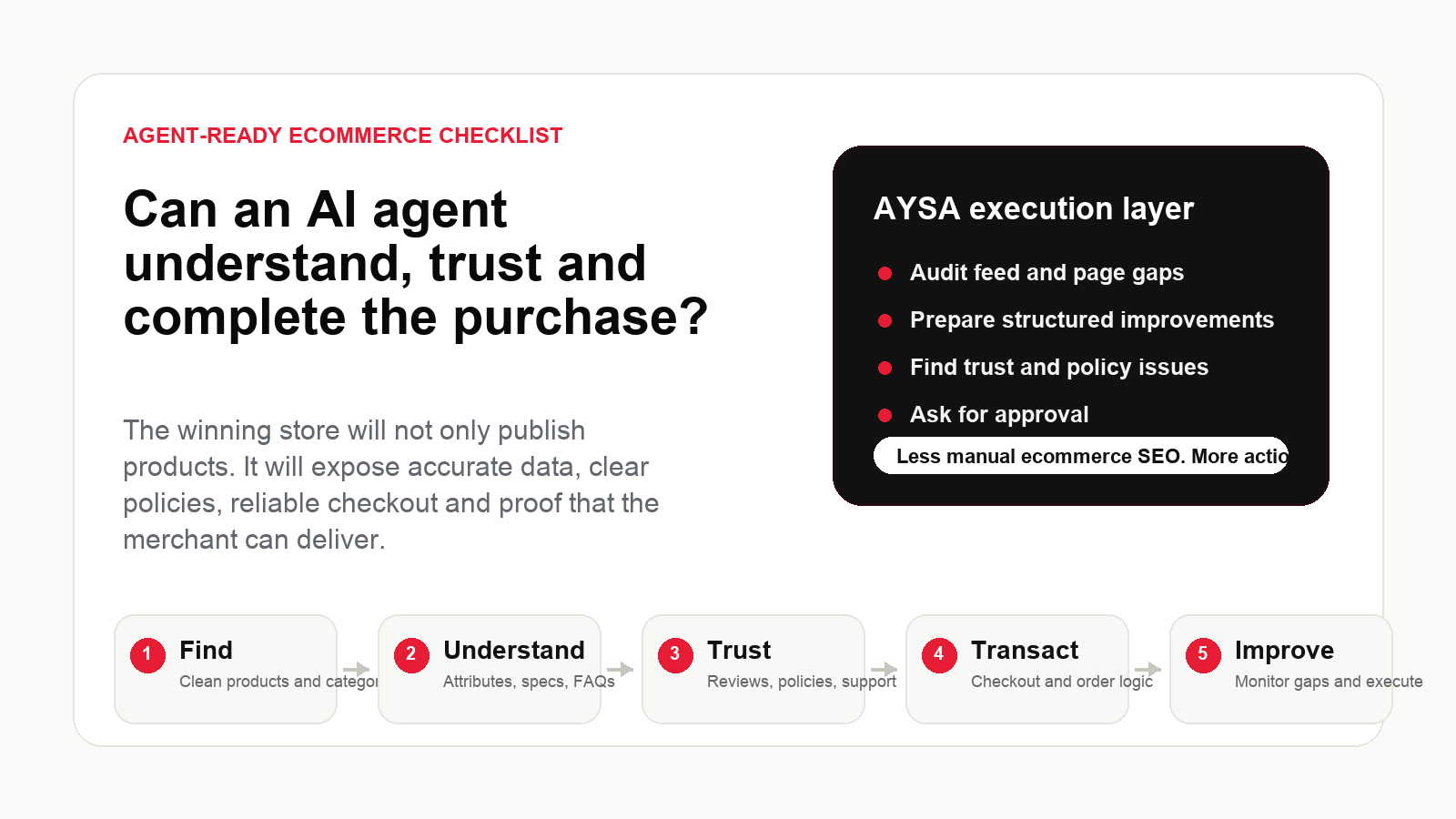
Merchant readiness is the ability of a store to be understood, trusted and used by search systems, shopping systems and AI agents. It includes product feed health, structured data, product page quality, category clarity, inventory accuracy, shipping rules, return policies, payment information, reviews, business identity, customer support and technical accessibility.
This is especially important for SMEs because many smaller stores are operationally messy. They may have good products but incomplete feeds. They may have useful product pages but weak policies. They may have strong reviews but poor structured data. They may have category pages that rank but product variants that confuse canonical rules. They may have stock changes that are not reflected consistently across channels.
In classic SEO, some of these issues were treated as “nice to fix.” In agentic commerce, they become eligibility and trust issues. If an assistant is helping a user choose where to buy, it will need more than a poetic product description. It needs confidence.
Merchant readiness also affects human conversion. Clear shipping, returns, support and product attributes help users buy. The same clarity helps search engines and AI systems understand the business. That is why agentic commerce SEO should not be seen as a separate technical trend. It is a forcing function for better ecommerce operations.
UGC, reviews and proof are not decorative anymore
User-generated content, reviews, Q&A, customer photos, social mentions and support conversations can all become evidence. They help humans decide. They also help AI systems understand how real buyers talk about products, problems, use cases and objections.
However, UGC is useful only when it is real, moderated and connected to the right context. Fake reviews, spam Q&A and thin testimonial blocks can create risk. Google’s systems and policies have become increasingly focused on helpful content, abuse prevention and trust. For ecommerce, the safest direction is not to manufacture proof. It is to collect genuine proof and expose it clearly.
A product page with useful reviews can answer questions the merchant never thought to include. A category page with real buying criteria can help users compare. A post-purchase email asking for specific feedback can create better UGC than a generic “leave a review” request. A support Q&A can reveal missing information that should be added to product content.
For AI search, UGC also helps language matching. Users do not always describe products with the merchant’s internal terms. They describe problems, outcomes, fears and constraints. Good UGC gives the store a richer vocabulary of real demand.
Weak UGC usage
Reviews are collected but hidden, unstructured, not connected to product questions and never used to improve content.
Agent-ready usage
The technical layer: feeds, structured data and clean architecture
Agentic commerce still depends on technical SEO fundamentals. If a store has broken canonical rules, duplicate products, blocked resources, slow pages, bad faceted navigation, missing schema, outdated product feeds or inconsistent URLs, it becomes harder for search systems to understand and trust.
Product feeds are central. Google Merchant Center depends on accurate product data: titles, descriptions, images, prices, availability, condition, shipping, identifiers and other attributes. If the feed and the website disagree, trust suffers. If availability is wrong, users suffer. If product attributes are thin, comparison becomes harder.
Structured data helps connect website content to machine-readable meaning. Product, Offer, Review, AggregateRating, BreadcrumbList, FAQ where visible, Organization and LocalBusiness markup can support clarity when used correctly. But schema is not a magic layer. It should describe visible, accurate content. Do not add markup for claims that the user cannot verify on the page.
Internal linking also matters. Category pages, buying guides, product pages, comparison pages and support content should connect logically. A store should not rely only on product grids. It should help users and systems understand the relationship between needs, products, categories, use cases and policies.
Finally, performance and crawl hygiene matter. AI and search systems still need access to clean HTML, stable URLs and useful content. Bloated ecommerce themes, excessive JavaScript, broken filters and uncontrolled parameters can waste crawl and reduce visibility.
What ecommerce teams should do now
First, audit product feed quality. Look for missing identifiers, weak product titles, poor descriptions, inconsistent availability, weak images, missing shipping details and product attributes that do not match how buyers compare. Feed quality is no longer only an ads issue. It is part of commerce discoverability.
Second, improve product and category pages around decision criteria. A product page should explain what the product is, who it is for, why it is different, how it is used, what is included, what limitations exist, how delivery works and what proof supports the claim. A category page should help users choose, not only list products.
Third, make policies visible and specific. Shipping, returns, refunds, warranty, support, payment and delivery rules are not boring legal leftovers. They are trust infrastructure. If an AI agent or user cannot understand the policy, confidence falls.
Fourth, connect reviews and Q&A to content improvement. Do not treat UGC as a widget. Use it to identify missing information, language patterns, objections and comparison criteria. Then update product pages, category pages and FAQs.
Fifth, monitor AI and shopping surfaces. Track where products appear, how the brand is described, whether competitors are recommended, which sources shape the answer and what information seems missing. As we explained in our AI search measurement framework, visibility alone is not enough. You need readiness and business impact.
Sixth, build an approval-first execution process. Ecommerce teams often know what should be fixed but struggle to implement consistently. Agentic commerce will reward stores that can move faster without losing control.
Where AYSA fits
AYSA is built for the gap between discovery and execution. Agentic commerce will create more signals, more checks and more recommended actions: feed issues, missing product attributes, weak category pages, poor internal links, outdated policies, schema opportunities, review gaps, AI visibility gaps and technical ecommerce problems. The question is not whether a tool can find them. The question is whether the work gets done.
AYSA can help ecommerce teams monitor website and search signals, prepare SEO, AEO and AI visibility actions, explain what matters, ask for approval and execute accepted changes inside the website workflow. For SMEs, this is important because agentic commerce can become overwhelming if every new Google or AI update turns into another manual audit.
In my opinion, UCP is not just a protocol story. It is a warning that ecommerce SEO is becoming more operational. The stores that win will not only publish products. They will maintain accurate commerce data, visible proof, clear policies, clean technical foundations and fast execution loops.
Agent-ready ecommerce needs execution
Tired of manually fixing feeds, product pages, SEO issues and AI visibility gaps?
Try AYSA: an AI SEO agent that helps ecommerce websites monitor search changes, prepare product and content improvements, ask for approval and execute accepted actions inside the website workflow.
Sources and further reading
This article cites and builds on Aleyda Solis’ analysis of UCP and agentic commerce SEO, Google’s developer announcement about the Universal Commerce Protocol, Google Merchant Center product data documentation, and Google Search Central’s AI features optimization guide. The AYSA sections are our author and product perspective. We do not claim guaranteed rankings, guaranteed AI recommendations or guaranteed AI transaction inclusion.
Continue the AI search topic inside AYSA.
Use these pages to connect the article with AI SEO tools, AI visibility monitoring, AI Overviews and approved website execution.
Turn this topic into a website action plan.
Use these AYSA hubs to move from reading to technical fixes, AI visibility monitoring, research, glossary context and approval-first SEO execution.

