
Agentic Search Will Multiply Searches. Most SMEs Are Not Ready.
Google’s AI Search box, AI Mode and information agents point to a future where search becomes a task workflow. Here is what SMEs need to do for SEO, AEO and AI visibility.
Executive summary: Search is moving from short Keyword queries to task-based, AI-assisted journeys. Google’s latest Search announcements show a future where users can ask longer questions, continue from AI Overviews into AI Mode, use multimodal inputs, and delegate parts of the research process to information agents. For SMEs, the real risk is not only losing rankings. It is becoming invisible inside the many micro-searches, comparisons and source checks that AI systems perform before they answer.
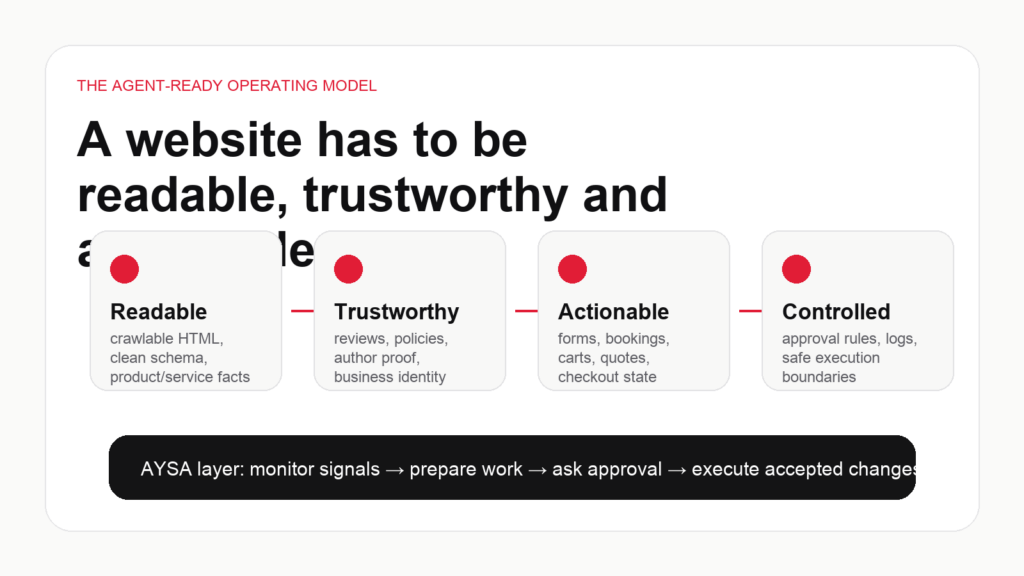
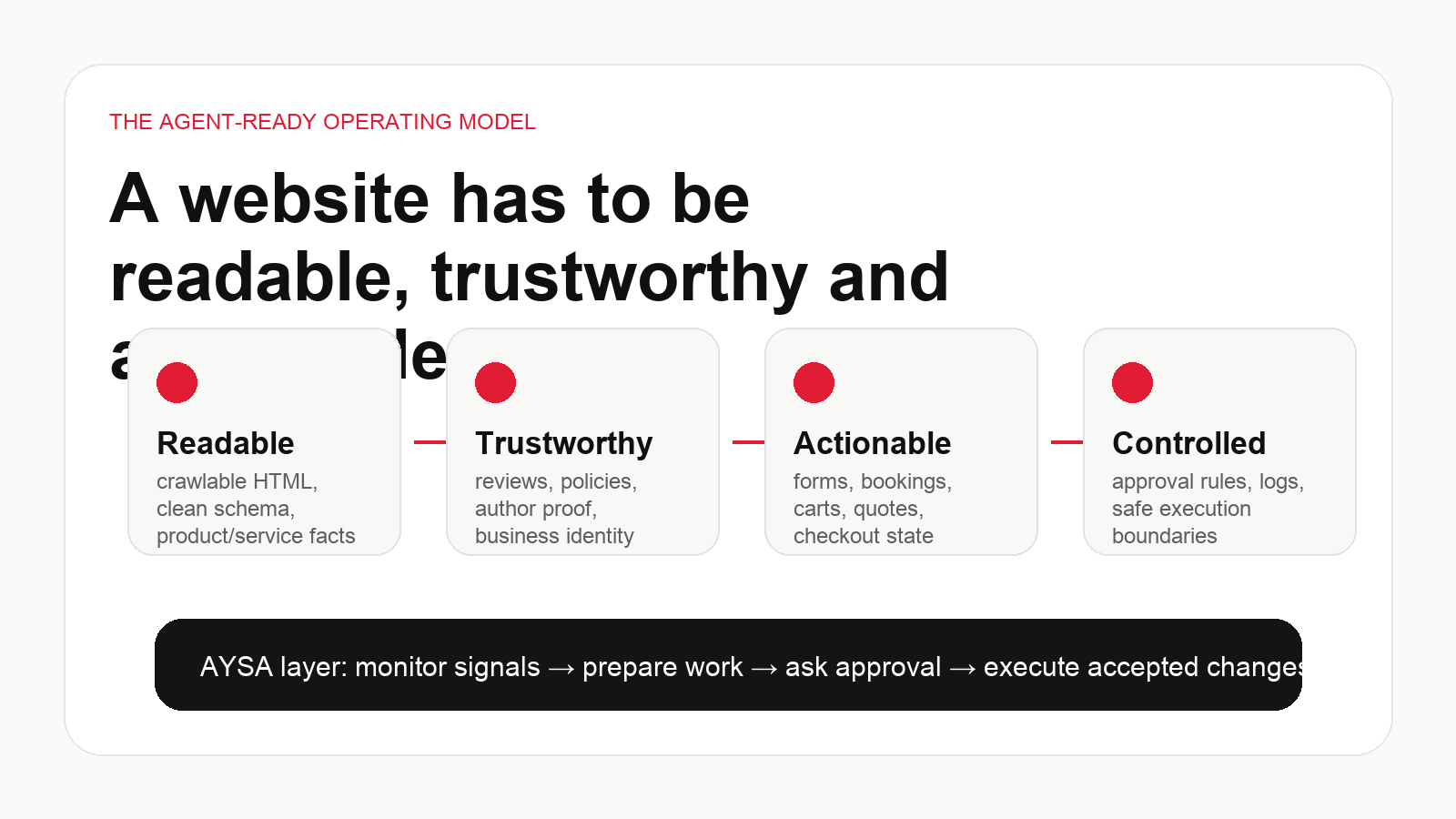
The practical response is not panic. It is execution. Websites need clearer service pages, better technical foundations, stronger entity signals, better Internal linking, useful Answer-ready content, fresh proof and controlled Authority Building. AYSA fits this shift because it monitors opportunities, prepares SEO/AEO/AI visibility work, asks for approval and executes accepted changes inside the website workflow.
What changed: search is becoming a task system
A useful observation has been circulating in the SEO community: the next version of search is not only a better answer box. It is a task system. Users do not simply type one keyword, compare ten blue links and click one page. They describe problems, add constraints, ask follow-up questions, compare options and expect the search system to carry more of the work.
Google’s Search I/O 2026 announcement supports that direction. Google introduced a new AI-powered Search box designed to let people describe what they need in more detail, use richer inputs and continue from AI Overviews into AI Mode. Google also announced more agentic experiences, including information agents that can help with tasks such as finding information, comparing details and continuing the search journey with more context.
In a separate update around AI Mode, Google said AI Mode is powered by Gemini and has moved search behavior toward longer, more complex questions. Search Engine Land also reported that Google Search gained improved agentic experiences and that AI Mode is now powered globally by Gemini 3.5 Flash. The exact product details will continue to evolve, but the direction is already clear: search is becoming more conversational, more contextual and more operational.
That matters because SEO has historically been optimized around visible search result pages. Agentic search changes the invisible part of the journey. A system may fan out a question into multiple supporting searches, open sources, compare pages, inspect facts, check context and then synthesize an answer. The user may see only a short response and a few citations, while the actual discovery process happened in the background.
task-driven discovery
Why agentic search multiplies searches
The phrase “agentic search” can sound abstract, but the behavior is easy to understand. A human user often compresses a need into a short query because typing is annoying. An AI-assisted search system can expand that need again. It can ask the supporting questions that the user did not type. It can compare more dimensions. It can inspect more sources. It can preserve context while the user keeps refining the task.
That means one customer journey can produce many retrieval moments. A simple local search might become separate checks for service availability, reviews, distance, opening hours, parking, prices, appointment options, emergency limitations, trust signals and alternatives. An ecommerce search might become checks for product specs, shipping, returns, warranty, stock, reviews, compatibility, comparison pages and buying guides. A B2B software search might become checks for pricing, integrations, security, case studies, documentation, support and migration risk.
In classic SEO, a business could win by ranking on a few obvious head terms. In agentic search, a business also needs to be present across the supporting facts that help the system complete the task. If your website answers only the headline query but not the surrounding decision criteria, you may be partially visible but not useful enough to cite or recommend.
This is why “AI visibility” should not be treated as a separate magic channel. It is built on the same foundations as good SEO: crawlability, indexability, useful content, entity clarity, internal links, authority and freshness. The difference is that AI-assisted systems put more pressure on completeness, specificity and structured explanation.
The SME problem: the website is often not ready for deep questions
Most small and mid-sized businesses do not lose because they lack ambition. They lose because their websites are under-executed. A florist may have products but weak delivery pages. A parking company may have location pages but not enough information about airport transfer, security, pricing and booking. A private clinic may have service pages but not enough parent-friendly explanations, doctor proof, appointment details, parking context or review integration. A hotel may have beautiful photos but weak local content and poor comparison support.
These gaps were already a problem in classic SEO. Agentic search makes them more visible. If a user asks a detailed question, the system needs detailed sources. It does not want a generic “we offer quality services” page. It wants specific, verifiable and useful information that can support an answer.
SMEs also face an execution bottleneck. Agencies can advise, but they cannot always keep up with the volume and speed of changes needed across technical SEO, content, internal links, Google Business Profile, AI visibility, schema, redirects, performance, topic coverage and authority. Business owners can approve decisions, but they usually do not want to operate SEO tools every day. ChatGPT or Claude can draft ideas, but they are not natively connected to the website, Search Console data, approval history and publishing workflow.
That is the gap AYSA was built to address: not “more SEO advice,” but a controlled execution layer that turns opportunities into approved website changes.
The AI visibility stack: what must be true before you get cited
A website that wants to perform in agentic search needs a stack of signals. None of these alone guarantees visibility, and no honest platform should promise guaranteed AI Overview inclusion or guaranteed citations. But together they improve the probability that a page can be found, understood and used.
1. Crawlable and indexable pages
If important pages are blocked, slow, canonicalized incorrectly, buried too deep or missing from the sitemap, AI visibility work starts on weak ground. Google’s own AI optimization guidance points back to standard Search fundamentals: make content accessible to Google, use helpful content, and apply structured data correctly where it is relevant.
2. Clear entities
AI systems need to understand who you are, what you sell, where you operate, who you serve and why you can be trusted. This includes brand pages, author profiles, organization data, location information, product/service clarity, reviews, press, partnerships and consistent naming across the web.
3. Answer-ready content
Pages should answer real questions, not just include keywords. A page about “SEO for florists” should explain seasonal demand, local SEO, product/category pages, bouquet delivery, Google Business Profile, review strategy, visual search and authority. A page about “car rental near the airport” should explain transfer, booking, cancellation, pricing, insurance, pickup, parking and trust.
4. Internal links and topic coverage
Agentic systems can inspect multiple pages. Internal links help them move from broad pages to specific proof. A glossary, blog, product page, case study and help article should reinforce each other. This is where topical authority becomes practical, not theoretical.
5. Freshness and monitoring
Search is changing fast. AI Mode, AI Overviews, product feeds, agentic commerce, Google Business Profile surfaces and ranking systems keep evolving. A website that is updated once a year will struggle against a website that is monitored and improved continuously.
Old SEO habit
- Target a keyword.
- Publish a page.
- Wait for rankings.
- Review performance weeks later.
Agentic search readiness
- Map the real task.
- Cover the supporting questions.
- Connect proof, entities and actions.
- Monitor and improve continuously.
What SMEs should fix first
The smartest response is to prioritize the parts of the website that AI systems and humans both need. Start with money pages and proof pages. Do not begin with endless blog posts if your service pages are vague, your pricing logic is missing, your contact flow is weak or your Google Business Profile does not match the website.
First, fix technical foundations. Make sure important pages return 200, have self-referencing canonicals, use clean redirects, load quickly on mobile, include useful titles and meta descriptions, and appear in the sitemap. Remove broken internal links and avoid pages that waste crawl budget.
Second, improve service and product pages. Explain who the offer is for, what is included, what the user should compare, what the process looks like, what constraints exist and how to take the next step. Add visible FAQs when they genuinely help. Add schema only when it reflects visible content.
Third, build proof. Reviews, case studies, media mentions, expert commentary, founder pages, client examples, before/after explanations and practical guides help both humans and AI systems evaluate trust. Do not fake proof. Make real proof easier to find and understand.
Fourth, connect the website semantically. Link product pages to guides, guides to glossary terms, glossary terms to product pages, case studies to use cases, and blog articles to deeper commercial pages. Internal links are not decoration. They are a map of meaning.
Fifth, monitor the market. Query patterns, competitor content, Google updates, AI visibility, answer engine citations and organic conversions all need ongoing observation. A static SEO project is increasingly mismatched with a dynamic search environment.
Where AYSA fits
AYSA is not positioned as another dashboard that gives the owner more work. It is an AI SEO execution agent. The difference matters. In the agentic search era, businesses need a system that can monitor signals, interpret them, prepare actions, explain what matters, request approval and execute accepted changes inside the website.
That can include technical SEO checks, on-page improvements, internal links, content opportunities, AI visibility monitoring, Google Business Profile context, authority-building opportunities, glossary and topic expansion, and continuous recommendations based on real website data. The user’s role is not to become an SEO specialist. The user’s role is to approve the important work and keep control.
This is also why AYSA integrates with the broader authority-building ecosystem, including Adverlink. Agentic search does not only care about what your website says about itself. It also depends on how the web references your brand, services and expertise. Authority building should be controlled, relevant and approved before spending, not messy outreach hidden in spreadsheets.
The future of SEO will not be won by businesses that collect more reports. It will be won by businesses that can execute faster, safer and more continuously. Agentic search will multiply the number of moments where your website can be discovered or ignored. AYSA exists to help SMEs become discoverable in more of those moments.
Sources and further reading
- Google: Search I/O 2026 Search announcements
- Google: AI Mode usage and query behavior insights
- Search Engine Land: Google Search gains information agents and improved agentic experiences
- Search Engine Land: Google Search now powered by Gemini 3.5 Flash
- Google Search Central: AI optimization guide
- Google Search Central: Creating helpful, reliable, people-first content
Tired of chasing dashboards while search keeps changing?
AYSA helps SMEs monitor SEO, AEO and AI visibility, prepare useful website actions, ask for approval and execute accepted changes inside the website workflow.
Continue the AI search topic inside AYSA.
Use these pages to connect the article with AI SEO tools, AI visibility monitoring, AI Overviews and approved website execution.
Turn this topic into a website action plan.
Use these AYSA hubs to move from reading to technical fixes, AI visibility monitoring, research, glossary context and approval-first SEO execution.

