
Google I/O 2026 Turned Search Into an Operating System. What SMEs Should Do Next.
Google I/O 2026 showed Search becoming multimodal, agentic and deeply AI-assisted. Here is what SMEs should do for SEO, AEO, AI Mode and approved execution.
Executive summary: Google I/O 2026 was not just another “AI in Search” event. Google described a Search experience that is more conversational, multimodal, personal, agentic and capable of doing work in the background. For SMEs, this means SEO can no longer be treated as a monthly reporting exercise. Your website has to be clear enough for people, crawlable enough for Google, structured enough for AI-assisted answers and operational enough to change quickly when search behavior changes.
This article connects Google’s I/O 2026 Search announcements with what we have already covered on AYSA.ai: the new AI Search box, Information Agents, Gemini 3.5 Flash, ads in AI Mode, Pomelli and the broader shift toward agentic search. The conclusion is simple: the winners will not be the businesses with the longest SEO checklist. They will be the businesses that can turn search changes into approved website action fast.
What Google actually announced at I/O 2026
It is easy to overreact to Google events. Every new interface can sound like the end of SEO. That is not the useful interpretation here. The useful interpretation is more practical: Google is rebuilding the search journey around richer questions, context and AI-assisted task completion.
In Google’s own I/O 2026 Search announcement, the company said it is bringing advanced model capabilities to Search and introducing what it called the biggest upgrade to the Search box in more than 25 years. Google also said AI Mode has surpassed one billion monthly users, that queries have more than doubled every quarter since launch and that Search queries reached an all-time high in the previous quarter.
Those details matter because they push back against a lazy narrative: “AI answers mean people will stop searching.” Google’s own message is different. People are asking more, not less. The search session is expanding. The queries are getting longer. The journey is moving from one Keyword to a chain of requests, comparisons and follow-up questions.
Google also announced that Gemini 3.5 Flash is becoming the default model in AI Mode globally. In plain language, this means the AI layer inside Search is becoming faster, more capable and more available. That does not mean every website gets more traffic. It means the system can evaluate, synthesize and respond across more context with less friction.
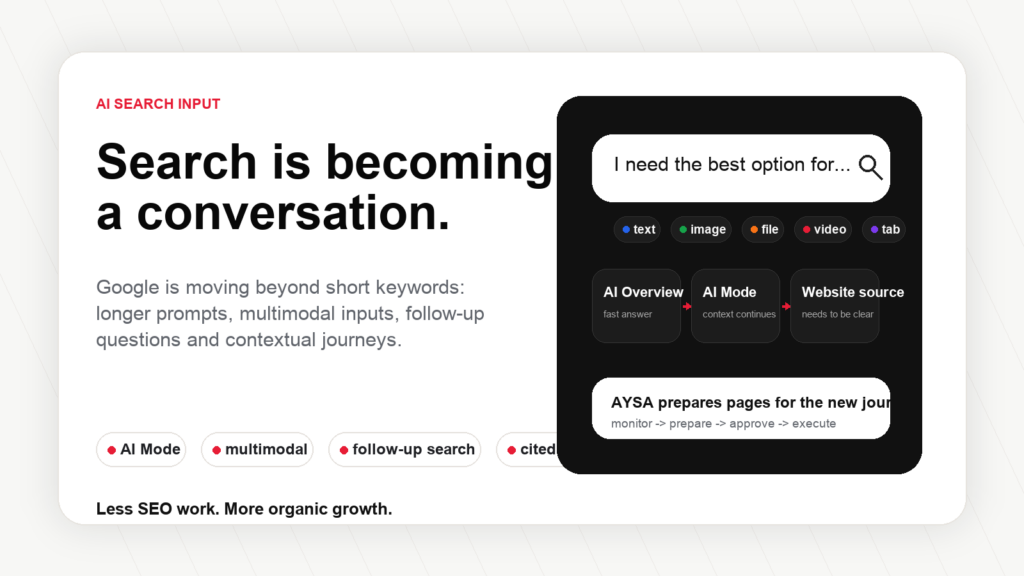
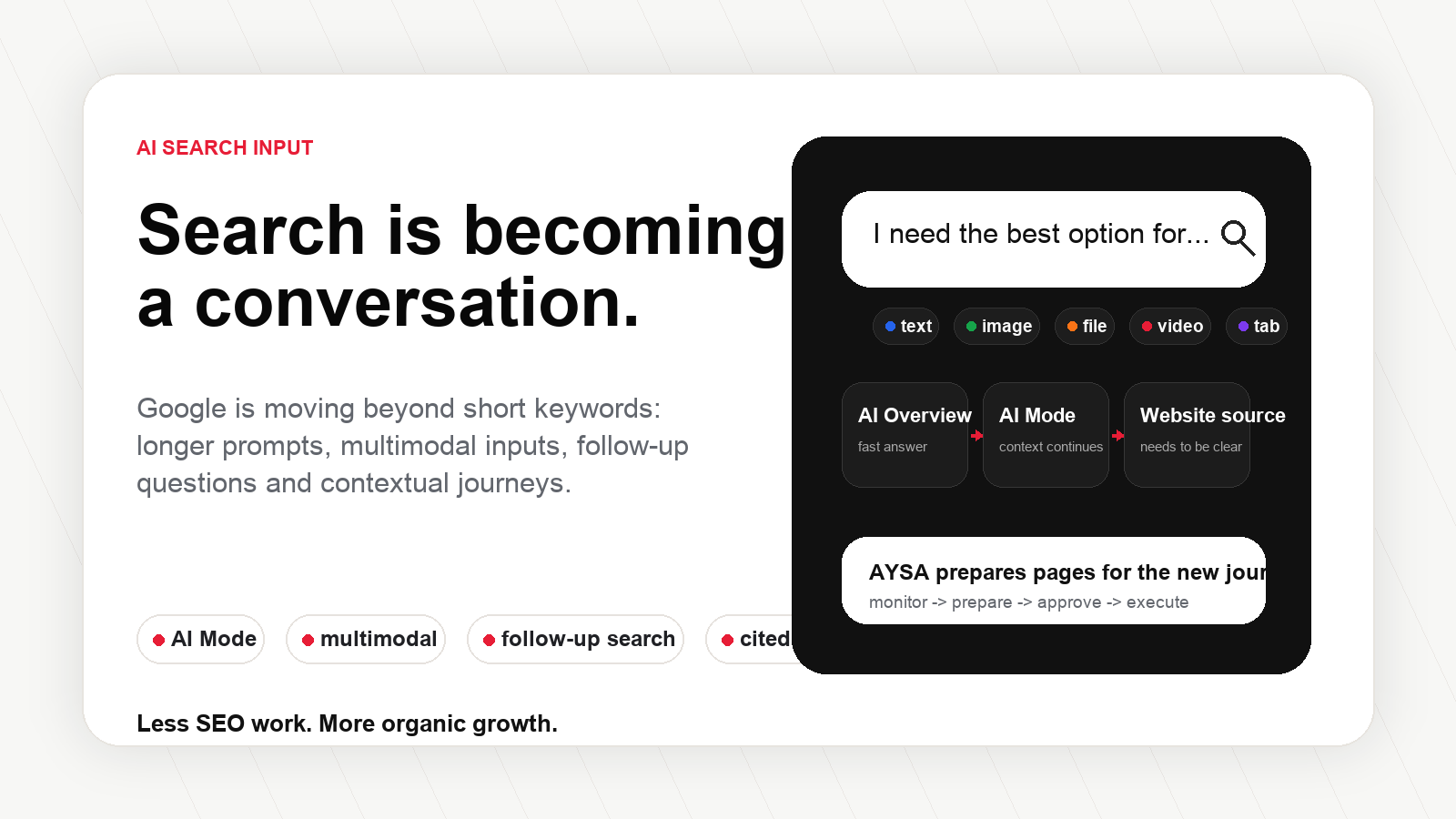
The Search box itself is also changing. Google described a dynamic, AI-powered input experience that gives users more space to describe what they need, suggests richer ways to ask questions and supports text, images, files, videos and Chrome tabs as inputs. Users can move from AI Overviews into AI Mode and continue with follow-up questions while context stays with them.
Finally, Google introduced Search agents. The first wave includes information agents that can run in the background, monitor changes across the web and synthesize updates when something important appears. Google also described agentic booking and shopping capabilities, including examples where Search can combine criteria, availability and direct provider links to help users take action.
from keywords to tasks
Why this is bigger than an interface change
The old search mental model was simple: keyword in, results out, click one result, evaluate the page. The new model is messier and more powerful. A user may start with a vague need, add constraints, compare options, upload a screenshot, ask a follow-up question, continue into AI Mode and ask the system to monitor changes or complete part of the task.
That creates three consequences for SEO and AEO.
1. Search demand becomes more fragmented
A single commercial need can fan out into many supporting information needs. “Best pediatric clinic in Bucharest” is not one query anymore. It can become questions about private care, emergency limitations, pediatric specialties, parking, online booking, reviews, doctor credentials, insurance, distance and parent-friendly explanations. “Airport parking” can become security, transfer time, cancellation policy, indoor versus outdoor parking, reviews, late arrivals and price transparency.
If your website covers only the main keyword, it may be visible in a classic ranking report but weak inside an AI-assisted comparison. The system needs enough evidence to complete the user’s task. Thin commercial pages will struggle because they do not provide enough material to compare, cite or recommend.
2. Retrieval becomes more contextual
Google’s new Search box supports richer inputs and continued context. That means the system can understand more about what the user is trying to do. The page that wins is not always the page with the most generic SEO text. It is the page that matches the real task: location, intent, constraints, trust, services, availability and next steps.
This is why Entity Clarity matters. Google, AI Overviews and AI Mode need to understand who the business is, what it offers, where it operates, which audience it serves and why the page is credible. That clarity has to appear in visible content, Internal linking, schema where appropriate, Google Business Profile context, reviews, author or business proof and consistent brand signals across the web.
3. Execution speed becomes a competitive advantage
The biggest practical problem for SMEs is not knowing that SEO matters. It is getting the work done. Google changes the interface. AI Mode changes behavior. Competitors update pages. Reviews change. New questions appear. Technical issues break crawling. Content decays. A monthly spreadsheet cannot keep up with that pace.
Search is becoming more dynamic, so the operating model has to become more dynamic too. This is where the gap between SEO tools, agencies and execution platforms becomes visible. Tools show data. Agencies interpret and recommend. But the business still needs a system that can prepare the work, request approval and implement accepted changes without turning the owner into a full-time SEO operator.
Where old SEO breaks after Google I/O 2026
Old SEO does not die because Google adds AI. Old SEO dies when it becomes disconnected from how people make decisions. Keyword rankings still matter. Technical SEO still matters. Links still matter. Content still matters. But none of those elements are enough if they are managed as isolated tasks instead of a connected search operating system.
Here are the failure points we see most often with SMEs.
Ranking reports without decision context
A business may rank for a keyword but fail to answer the buyer’s real question. For example, a clinic page can mention “pediatrics” but fail to explain booking, age groups, recurring fever guidance, parking, reviews, doctors and what a parent should do next. A hotel page can rank for a destination term but fail to explain nearby attractions, parking, restaurant options, family suitability or local transport. An ecommerce page can rank but fail to answer sizing, compatibility, stock, shipping, warranty and comparison questions.
Content production without proof
AI-assisted search is not impressed by generic paragraphs. Helpful content has to be specific. It has to show real expertise, real examples, clear definitions, visible limitations and practical next steps. A page that says “we provide high quality services” is not useful enough. A page that explains what to compare, when to choose one option over another, what the risks are and how the customer should act is far more valuable.
Technical SEO treated as a one-time audit
Search agents and AI-assisted retrieval still need crawlable pages. Google’s own guidance for generative AI features points back to the same fundamentals: make content accessible to Google, control snippets and previews properly, use Search Essentials, and ensure technical foundations do not block discovery. If a website has canonical conflicts, noindex mistakes, slow mobile performance, broken internal links or poor structured data, it is not “AI-ready.” It is simply not search-ready.
Manual workflows that cannot keep pace
Many SMEs depend on a human loop that is too slow: audit, meeting, recommendation, copywriter, developer, approval, delay, partial implementation, another audit. That model worked better when search changed more slowly. It is weaker when Google keeps adding AI interfaces, ads formats, agentic capabilities and richer search behavior.
The SME playbook after Google I/O 2026
The right response is not to chase every new acronym. The right response is to make the website more useful, more understandable and easier to execute against. For SMEs, I would prioritize six areas.
1. Rewrite priority pages around real jobs, not keywords
Start with the pages that should produce business: service pages, category pages, location pages, product pages and comparison pages. Ask a harder question: what would make this page the most useful result for a specific user, at a specific stage of the journey, in a specific market?
A page about “private pediatric clinic in Bucharest” should help a parent compare options, understand when to choose emergency care, evaluate trust signals, see appointment options and decide what to do next. A page about “airport parking Otopeni” should explain distance, transfer, security, booking, price, late arrivals and cancellation. A page about “florist delivery Bucharest” should explain same-day delivery, cut-off times, bouquet types, events, quality, payment and service area.
2. Build answer-ready sections
Do not add FAQs just because “FAQ schema” used to produce rich results. Add question-and-answer sections because users and AI-assisted systems need concise, extractable explanations. Good answer-ready sections clarify definitions, comparisons, criteria, limitations and next steps.
For AI Mode and AI Overviews, the goal is not to trick the system. The goal is to make the page easier to understand and cite. Short definitions, clean headings, examples, tables, bullet points and visible evidence make the content more useful for humans and machines.
3. Connect content into topical clusters
Google I/O 2026 makes context more important, not less. A single article or landing page rarely carries the full picture. You need internal links between related pages: service pages, guides, glossary definitions, case studies, pricing, examples and local proof. This helps users continue their journey and helps search systems understand the relationship between topics.
This is also why we are careful about internal linking on AYSA.ai. When we publish around AI Mode, Information Agents, Gemini 3.5 Flash and Google’s AI optimization guide, those articles need to support each other instead of living as isolated posts.
4. Keep the technical layer clean
AI-assisted search does not remove the need for technical SEO. If anything, it makes technical discipline more important. Your website should have clean canonical signals, useful sitemap entries, fast mobile pages, crawlable links, stable templates, no CSS leakage in content, readable HTML and no broken internal links. If Google or another AI retrieval system cannot reliably access and interpret the page, all the strategy in the world becomes theory.
5. Treat authority as proof, not manipulation
Authority still matters, but the useful interpretation is broader than “buy links.” Mentions, citations, reviews, publisher references, case studies, social proof, local profiles and credible third-party context help systems understand whether a business is real and trusted. AYSA’s authority-building workflow is built around review and approval because careless authority work creates risk.
6. Create a weekly execution rhythm
The businesses that win in 2026 will not be the ones that read every Search update. They will be the ones that turn the right updates into action. That means a weekly rhythm: monitor opportunities, prepare improvements, approve important changes, execute, measure and repeat. This is operational SEO, not dashboard SEO.
Reports, meetings and delayed implementation.
Rankings are reviewed, recommendations are discussed, but changes often wait for copy, developers, approvals and another round of prioritization.
Monitoring, approval and applied website changes.
The system detects opportunities, prepares the work, explains the impact, asks for approval and executes accepted changes inside the website workflow.
Related AYSA analysis: the Google I/O 2026 cluster
This article is the hub view. If you want to go deeper into specific parts of Google’s announcements and what they mean for SEO, we have already covered several connected topics.
- Google’s AI Search Box Changes SEO More Than Rankings explains why the new input interface matters for long, contextual questions.
- Google Search Agents: Why SEO Is Becoming a Task-Readiness Discipline focuses on information agents and why websites need to support task completion.
- Gemini 3.5 Flash in Google Search looks at why faster AI Mode raises the execution bar for SEO and AEO.
- Google AI Mode Ads explains why paid and organic discovery are converging inside AI-assisted journeys.
- Google Pomelli and Marketing Live 2026 covers AI campaign creation and why creative automation still needs website and search context.
- Google’s Generative AI Optimization Guide for SMEs translates Google’s official guidance into practical execution priorities.
- Agentic Search Will Multiply Searches expands the idea that search sessions are becoming task systems, not isolated queries.
Where AYSA fits: from Google I/O insight to approved website execution
The most dangerous reaction to Google I/O 2026 is to treat it as another thing to read and debate. SMEs do not need more unread strategy decks. They need a way to keep their websites aligned with how search is changing.
AYSA is built for that execution layer. It connects to the website, learns the business context, uses search and performance signals, monitors opportunities, prepares SEO/AEO/AI visibility actions, asks for approval and executes accepted changes. The point is not blind automation. The point is controlled automation: the business owner stays in control, while the repetitive SEO work moves out of spreadsheets, dashboards and copy-paste workflows.
After Google I/O 2026, this matters more. The search interface is moving faster. Query behavior is becoming richer. AI Mode is becoming more capable. Information agents will create new discovery surfaces. Ads and organic results will increasingly share the same AI-assisted journey. A website that cannot adapt quickly will lose opportunities even if it still ranks for some old keywords.
In my opinion, the next SEO advantage for SMEs is not owning the most tools. It is owning the fastest safe execution loop: detect, prepare, approve, execute, measure and improve.
Sources and further reading
- Google: Search’s I/O 2026 updates
- Google Search Central: Guide to optimizing for generative AI features on Google Search
- Google: Search I/O 2026 AI updates
- Search Engine Land: Google Search gains information agents and improved agentic experiences
- Search Engine Land: Google Search now powered by Gemini 3.5 Flash
Tired of reading Google updates without knowing what to change?
AYSA monitors your website, prepares SEO, AEO and AI visibility work, asks for approval and executes accepted changes inside your website workflow.
Continue the AI search topic inside AYSA.
Use these pages to connect the article with AI SEO tools, AI visibility monitoring, AI Overviews and approved website execution.
Turn this topic into a website action plan.
Use these AYSA hubs to move from reading to technical fixes, AI visibility monitoring, research, glossary context and approval-first SEO execution.

