Google AI Mode Ads: Why SEO and PPC Are Becoming One Discovery System
Google is testing ads inside AI Mode and expanding AI-powered ad formats. The real story for SMEs is not SEO versus PPC, but whether the website is ready for conversational discovery.
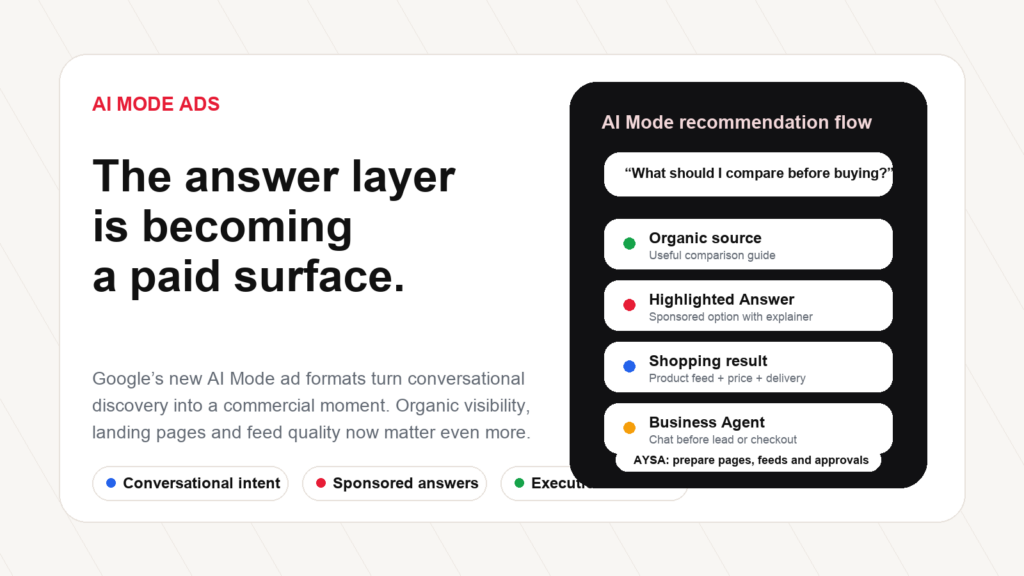
Executive summary: Google is moving ads deeper into AI-assisted search. Search Engine Journal reported that new formats include ads in AI Mode, Conversational Discovery ads, Highlighted Answers, AI-powered Shopping experiences, Business Agent for Leads and Direct Offers. Google’s own announcement frames this as a new generation of advertising for the AI era of Search.
The practical takeaway is simple: SEO and PPC are no longer separate lanes. They are becoming two sides of the same discovery system. A user can ask a long, conversational question, compare options, click an ad, inspect a product feed, ask a follow-up, visit a publisher result, return to AI Mode and then convert through a lead agent or checkout flow.
For SMEs, the danger is thinking this is only a Google Ads update. It is not. Paid visibility will increasingly depend on the same foundations that organic and AI visibility depend on: clear pages, accurate product and service data, useful answers, trust signals, reviews, structured content, fast landing pages and a website that can be understood by both humans and AI systems.
What Google announced
Search Engine Journal reported that Google is introducing and testing several new ad formats designed for AI-assisted search behavior. The headline item is ads in AI Mode, but the broader story is bigger than one placement.
Google’s official announcement, “A new generation of ads for the AI era of Search,” describes a search environment where people use Lens, Circle to Search, AI Overviews and AI Mode to ask more complex questions. In that environment, Google says it is experimenting with Search and Shopping ads in AI Mode on desktop in the United States, where relevant.
The announcement also covers several connected ad and commerce formats:
Ads in AI Mode. Google is testing sponsored placements inside the AI Mode experience. The important detail is not only placement. It is context. AI Mode is built around longer questions, follow-ups and exploration, which means ad relevance may depend on understanding intent across a conversation, not just matching a Keyword.
AI Max for Search campaigns. Google describes AI Max as a one-click upgrade for Search campaigns that helps advertisers reach more relevant queries and landing pages. Google reports that early beta advertisers saw 14% more conversions or conversion value at a similar CPA or ROAS. It also says campaigns that still rely heavily on exact and phrase match keywords can see a larger uplift, reported at 27%. Those are Google-reported beta numbers, not a guarantee for every account.
Conversational Discovery ads. These are designed for Discover and use AI-powered creative to invite more exploratory engagement. The format points toward a future where discovery does not always begin with a typed Search query.
Highlighted Answers. SEJ describes a format where users can select text or ask questions on publisher pages and receive AI-generated answers with relevant ads. That is a major signal: monetization is moving closer to the moment of explanation, not only the moment of search.
AI-powered Shopping ads. Google is pushing merchant feeds, shopping conversations and product-answer experiences deeper into AI-assisted journeys. For ecommerce, this makes product data quality and feed hygiene more important, not less.
Business Agent for Leads. Google is also moving toward agentic lead handling: answering questions and helping users book or request information. That changes the job of a landing page. The page does not only need to rank or convert a click. It needs to provide clean, trustworthy information that can support an automated lead experience.
SEO and PPC were often planned as separate workflows with separate reporting and separate owners.
Organic answers, Shopping data, ads, publisher context and Website Execution now shape one discovery path.
Why this matters beyond Google Ads
The easy interpretation is: Google found another place to show ads. That is true, but incomplete.
The harder interpretation is: Google is redesigning the commercial search journey around conversational intent. When people ask longer questions, they reveal more context: budget, urgency, location, constraints, preferences, product requirements, risk concerns and comparison criteria. That makes the search box less like a keyword field and more like a discovery assistant.
This changes how businesses need to prepare. A classic Google Ads account could survive with a good keyword list, decent landing pages, Conversion tracking and bid management. That will still matter. But AI-assisted search adds more pressure on the website itself.
If a user asks, “I need a pediatric clinic in Bucharest for a toddler with recurring fever, preferably private, good reviews, easy parking and online booking. What should I compare?”, the best answer is not a generic clinic page. The useful answer needs criteria: pediatric expertise, emergency availability, reviews, location, parking, appointment process, parent instructions, pricing transparency and trust signals.
If a user asks, “Which accounting software is best for a small ecommerce business that sells in Germany and Romania?”, the useful answer needs integration details, tax logic, ecommerce connectors, support availability, pricing, migration risk and real limitations.
That is the kind of content and data layer that supports both organic AI visibility and paid AI visibility.
SEO and PPC are becoming one discovery system
For years, SEO and PPC were often managed as different disciplines. SEO owned rankings, content, technical health and backlinks. PPC owned campaigns, bids, creative, landing pages and conversion tracking. That division is still useful operationally, but it is becoming less useful strategically.
In AI Mode, the user journey can mix organic and paid signals in one session. A person may see an AI response, inspect cited sources, click a Shopping ad, ask a follow-up question, compare reviews, return to Google, then click a lead form. The journey is not linear. It is an exploration loop.
That means paid performance can be limited by organic weakness. If the ad promises one thing but the page does not explain it clearly, the AI-assisted user may continue researching and choose someone else. If the product feed is incomplete, Shopping ads may answer fewer useful questions. If the service page lacks proof, the user may not trust the next step. If reviews are weak, Local intent becomes harder to convert. If technical performance is poor, mobile users leave before the system has a chance to work.
The reverse is also true. PPC data can inform SEO and AEO. Search terms, conversion queries, product questions, lead objections, landing page behavior and Shopping feed performance can reveal what content needs to exist, what pages need improvement and where the business is not answering customer intent well enough.
In my opinion, the future operating model is not “SEO team here, ads team there.” It is a shared discovery layer. The business needs one system that monitors demand, prepares pages, improves product and service data, answers customer questions, tracks AI visibility, improves technical health and feeds both organic and paid performance.
The SME risk: paying for traffic before fixing the website
Small and medium-sized businesses are often told that ads are the fast solution. Sometimes they are. But AI Mode makes a weak website more expensive, not less expensive.
If a business pays for clicks but the website lacks clear information, the user will keep asking questions elsewhere. If the page has no useful comparison, no FAQ, no trust signals and no specific answer to the user’s problem, the ad may win the click and lose the decision. If a product feed is incomplete, the ad system has less useful data to work with. If conversion tracking is messy, the business will not know which queries, pages or offers actually drive profit.
This is especially important for categories where decisions require trust: healthcare, legal, financial services, education, home services, car rental, local services, B2B software, ecommerce and hospitality. In those markets, users do not only search for a provider. They search for confidence.
AI-assisted search raises the bar for confidence. It encourages users to ask better questions. It exposes gaps faster. It makes thin pages feel even thinner.
That does not mean SMEs should avoid Google Ads. It means they should stop treating ads as a substitute for website execution. Ads can amplify a good search system. They cannot fully repair a bad one.
What SMEs should fix before AI Mode ads become normal
Here is the practical checklist I would use before increasing spend in an AI-assisted Search environment.
1. Clarify service and product pages. Every important page should answer who the offer is for, what problem it solves, what is included, what it costs or how pricing works, where it is available, what happens next and why the business can be trusted.
2. Build answer-ready sections. FAQs are not just for rich results. They help users and AI systems understand the page. Write questions the customer actually asks: pricing, timing, process, location, risk, alternatives, refunds, booking, delivery, guarantees and limitations.
3. Improve feed and structured data quality. Ecommerce businesses need clean product titles, descriptions, attributes, availability, pricing, images and identifiers. Service businesses need clear entities, locations, service areas, reviews and contact routes.
4. Connect SEO and paid search data. Search Console, Analytics, Google Ads, Merchant Center, Business Profile and website conversion data should not live in separate silos. The questions that convert in ads should influence content. Organic pages that earn impressions but low CTR should be improved. Pages that attract AI visibility but fail to convert should be rewritten.
5. Reduce technical friction. Slow mobile pages, render-blocking scripts, broken links, redirect chains, duplicate canonicals and weak indexation control will hurt both organic and paid performance. AI Mode does not remove technical SEO. It makes technical SEO part of conversion readiness.
6. Monitor brand and answer visibility. Businesses should track not only rankings, but also whether they are mentioned, cited, compared and recommended in AI-assisted search contexts. The measurement stack is still evolving, but ignoring it is not a strategy.
Improve pages, feeds, FAQs, trust signals, tracking and technical health before scaling AI-era paid traffic.
Use approved SEO, AEO and conversion improvements to support both organic visibility and paid performance.
What this means for agencies and internal marketing teams
This update also changes the work of agencies. The old model was to separate tasks: the PPC specialist optimizes campaigns, the SEO specialist writes recommendations, the developer eventually implements changes, and the client waits. That model is too slow for the AI search era.
If AI Mode surfaces new commercial behavior, teams need faster loops. A campaign insight should become a page update. A Shopping question should become a feed improvement. A recurring objection should become an FAQ. A weak conversion page should be rewritten. A missing trust signal should be added. A technical issue should be fixed before it burns more budget.
The challenge is not ideas. Marketing teams have plenty of ideas. The challenge is execution speed with control.
Where AYSA fits
AYSA.ai is not a replacement for Google Ads. It is an execution layer for the website side of search visibility. That distinction matters.
If AI Mode is turning search into a mixed organic, paid, Shopping and answer experience, then SMEs need a website that is ready for that experience. AYSA helps by monitoring the website, identifying SEO, AEO, GEO and AI visibility opportunities, preparing changes, explaining why they matter, asking for approval and executing accepted updates inside the website workflow.
That can include improving pages that get impressions but do not answer the query well, preparing FAQ and answer-ready content, improving internal linking, identifying technical issues, clarifying service and product pages, supporting authority-building workflows and helping the business respond faster when search behavior changes.
The important part is approval. AI-era search needs speed, but businesses still need control. AYSA is designed around approved execution: the agent prepares the work, the user reviews important actions, and accepted changes move forward without endless copy-paste between tools, documents and developers.
In my opinion, this is where SMEs can compete. They do not need to outspend enterprise brands. They need to become faster at turning search insight into approved website improvement.
Final view
Google’s new AI Mode ad formats are not just another inventory expansion. They are part of a larger shift: search is becoming conversational, commercial journeys are becoming less linear, and ads are moving closer to the moment of explanation.
For advertisers, this creates opportunity. Better intent, richer context and new formats can help users discover products and services in more useful ways. But for businesses with weak pages, poor data, thin content or slow execution, the same shift can make performance harder to defend.
The winners will not be the companies that simply add AI Max and wait. The winners will be the companies that connect SEO, PPC, content, feeds, tracking and technical execution into one operating system.
Less dashboard watching. More approved action.
Make your website ready before the click gets more expensive.
If you are tired of separating SEO reports, ad campaigns, content tasks and developer tickets, AYSA helps turn search opportunities into approved website execution for the AI search era.
Sources and further reading
- Search Engine Journal: Google introduces new ad formats in AI Mode
- Google: A new generation of ads for the AI era of Search
- Google Search Central: AI features and your website
- Google Merchant Center Help: Product data specification
- AYSA: Google’s AI-powered Search box and AI Mode
- AYSA: Universal Cart, AP2 and agentic commerce
- AYSA: AI search visibility
Continue the AI search topic inside AYSA.
Use these pages to connect the article with AI SEO tools, AI visibility monitoring, AI Overviews and approved website execution.
Turn this topic into a website action plan.
Use these AYSA hubs to move from reading to technical fixes, AI visibility monitoring, research, glossary context and approval-first SEO execution.