
Google’s Generative AI Optimization Guide: What SMEs Should Actually Do Next
Google says SEO remains the foundation for AI Overviews and AI Mode. Here is what the new guidance means for SMEs, non-SEO teams and approval-first execution with AYSA.
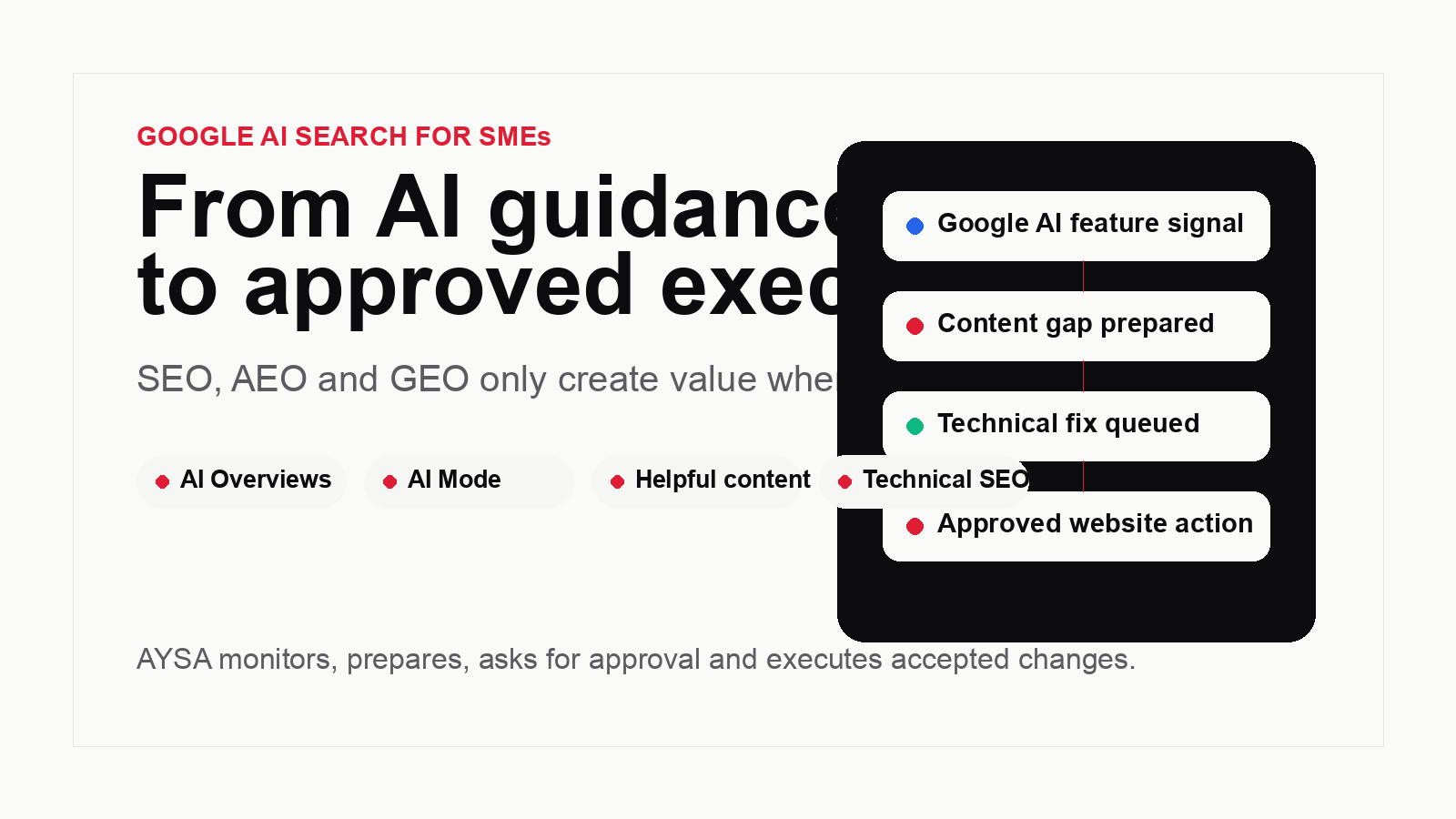
Executive summary: Google’s new guide to optimizing for generative AI features is important, but not because it introduces a secret new checklist. It does almost the opposite. Google says that SEO fundamentals still matter for AI Overviews and AI Mode: crawlable pages, useful content, clear technical structure, good page experience, internal links, images and videos where helpful, accurate business details, and content that gives users real value.
For small and medium-sized businesses, the hard part is not understanding one more acronym. The hard part is execution. A business owner does not need to manually chase SEO, AEO, GEO, AI Overviews, AI Mode, schema, Search Console, content updates, technical fixes and internal links every week. This is where AYSA fits: the agent monitors, prepares the work, explains what matters, asks for approval and executes approved changes inside the website workflow.

What happened
On May 15, 2026, Search Engine Land reported that Google had published a new guide about optimizing websites for generative AI features in Google Search. The guide is not a tiny announcement. It is a useful consolidation of how Google wants site owners to think about AI Overviews, AI Mode, query fan-out, content quality, Technical SEO, local and ecommerce details, and the myths that have started to grow around “AI SEO.”
The Search Engine Land article summarized the guide as covering the continued relevance of SEO, the need for valuable non-commodity content, technical structure, local and ecommerce details, mythbusting, agentic experiences and next steps. That summary is useful because it gives marketers the map. But the official Google document is where the real signal is.
Google’s official guide says that generative AI features in Search are rooted in core Search ranking and quality systems. It also explains two important concepts: retrieval-augmented generation, where systems use Search ranking systems to retrieve relevant current web pages, and query fan-out, where a model issues multiple related searches to gather more information around a user’s question.
That matters because it confirms something many SEOs have felt for the last year: AI visibility is not separate from SEO, but it does increase the need for clarity, depth, technical hygiene and useful content. A weak website does not become strong because someone adds “GEO” to the strategy deck. A strong website becomes more eligible because it is crawlable, useful, trusted, structured and maintained.
Google’s central message: SEO is still relevant
The clearest line from Google is that SEO best practices continue to matter for generative AI search. Google explicitly frames AEO and GEO as terms people may use, but from Google Search’s perspective, optimizing for generative AI search is still optimizing for the search experience.
This is important because the market is already full of noise. Some vendors are selling AI visibility as if it were a completely separate channel with secret files, secret markup and secret text formatting. Google’s guide pushes back against that. It says that AI Overviews and AI Mode rely on Google’s Search systems, and that the best path is still to create useful content, keep the site technically accessible, follow policies and serve users well.
That does not mean nothing changed. The user interface changed. The way answers are synthesized changed. The number of supporting sources can change. The user journey can become more conversational. Query fan-out means a single user question can trigger multiple related searches across subtopics. But the work behind visibility still looks like serious search work: crawl, index, content, authority, entity clarity, page experience, internal linking, structured information and measurement.
For SMEs, this is both good news and bad news. The good news is that they do not need to throw away everything and chase a new magical discipline. The bad news is that the fundamentals are not easy to execute consistently. Most small businesses already struggle to keep titles, service pages, product pages, reviews, technical SEO, internal links, Search Console issues and content refreshes up to date.
SEO, AEO and GEO: useful language, not separate realities
It is useful to talk about SEO, AEO and GEO because each label helps explain a different user interface. SEO is the foundation: search visibility, indexing, content, links, technical quality and user satisfaction. AEO focuses attention on direct answer readiness: clear explanations, concise answers, FAQs, definitions, comparisons and structured content. GEO focuses attention on generative engines: source selection, synthesis, citation, entity clarity and content that can support an AI-generated response.
But these should not become disconnected silos. A business owner does not need one freelancer for SEO, another consultant for AEO, a separate GEO checklist, a schema person, a technical auditor and a content strategist who never talks to the developer. The website needs one operating model that can handle visibility across classic search and AI-assisted search.
Google’s guide supports this unified view. It does not say “build a different website for AI.” It says the underlying Search work remains relevant. It also says AI features use query fan-out and may show a broader set of helpful links. That means a website should answer the real topic space around a user’s need, not only a single exact-match keyword.
For example, a small ecommerce site selling children’s shoes should not only publish a category page called “children’s shoes.” It should explain sizes, age ranges, return policy, materials, delivery, foot measurement, seasonal use, parent concerns, brand differences, care instructions and buying guidance. A local clinic should not only have a page called “pediatrics.” It should answer what parents need to know, when to book, what doctors are available, how the appointment works, what is urgent and what the clinic can or cannot handle.
This is where AI search raises the standard. Generic content is easier to ignore. Useful, specific, well-structured, experience-backed content has a better chance of being selected as support for a more complex answer.
The real content challenge: non-commodity content
One of the strongest parts of Google’s guide is the focus on non-commodity content. Google warns against recycling what is already on the internet or publishing content that could easily be produced by a generative AI model. The point is not that AI-assisted writing is forbidden. Google’s broader guidance has repeatedly focused on the quality and usefulness of content rather than the mere fact that automation was used. The point is that the final page must give users something valuable.
This is the line many websites fail to cross. They publish pages that are technically readable but practically empty. They define a term, list five generic tips, add a stock-like image and call it a strategy. That does not help a user make a decision. It also does not help an AI system understand why this page is uniquely useful.
Good content starts with a harder question: what would make this page the most useful result for a specific user, at a specific stage of the journey, in a specific market? A page about “best pediatric clinic in Bucharest” should not look like a generic medical directory. It should help a parent compare options, understand when to choose emergency care, see real criteria, evaluate trust signals and decide what to do next. A page about “technical SEO audit” should not only define the term. It should explain the checks, risks, examples, prioritization and what happens after issues are found.
That kind of content requires experience, structure and maintenance. It also requires restraint. Google warns against creating pages for every possible query variation simply to manipulate rankings or AI responses. That is a useful warning for the AI era. Query fan-out does not mean “generate thousands of thin pages.” It means “understand the real subtopics around a user need and cover them in a way that helps people.”
For SMEs, the right move is not mass content production. It is approved content execution: identify important gaps, prepare useful updates, review sensitive claims, publish carefully and measure the impact.
Technical structure becomes AI visibility infrastructure
Google’s guide also emphasizes technical structure. It mentions Search technical requirements, crawlability, JavaScript SEO, semantic HTML, page experience and duplicate content. This should not surprise anyone who has worked on real websites. AI features still need access to web content. If a page cannot be crawled, indexed, rendered, understood or shown with a snippet, it is not a strong candidate for visibility in Google’s AI features.
Technical SEO becomes more important for SMEs because many small websites run on fragile stacks: overloaded WordPress themes, too many plugins, slow hosting, broken redirects, duplicate archives, bad canonicals, messy sitemaps, uncompressed images and JavaScript-heavy interfaces. These problems are not glamorous, but they block growth.
Google also points out that semantic HTML should be used for human readability and accessibility, not as a perfection contest. That is a healthy message. The goal is not to create a website that only machines appreciate. The goal is to make the page understandable to people, screen readers, browsers, crawlers and retrieval systems.
For AI features, technical hygiene has a second effect: it reduces ambiguity. Clean internal links tell search systems which pages matter. Good canonical handling reduces duplicate confusion. Fast, stable pages help users and crawlers. Structured data that matches visible content can support rich result eligibility and clarity. Updated sitemaps help discovery. Accurate robots and preview controls help site owners manage what is shown.
The practical problem is that technical SEO recommendations often die in reports. Someone audits the website, exports a spreadsheet and sends it to the business owner. The owner is busy. The developer is unavailable. The agency prioritizes something else. The same issues remain for months. AI search does not make that execution gap less painful. It makes it more expensive.
Local business and ecommerce details matter more than most SMEs think
Google’s guide calls out local business and ecommerce details because AI responses can include product, service and local business information. For SMEs, this is not a minor footnote. It is often the commercial core of the website.
A local business needs accurate business details: name, address, phone, hours, service areas, categories, services, reviews, booking options and website pages that match the real offering. An ecommerce business needs product data, availability, prices, shipping, returns, images, category structure, product descriptions and information that helps a buyer choose confidently.
AI-assisted search can expose weak business information quickly. If your website says one thing, Google Business Profile says another, product feeds are incomplete, return policy is unclear and pages do not answer common buying questions, the business becomes harder to recommend.
This is why AI search optimization is not only a content department problem. It touches operations. It touches how a company describes services, manages inventory, handles reviews, publishes product data and keeps public information consistent. For small companies, this is exactly where the workload becomes unrealistic without automation.
AYSA’s view is that these details should be monitored as part of the same execution workflow. A missing service detail, a weak category page, a review pattern, an outdated business description, a product page with thin content and a technical indexation problem are not separate worlds. They are all website visibility tasks that need to be prepared, approved and executed.
The myths Google tells site owners to ignore
The mythbusting section of Google’s guide is useful because it cuts through several trends that have become fashionable. Google says site owners do not need special machine-readable files, AI text files or special markup to appear in generative AI features. It also says there is no requirement to “chunk” content into tiny pieces, no need to rewrite content in a special AI-only style, and no need to chase inauthentic mentions.
This does not mean structure is useless. Structure is extremely useful. But structure should serve humans first. A table of contents, clear headings, concise answer blocks, examples, comparison tables, images and video can all help users. They can also make content easier to interpret. The mistake is turning every page into a mechanical artifact for AI extraction while forgetting the reader.
Google’s warning about inauthentic mentions is also important. As AI visibility becomes a commercial target, some businesses will try to manufacture fake references across the web. That is risky and short-sighted. Authority building should be real, relevant and controlled. Mentions, links, PR, partnerships and publisher placements should support actual trust, not create artificial noise.
This is why AYSA integrates authority building carefully. The goal is not “buy links and hope.” The goal is to surface relevant publisher opportunities, explain the context, require approval before spending and track delivery. In the AI search era, authority should help users and systems understand why a business is credible.
What to avoid
Special AI-only files, thin pages for every query variation, fake mentions, generic AI summaries, schema that does not match the page, and content written only for machines.
What to build
What SMEs and non-SEO teams should actually do next
The average SME does not need a 90-page AI SEO framework. It needs a practical operating model. Based on Google’s guide, the next steps are clear.
First, identify the pages that matter commercially. For most businesses, that means homepage, core service pages, product category pages, pricing pages, location pages, comparison pages, FAQ/support pages and a few educational guides that influence buying decisions. These pages should be useful, specific and current.
Second, audit content for usefulness, not only keywords. Ask whether the page answers real user questions, contains a unique point of view, explains the process, shows proof, includes relevant images or video, and helps the user decide. If the page only repeats generic information, it is a candidate for improvement.
Third, fix technical blockers. Make sure important pages can be crawled, indexed and shown with snippets. Clean up duplicates, broken links, redirect chains, orphan pages, canonical conflicts, sitemap noise and slow mobile experiences.
Fourth, update business data. For local businesses, keep Google Business Profile and website details aligned. For ecommerce, keep product data, images, availability, shipping and return information accurate. For service businesses, make the offer, pricing logic and process explicit.
Fifth, measure what matters. Search Console still matters, but Google’s guide reminds us that AI feature traffic is reported within overall Web search data. That means businesses should combine Search Console, Analytics, conversion tracking, rank monitoring, AI visibility checks and business outcomes rather than relying on one number.
Sixth, build a repeatable approval workflow. This is the missing piece. Recommendations are not results. The work must be prepared, reviewed, approved and executed. Without that loop, the website slowly falls behind.
Where AYSA fits in this mix
AYSA is built for exactly this moment. Google’s guidance does not say that businesses need magic AI tricks. It says the hard work of SEO still matters in generative AI search: useful content, technical clarity, crawlability, internal links, page experience, accurate business details, images, video, structured data where appropriate and real value for users.
That is a lot of work. For an enterprise team, it becomes a roadmap. For a small business owner, it becomes a burden. For a non-SEO marketer, it becomes a pile of tools and tabs. AYSA turns that into an execution workflow.
AYSA can monitor website performance, read Google signals, detect opportunities, prepare page improvements, suggest internal links, identify technical issues, prepare AEO-friendly answer sections, surface authority opportunities, flag sensitive items for approval and execute accepted changes inside the website workflow. The user does not need to become a full-time SEO specialist. The user needs to review and approve the important actions.
This is the difference between a tool and an agent. A tool shows data. An agent prepares work. A good SEO agency can do this manually, but many SMEs cannot afford slow, custom execution for every small task. AYSA’s promise is not “no human judgment.” The promise is “less manual SEO work, more approved execution.”
For non-SEO users, this matters because the product speaks in business terms: what is wrong, why it matters, what will be changed, what requires approval and what happens next. That is the layer most SEO tools miss. They provide diagnostics, but not operational clarity.
The AYSA point of view
My view is that Google’s guide should calm the market down, not make it more frantic. AI Overviews and AI Mode are important. Query fan-out is important. Agentic experiences are important. But the answer is not to chase hacks. The answer is to build a website that deserves to be used as a source and to create a system that keeps improving it.
For SMEs, the future of SEO is not becoming more technical acronyms. The future is execution. Monitor the site. Understand the business. Find opportunities. Prepare useful changes. Get approval. Publish. Measure. Repeat.
That is why AYSA exists. It is not another dashboard for people who already have too many dashboards. It is an AI SEO execution agent for companies that want organic growth without doing the manual SEO work themselves.
Less SEO work. More organic growth.
Turn Google’s AI search guidance into approved website action.
AYSA monitors your website, prepares SEO, AEO, GEO and AI visibility improvements, asks for approval and executes accepted changes inside your website workflow.
Sources and further reading
- Search Engine Land: Google publishes guide on optimizing for generative AI features
- Google Search Central: Optimizing your website for generative AI features on Google Search
- Google Search Central: AI features and your website
- Google Search Central: Creating helpful, reliable, people-first content
- Google Search Central: Meta tags and preview controls Google supports
- Google Search Central: Get started with Search Console
Continue the AI search topic inside AYSA.
Use these pages to connect the article with AI SEO tools, AI visibility monitoring, AI Overviews and approved website execution.
Turn this topic into a website action plan.
Use these AYSA hubs to move from reading to technical fixes, AI visibility monitoring, research, glossary context and approval-first SEO execution.

