
Google Search Agents: Why SEO Is Becoming a Task-Readiness Discipline
Google Search is gaining information agents and improved agentic experiences. Here is what SMEs need to understand about SEO, AI visibility and approved execution.
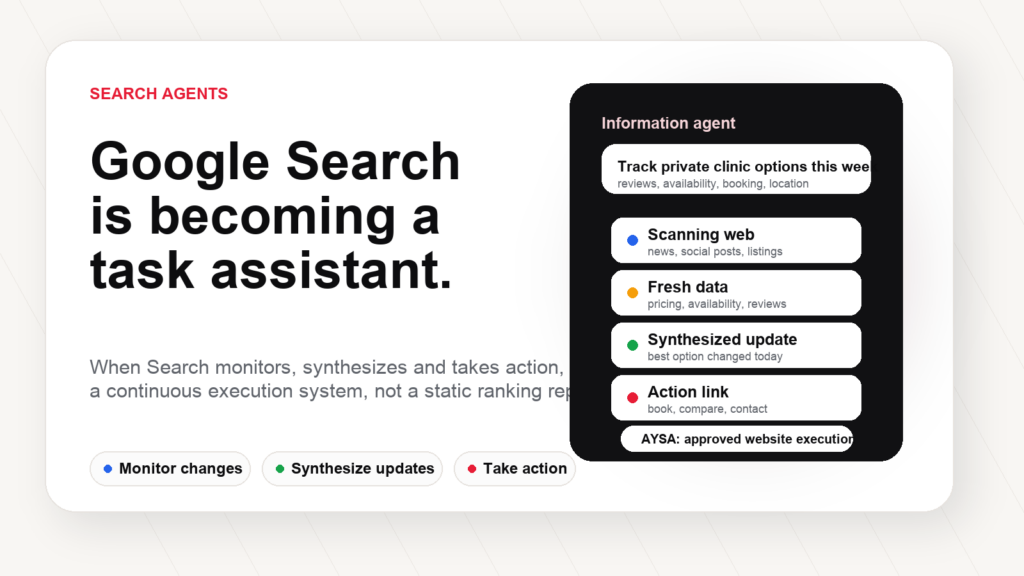
Executive summary: Google is turning Search into something more active than a list of links. Search Engine Land reported on Google’s new information agents and improved agentic experiences: systems that can help users monitor information, research topics, plan decisions and complete tasks. This is part of the same direction we have already seen with AI Mode, query fan-out, Universal Cart and AP2.
For SMEs, the implication is practical: SEO is no longer only about being found at the moment of the query. Your website, products, services, reviews, policies and authority signals must be clear enough for AI systems to understand, compare and act on. And because the environment changes quickly, the business needs a workflow that can monitor, prepare, approve and execute improvements continuously.
What Google announced
Search Engine Land reported that Google Search is gaining information agents and improved agentic experiences. The announcement fits Google’s broader Search I/O 2026 message: Search is moving from answering a single query to helping users explore, plan and act across longer tasks.
Google’s official Search I/O 2026 announcement describes several related shifts: AI Mode as a deeper search experience, query fan-out for complex questions, personal context when users allow it, improved multimodal inputs, agentic checkout and experiences that can help users continue from an overview into a richer workflow.
The word “agent” is important. In classic search, the user did most of the work: type a query, scan results, open tabs, compare pages, remember constraints, make a decision. In agentic search, Google wants the system to do more of that work: gather information, monitor changes, synthesize options and help the user move toward action.
This is not science fiction anymore. It is product direction from the largest search platform in the world.
The user collects information and decides which result deserves attention.
The system helps compare options, watch changes and move the user closer to completion.
From search engine to task assistant
For more than two decades, the main mental model of SEO was simple: people search, Google ranks pages, users click. That model is still true, but it is no longer complete.
When Search becomes more agentic, it starts to behave less like a directory and more like a task assistant. A user may not ask “best pediatric clinic Bucharest” anymore. They may ask: “I need a private pediatric clinic in Bucharest for a toddler with recurring fever, good reviews, easy parking and online booking. What should I compare?”
That query is not looking for one Keyword-matched page. It asks the system to understand need, location, trust, urgency, logistics and decision criteria. A useful answer may combine business listings, reviews, websites, maps, booking availability, articles and local context. In that world, a business has to be understandable in several layers: website content, Structured data, reviews, local profiles, third-party references and practical operational details.
The same pattern applies to ecommerce, B2B software, hotels, parking near airports, local services, clinics, florists and agencies. People are not only searching for pages. They are asking systems to help them decide.
What this changes for SEO
The biggest change is not that classic SEO disappears. It does not. Google’s own guidance for generative AI features still points to foundational search quality: Crawlability, Indexability, useful content, page experience, structured data where appropriate and snippet eligibility.
But agentic experiences add pressure on three areas.
First: completeness. A thin service page may rank for a keyword, but it may not contain enough information for an AI system to confidently recommend it in a nuanced task. Missing pricing context, location details, process explanations, availability, eligibility, reviews or clear next steps can all become visibility gaps.
Second: freshness. If agents monitor changes, stale information becomes more dangerous. Old opening hours, outdated pricing, discontinued products, broken booking links and expired offers can reduce trust. Freshness is not only a blog tactic. It becomes a business-data requirement.
Third: actionability. A page should not only inform. It should help the next step happen: book, compare, request, buy, call, check availability, understand the process or decide not to proceed. Agentic systems favor information that can support a task.
This is why the old SEO workflow of quarterly audits and slow implementation is getting weaker. Search is becoming more dynamic, but many websites are still maintained like brochures.
Examples for SMEs
For a private clinic, agentic search readiness means more than a homepage and a few service pages. It means clear specialties, doctor information, appointment process, location, parking, accepted age groups, emergency limitations, reviews, online booking and helpful medical content written carefully and responsibly.
For an ecommerce store, it means clean product data, accurate stock, delivery information, returns, reviews, comparison guidance and category pages that answer buying questions. This connects directly to our recent article on Google Universal Cart, AP2 and agentic commerce: shopping discovery is becoming more structured, contextual and action-oriented.
For a hotel or HoReCa business, it means room types, amenities, location context, parking, policies, nearby attractions, reviews, seasonal information and booking clarity. For parking or car rental near airports, it means airport distance, shuttle timing, insurance, pricing transparency, booking process, pickup rules and trust signals.
For agencies and B2B services, it means case studies, proof, process, pricing logic, service boundaries, team expertise and clear outcomes. A generic “we help you grow” page is not enough when AI systems are asked to compare providers.
Technical readiness matters more, not less
Agentic search does not make Technical SEO obsolete. It makes technical SEO more important because the system has to discover, retrieve and interpret information reliably.
Important technical layers include:
- crawlable HTML content, not hidden behind fragile JavaScript;
- clean canonical rules and no redirect chains;
- fast mobile performance and stable layout;
- schema that matches visible content;
- clear Internal linking between related pages;
- indexation control for duplicate or low-value pages;
- fresh sitemaps and accurate metadata;
- consistent entity signals across website, profiles and external mentions.
The important point is that technical SEO is no longer only about crawling efficiency. It is also about retrieval quality. If a machine has to understand and cite the page, messy structure becomes a business problem.
Where AYSA fits
AYSA.ai is built for the part most SMEs struggle with: moving from insight to approved execution.
When Search becomes agentic, the website needs constant improvement. Not chaotic daily rewriting, but controlled, evidence-based updates: better service pages, clearer FAQs, improved internal links, schema opportunities, refreshed content, stronger business profiles, repaired redirects, better category explanations, authority-building opportunities and monitoring of AI visibility gaps.
AYSA can help monitor the website and Google data, detect SEO, AEO and AI visibility opportunities, prepare the work, explain why it matters, request approval and execute accepted changes inside the website workflow. That last part matters. Most businesses do not fail because nobody found a problem. They fail because the problem stayed in a report.
Agentic Search raises the cost of slow execution. If Google can help users compare and act faster, businesses need to update and clarify their own information faster too.
My point of view
In my opinion, the next version of SEO is not “AI tricks.” It is operational clarity. The businesses that win will make themselves easy to understand, easy to compare, easy to trust and easy to act on.
That requires content, technical SEO, structured information, authority signals and execution working together. It also requires humility: no one can guarantee AI Overviews, AI Mode citations or agentic recommendations. But businesses can improve the signals that make inclusion and recommendation more likely.
The practical question for SMEs is not: “How do I hack AI Search?” The better question is: “If an AI agent had to understand, compare and recommend my business tomorrow, what would it fail to understand today?”
That is where the work starts.
Make your website easier for people and agents to understand.
If you are tired of SEO work living in reports, AYSA can monitor your website, prepare improvements, ask for approval and execute accepted SEO, AEO and AI visibility actions inside your website workflow.
Sources and further reading
Continue the AI search topic inside AYSA.
Use these pages to connect the article with AI SEO tools, AI visibility monitoring, AI Overviews and approved website execution.
Turn this topic into a website action plan.
Use these AYSA hubs to move from reading to technical fixes, AI visibility monitoring, research, glossary context and approval-first SEO execution.

