
Gemini 3.5 Flash in Google Search: Why Faster AI Mode Raises the SEO Execution Bar
Google Search is now powered by Gemini 3.5 Flash. Faster AI Mode changes query fan-out, source comparison and the speed required for SEO execution.
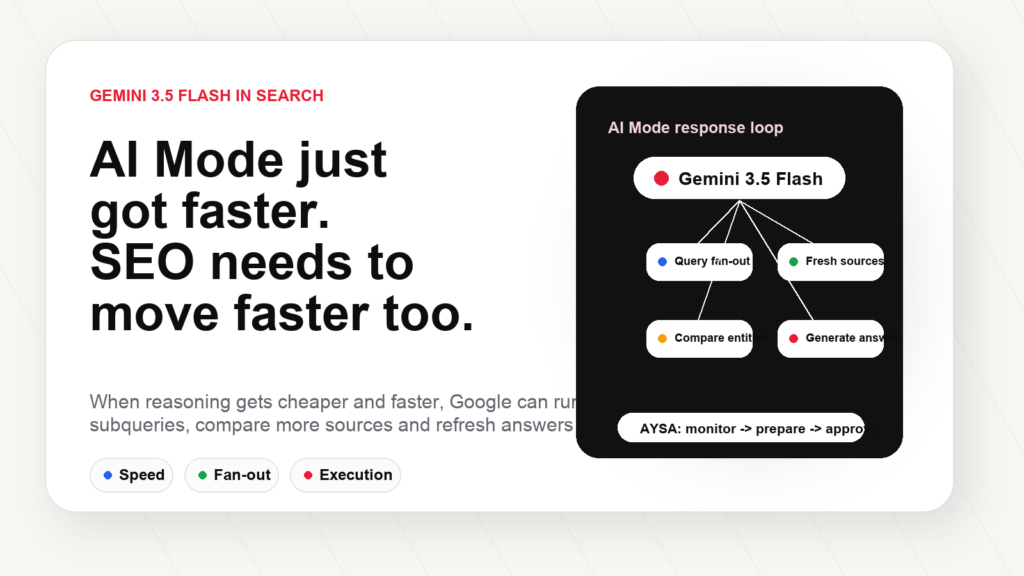
Executive summary: Search Engine Land reports that Google Search is now powered by Gemini 3.5 Flash. This matters because AI Mode is not only becoming more capable; it is becoming faster and more economical to run at scale. When reasoning gets faster, Google can fan out more queries, compare more sources and generate richer answers with less friction.
For SEO, the message is simple: slower execution becomes a bigger risk. Websites need clean technical access, useful content, Entity Clarity, fresh information and an operating workflow that can turn opportunities into approved updates quickly. Gemini 3.5 Flash is not a reason to chase AI tricks. It is a reason to make the website easier to retrieve, understand and act on.
What happened
Search Engine Land reported that Google Search is now powered by Gemini 3.5 Flash. The news fits a broader set of Google Search I/O 2026 announcements: AI Mode, query fan-out, information agents, agentic shopping and richer search experiences that go beyond classic Keyword matching.
Google’s official Search I/O 2026 update describes Search moving toward more complex, multimodal and conversational tasks. The model behind those experiences matters because speed and cost shape product behavior. A faster reasoning model makes it easier for Google to run deeper workflows more often.
Google DeepMind describes the Gemini Flash line as optimized for speed, efficiency and high-volume use cases. That is exactly the kind of model profile that fits Search: millions of users, many queries, quick responses and enough reasoning power to synthesize information across multiple sources.
SEO teams optimize pages and wait for rankings to move.
Google can retrieve, compare and synthesize information faster across a wider answer space.
Why Flash matters
When a search product uses a faster model, the user experience changes. It can answer more quickly. It can support follow-up questions with less friction. It can run more subqueries in the background. It can compare options, summarize sources and maintain context more fluidly.
This is not only a technical upgrade. It changes the competitive environment for websites. If AI Mode can run deeper research on behalf of the user, then weak pages become easier to skip. Generic content becomes easier to summarize without Attribution. Missing details become easier to expose. Stronger sources become easier to combine into better answers.
In a classic SERP, a page could sometimes win with a decent title, some authority and acceptable content. In a richer AI Search experience, the page must contribute something useful to a synthesized answer. That means clear facts, fresh information, well-structured sections, evidence, examples, entities and practical next steps.
What changes for SEO
The first change is that query fan-out becomes more important. Google has already described AI Mode as using a query fan-out technique, where the system breaks a complex question into related subtopics and searches across them. A faster model makes this type of behavior more natural.
The second change is that topical gaps become more visible. If your website has a service page but does not explain pricing logic, locations, eligibility, process, comparisons or proof, AI systems may retrieve competitors that answer those subquestions better.
The third change is freshness. Faster AI search experiences can make stale information more costly. If your business hours, prices, product availability, booking flow, shipping information or service details are outdated, that weakness can influence recommendations and summaries.
The fourth change is that Technical SEO remains foundational. Google’s guidance for generative AI features still points to Crawlability, indexability, snippet eligibility, useful content and page experience. AI Search does not bypass the website layer. It depends on a clean, retrievable web.
The fifth change is speed of implementation. If the search system can evaluate more sources faster, the business cannot afford slow website updates. The bottleneck becomes not only analysis, but execution.
The risk for SMEs
Large companies can assign teams to content, product data, technical SEO, analytics, PR and development. SMEs usually cannot. That creates a dangerous gap: Google Search is becoming more dynamic, but many SME websites are updated slowly, manually and inconsistently.
A clinic may have excellent doctors but weak service pages. A hotel may have great rooms but unclear amenity information. A florist may have strong local demand but poor category structure. A car rental company may have good offers but confusing pickup rules. An ecommerce store may have products in stock but incomplete schema, weak category copy and inconsistent feed data.
In a faster AI search environment, those missing details are not small editorial issues. They can be reasons the business is not selected, cited or recommended.
A practical playbook
If I were preparing an SME website for AI Mode powered by faster models, I would focus on five areas.
1. Make the important pages complete. Service pages and category pages should answer the questions a buyer actually asks: what it is, who it is for, where it is available, how much it costs or how pricing works, what the process looks like, what proof exists and what to do next.
2. Strengthen entity clarity. The website should make the business, services, locations, products, people and credentials easy to understand. This is useful for users and for retrieval systems.
3. Improve internal linking. AI search may retrieve passages across related topics. Strong internal linking helps clarify relationships between services, guides, categories, locations and glossary concepts.
4. Keep data fresh. Outdated business information is a trust problem. Update pages, feeds, opening hours, policies, pricing context, booking links and stock information when reality changes.
5. Move faster from insight to action. Ranking reports are not enough. If AI search exposes a gap, the website needs an approved change, not another meeting.
Where AYSA fits
AYSA.ai is built around the execution layer that most SMEs lack. It monitors the website and Google data, identifies SEO, AEO and AI visibility opportunities, prepares the work, explains the reason, asks for approval and executes accepted changes inside the website workflow.
That matters more as Search becomes faster and more agentic. Gemini 3.5 Flash is not just a model upgrade; it is a sign that AI Search can run more reasoning at scale. The web will be evaluated more dynamically. Businesses need a system that can keep up.
AYSA does not promise guaranteed AI Overview inclusion or guaranteed citations. No serious product should. But it can help improve the practical signals that make a website easier to crawl, understand, retrieve, compare and update.
In my opinion, that is the real SME opportunity: not to “hack” Gemini, but to build a website operating model that can keep pace with AI-assisted search.
Your SEO execution needs to get faster too.
If your website still depends on slow manual SEO workflows, AYSA can monitor opportunities, prepare approved actions and execute accepted changes inside your website workflow.
Sources and further reading
Continue the AI search topic inside AYSA.
Use these pages to connect the article with AI SEO tools, AI visibility monitoring, AI Overviews and approved website execution.
Turn this topic into a website action plan.
Use these AYSA hubs to move from reading to technical fixes, AI visibility monitoring, research, glossary context and approval-first SEO execution.

