
Gemini Spark and the Agent Era: Why SEO Software Must Move From Advice to Execution
Google Gemini Spark shows the move from chatbot answers to background AI agents. Here is why SEO software for SMEs must become an approved execution layer.
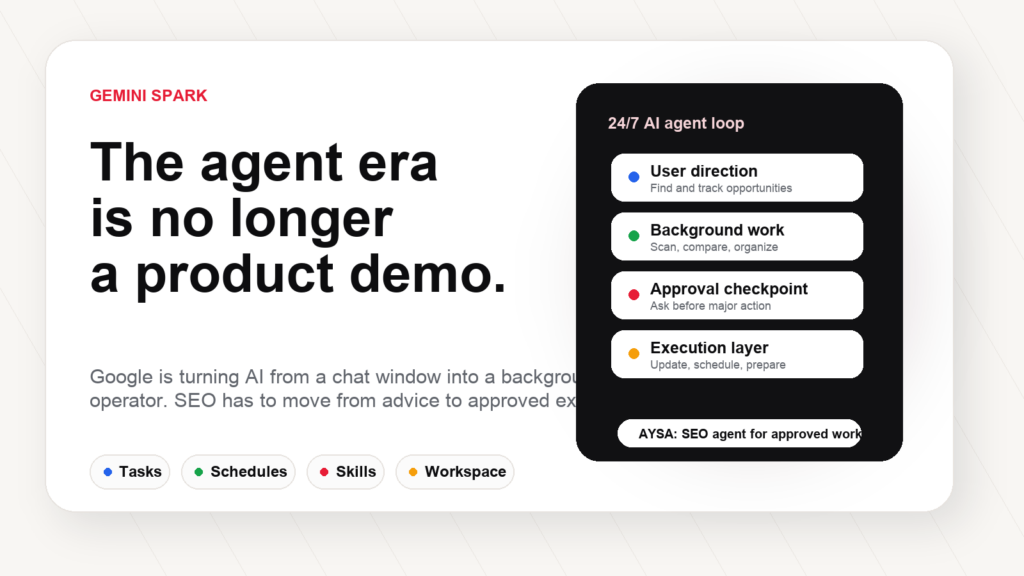
Executive summary: Google’s Gemini Spark page describes a 24/7 personal AI agent that can work in the background, use connected Google apps, organize tasks, research, plan and check with the user before important actions. This is not just another chatbot feature. It is a signal that AI products are moving from “answer my question” to “help me operate.”
For SEO, AEO and AI visibility, the implication is direct: the future belongs to systems that can monitor, prepare, ask for approval and execute. SMEs will not win by reading more dashboards. They will win by turning the right work into approved website action faster than competitors.
What Gemini Spark is
Google’s official Gemini Spark page presents Spark as a personal AI agent that can run continuously, work in the background, connect to Google apps and help users plan, research, organize and execute tasks. The positioning is important: Spark is not described as a simple Answer box. It is described as an agent.
The page highlights several ideas that matter for the broader market: background work, scheduled and recurring tasks, connections to Gmail, Calendar, Drive, Docs, Sheets, Slides, YouTube and Maps, and approval before major actions. That last part is especially important. The agent is useful because it can act, but safe because the user remains in control.
This is the same pattern we are seeing across Google Search announcements in 2026: AI Mode, information agents, Universal Cart, Agent Payments Protocol and richer task-oriented experiences. The product direction is clear. AI is moving from content generation toward operational assistance.
The user still has to copy, paste, check, prioritize, schedule and execute.
The system can monitor, prepare, organize and execute approved steps.
Why Spark matters beyond Google Workspace
Spark matters because it teaches users a new expectation: AI should not only talk. It should help move work forward. Once users get used to agents that can remember context, monitor tasks and prepare actions, they will expect the same from business software.
This is a big shift for SEO tools. Traditional SEO software shows rankings, dashboards, technical issues, content gaps and reports. That is useful, but it is not enough for most SMEs. A business owner does not want ten dashboards. They want to know what should be done, why it matters, what it costs, what risk exists and whether they can approve it.
Google’s Spark framing reinforces the same direction we covered in our recent article on Google Search agents and task-readiness SEO: Search and AI experiences are becoming more operational. They do not stop at discovery. They move toward decisions and actions.
The agentic shift: background work plus approval
The most important product idea in Spark is not the visual design or the app list. It is the combination of background work and user control.
In the old software model, the user had to do everything manually: open the dashboard, interpret the issue, create the task, brief the developer, check the content, approve the change and publish. In the agentic model, the software can prepare much of that work and bring the user into the loop at the right moment.
That is the correct model for SEO too. Blind automation is dangerous. Manual execution is too slow. The practical middle ground is approval-first automation: the agent monitors, prepares and explains; the user approves important actions; the system executes what was accepted.
This is not only safer. It is also more realistic for SMEs. Most business owners do not want to become SEO specialists. They want the benefits of SEO without having to manage every technical detail.
What this means for SEO, AEO and AI visibility
SEO is becoming a continuous operating function. AI Search changes quickly. Google rolls out new Search experiences. AI Overviews evolve. AI Mode changes how users ask questions. Product discovery shifts toward agents. Search engines and answer engines use different retrieval patterns. Competitors update content. Reviews change. Technical issues appear. Old pages become stale.
A traditional SEO workflow struggles with that speed. A monthly report can identify issues, but the website may still be unchanged months later. The more dynamic search becomes, the more expensive slow execution becomes.
An Agentic SEO workflow should be able to:
- monitor Google Search Console, analytics, rankings and AI visibility signals;
- detect weak pages, missing topics, poor internal links and technical issues;
- prepare specific changes rather than vague recommendations;
- explain the business impact in plain language;
- ask for approval before publishing or spending;
- execute accepted website changes safely;
- keep action history so the business understands what changed.
That is a different category from a reporting tool. It is closer to an operating layer.
A practical SME playbook
If you run an SME website, Spark should not make you panic about another Google product. It should make you ask a better question: where is your business still dependent on manual SEO work that nobody has time to do?
Start with the obvious bottlenecks. Are your service pages complete? Are your product pages structured clearly? Are your important pages internally linked? Are old redirects still broken? Are reviews and trust signals visible? Are AI-relevant questions answered? Are your local profiles consistent? Are your metadata and schema aligned with visible content?
Then ask: when a gap is found, who actually fixes it?
If the answer is “we send it to someone and wait,” that is the weakness. In an agentic web, finding the issue is not enough. The business needs an execution system.
Where AYSA fits
AYSA.ai is built around the same principle that makes agents useful: less manual work, more approved execution. AYSA is not a generic chatbot. It is designed as an AI SEO agent that understands the website, monitors opportunities, prepares SEO, AEO and AI visibility actions, asks for approval and executes accepted changes inside the website workflow.
Spark shows where user expectations are going. People will increasingly expect AI to organize work, prepare tasks and reduce operational friction. AYSA applies that logic to SEO and website visibility.
The goal is not to remove human judgment. The goal is to use human judgment at the right moment. Business owners should approve important actions, budgets and brand-sensitive changes. They should not have to manually copy meta descriptions, hunt for internal links, inspect redirects, update schema or translate every SEO recommendation into a developer task.
In my opinion, this is the future of SEO software for SMEs: not dashboards first, but agents that turn search work into controlled website execution.
Use an SEO agent that prepares work for approval.
If you want SEO, AEO and AI visibility work to move without becoming a full-time job, AYSA can monitor your website, prepare actions, ask for approval and execute accepted changes inside your website workflow.
Sources and further reading
Continue the AI search topic inside AYSA.
Use these pages to connect the article with AI SEO tools, AI visibility monitoring, AI Overviews and approved website execution.
Turn this topic into a website action plan.
Use these AYSA hubs to move from reading to technical fixes, AI visibility monitoring, research, glossary context and approval-first SEO execution.

