
Google May 2026 Core Update: What SMEs Should Do While It Rolls Out
Google’s May 2026 core update is rolling out. Here is how SMEs should analyze it without panic and turn volatility into approved SEO execution.
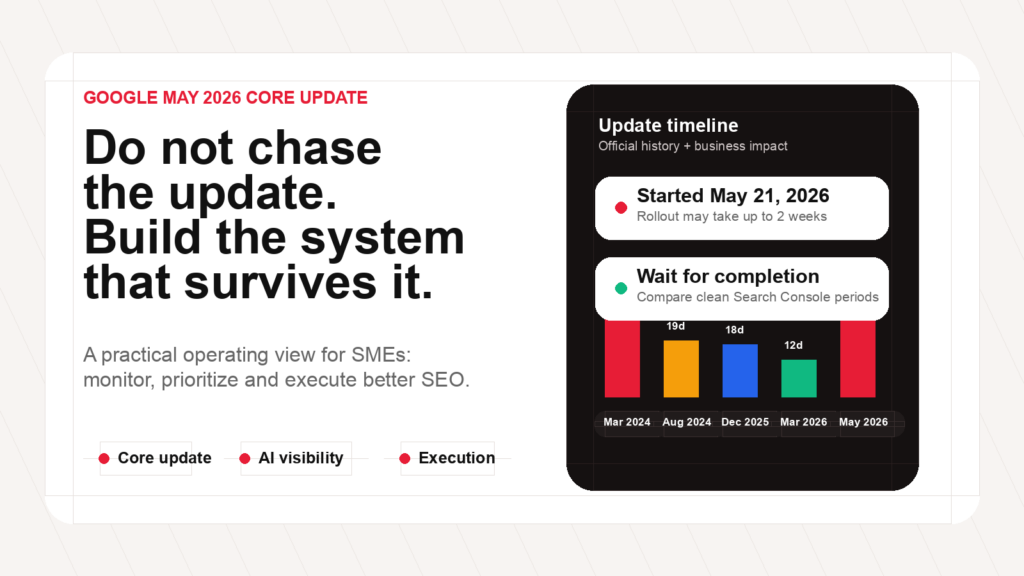
Quick summary: Google’s May 2026 core update started rolling out on May 21, 2026 at 08:40 PDT, according to the official Google Search Status Dashboard. Google says the rollout may take up to two weeks. That means that on May 22, 2026, it is still too early to declare winners, losers or final patterns.
The responsible response is not panic editing. It is measurement discipline: document baseline visibility, wait for the rollout to complete, compare clean time windows, inspect affected pages by intent and business value, and then improve the website system: content usefulness, technical accessibility, Entity Clarity, internal links, authority signals and conversion quality.
From the AYSA perspective, core updates are not “events to survive” once or twice a year. They are proof that SEO needs to operate continuously. The future is not a bigger report. It is an Approval-First Execution loop: monitor, diagnose, prepare work, approve, publish, measure and repeat.
What happened: Google’s May 2026 core update is rolling out
Google has started the May 2026 core update. The official Search Status Dashboard lists the start time as May 21, 2026 at 08:40 PDT and says the rollout may take up to two weeks. Search Engine Land covered the announcement in its report, “Google May 2026 core update rolling out now”.
This is the kind of update that creates anxiety because core updates are broad. They are not narrow spam actions. They are not manual penalties. They are changes to Google’s core ranking systems, which means many types of websites can move: publishers, ecommerce sites, local service businesses, SaaS companies, affiliate sites, marketplaces, medical sites, travel sites and small business websites.
But broad does not mean random. Core updates usually reassess how Google’s systems evaluate relevance, usefulness, quality, trust, intent satisfaction and overall page value. Sometimes a site drops because it did something wrong. Sometimes it drops because other pages became better, clearer, more complete, more trusted or more aligned with the query. Sometimes the change is not even site-wide; it is section-specific or intent-specific.
The important thing on day one is emotional control. During a rollout, rankings can move in ways that do not represent the final state. A page can drop, recover, move again and settle later. If you rewrite everything while Google is still rolling out the update, you may confuse diagnosis with reaction. You may also create new problems that make the next comparison impossible.
A ranking drop is a diagnostic signal, not a command to rewrite everything today.
Panic response
Change titles, rewrite pages, delete sections, Noindex content, rebuild navigation and blame one metric before the rollout is complete.
Operating response
Wait for stability, compare clean data, group affected URLs by intent, identify patterns, prepare fixes and approve execution in priority order.
What core updates are, in plain language
Google’s own core update guidance explains that there may be nothing “wrong” with pages that perform less well after a core update. The classic analogy Google uses is that a list of top movies can change over time because new movies become relevant or old evaluations change. The same idea applies to search. A page can lose visibility because the web, user expectations and Google’s evaluation systems changed around it.
For business owners, this is a frustrating but important distinction. A core update is not always a punishment. It is often a re-sorting of the web. If another page answers the query better, shows stronger first-hand usefulness, gives clearer evidence, covers the topic more completely, loads better, has stronger authority, or satisfies the intent more directly, it may rise. Your page may fall even if you did not “break” anything.
That is why generic SEO checklists are weak during core updates. The real question is not “What did Google change?” in the abstract. The real question is: “For the queries and pages where we lost visibility, what did Google decide is a better result, and why?”
That analysis requires looking at actual SERPs, competitors, page intent, content structure, internal links, search features, AI Overviews, local packs, video results, shopping results, user expectations and the business value of the page. A drop for a low-value informational post is different from a drop for a service page that drives leads. A drop in Impressions with stable conversions is different from a drop in qualified traffic. A drop in Google Search can also intersect with AI Search if the same content is difficult for answer systems to understand or cite.
A short history of recent Google core updates
The May 2026 core update is not happening in isolation. Google has been updating Search continuously, and broad core updates have become part of the normal operating environment for serious websites. The official Search Status Dashboard provides a useful public record of confirmed ranking update incidents and their durations.
A few recent examples matter for context. The March 2024 core update was unusually long, taking about 45 days to complete. Later updates, such as the August 2024 and December 2025 core updates, were shorter but still long enough to make mid-rollout analysis dangerous. The March 2026 core update took about 12 days and 4 hours, based on the official dashboard. The May 2026 update is currently expected to take up to two weeks.
That history gives us a useful operating statistic: many recent core updates should be analyzed on a two-to-six-week horizon, not a two-day horizon. You need enough time for rollout completion, data stabilization, query-level shifts, seasonality control and post-update measurement.
Core updates also rarely affect only one SEO dimension. A site can be hit because thin content is no longer competitive. Another can be affected because Internal linking fails to show topical relationships. Another can lose because its product pages are too generic. Another can drop because competitors improved trust and editorial depth. Another can struggle because technical rendering, indexation or crawlability prevents Google from reliably understanding the site.
That is why update history should be used as an operational planning tool, not just as industry trivia. If core updates regularly take days or weeks to complete, then a serious SEO process needs saved baselines, clean annotations, crawl snapshots, Search Console exports, page-group segmentation and a way to compare what changed after the system stabilizes. Without that discipline, every update becomes a debate based on feelings, screenshots and isolated keyword movements.
In 2026, we also have to add AI search to the context. Search is not only ten blue links. AI Overviews, AI Mode, answer engines and generative retrieval systems are changing how content is selected, summarized and cited. A core update may not be “about AI” directly, but the same foundations matter: useful pages, clear entities, structured information, crawlable content, original experience, trusted sources and strong internal relationships.
Use confirmed dates and clean comparisons, not one-day panic charts.
Long rollout, roughly 45 days. A reminder that broad systems can take weeks to settle.
Completed after about 12 days and 4 hours on the official dashboard.
Started May 21, 2026. Google says rollout may take up to two weeks.
Useful statistics and signals to track during this update
When a core update starts, many people immediately look at ranking volatility tools. Those tools can be useful for detecting market turbulence, but they do not tell you what happened to your business. Your own data matters more.
Here are the statistics I would track first:
1. Search Console clicks and impressions by page group
Do not only look at the whole domain. Segment by page type: service pages, category pages, product pages, blog posts, glossary pages, local landing pages, comparison pages and guides. A domain-wide drop can hide that one section fell while another improved. AYSA uses this kind of segmentation because SEO action should happen at page and cluster level, not only domain level.
2. Query groups, not only single keywords
Single keyword tracking can mislead you during a rollout. Group queries by intent: informational, local, commercial, transactional, branded, competitor comparison, problem/solution and AI-search-style questions. Core updates often reshape which type of page Google prefers for an intent. If an article loses informational impressions but a commercial page gains qualified clicks, that is a different business story than a full visibility collapse.
3. Average position distribution
Look at how many queries moved from positions 1-3 to 4-10, 4-10 to 11-20, or 11-20 to 20+. A small average-position change can hide a major loss of top visibility. A page that moves from position 2 to position 6 may still “rank,” but the click economics change dramatically.
4. SERP feature changes
Track whether affected queries gained AI Overviews, videos, product grids, local packs, forums, news boxes or shopping modules. Sometimes organic blue-link movement is partly caused by SERP layout changes. This is why we increasingly talk about search visibility rather than rankings alone.
5. Conversion quality
SEO is not only traffic. For SMEs, the business question is whether qualified leads, bookings, orders or calls changed. A page can lose low-quality impressions and still become more efficient. Another can maintain traffic but lose the queries that actually convert. If you only look at total clicks, you may optimize the wrong thing.
6. AI visibility and citation signals
As AI search grows, it becomes important to track whether your brand appears in AI answers, whether pages are cited, whether competitors are mentioned more often, and whether your content is easy to extract. We should be careful here because measurement is still evolving, but ignoring it would be a mistake.
What not to do while the May 2026 core update is rolling out
The most expensive mistakes during core updates usually come from reaction, not from analysis. Here is what I would avoid.
Do not rewrite your entire site during the rollout
If rankings move today and you rewrite a large number of pages tomorrow, you destroy the baseline. You will not know whether future movement came from the update, your changes, seasonal demand, competitor movement, tracking changes or a combination. Wait for completion before making large strategic edits unless you find a clear technical or compliance problem.
Do not delete content just because it lost impressions
Content pruning can be useful, but deleting too quickly can remove internal link value, topical support and long-tail coverage. A page with lower traffic may still support a cluster, answer a customer question or help AI systems understand the business. First classify the page: update, merge, redirect, noindex, keep or delete.
Do not chase one “ranking factor” explanation
Core updates are broad. If someone says the May 2026 update is only about backlinks, only about AI content, only about E-E-A-T, only about freshness or only about page speed, be careful. Those elements can matter, but the actual impact usually depends on query, intent, competitor set and page quality.
Do not ignore technical health
Content quality is not enough if Google struggles to crawl, render, canonicalize or index the site. Core update recovery work often reveals boring technical problems: duplicate canonicals, weak internal linking, thin tag pages, slow templates, plugin bloat, bad redirects, broken pages, sitemap noise or content hidden behind heavy JavaScript.
Do not separate SEO from business reality
A page can be optimized for a keyword and still fail the user. If the page does not explain the offer, price context, process, location, proof, availability, trust signals or next step, then it is not a strong business page. Google’s systems are increasingly good at rewarding pages that help users make decisions, not pages that only repeat keywords.
A practical audit framework for the May 2026 core update
Once the rollout completes, I would run a structured audit in five layers.
Layer 1: Identify affected clusters
Start with Search Console. Compare a stable pre-update period with a stable post-rollout period. Use the same weekday pattern where possible. Group affected URLs by template and topic. Look for patterns: all local pages, all glossary terms, all ecommerce categories, all blog posts in a thin cluster, all pages created by one template, or all pages with weak internal links.
Layer 2: Compare winners and losers inside the SERP
For each important query group, inspect the current results. What changed? Are more forums ranking? Are official sources stronger? Are ecommerce category pages replacing blog posts? Are listicles replacing generic guides? Are local packs taking attention? Are AI Overviews answering the query before the click? The SERP tells you what Google currently believes users want.
Layer 3: Audit the page as a user, not as a checklist
Ask: would this page be the most useful result for this specific query, for this specific user, in this specific market? A page about “technical SEO audit” should explain checks, examples, risks, prioritization and what happens after issues are found. A page about “best pediatric clinic in Bucharest” should help a parent compare options, not read a generic directory paragraph. A page about ecommerce SEO should show operational examples, not only definitions.
Layer 4: Check technical and structural signals
Review indexability, canonical tags, crawl depth, internal links, schema, page speed, mobile layout, broken links, redirect chains, sitemap inclusion and duplicate titles/meta. These are not glamorous, but they decide whether Google and AI systems can reliably understand and retrieve the page.
Layer 5: Prepare approved actions
Do not turn the audit into a 200-row spreadsheet nobody implements. Convert findings into actions: rewrite the intro, add examples, merge two thin pages, improve internal links, update schema, fix broken redirects, improve FAQ structure, add proof, improve image delivery, refresh outdated sections, strengthen author context or create a missing supporting page.
The AI search angle: core updates and AI visibility are converging
Google’s core ranking systems and AI search experiences are not the same thing, but the foundations overlap. The Google AI optimization guide emphasizes creating useful, crawlable, accessible content that can be understood by Google. That is also the foundation of classic SEO.
AI systems need extractable answers, clear entities, source trust, structured information and context. If your pages are vague, generic, unstructured or technically difficult to access, they are less useful for both classic rankings and AI-assisted retrieval. This is why the May 2026 core update should not be analyzed only through “rankings.” It should be analyzed through the broader question of visibility: can users and machines understand why your business deserves to be selected?
For SMEs, this is practical. A local clinic needs pages that explain services, doctors, location, appointment process, trust signals and when to seek urgent care. A florist needs pages that explain delivery areas, flower types, occasions, freshness, ordering process and real local availability. An ecommerce store needs category pages that help users choose, not only filter products. A SaaS company needs use-case pages, examples, pricing clarity and proof.
The same improvements help SEO, AEO, GEO and AI visibility. The labels change. The work remains: make the website more useful, more structured, more trustworthy and easier to act on.
Core update recovery is not one trick. It is a system.
The AYSA playbook for SMEs during the May 2026 core update
AYSA’s view is simple: core updates are not a reason to guess faster. They are a reason to execute better. SMEs do not need another dashboard that says visibility moved. They need a system that turns change into prioritized, approved website work.
1. Monitor continuously
Track rankings, Search Console changes, page groups, technical signals, AI visibility and competitor movement. Monitoring should not happen only after a crisis. If you only start measuring after the drop, you have already lost context.
2. Detect affected opportunities
AYSA can help identify pages with declining impressions, pages that still rank but no longer satisfy intent well, pages with weak CTR, missing internal links, technical issues, outdated content, thin comparisons or poor answer readiness.
3. Prepare work, not just reports
The real output should be actionable: proposed title improvements, content updates, FAQ additions, internal link suggestions, schema recommendations, redirects, canonical repairs, sitemap cleanup, topical expansion and authority-building opportunities.
4. Keep approval in the loop
Core update response should not become blind automation. The business owner, marketer or agency should review important changes. This is especially important for medical, legal, finance, ecommerce claims, pricing and local service promises.
5. Execute and learn
After approval, changes should be applied and tracked. Then the system monitors what happens next. This is the difference between an SEO report and an SEO operating system.
We have discussed related themes in previous AYSA articles about Google Ask Advisor, Google AI Brief and Ads in AI Mode. The pattern is consistent: Google is adding more AI into discovery and advertising. Businesses need cleaner websites, better content systems and faster approved execution.
Final opinion: stop treating core updates like weather
Many businesses treat core updates like storms. They watch the sky, panic when rain starts, and hope the roof holds. That is not a strategy.
A better approach is to build the house properly: strong structure, clear information, fast pages, useful content, trustworthy proof, clean internal links, good measurement and continuous improvement. Then, when the weather changes, you inspect, repair and improve. You do not rebuild the entire house in the middle of the storm.
The May 2026 core update is still rolling out. We should not pretend to know final winners and losers today. But we can say this with confidence: the businesses that win over time will not be the ones that chase every update headline. They will be the ones that build a website system capable of learning, improving and executing faster than the market changes.
Sources and further reading
Core updates reward systems, not panic.
Turn update anxiety into approved SEO execution.
AYSA monitors your website, prepares SEO and AI visibility work, asks for approval and executes accepted changes inside your website workflow.
Continue the AI search topic inside AYSA.
Use these pages to connect the article with AI SEO tools, AI visibility monitoring, AI Overviews and approved website execution.
Turn this topic into a website action plan.
Use these AYSA hubs to move from reading to technical fixes, AI visibility monitoring, research, glossary context and approval-first SEO execution.

