Google Ask Advisor: When the Ads Specialist Becomes an AI Agent
Google Ask Advisor brings AI guidance into Ads, Analytics and Merchant Center. The real opportunity for SMEs is turning that advice into approved website execution.
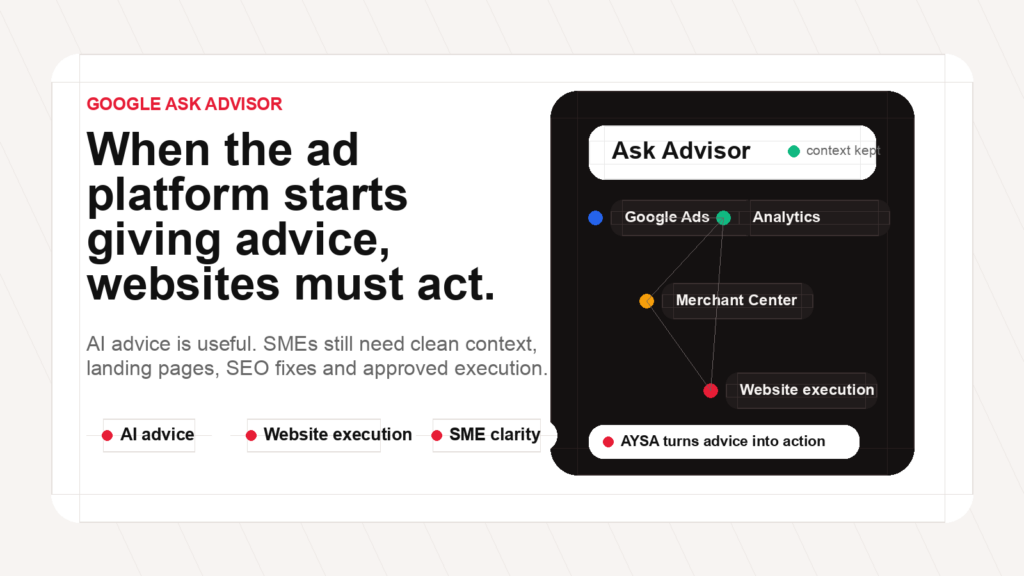
Quick summary: Google Ask Advisor is another signal that marketing software is becoming conversational, contextual and agent-like. It can help advertisers ask questions inside Google’s advertising ecosystem and receive guidance that uses campaign and account context. That is useful. But it also creates a new gap for small and medium-sized businesses: advice does not automatically fix the website, rewrite landing pages, improve product feeds, repair SEO issues or build the content and authority that make paid and organic visibility work together.
In my opinion, Ask Advisor is not a threat to marketers who understand execution. It is a threat to slow, manual marketing workflows. The winners will be companies that can turn recommendations into approved website action quickly, safely and repeatedly.
What Google announced with Ask Advisor
Google’s Ask Advisor announcement describes an AI assistant inside Google’s business and advertising environment. The idea is simple but important: instead of forcing advertisers to dig through settings, reports and disconnected dashboards, Google is moving toward a conversational layer that can answer questions, interpret account context and guide next steps.
This fits a broader pattern from Google Marketing Live and the Accelerate announcements. Google is introducing more AI assistance around campaign creation, creative production, performance diagnosis, retail data and search experiences. The same event cycle included announcements around AI Brief, ads in AI Mode, and more automation in Google Ads. The direction is unmistakable: Google wants advertisers to interact with its systems through questions, prompts and AI recommendations, not only through tables and settings.
The important detail is context. Ask Advisor is not positioned as a generic chatbot floating outside the account. It is meant to be useful because it can reason from the user’s Google environment. When a business asks why performance changed, what campaign to adjust, or how to interpret a result, the quality of the answer depends on campaign history, conversion signals, product data, audience information and measurement setup.
That is why this announcement matters beyond paid media. It shows where marketing interfaces are going. The future dashboard is not only a dashboard. It is a conversation with a system that knows the business context, reads multiple signals and recommends what to do next.
Advice is becoming conversational. Execution still has to happen.
Traditional workflow
Open reports. Compare tabs. Ask a specialist. Export data. Decide later. Send website changes to someone else. Wait.
Agentic workflow
Ask a question. Receive context-aware guidance. Approve the right work. Execute changes in the systems that actually affect visibility.
Why Ask Advisor is bigger than another Google Ads feature
The easy interpretation is: “Google added an AI helper to Google Ads.” That is true, but incomplete. The more important interpretation is that marketing tools are being re-shaped around advisory agents. Instead of every user needing to know where a report lives, which setting controls what, or how to translate a metric into a decision, the platform itself starts acting like a guide.
For large teams, this may reduce the time spent navigating interfaces. For small businesses, it could be more meaningful. Many SMEs do not have a dedicated paid media analyst, SEO strategist, conversion-rate specialist, feed manager and developer. They have one founder, one marketing person, one agency contact, or someone in the company who is trying to understand why leads dropped this month.
Ask Advisor can make the first layer of diagnosis easier. If it can explain why a campaign changed, identify missing setup, suggest how to improve assets, or point toward a conversion issue, that is valuable. But it also raises the bar. Once recommendations become easier to obtain, the bottleneck moves from “knowing what might be wrong” to “doing the work correctly.”
This is the same shift we are seeing in SEO and AI Search. Reports are no longer enough. Dashboards are no longer enough. The hard part is turning insight into implementation, especially when search behaviour, AI Overviews, AI Mode, product discovery and paid media surfaces are all changing at the same time.
The difference between an advisor and an execution layer
An advisor can tell you what to consider. An execution layer changes the system after approval. That distinction is everything.
If Ask Advisor tells a business that a campaign needs better landing page relevance, the recommendation is only the beginning. Someone still has to inspect the landing page, understand the Search intent, rewrite the page, adjust headings, improve proof points, add FAQs, strengthen internal links, make the offer clearer, check Page speed, review tracking and publish the changes. If the issue is product-feed quality, someone has to improve product titles, descriptions, attributes, images, category mapping and Structured data. If the issue is conversion quality, someone has to connect the measurement story back to business outcomes, not only ad platform events.
This is why I do not think the future belongs to “AI advice” alone. It belongs to systems that combine advice, context, approval and execution. The advisor is useful when it explains. The operating system is useful when it helps the business act.
Google’s AI Max documentation shows a similar direction in paid search: Google is using AI to expand matching, generate or adapt assets, and help advertisers find more relevant searches. That creates opportunity, but also risk. If a website is thin, generic or technically weak, AI expansion may find more demand than the website can convert. The landing page still has to be useful. The content still has to answer the user. The business still needs trust signals. The offer still has to be clear.
The recommendation is not the result.
The real SME problem: too many recommendations, not enough execution capacity
Most small and medium-sized companies do not fail at digital marketing because they have no tools. They fail because the work comes faster than the organization can process it. Paid media creates tasks. SEO creates tasks. AI search creates tasks. Analytics creates tasks. Customer feedback creates tasks. Technical audits create tasks. Every platform now has suggestions, alerts and AI-generated advice.
But who decides what matters? Who checks whether a recommendation is safe? Who rewrites the page? Who fixes the missing schema? Who removes the broken internal links? Who updates the product content? Who makes the landing page match the campaign? Who checks whether the site is crawlable, indexable and understandable by AI-assisted search systems?
This is where the classic agency model often becomes strained. Agencies can be very valuable, especially when strategy, creative direction and senior judgement are needed. But the modern search environment requires a level of continuous Monitoring and implementation that is hard to deliver manually for every SME at a reasonable price. The speed of change has increased. Google Search is changing. AI Mode is changing the query journey. AI Overviews are changing click patterns. Google Ads is becoming more automated. Social and marketplace signals are becoming part of discovery. A monthly report is too slow for this environment.
Ask Advisor makes this even clearer. If Google gives the advertiser more recommendations inside the platform, the business still needs an execution process outside the platform. The website cannot remain slow, unclear and outdated while the ad account becomes smarter.
Why this is also an SEO and AEO story
It would be a mistake to treat Ask Advisor as “only ads.” Paid and organic discovery are no longer cleanly separated in the user journey. A person might see an ad, ask an AI assistant for alternatives, compare reviews, search Google, click an AI Overview citation, check a map result, revisit a brand page, and then convert later. A weak website hurts every part of that journey.
Google’s own AI optimization guidance for Search continues to emphasize fundamentals: make useful content, make it accessible to Google, keep pages crawlable, use clear structure, and provide a good page experience. That is not a separate discipline from paid media anymore. It is the foundation that makes all discovery channels work better.
For example, if Ask Advisor suggests improving a campaign for a private clinic, the landing page may need more than a new headline. It may need clearer service information, appointment process details, location context, doctor credibility, pricing signals where appropriate, FAQs, reviews, structured data, and internal links to related services. If the campaign is for an ecommerce product, the site may need product details, availability, shipping information, comparison content, review signals, image optimization and feed consistency. If the campaign is for a local service, the website and Google Business Profile must tell the same story.
This is where SEO, AEO and paid media meet. AEO is not magic text written for answer engines. It is often the same hard work: clearer entities, better questions and answers, stronger proof, cleaner structure, better internal linking and pages that can be understood by both humans and machines.
We covered a similar idea in the AYSA article on Google AI Brief and ad automation: when AI systems generate more of the campaign layer, the business context becomes more important, not less. Ask Advisor is another step in that direction.
Where AYSA fits: from platform advice to approved website execution
AYSA is built from a different angle than Google Ask Advisor. Ask Advisor helps inside Google’s environment. AYSA focuses on the website execution layer: the place where SEO work, AEO readiness, content improvements, technical fixes, monitoring and approval workflows need to become real changes.
That is the bridge many SMEs need. A platform can say “improve landing page relevance.” AYSA can help translate that into actual website tasks: improve title tags, rewrite page sections, add missing FAQs, suggest internal links, prepare schema where it matches visible content, identify thin pages, monitor rankings and visibility, and prepare approved changes. The user stays in control, but does not have to manually interpret every report or copy-paste every recommendation into WordPress.
In my opinion, this is the near future of practical marketing for SMEs: Google will provide more AI guidance inside Google surfaces, while businesses will need their own execution layer for the assets they control. That means websites, content, local pages, category pages, service pages, product descriptions, technical health and authority-building workflows.
There is also a governance angle. AI recommendations can be useful, but SMEs should not blindly publish every suggestion. Good execution requires approval, context and a history of what changed. If a recommendation affects medical claims, legal claims, pricing, offers, reviews, finance, regulated topics or brand positioning, the business needs a controlled workflow. “AI said so” is not enough.
Advice becomes useful when it is connected to action.
Prepared
New page title, rewritten intro, answer-ready FAQ block and two contextual internal links.
Review
The business checks claims, wording and commercial accuracy before publishing.
Execute
Approved changes are applied inside the website workflow and tracked in action history.
A practical playbook for SMEs using AI advertising advisors
If you are a business owner or marketing lead, the right response to Ask Advisor is not panic. It is operational discipline. Use the advisor, but do not confuse advice with execution. Here is the workflow I would recommend.
1. Connect the right data before trusting recommendations
AI advice becomes better when the inputs are better. Make sure conversions are meaningful, not only easy to track. A form submission, phone call, booked appointment, paid order and qualified lead are not the same thing. If Google Ads, Analytics, Merchant Center and your CRM tell different stories, an AI advisor can still help, but the recommendations may optimize toward the wrong target.
2. Separate campaign problems from website problems
When performance drops, the cause may not be the bid strategy. It may be page speed, weak content, a poor offer, unclear trust signals, mismatched search intent, tracking drift, seasonality, competitor movement or AI search changing the journey. Treat campaign recommendations as one signal, not the entire diagnosis.
3. Turn every recommendation into a website task
If the advisor says “improve assets,” ask what that means on the website. Does the page need better headings? More proof? More specific service details? Better product data? Schema? Internal links? A comparison section? A stronger local explanation? This is where the work becomes real.
4. Keep approval in the loop
Automation should save time, not remove responsibility. SMEs need a simple approval workflow: show the proposed change, explain why it matters, let the user accept or reject it, then apply accepted changes. This is especially important for regulated sectors, medical topics, finance, legal, ecommerce policies and local service promises.
5. Measure qualified outcomes, not platform comfort
A platform can make metrics look cleaner while the business still feels no growth. The real question is whether the work improves qualified demand: better leads, better bookings, better orders, better organic visibility, better local discovery and better conversion quality. The point is not to satisfy a dashboard. The point is to grow the business.
What could go wrong if SMEs rely only on AI advice?
The first risk is overconfidence. AI advisors can sound certain even when the business context is incomplete. A recommendation that makes sense for one account may be wrong for another if margins, stock, seasonality, service area, sales capacity or customer quality are different.
The second risk is platform tunnel vision. A Google Ads advisor naturally sees the world through Google Ads, Google Analytics and Google Merchant Center. Those are important systems, but the customer journey also includes organic search, AI answers, social proof, reviews, offline sales, word of mouth, email, competitor reputation and the actual website experience.
The third risk is implementation debt. If every AI tool creates more suggestions, businesses can end up with a larger backlog than before. This is already a problem in SEO: audits create lists, but lists do not improve rankings until someone prioritizes and executes. The same will happen in paid media if advice is not connected to a practical execution workflow.
The fourth risk is compliance. AI can recommend changes that need review. Medical services, financial products, legal services, insurance, health claims and sensitive ecommerce categories require careful language. A business needs human approval and clear responsibility before publishing.
The strategic takeaway
Google Ask Advisor is important because it confirms the direction of marketing software: conversational, context-aware, automated and more agentic. But it also confirms the gap AYSA is focused on. The more advice platforms generate, the more valuable execution systems become.
For SMEs, the question is no longer “Can I get recommendations?” Recommendations are everywhere. The question is: “Can my business safely turn the right recommendations into live improvements fast enough?”
That is why the future is not only AI ads, AI SEO, AI analytics or AI content. The future is an operating loop: monitor, understand, prepare, approve, execute and learn. Google is building more AI assistance inside its own surfaces. Businesses need the same kind of operational intelligence inside their websites.
How I would use Ask Advisor without becoming dependent on it
The best way to use an AI advisor is to ask it questions that expose business reality, not only interface shortcuts. A weak question is “How do I improve performance?” A stronger question is: “Which campaigns are bringing cheaper leads but lower sales quality, and which landing pages should I review first?” Another strong question is: “Which product groups have demand but weak conversion, and is the problem likely feed quality, pricing, page relevance, availability or competition?”
The difference matters. If the question is vague, the advisor may return generic optimization advice. If the question is tied to business outcomes, the answer becomes a starting point for real work. This is especially important for SMEs because they often do not have time to run a long diagnostic process. They need a shortlist of actions that can be reviewed and executed.
I would also use Ask Advisor to challenge assumptions. If a business believes “ads stopped working,” the advisor may help separate symptoms: cost per click increased, conversion rate dropped, landing page changed, audience quality changed, demand shifted, tracking changed, or competitors became more aggressive. But I would never stop at the platform explanation. I would compare it with Search Console, Analytics, CRM feedback, organic rankings, review signals, page speed and customer conversations.
This is where many marketing teams make a mistake. They treat the advertising platform as the source of truth. It is not. It is one measurement surface. A business can have excellent ad optimization and still lose customers because the website does not answer the right questions, the offer is unclear, the page loads slowly on mobile, the proof is weak, or AI assistants cannot understand the brand well enough to recommend it.
So the practical rule is simple: use Ask Advisor to ask better questions, then use an execution workflow to make the website better. The AI assistant can help with diagnosis. The business still needs a controlled system for implementation.
What this means for agencies and consultants
Ask Advisor does not make good agencies irrelevant. It makes weak agency workflows more visible. If an agency’s value is only knowing where to click inside Google Ads, that value will shrink. If the agency understands strategy, positioning, offer quality, landing-page usefulness, technical SEO, measurement, creative testing and business economics, the agency can become more valuable because AI removes some of the interface friction.
The same is true for SEO consultants. If the work is only monthly reporting, AI will compress that value. If the work is prioritization, architecture, content quality, technical execution, authority building and continuous improvement, AI can become a force multiplier.
In my opinion, the best agencies will not fight AI advisors. They will build operating models around them. They will use platform AI to accelerate diagnosis, then use human judgement and execution systems to decide what is safe, commercial and worth doing. The worst response is to pretend nothing changed. The second worst response is to hand the whole process to AI without review.
For AYSA, this is exactly the middle ground: the agent prepares work, explains the reason, asks for approval and executes accepted changes. That keeps the speed advantage of automation without pretending that business responsibility can be outsourced to a black box.
Sources and further reading
AI advisors are useful. Execution is where growth happens.
Turn marketing recommendations into approved website action.
If you are tired of receiving advice from every platform but still waiting for the website work to happen, try AYSA: an AI SEO execution agent for the near future of search, ads and AI discovery.
Continue the AI search topic inside AYSA.
Use these pages to connect the article with AI SEO tools, AI visibility monitoring, AI Overviews and approved website execution.
Turn this topic into a website action plan.
Use these AYSA hubs to move from reading to technical fixes, AI visibility monitoring, research, glossary context and approval-first SEO execution.