
Google AI Brief: Why Ad Automation Now Needs SEO-Grade Business Context
Google AI Brief gives advertisers a way to add business context, brand guidance and guardrails to AI-powered campaigns. Here is why that matters for SEO, ads and AI search execution.
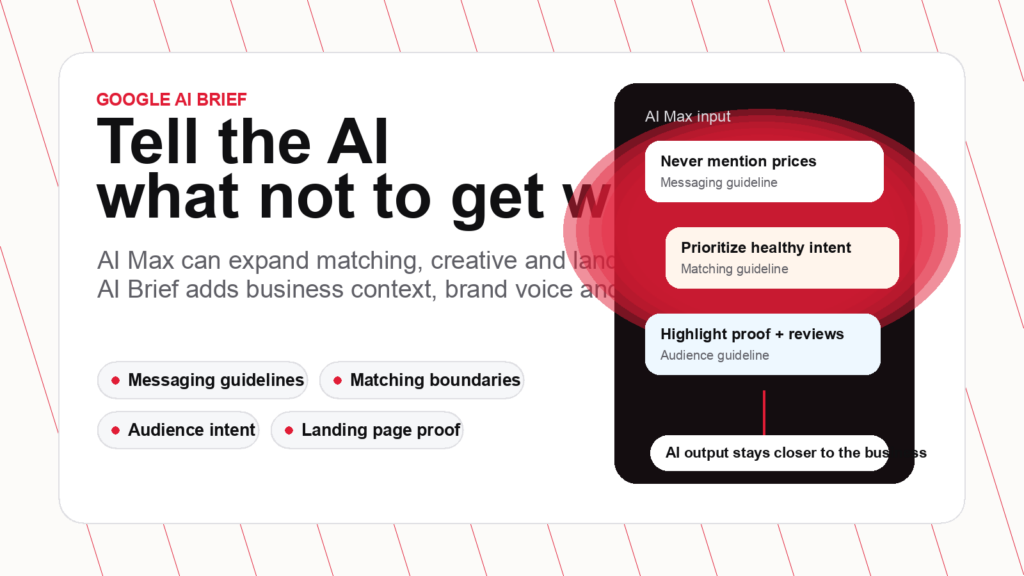
Summary: Google AI Brief is important because it recognizes a problem every serious advertiser already feels: AI-powered campaigns can expand faster than the business can explain itself. AI Max, Performance Max and AI-powered ad surfaces can use more signals, match broader intent and adapt more creative, but they still need business context, brand guidance and clear constraints.
My view is simple: AI Brief is not only an ads feature. It is a sign that the future of paid search, SEO, AEO and AI visibility will depend on better source material. If the AI is going to reason, match, write and recommend, the business must feed it accurate, useful, structured and commercially meaningful context.
Automation still needs instructions.
What Google AI Brief is
Google’s AI Brief announcement sits inside the same broader shift as AI Max, Performance Max and Ads in AI Mode. Google is giving advertisers more AI-powered automation, but also more ways to tell the system what the business is trying to do.
The concept is practical: instead of relying only on keywords, existing ads, feeds, landing pages and assets, advertisers can add a brief that gives the system business context and campaign guidance. This matters because AI systems can generate and match at scale, but they do not automatically know the commercial reality behind a business.
For example, a clinic may not want to sound aggressive or promise outcomes. A B2B software company may want to avoid consumer language. A local service provider may need to emphasize service area, booking constraints, emergency availability or pricing ranges. An ecommerce business may want to promote certain product categories but avoid outdated seasonal products. A brief is the layer where the advertiser can explain these things before the AI turns them into campaign behavior.
That is why AI Brief should not be treated as a small workflow convenience. It is part of a much bigger trend: the ad system is becoming more autonomous, so business context becomes a control layer.
Why AI Brief matters now
Google’s ad ecosystem is moving toward broader automation. AI Max for Search campaigns can use improved search term matching, text customization and final URL expansion. Performance Max has already pushed advertisers toward cross-channel automation. Ads in AI Mode bring paid visibility closer to AI-generated answer experiences. In that environment, the question is no longer only “what Keyword do we bid on?”
The better question is: what does the AI understand about the business, and what is it allowed to do with that understanding?
This is a major change for SMEs. Many small and medium-sized businesses do not have perfect brand books, cleaned product feeds, well-structured landing pages, CRM feedback loops or clear campaign documentation. They often have a website built over several years, a few pages that rank, a Google Business Profile, some ads, a collection of old landing pages and a lot of messy assumptions in the owner’s head.
AI Brief is useful because it forces some of that implicit knowledge to become explicit. But it also exposes a deeper problem: if the website and business data are weak, a brief alone cannot fix everything.
An AI brief can say “focus on high-intent users,” but the landing page still needs to explain the offer. It can say “use a professional and calm tone,” but the website still needs credible content. It can say “promote products with quick delivery,” but the feed still needs accurate delivery information. It can say “avoid discount positioning,” but the page must still communicate value. The brief is not a replacement for website quality. It is a bridge between business strategy and AI campaign execution.
Keyword, ad, landing page, report.
Manual control worked better when the search journey was shorter and campaigns were easier to constrain.
Context, guidance, source material, approved execution.
AI-powered ads need business context, clean pages, accurate feeds and stronger measurement.
The SEO connection: your website becomes campaign source material
AI Brief is an ads feature, but its quality depends heavily on work that looks a lot like SEO. That is the part many advertisers will miss.
Google’s AI Max documentation explains that text customization and final URL expansion can use content from your domain, landing pages, ads, keywords and assets. Google’s guidance for ads in AI Overviews also points retailers toward better feeds, accurate product data, strong creative assets and landing-page relevance. Google Search Central’s AI Optimization guidance still centers on fundamentals: make useful, accessible, crawlable, high-quality content that helps people.
Put those together and a pattern becomes obvious. AI-powered ads need stronger source material. That source material includes:
- landing pages with specific, useful information;
- product and service pages that explain use cases and constraints;
- accurate feeds and business data;
- clear reviews, proof and trust signals;
- Structured data that matches visible content;
- fast, crawlable and indexable pages;
- internal links that show topical relationships;
- content that answers the real decision questions users ask.
This is why I do not see SEO and ads as separate silos anymore. SEO is becoming the operating layer that makes the business legible to search, AI systems and ad automation. The paid system can then use that improved source material to match, explain and convert more intelligently.
We covered this from the paid-search side in Ads in AI Mode, from the measurement side in Qualified Future Conversions, and from the query expansion side in How Google AI Mode Expands Queries Beyond Keywords. AI Brief completes the triangle: automation needs context, context needs website quality, and website quality needs execution.
Why a brief is not enough without an execution loop
The most dangerous misunderstanding is to treat AI Brief as a one-time setup field. A brief is only useful if the business reality behind it stays true. If prices change, locations change, delivery changes, stock changes, service availability changes or positioning changes, the brief can become stale very quickly.
This is where many SMEs struggle. The owner knows the business changed, but the website does not. The ads person knows some leads are low quality, but the landing page still invites the wrong audience. The content person wrote a strong service page six months ago, but the actual offer has changed. The agency has reports, but implementation is slow. AI Brief cannot solve that execution gap by itself.
A modern marketing system needs a loop:
- collect business and performance signals;
- detect where the website no longer matches reality;
- prepare landing-page, content, feed, schema and internal-link improvements;
- ask the business owner to approve important changes;
- execute accepted changes quickly;
- monitor whether the change improves visibility, relevance and conversion quality.
Without that loop, the brief becomes a nice instruction attached to a messy source. With that loop, the brief becomes one part of a living operating model.
Examples: how AI Brief changes by business type
The best way to understand AI Brief is to imagine what a non-generic brief would look like for different SMEs.
Local medical clinic
A clinic should explain tone, trust and compliance. The brief might say that messaging should be calm, factual and appointment-focused. It should avoid diagnosis promises, treatment guarantees or exaggerated urgency. It should emphasize online booking, accepted specialties, location, parking, doctor experience, patient reviews and when the user should contact emergency services instead of booking a routine appointment.
The SEO work behind that brief would include clean service pages, doctor profile pages, Google Business Profile accuracy, review workflows, FAQ content that matches visible services, medical schema used carefully, fast mobile pages and clear contact/booking paths.
Ecommerce store
An ecommerce store should explain product priorities, margins, availability, delivery promises and what not to promote. The brief might say that the campaign should prefer in-stock products with strong margins and fast delivery, avoid outdated seasonal products, use premium but practical language and emphasize returns, warranty and product comparison help.
The SEO work behind that brief would include product feed cleanup, category-page improvements, internal links from guides to products, comparison content, review visibility, product schema consistency, image quality and landing pages that explain who each product is for.
Local service provider
A parking or car-rental business near an airport should define geography, availability, transfer details, booking requirements, trust proof and urgent use cases. The brief should prevent the AI from promoting unavailable locations or unrealistic promises. The website should support the campaign with pages for service area, booking steps, prices, FAQs, directions, reviews and policies.
B2B SaaS
A SaaS company should explain customer type, problem maturity and the difference between education and conversion. A tool like AYSA should not be framed as a generic SEO checker. The brief should explain that AYSA is an approved SEO execution agent for businesses that do not want manual SEO busywork. The website must then prove that with product pages, pricing, examples, help content, glossary definitions, case studies and comparison pages.
What AI Brief says about the future of agencies
AI Brief also changes the role of agencies and consultants. In the old model, campaign managers spent a lot of energy manually translating business intent into campaign structure. That work does not disappear, but part of it moves into instruction design, source-quality management and governance.
The value is no longer only “I know which buttons to click in Google Ads.” The value is knowing what the business should tell the machine, what the machine should not be trusted to decide alone, which website inputs are weak, and how to connect paid performance back to real business outcomes.
That is a higher-level job. It is also harder to scale manually. This is why agentic SEO and approved execution matter. If every campaign now depends on clean website context, the business cannot wait three months for small landing-page changes. The system has to monitor, prepare and execute faster.
How to evaluate AI Brief performance
Google may provide different reporting controls over time, but businesses can already evaluate whether their AI-powered setup is improving the right things.
Watch these signals:
- Lead quality: Are leads closer to the ideal customer, or are they just cheaper?
- Final URL quality: Are users landing on the right pages, or on generic/outdated URLs?
- Query and insight direction: Is demand expanding into relevant use cases or drifting into weak intent?
- Conversion depth: Are users only submitting forms, or are they booking, buying, returning and becoming profitable?
- Organic support: Are the same pages also improving impressions, rankings, AI visibility or branded searches?
- Message consistency: Does ad language match the website and business reality?
- Sales feedback: Do sales or support teams confirm that prospects understand the offer better?
The important point is that AI Brief should be judged by business alignment, not only platform-level convenience. If the campaign becomes easier to launch but attracts the wrong customers, it is not a win.
What should go into an AI Brief?
A good AI brief should not be a vague slogan. “Sell more” is not a brief. “Grow awareness” is not enough. The brief should translate business reality into practical instructions that campaign automation can use.
For an SME, I would think about seven layers.
1. Who the customer is
Describe the real customer, not a generic demographic. A florist may serve last-minute gift buyers, wedding planners, corporate clients and people sending sympathy flowers. A clinic may serve parents, adults looking for prevention, or patients who need a specific specialist. A SaaS company may serve non-specialists, agencies or internal teams. Each buyer has different triggers, fears and proof requirements.
2. What the business does not want to promise
This is critical in regulated or trust-sensitive sectors. Medical, financial, legal, childcare, real estate and B2B services must avoid claims that sound too absolute. AI can write confidently. The brief must tell it where confidence becomes risk.
3. What makes the offer different
Automation cannot invent differentiation safely. If the business has same-day delivery, online booking, free consultation, local availability, certified staff, premium support, fast onboarding or a special guarantee, those details should exist on the website and in the brief.
4. Which pages matter most
If final URL expansion is used, URL quality matters. The brief should point toward preferred pages and away from weak or outdated pages. But the better long-term solution is to clean the website so automation has fewer bad options.
5. What tone should be used
Tone is not decoration. For SMEs, tone can determine trust. A clinic should not sound like an aggressive ecommerce sale. A B2B platform should not sound like a consumer gadget. A premium service should not sound like a discount marketplace. The brief should define tone in plain language.
6. What business data must stay current
Prices, delivery, availability, service area, locations, booking rules, refunds, warranties and exclusions should be current. If the business cannot keep these updated, AI-powered ads may amplify outdated information.
7. How success should be judged
The brief should align with measurement. If the goal is qualified leads, the business needs a way to measure qualified leads. If the goal is profitable orders, the business needs revenue or margin feedback. If the goal is bookings, the business needs booking quality, not only form submissions.
A practical SME playbook for AI Brief
Small businesses should not wait for the perfect AI ads stack before preparing. The preparation work is already useful for SEO, AEO, AI visibility, conversion rate and campaign performance.
Step 1: Write the business context in plain language
Start with a simple document: what you sell, who you sell to, where you operate, why people choose you, what you should not say, and what a good customer looks like. This should be understandable by a non-specialist. If the owner cannot explain it, the AI will not rescue the campaign.
Step 2: Make sure the website says the same thing
The brief and website should not contradict each other. If the brief says “premium local service,” but the page has thin generic copy and no proof, the campaign has a weak foundation. If the brief says “fast delivery,” the website should explain delivery conditions. If the brief says “for SMEs,” the website should show SME examples.
Step 3: Clean important landing pages
Every page used by ads should answer the user’s decision questions. What is it? Who is it for? Why trust it? What does it cost? What happens next? What proof exists? What are the limitations? A page that cannot answer those questions is not ready for AI-powered matching.
Step 4: Connect organic and paid data
Search Console can show what people already search before finding the site. Google Ads can show paid intent. GA4 can show engagement and conversion paths. CRM data can show lead quality. AI Brief becomes stronger when it is informed by real demand, not only guesswork.
Step 5: Monitor what changes
AI-powered campaigns are not “set and forget.” Review landing pages, search terms and insights where available, conversion quality, brand terms, final URLs, page engagement and organic movement. Automation should be watched with business judgment, not blind faith.
Risks: AI Brief will not fix poor strategy
There are several risks advertisers should understand.
First, a brief can create false confidence. Writing a good brief feels strategic, but it does not guarantee good performance. If the landing page is weak, the offer unclear, the feed incomplete or the tracking broken, the brief only sits on top of a weak system.
Second, automation can scale mistakes. If the business gives broad guidance and the website contains outdated pages, weak product copy or confusing offers, AI can expand into the wrong areas. Automation is powerful because it scales. That is also why it is dangerous when inputs are poor.
Third, reporting may remain imperfect. AI-powered placements, AI Overviews and AI Mode surfaces create new questions about attribution and visibility. Businesses should evaluate outcomes carefully and avoid treating every reported conversion as equal.
Fourth, brand safety becomes more operational. The business must know what it does not want to say, what claims require proof, what legal or compliance limits exist, and which offers should not be promoted. These are not purely marketing decisions. They are operational controls.
Fifth, generic AI briefs will become common. If every advertiser writes similar instructions, the advantage moves back to real business substance: better pages, better data, better proof, better customer experience and faster execution.
Where AYSA fits: from business context to approved website execution
AYSA is not an ad platform. But AI Brief makes AYSA’s role easier to explain because it shows the same truth from another angle: AI systems need structured business context and continuous website improvement.
AYSA helps businesses build and maintain that context. It learns the business, connects website and Google data, monitors SEO, AEO and AI visibility, prepares improvements, asks for approval and executes accepted changes inside the website workflow.
That can support AI-powered advertising indirectly in several ways:
- making landing pages clearer and more useful;
- improving service and product descriptions;
- finding missing FAQ and comparison content;
- strengthening internal links between related pages;
- detecting technical issues that reduce crawlability and page experience;
- improving AI visibility for topics where the business should be understood;
- keeping website content aligned with business reality.
My opinion is that AI Brief is a small visible part of a larger operating-system shift. Google is saying, in effect: “Give the AI better instructions.” AYSA’s answer is: “Give the AI better website reality too.” A brief matters. But a brief plus a clear, fast, useful, well-structured website matters more.
For SMEs, that is the opportunity. You do not need a giant marketing department to compete in the AI search and AI ads era. But you do need a system that turns business knowledge into website execution quickly, safely and continuously.
If Google’s AI needs a brief, your website needs one too.
AYSA helps SMEs turn business context into SEO, AEO and AI visibility improvements, then execute accepted changes inside the website workflow.
Sources and further reading
- Google Accelerate: AI Brief
- Google Ads Help: About AI Max for Search campaigns
- Google Ads Help: Set up AI Max in Google Ads
- Google Accelerate: Ads in AI Mode
- Google Ads Help: About ads and AI Overviews
- Google Search Central: AI optimization guide
- AYSA: Ads in AI Mode and SEO
- AYSA: Qualified Future Conversions and SEO measurement
- AYSA: How Google AI Mode Expands Queries Beyond Keywords
Continue the AI search topic inside AYSA.
Use these pages to connect the article with AI SEO tools, AI visibility monitoring, AI Overviews and approved website execution.
Turn this topic into a website action plan.
Use these AYSA hubs to move from reading to technical fixes, AI visibility monitoring, research, glossary context and approval-first SEO execution.

