The “AI Recommendation Cliff” Is Real: Why 62% of Brands Disappear After One Follow‑Up—and How to Stay Cited
Clovion’s corrected data shows a harsh reality: AI assistants don’t just recommend brands—they rapidly prune them once a buyer gets specific. Here’s what changed, why it matters, and a practical execution plan (with monitoring + approved changes) to stay visible across ChatGPT, Claude, and Gemini.

AI Search is teaching marketers an uncomfortable lesson: being mentioned is not the same as being chosen.
New (corrected) findings reported by Clovion and covered by Search Engine Journal show that when buyers ask one normal follow-up question, a large majority of brand recommendations vanish. The “list” you celebrate in the first answer often collapses in the second turn of the conversation.
As an operator, I don’t see this as a scary AI headline. I see it as the next evolution of the same old truth in search: relevance beats visibility. The difference is speed. In AI assistants, relevance gets re-scored instantly—and the re-score happens inside a conversation that your team usually isn’t tracking.
This editorial is a standalone, practical resource: what changed in the data, why it matters, how AI assistants fail differently, what SMEs and agencies should monitor, and a clear Execution Plan. I’ll also show where AYSA fits as an execution system—not just a Monitoring tool—because in 2026, insight without implementation is just another dashboard.
Concise summary
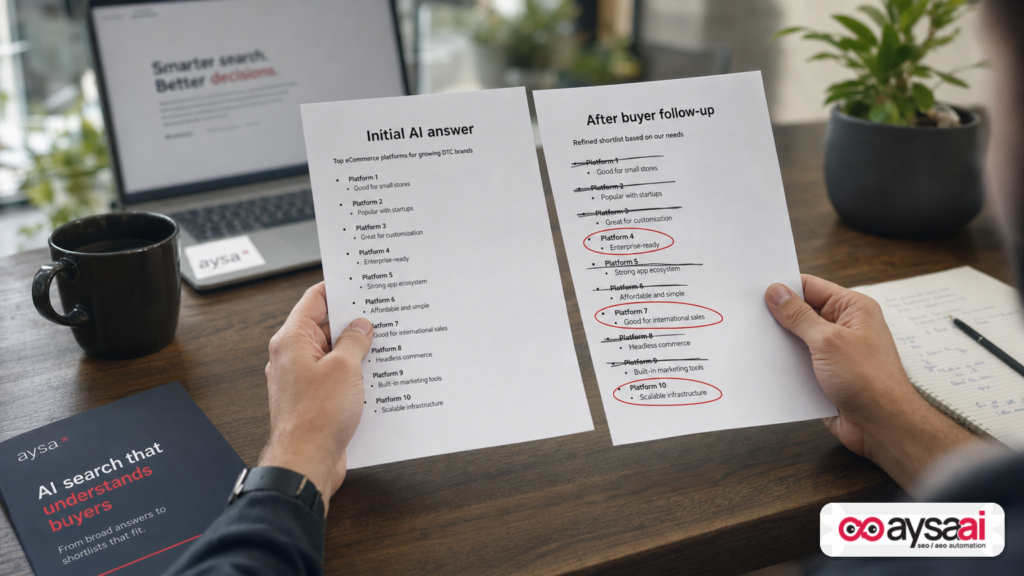
- Clovion’s corrected analysis indicates a major drop-off: when a buyer adds one basic constraint (like “for a small team”), many brands listed in the first AI answer disappear in the second. In the SEJ coverage, the figure cited is 62% drop after a single follow-up question.
- The “missing zero” correction matters: the corrected contradiction count (reported to be 330 instead of 33) changes how confident you can be about per-model patterns (e.g., some assistants under-claim features; others over-claim).
- AI visibility is now multi-turn: tracking a single prompt is like measuring only the first pageview in a checkout funnel.
- Practical takeaway: optimize for the follow-up questions buyers ask (size, industry, budget, integrations, compliance)—and ship changes fast.
- Where AYSA fits: monitoring multi-turn prompts, preparing site changes, requesting approval, and executing accepted changes to improve AEO/GEO outcomes—without forcing teams into slow backlogs.
Table of contents

- What changed in the Clovion data—and why you should care
- The corrected Clovion finding: AI lists aren’t stable—they’re conditional
- Why the missing zero matters more than it sounds (and how it happens)
- What this means for SMEs: the new “AI consideration funnel”
- How AI assistants decide who stays on the list
- Why brands disappear after a follow-up: 10 failure modes
- Model differences: why ChatGPT, Claude, and Gemini can misdescribe you in different directions
- What you should monitor now (and what not to over-index on)
- The new playbook: optimize for follow-up questions, not the first prompt
- A concrete SME scenario: how an ecommerce brand loses the AI shortlist—and how to fix it
- Where AYSA fits: monitoring + approved execution (the missing operational layer)
- What agencies should rethink: deliver “AI conversation share,” not just rankings
- What to do next (action list)
- Sources and further reading
What changed in the Clovion data—and why you should care

The headline number that got everyone’s attention is the drop-off: after a buyer asks one follow-up question, a significant portion of the brands recommended in the first answer disappear. In the SEJ reporting of Clovion’s study, the figure is 62% vanishing after one buyer question.
But the deeper issue isn’t “AI is unstable.” It’s that AI is conditional—and most brand teams are optimizing for the wrong condition.
In classic SEO, you fought to rank for a query, then you improved conversion on the page. In AI search, your brand is effectively being “ranked” repeatedly across a conversation, and the criteria can change turn-by-turn. You can be a great answer for:
- “best CRM tools”
- …and a poor answer for “best CRM tools for a 5-person team”
If you only monitor the first question, you’ll report “wins” that never reach purchase intent.
This is why I call it the AI recommendation cliff: the drop isn’t gradual like Organic traffic trends. It’s sudden—one follow-up and you’re gone.
The corrected Clovion finding: AI lists aren’t stable—they’re conditional
According to the SEJ coverage, Clovion tested multi-turn conversations across leading assistants (Claude, ChatGPT, Gemini). They found that re-asking the same question tends to keep the list similar, but adding a realistic buyer detail changes the recommendations drastically.
That distinction matters. It suggests the model isn’t “randomly hallucinating a new list.” Instead, it’s re-evaluating fit:
- Who is this for?
- What constraints matter (team size, compliance, budget, integrations)?
- Which vendors have strong signals for those constraints?
For businesses, this reframes the problem. The goal is not “show up in AI.” The goal is:
Show up when the buyer becomes specific.
If your brand disappears at specificity, you don’t have a visibility problem. You have a positioning + evidence problem.
Why the missing zero matters more than it sounds (and how it happens)
The SEJ story includes a key editorial detail: a “dropped zero” in Clovion’s draft report changed some counts (e.g., contradictions) by an order of magnitude. That correction is more than an embarrassing formatting error. It changes:
- Confidence: larger samples can support stronger claims about patterns.
- Risk: teams might have ignored the original numbers as “too small to matter.”
- Strategy: per-model behaviors become more actionable when backed by sufficient counts.
This also points to a bigger 2026 reality: we’re entering an era where marketing teams will cite more AI research than ever—while attention spans keep shrinking. That combination produces a predictable failure mode:
We repeat the headline instead of auditing the denominator.
If you’re an SME, you might think, “That’s for analysts and publications.” It’s not. This affects you when an agency, consultant, or internal stakeholder builds a strategy deck on top of shaky numbers.
So here’s the operational rule:
Don’t implement a roadmap based on a percentage unless you understand the underlying count and methodology.
And here’s the leadership rule:
Reward the person who asks “how do we know?” before you reward the person who says “we should.”
What this means for SMEs: the new “AI consideration funnel”
Most businesses already understand funnels. The mistake is assuming AI recommendations map to the old funnel stages.
In the AI assistant era, the funnel looks more like this:
- Turn 1 (Discovery): broad lists, generic “best tools.” Many brands can appear here.
- Turn 2 (Qualification): a single constraint (size, industry, region, compliance) triggers a massive prune.
- Turn 3+ (Validation): buyers ask for proof: pricing, implementation time, integrations, support, limitations.
If Clovion’s reported drop is directionally right, then most brands are fighting over the least valuable layer: broad discovery lists that don’t survive qualification.
This is why I’m cautious when someone celebrates “we got mentioned in ChatGPT.” The real question is:
Do we stay mentioned after the buyer adds the constraint that matches our best customers?
How AI assistants decide who stays on the list
We should be honest about what we can and can’t prove from the provided context. We don’t have Clovion’s full dataset in this prompt, and we should not pretend we do. But we can still reason clearly about what must be happening for the drop-off to occur.
When a model receives a follow-up, it’s doing some mix of:
- Re-weighting relevance signals: “small team” makes ease-of-use, price, onboarding, and self-serve docs more important.
- Filtering by implied constraints: “enterprise” implies SOC2/ISO, admin controls, SSO, procurement readiness.
- Reducing uncertainty: when it’s not sure a vendor fits, it will often exclude it to avoid giving a bad recommendation.
This last point is underrated. In many AI experiences, models are incentivized (by design goals and safety constraints) to avoid confidently wrong recommendations. That leads to conservative behavior: if your fit is unclear, you get dropped.
So the businesses that survive turn two are usually the businesses that make fit easy to infer from public information.
Why brands disappear after a follow-up: 10 failure modes
Below are the most common, non-mystical reasons a brand can show up initially, then vanish as soon as the buyer gets specific. This is written for SMEs and non-SEO operators—because AI search doesn’t care whether your team is “technical.” It cares whether your positioning is legible.
1) Your ICP is implied, not explicit
If your website never clearly says who you serve (team size, segment, industry), you force the model to guess. After a follow-up, guesses get punished.
Fix: Put a clear “Who it’s for” section on core pages and category landing pages.
2) Your features aren’t documented in a durable, crawlable way
Models and retrieval systems tend to reward stable documentation: product pages, help centers, API docs, release notes. If your “real truth” lives in sales decks, webinars, or scattered social posts, it may not be considered strong evidence.
Fix: Create a canonical feature hub and link to it prominently.
3) Your category language doesn’t match the buyer’s language
You might sell “workflow intelligence,” but the buyer asks for “job scheduling software.” If you don’t bridge those phrases, you get dropped when the conversation turns specific.
Fix: Build plain-language pages and FAQs that mirror customer phrasing.
4) You don’t have comparison pages (and competitors do)
In AI answers, comparisons are disproportionately influential because they’re directly aligned with user intent. If you’re absent from comparative narratives, you’re easier to prune.
Fix: Create honest, specific comparison pages (with limitations included).
5) Pricing ambiguity becomes a disqualifier
When a user says “small team” or “budget-friendly,” hidden pricing can be interpreted as “not for you.”
Fix: Add pricing ranges, example packages, or transparent “starts at” plus what’s included.
6) Integrations aren’t clearly listed and maintained
Follow-ups often include stack constraints (“works with Shopify,” “integrates with QuickBooks,” “supports HubSpot”). If integration pages are missing or outdated, you drop.
Fix: Maintain an integrations index page; keep it current.
7) You’re overselling (and the model penalizes uncertainty)
Overly broad claims (“best for everyone”) can backfire. When the buyer asks “for healthcare clinics,” the model wants specialization signals. Generic marketing can read as weak fit.
Fix: Replace vague superlatives with specific, verifiable claims and constraints.
8) You have inconsistent facts across the site
Conflicting facts (feature availability, regional support, SLA terms) increase uncertainty. Uncertainty increases pruning.
Fix: Create a single source of truth page and align all mentions to it.
9) Your brand signals are strong, but your “proof signals” are weak
Brands with PR and awareness can appear in broad lists. But follow-ups demand proof: case studies, certifications, compliance, performance benchmarks, testimonials.
Fix: Build a proof library matched to the follow-ups your buyers ask.
10) You’re monitoring the wrong thing
If your reporting checks only one prompt (“best X software”), you’re measuring stage 1 only. You can “win” stage 1 and lose the business at stage 2.
Fix: Monitor prompt sequences that reflect real buyer conversations.
Model differences: why ChatGPT, Claude, and Gemini can misdescribe you in different directions
In the SEJ coverage, the corrected contradiction counts also enabled a more nuanced observation: different assistants may err in different directions (under-claiming features vs over-claiming). The reported working theory in that piece suggests assistants may lean on different kinds of sources (for example, marketing materials versus documentation), which could influence whether they overstate or understate capabilities.
Even without asserting more than the provided context supports, this is enough to drive a practical conclusion:
“Fixing AI visibility” is not a single universal optimization.
It’s closer to cross-platform SEO, where each ecosystem has different retrieval and citation behavior. That means:
- You may need to correct factual under-claims with stronger documentation, release notes, and canonical pages.
- You may need to correct over-claims by tightening marketing language, adding explicit limitations, and ensuring accurate feature matrices.
For SMEs, the simplest operational approach is to treat each assistant like a separate storefront:
- ChatGPT storefront: does it describe us correctly and recommend us for our best-fit scenarios?
- Claude storefront: same question, separately tested.
- Gemini storefront: same question, separately tested.
Do not assume a fix in one automatically transfers to the others.
What you should monitor now (and what not to over-index on)
Businesses love KPIs—until KPIs become a substitute for decisions.
Based on the study context and what we see in the market, here’s what I’d monitor in 2026 if you want to stay on the shortlist after follow-ups.
Monitor 1: “Conversation survival rate”
Track whether you appear:
- in the initial recommendation
- and after each of the top 3–5 buyer follow-ups
You’re not optimizing for a mention. You’re optimizing for survival across turns.
AYSA angle: use AI search visibility monitoring as a multi-turn workflow, not a one-off prompt test.
Monitor 2: “Fit clarity” language
When assistants explain why they recommended a vendor, look for whether they can clearly articulate your:
- ideal customer
- core strengths
- constraints/limitations
If the explanation is vague, you’re at risk of being pruned on the next follow-up.
Monitor 3: feature accuracy (under-claim vs over-claim)
If an assistant consistently says you don’t have something you do, that’s lost deals. If it says you do have something you don’t, that’s worse: it creates churn, refunds, and reputation damage.
Either way, it’s a content and evidence problem you can fix.
Monitor 4: citation surfaces (where possible)
Not every assistant provides transparent citations in every experience. When citations are shown, track what pages are being used as evidence.
Do not over-index on vanity metrics like “how many times did we show up in one generic prompt this week?” That’s how you accidentally optimize for awareness while losing qualified demand.
AYSA angle: build monitoring prompts and sequences that mirror buyer reality. See AYSA monitoring.
The new playbook: optimize for follow-up questions, not the first prompt
Here’s a practical playbook you can apply whether you’re a local clinic, an ecommerce brand, a SaaS company, or an agency managing dozens of clients.
Step 1: Collect your real follow-ups
Start with data you already have:
- sales call notes
- support tickets
- live chat transcripts
- on-site search queries
- RFP questionnaires (for B2B)
Turn these into 20–50 follow-up prompts that represent actual qualification steps. Examples:
- “for a small team”
- “for an enterprise with SOC2”
- “for a hotel with multiple locations”
- “for Shopify”
- “under $200/month”
- “with multilingual support”
Step 2: Build a “fit evidence” map
For each follow-up, ask: What page on our site proves we fit?
- If the answer is “we don’t have one,” that’s your backlog.
- If the answer is “it’s in a PDF,” publish a canonical web page.
- If the answer is “it’s scattered,” consolidate and link internally.
This is the core shift: stop thinking about content as “blog posts.” Start thinking about content as evidence.
AYSA angle: use AI SEO tools to inventory, plan, and prepare content changes tied to buyer questions.
Step 3: Fix your “who it’s for” signals on money pages
Do not bury fit in a blog post. Put it where assistants and humans can’t miss it:
- homepage
- product/service pages
- pricing page
- industry pages
- integration pages
Add clear sections like:
- “Best for”
- “Not ideal for”
- “Typical team size”
- “Compliance & security”
Clarity beats cleverness.
Step 4: Create comparison and alternative pages—ethically
Comparison pages are not about attacking competitors. They’re about matching the buyer’s next question, which is usually: “X vs Y?”
Do it right:
- Use specific feature matrices with dates (“as of Q3 2026”).
- Include limitations (this increases trust and reduces misrecommendations).
- Link to docs that support claims.
Step 5: Make your factual truth easy to cite
Because assistants can misdescribe features (under-claiming or over-claiming), your job is to reduce ambiguity:
- Publish release notes.
- Maintain “feature availability” pages (what plan, what region, what timeline).
- Keep integrations and supported platforms current.
This isn’t busywork. It’s revenue protection.
Step 6: Monitor, then ship changes fast
The gap between “we saw an issue” and “we fixed the site” is where most brands lose. AI search moves faster than quarterly roadmaps.
This is exactly why AYSA is built around monitored insights plus approved execution: we monitor outcomes, prepare changes, ask for approval, and then execute accepted website updates.
A concrete SME scenario: how an ecommerce brand loses the AI shortlist—and how to fix it
Let’s make this real with a scenario most operators can picture.
Business: a small ecommerce brand selling eco-friendly cleaning products.
What they want: to be recommended when shoppers ask assistants for “best non-toxic laundry detergent.”
What happens in AI:
- Turn 1 (broad): “What are the best non-toxic laundry detergents?” The assistant lists a mix of well-known brands and a few niche brands. The SME sometimes appears.
- Turn 2 (qualification): The buyer asks: “Which one is best for sensitive skin and fragrance-free?”
- Result: the SME disappears.
Why might that happen?
- The product page says “gentle” but never says “fragrance-free.”
- The ingredient list is an image (harder to interpret and cite) instead of text.
- There is no clear “for sensitive skin” section, no dermatologist-tested claim (and if it’s not true, it shouldn’t be claimed), and no FAQ about irritants.
- Reviews mention “smells great” more than “no fragrance,” which can confuse fit.
Fix plan (ethical, practical):
- Create a “Sensitive skin” FAQ page: what ingredients you avoid, what you include, how to patch test, who it’s not for.
- Ensure fragrance status is explicitly stated on the product page (if true).
- Convert key ingredient information into plain HTML text.
- Add internal links from category pages to the sensitive-skin page.
- Monitor the exact two-turn prompt sequence weekly.
This is the pattern across industries. The second question isn’t exotic. It’s the buyer trying to avoid a bad outcome. If your site doesn’t make the answer easy, you get pruned.
Where AYSA fits: monitoring + approved execution (the missing operational layer)
Most tools in the AI visibility space stop at reporting:
- “You were mentioned.”
- “You weren’t mentioned.”
- “Your sentiment changed.”
That’s useful, but incomplete. Businesses don’t win because they measured a problem. They win because they fixed it faster than competitors.
AYSA is designed as an execution engine for SEO/AEO/GEO:
- Monitor: multi-turn prompts that match your buyers’ questions (Monitoring).
- Prepare: recommended site updates (content clarifications, internal linking, structured information improvements) tied to “why you got dropped.”
- Ask for approval: you control what goes live.
- Execute: accepted changes are implemented—so your strategy becomes reality.
This “approved execution” model matters because the AI recommendation cliff is a speed problem as much as a strategy problem. If your team needs three weeks to publish a clarification that takes 30 minutes to write, you’ll keep losing the second turn of the conversation.
Explore how we approach AI-era visibility here:
What agencies should rethink: deliver “AI conversation share,” not just rankings
If you run an agency, this moment is similar to the shift to zero-click SERPs: the deliverable cannot be “rankings” alone, because the buyer journey happens partly outside the click.
In AI assistants, the new agency deliverable is something like:
- Conversation share: how often the brand survives to turn 2 and turn 3 for high-intent prompt sequences.
- Accuracy: whether assistants describe the brand’s features correctly.
- Fit alignment: whether assistants recommend the brand for its best ICP (not just any ICP).
And agencies need to operationalize execution. Many agencies can diagnose issues, but publishing changes still depends on client cycles.
That’s where an approved execution system becomes an advantage: it turns “we should update these pages” into a controlled, auditable set of changes that actually ship.
Even if you don’t use AYSA, the principle holds: if your delivery stops at a report, you’ll lose to someone who can implement in days, not quarters.
What to do next (action list)
- Write down your top 10 buyer follow-up questions (team size, budget, industry, compliance, integrations).
- Test those as multi-turn sequences in the assistants your customers actually use (don’t assume).
- Document where you disappear (turn 2 is usually the cliff).
- For each disappearance, identify the missing evidence on your site (not “more content,” but proof of fit).
- Ship the top 5 fixes on money pages first: product/service, pricing, integrations, “who it’s for,” comparisons.
- Re-test weekly and keep a change log so you learn what moves outcomes.
- Implement a monitoring + execution loop so insights don’t die in a backlog (see AYSA monitoring and AI search visibility).
Sources and further reading
- Search Engine Journal: 62% Of AI Brand Recommendations Vanish After One Buyer Question – New Clovion Data
- Search Engine Journal: Latest news (AI + search context)
- Search Engine Journal: SEO coverage (ongoing changes)
- Search Engine Journal: Google algorithm updates timeline (historical context for search shifts)
Note: The SEJ article references Clovion’s corrected report and additional unreleased research. This editorial does not claim access to those materials beyond what is described in the provided source context.
The operator takeaway
The AI era doesn’t eliminate marketing fundamentals. It compresses them.
In a conversational interface, positioning, proof, and clarity are no longer “nice to have.” They’re the difference between being included in the first answer and surviving the second question.
If 2025 was about getting mentioned, 2026 is about staying mentioned—when the buyer finally tells the truth about what they need.
Continue the AI search topic inside AYSA.
Use these pages to connect the article with AI SEO tools, AI visibility monitoring, AI Overviews and approved website execution.
Turn this topic into a website action plan.
Use these AYSA hubs to move from reading to technical fixes, AI visibility monitoring, research, glossary context and approval-first SEO execution.