AI Search Is Growing. Trust Is Shrinking. Here’s How SMEs Win Visibility Anyway.
AI-powered search is becoming a daily habit—but consumers are increasingly skeptical. This editorial breaks down what changed, why it’s happening, and a practical 2026 playbook for winning trust and visibility across Google, AI Overviews, ChatGPT-style assistants, YouTube, Reddit, and beyond—with governed, approval-based execution.

By Marius Dosinescu (AYSA.ai)
AI Search is turning into a daily habit for consumers—and a daily operational problem for businesses. The uncomfortable truth is that adoption and trust are moving in opposite directions: more people are using AI tools to search, while fewer people believe the answers are better than traditional search.
This editorial is a practical guide for SMEs, ecommerce operators, local businesses, and agencies who need to stay visible in a world where Google still matters, but “search” now happens across AI summaries, assistants, YouTube, Reddit, review sites, and social feeds.
I’ll use Search Engine Land’s coverage of new research (consumer and marketer survey data) as the starting point, then build a 2026-ready playbook: what changed, why it matters, what to monitor, what to fix, and how to operationalize it with governed execution so you don’t accidentally trade speed for trust.
Concise summary
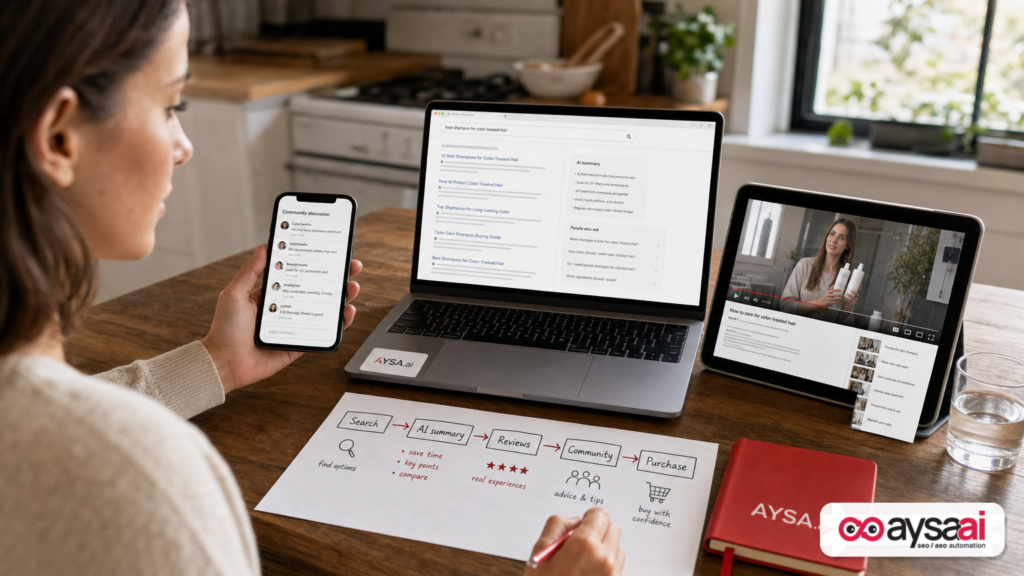
- AI search usage is rising, but trust is eroding fast. That creates a new gap: it’s not enough to “show up” in AI results—you need to be believed.
- Google still leads for purchase-intent trust, but customers increasingly validate on other platforms (forums, video, AI assistants, reviews).
- Heavy AI content is now a brand-trust liability unless governed, fact-checked, and transparently disclosed.
- GEO/AEO is real, but the easy tactics are also the least defensible. Authority moats come from expertise, original data, and earned mentions.
- Execution is the bottleneck. The winners will monitor AI visibility and misinformation, prepare fixes, get approvals fast, and deploy changes consistently.
Table of contents

- What changed: AI search adoption up, trust down
- The new reality: adoption up, trust down, and “search” splintering into many destinations
- Why trust is falling: the three forces most businesses underestimate
- Google still anchors purchase trust—but it’s no longer the whole journey
- Trust is the new ranking factor (even when rankings don’t change)
- GEO/AEO explained for SMEs: what you can control vs. what you can’t
- Visibility without clicks: what to measure now
- Content strategy in the AI era: fewer pages, stronger proof
- Governance and disclosure: how to scale without destroying trust
- A practical 2026 playbook: how to become the brand AI recommends (without becoming AI slop)
- SME scenario: a local clinic competing in AI summaries and Google results at the same time
- Agency reset: what to stop selling, what to start shipping
- Where AYSA fits: approved execution for AI-era search
- What to do next
- Sources and further reading
What changed: AI search adoption up, trust down
The research discussed by Search Engine Land describes a clear shift: consumers are using AI tools for search more than last year, yet a much smaller share say AI search is more helpful than traditional search. That combination—higher usage, lower trust—should change how you think about “SEO” and how you budget for it.
In earlier phases of any channel shift, the playbook is about adoption: “Be early, show up, get cheap reach.” In 2026, the AI search adoption curve is no longer the main story. The main story is that trust has become the scarce resource.
That means the businesses that win are not the ones who publish the most AI-assisted content or chase every new prompt trend. The winners are the ones that: (1) earn citations and mentions, (2) keep their facts consistent everywhere, (3) ship improvements fast when misinformation appears, and (4) create proof that humans can recognize even when AI summarizes it.
Primary research reference: Search Engine Land – “AI search adoption rises as consumer trust declines: Study”.
The new reality: adoption up, trust down, and “search” splintering into many destinations
For most SMEs, “search” used to mean:
- Google search → your website → a call, form, booking, or purchase.
Now it looks more like:
- Google results (sometimes with AI summaries) →
- an AI assistant for a quick comparison →
- Reddit or a niche community to validate →
- YouTube to see it done →
- review sites to confirm →
- then branded/direct traffic to convert.
The Search Engine Land research recap highlights multi-platform behavior and the fact that many consumers consult multiple platforms before they decide. The strategic implication is simple but brutal:
You can “rank” and still lose. Because if the buyer validates elsewhere and sees no proof of your credibility—no consistent mentions, no authoritative references, no clear expertise—AI summaries and community threads will steer them to a competitor even if your page is technically optimized.
This is why the AI era is merging what used to be separate disciplines: SEO, brand, PR, reviews, community, content, and analytics. Search visibility is now a surface-area problem.
Why trust is falling: the three forces most businesses underestimate
Let’s talk about why consumer trust erodes even when the technology seems “better” each month. You don’t need perfect answers to every question; you need to understand the forces shaping buyer behavior so you can design around them.
Force #1: hallucinations turned from “funny” into “costly”
Early on, AI hallucinations were mostly a curiosity: people posted screenshots, laughed, and moved on. But as AI results get used in real decisions—health, finances, contracts, purchases—hallucinations become expensive. The Search Engine Land research recap notes that marketers are already seeing brand misrepresentation and business impact.
For SMEs, a single incorrect AI claim can cause:
- lost sales (wrong pricing, wrong availability, wrong features),
- support burden (customers ask you to explain what the AI told them),
- reputation damage (you look dishonest, even when you’re the victim),
- legal risk (especially in regulated categories).
Force #2: content volume exploded—and buyers can feel it
The web is now saturated with “good enough” content. Buyers feel the sameness: generic intros, predictable headings, vague benefits, no firsthand experience, no photos, no data, no named experts.
Search Engine Land’s coverage points to rising consumer sensitivity to brands that use AI heavily in marketing. That aligns with what I see across SMEs: people don’t hate AI tools—they hate being treated like a Conversion event instead of a human.
Force #3: disclosure expectations are becoming the norm
Consumers increasingly expect labeling or transparency when content is AI-generated, especially in rich media formats. Whether or not your business chooses to disclose, the key reality is this: buyers are developing a trust heuristic. If something smells automated, they penalize it.
You don’t fix that with a disclaimer alone. You fix it by publishing content that contains the hard-to-fake signals of real expertise and accountability: sources, names, dates, testing notes, constraints, and clear ownership.
Google still anchors purchase trust—but it’s no longer the whole journey
The Search Engine Land research recap indicates Google remains a leading starting point for purchase-intent searches, with other destinations (including AI tools and community platforms) playing important validation roles.
So no, this is not the “Google is dead” narrative. It’s worse and more nuanced:
- Google remains the default authority for many categories.
- AI summaries compress the click by answering earlier in the journey.
- Validation happens elsewhere—and those surfaces shape the final decision.
As a business owner, this changes your job from “rank a page” to “win the journey.” You need your brand to be:
- discoverable in Google,
- understandable in AI summaries/assistants,
- defended by third-party proof,
- and consistent across every profile, listing, and review surface.
Related context worth reading (research leads):
- Search Engine Land – Pew: 60% of Americans read AI summaries in search results (via SEL)
- Search Engine Land – USA Today vs. Google AI Overviews: a breaking news traffic battle
Even if you’re not a publisher, the lesson is transferable: when an AI summary satisfies intent, your click becomes optional. So your brand cues, citations, and proof must do more work earlier.
Trust is the new ranking factor (even when rankings don’t change)
In classic SEO, we’d say: “Rank higher = get more Clicks.” In AI-assisted search, that relationship breaks.
Here’s the model I want SMEs to internalize:
- Visibility = you appear as a source, citation, mention, or recommended option.
- Trust = the user believes it and acts, or the AI model favors your entity in future synthesis.
- Conversion = the user reaches you directly, or chooses you without ever clicking.
Trust is the bridge between visibility and conversion. And it’s built with:
- accuracy, consistency, and recency,
- expertise signals (real names, credentials, firsthand experience),
- third-party validation (mentions, reviews, coverage),
- and clean, accessible content structure that can be extracted and attributed.
That’s why I’m increasingly skeptical of “publish 200 AI articles and see what sticks.” It might lift impressions for a month and then quietly poison your brand with low-trust signals.
GEO/AEO explained for SMEs: what you can control vs. what you can’t
Let’s demystify the acronyms:
- AEO (Answer Engine Optimization): optimizing content so it can be used directly in answers (snippets, AI summaries, assistants).
- GEO (Generative Engine Optimization): optimizing your brand/entity and content ecosystem so generative systems cite, mention, and recommend you.
What you can control:
- Your website’s factual core: pricing, policies, locations, product specs, service definitions, guarantees, refund terms, shipping times, eligibility criteria.
- Your content architecture: pages that map to real intents; internal linking; clear topic ownership; updated pages with “last reviewed” dates.
- Your entity consistency: same brand name usage, same address format, same phone, same leadership bios, same product naming everywhere.
- Your proof: original data, case studies, expert quotes, and third-party mentions that can be cited.
What you can’t fully control:
- exact phrasing of AI summaries,
- which competitors get suggested next to you,
- how community threads evolve.
Your job is to control the controllable so the output trends your way over time. That’s why monitoring and fast execution matter more now than “one-time optimization.”
Two useful industry leads on how AI is affecting visibility surfaces (from the provided context):
- Search Engine Land – How AI is merging paid and organic visibility
- Search Engine Land – Adobe tool shows where brands win/lose in AI search
Even if you never buy those tools, the takeaway is the same: the industry is moving from “rank tracking” to “brand presence tracking across AI.”
Visibility without clicks: what to measure now
If AI summaries reduce clicks, traditional SEO reporting can send you into the wrong decisions. You’ll see “traffic down” and panic—cut content, cut SEO, cut brand—and accidentally make the trust problem worse.
Instead, add a second measurement layer: visibility and trust indicators that don’t rely on a click.
What SMEs should track monthly
- Branded search demand (are more people searching your name and products?).
- Direct traffic and returning visitors (a proxy for trust and memory).
- Conversion rate by landing page type (are fewer but more qualified visitors arriving?).
- Search Console query mix: are you losing generic informational queries but holding commercial ones?
- Review velocity and sentiment (especially for local services and ecommerce).
- AI visibility checks: when people ask category questions, are you mentioned, cited, or recommended?
What to monitor weekly (or continuously)
- Critical misinformation about your brand: wrong address, wrong hours, wrong product compatibility, wrong return policy.
- Competitor capture patterns: are they being cited for questions you should own?
- Content decay: pages that still rank but contain outdated info—these are AI hallucination magnets.
This is exactly where a system like AYSA should live in your stack: not just “reporting,” but monitoring that triggers prepared changes and an approval flow.
Relevant AYSA pages:
Content strategy in the AI era: fewer pages, stronger proof
Most SMEs don’t have a content problem. They have a proof problem.
AI can synthesize what everyone already said. It struggles to synthesize what only you can know:
- your internal benchmarks,
- your actual support tickets and common edge cases,
- your real before/after results (with context),
- your firsthand comparisons of approaches,
- your constraints and tradeoffs.
Stop publishing content that trains buyers to distrust you
These page types are high-risk in 2026 when produced at scale with AI:
- generic “ultimate guides” with no unique angles,
- thin “best X” lists with no testing notes,
- FAQ pages that exist only to catch long-tail queries and repeat the obvious.
That doesn’t mean you shouldn’t answer FAQs. It means the answer must contain your expertise, not a paraphrase of the internet.
From the provided research leads, there’s even a direct discussion around what replaces the “ultimate guide” approach in AI search: Search Engine Land – What replaces the ultimate guide in AI search.
What to create instead (SME-friendly)
- Decision pages: “Which option is right for you?” with clear constraints and recommendations.
- Proof pages: documented methodology, testing notes, and outcomes (not just testimonials).
- Comparisons you can defend: where you’re explicit about assumptions and audience fit.
- Policy clarity pages: shipping, returns, eligibility, pricing logic—because AI often gets these wrong.
- Expert-led explainers: written or reviewed by a named person with credible experience.
And for many businesses, the single best “content” investment isn’t another blog post—it’s a better product/service page that eliminates ambiguity and strengthens extraction for AI summaries.
If you need a tools-oriented starting point, AYSA maintains an overview of practical tooling and workflows here: AYSA AI SEO Tools.
Governance and disclosure: how to scale without destroying trust
The Search Engine Land research recap highlights a widening governance gap: organizations use AI more, but governance processes don’t always keep up—and consumers increasingly want disclosure/labelling.
Here’s my editorial position: governance is now a growth lever.
Why? Because when competitors flood the market with fast, generic output, the businesses with an actual review system ship fewer mistakes, suffer fewer reputation hits, and build more durable authority signals.
A minimum governance checklist (practical for SMEs)
- Claim verification: every factual claim that could affect a decision gets checked or removed.
- Source anchoring: where you’re summarizing external facts, link to reputable sources (not random blogs).
- Ownership: a named internal owner (or editor) is accountable for accuracy.
- Recency: “last reviewed” dates for pages that can become outdated.
- Disclosure policy: define when and how you disclose AI assistance; be consistent.
- Consistency sweep: match policies, pricing, and definitions across your site and profiles.
For regulated industries (health, finance, legal), add legal/compliance review. If you don’t have in-house counsel, keep a tighter scope: fewer claims, more citations, more “what we can/can’t do” clarity.
Disclosure isn’t a moral debate—it’s a trust design decision
Businesses get stuck debating disclosure philosophically. Meanwhile, customers are building heuristics and punishing low-trust signals.
If you use AI in your workflow, the goal is not to plaster your site with disclaimers. The goal is to make your work visibly accountable: real authorship, clear sourcing, and content that shows genuine experience.
A practical 2026 playbook: how to become the brand AI recommends (without becoming AI slop)
Let’s turn strategy into operations. If you’re an SME, your advantage isn’t headcount. It’s focus and speed—if you build the right system.
Step 1: Build your “factual core” and keep it consistent
Create a short list of pages and data points that must be accurate everywhere:
- locations, hours, service areas, contact methods,
- pricing ranges and what affects pricing,
- shipping/returns/cancellations,
- product compatibility and requirements,
- credentialing and who performs the service.
These are the most common sources of AI misrepresentation because they are: frequently mentioned, frequently updated, and easy to confuse.
Step 2: Design content for extraction and attribution
AI systems summarize. They don’t “appreciate” your brand voice. They extract structure.
So make your content structurally helpful:
- clear definitions,
- bulleted decision criteria,
- tables for comparisons (when appropriate),
- FAQ blocks that address real edge cases,
- explicit “who this is for / not for.”
Schema can help machines understand your content, but schema alone doesn’t create trust. It’s a legibility tool, not a credibility tool.
Step 3: Earn mentions, not just rankings
Mentions and citations are how AI systems and humans triangulate credibility.
If you’re resource-constrained, aim for “earned proof” that matches your business model:
- industry associations,
- local press and community partnerships,
- podcasts or webinars where you bring expertise,
- expert quotes in reputable articles,
- high-quality customer reviews with specific details.
And yes: you still need a technically solid website. But technical hygiene is table stakes; it rarely becomes the moat by itself.
Step 4: Monitor AI visibility and brand accuracy like you monitor uptime
Most SMEs monitor server uptime, payments, or inventory. In 2026, you should also monitor whether AI systems are describing your brand correctly.
That means setting up recurring checks for:
- “What is [brand]?”
- “Is [brand] worth it?”
- “[brand] pricing”
- “[brand] vs [competitor]”
- “Best [category] for [use case]”
When an answer is wrong, don’t argue with the output. Fix the inputs: your site, your profiles, and the third-party sources the ecosystem relies on.
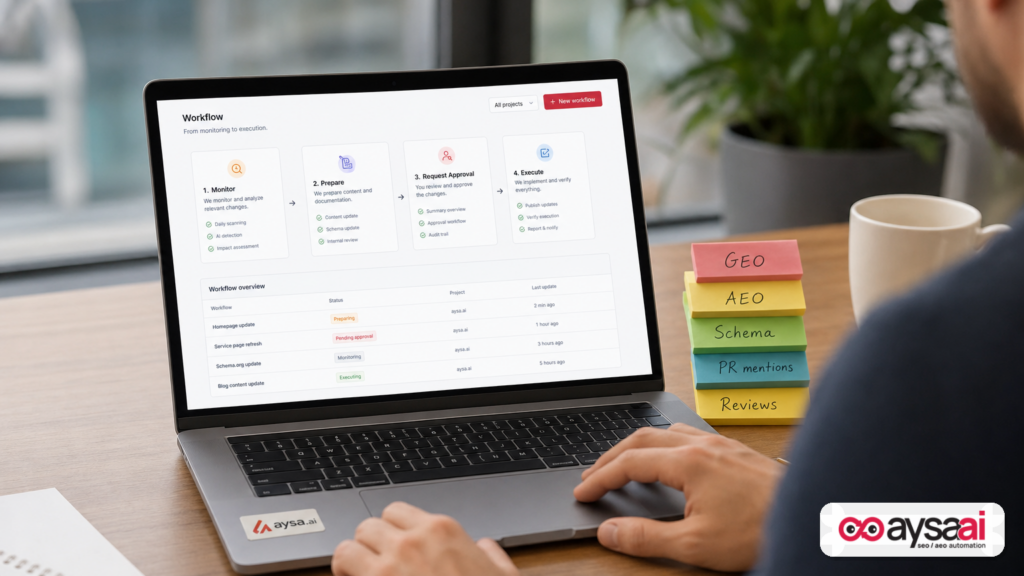
AYSA’s operating model is built for this loop: monitor → prepare → ask for approval → execute. Learn more here:
Step 5: Treat approvals as a speed advantage, not a bottleneck
In most organizations, approvals slow things down. But in the AI era, approvals can be the mechanism that lets you ship confidently, fast.
The trick is to approve bundles of changes that are clearly documented, reversible, and aligned with a defined policy (voice, compliance, claims standards). This is how you scale without chaos.
SME scenario: a local clinic competing in AI summaries and Google results at the same time
Let’s make this real with a scenario I see constantly.
Business: A local clinic (e.g., dermatology, dental, physical therapy) in a competitive metro area.
Problem: New patient bookings flatten. Rankings haven’t collapsed, but fewer people click. Meanwhile, front desk staff report a new pattern: patients arrive with “AI answers” that include incorrect insurance info and outdated service details.
What changed:
- Google still shows the clinic, but AI summaries and “quick answers” satisfy early questions.
- Patients validate with AI tools and community posts.
- Any inconsistency (hours, pricing estimates, eligibility) becomes amplified.
A pragmatic fix in 30 days
- Week 1: Identify the top 20 questions patients ask (from call logs, intake forms). Prioritize the ones that affect eligibility, insurance, pricing ranges, and safety.
- Week 2: Rewrite the top service pages to include: who it’s for/not for, what affects price, what to expect, and a clearly labeled “last reviewed” date. Add a short “insurance and billing” clarity block.
- Week 3: Publish an “Accuracy & Updates” page that explains how information is maintained and who reviews it (human accountability). Ensure listings and profiles match the website.
- Week 4: Monitor AI summaries for brand accuracy weekly; correct inconsistencies at the source (website + profiles + reputable directories).
Expected outcome: You may not regain every informational click—but you increase trust, reduce misinformation-driven friction, and protect conversion (calls, bookings, form fills).
This is the key mindset shift: you’re optimizing for decision confidence, not just traffic volume.
Agency reset: what to stop selling, what to start shipping
If you run an agency (or if you hire one), here’s what I believe needs to change immediately.
Stop selling these as your core deliverable
- “We’ll publish X blogs per month” (without proof, governance, or distribution).
- “We’ll optimize meta tags and schema and you’ll win AI Overviews.”
- Rankings-only reporting that ignores brand demand and multi-surface visibility.
Start shipping these instead
- Accuracy systems: consistency across the brand’s factual core.
- Entity authority building: expert-led content + earned mentions + review strategy.
- AI visibility monitoring: recurring checks for misrepresentation and missing citations.
- Governed execution: changes that are proposed, approved, deployed, and tracked.
This shift also changes pricing conversations: you’re not selling “content output.” You’re selling trust infrastructure.
On the tooling/operations side, it’s worth watching how platforms are expanding reporting around AI (research lead): Bing Webmaster Tools updates AI reporting…. Even if you’re Google-first, this points to an industry direction: more measurement around intents, topics, and citations.
Where AYSA fits: approved execution for AI-era search
Most SEO tools tell you what’s wrong. Most businesses already know a lot is wrong. The bottleneck is execution: prioritization, approvals, implementation, and follow-through.
AYSA is designed as an execution system for SEO/AEO/GEO:
- Monitors visibility and issues over time,
- Prepares changes and recommendations,
- Asks for approval (so humans stay accountable),
- Executes accepted website changes.
This model matters more in the AI era because mistakes compound faster. When AI summaries or assistants misstate facts, you need a reliable way to trace back to sources and deploy corrections quickly—without “hope and pray” publishing.
If you want to see how AYSA approaches AI-era visibility specifically:
What to do next
If you’re an SME owner or marketing lead, here’s a concrete next-step list you can execute this quarter.
Next 7 days (quick wins)
- Audit your factual core: identify the top 10 facts customers need (pricing logic, hours, service areas, returns, eligibility).
- Pick 5 “AI prompt checks” for your brand (pricing, vs competitor, best for, is it worth it, how it works) and document what’s wrong or missing.
- Stop the bleed: pause publishing any AI-assisted content that can’t be reviewed properly.
Next 30 days (build trust assets)
- Upgrade 3 money pages (top product/service pages) with clear decision criteria, edge cases, and a last-reviewed date.
- Add proof: one case study, one benchmark, or one original dataset—even small. The point is uniqueness.
- Align your profiles (listings/review sites) with your website’s facts.
Next 90 days (durable moat)
- Build an earned mention plan: 10 targets (local press, associations, partners, podcasts) and a monthly cadence.
- Implement monitoring for AI misrepresentation and category visibility, and create an internal response process.
- Operationalize approvals so changes can ship weekly without drama.
If you want a system designed for that “monitor → approve → execute” loop, start here: AYSA Monitoring.
Sources and further reading
- Search Engine Land: AI search adoption rises as consumer trust declines: Study
- Search Engine Land: Pew: 60% of Americans read AI summaries in search results
- Search Engine Land: How AI is merging paid and organic visibility
- Search Engine Land: Bing Webmaster Tools updates AI reporting with Intents, Topics, Citation Share and Compare
- Search Engine Land: New Adobe tool shows where brands win and lose in AI search
- Search Engine Land: What replaces the ultimate guide in AI search
- AYSA: AI Search Visibility
- AYSA: AI SEO Tools
- AYSA: Monitoring
- AYSA: Pricing
Note: This article uses Search Engine Land’s reporting and referenced research as an input for analysis and strategy. Where platform-specific claims or broader industry metrics would require additional primary verification beyond the provided context, I’ve avoided adding new numbers and focused on operational guidance you can validate in your own business.
Continue the AI search topic inside AYSA.
Use these pages to connect the article with AI SEO tools, AI visibility monitoring, AI Overviews and approved website execution.
Turn this topic into a website action plan.
Use these AYSA hubs to move from reading to technical fixes, AI visibility monitoring, research, glossary context and approval-first SEO execution.