
The Integrated Search Brief: How SMEs Align SEO, Google Ads, And Content For AI Overviews & AI Mode
AI Overviews and AI Mode are compressing clicks and reshaping SERPs. The fix isn’t “more content” or “more budget”—it’s a shared integrated search brief that aligns SEO, PPC, and content around one outcome, one intent model, one SERP reality, and one measurement plan. Here’s the playbook—and how AYSA turns it into approved execution.

By Marius Dosinescu (AYSA.ai)
Search used to be a fairly linear machine: research keywords, publish pages, earn links, adjust bids, iterate. Today, the “search results page” is less a page and more a multi-surface experience where users might see an AI Overview, ads, shopping modules, forums, video, a Local pack, and then—sometimes—choose to keep the conversation going inside AI Mode instead of clicking anything at all.
That complexity doesn’t just change tactics; it breaks the workflow most businesses still run:
- SEO works from Keyword lists and a content calendar.
- PPC works from campaigns, automation, creative tests, and landing page Conversion rate.
- Content works from brand narratives, product launches, and stakeholder requests.
Those streams collide on the same SERP, in front of the same buyer, at the same moment. If you don’t align them, you get duplicate work, conflicting messages, and measurement that’s impossible to interpret—especially in the AI Search era.
This editorial is inspired by Corey Morris’ framework for an integrated search brief (via Search Engine Journal) and expands it into a full, practical operating system for SMEs and agencies—plus how we at AYSA think about turning alignment into Approved Execution.
Primary source: Search Engine Journal – “The Integrated Search Brief That Aligns SEO, PPC & Content In The AI Search Era”.
Table of contents
- The 60-Second Summary (What This Article Helps You Do)
- Key takeaways
- Context: Integrated search used to be nice-to-have—now it’s survival
- What Changed In Search (And Why Your Old Workflow Breaks)
- The Integrated Search Brief (A Practical Template You Can Reuse)
- 1) Business objective: write outcomes, not tasks
- 2) Audience & intent: define the searcher before you define the channel
- 3) SERP landscape: plan for the real page, not the spreadsheet
- 4) Channel roles: stop fighting over ownership, start assigning roles
- 5) Content & landing page requirements: build once, use everywhere
- 6) Measurement plan: align KPIs when AI blurs attribution
- 7) Action plan: make it executable, testable, repeatable
- A concrete SME scenario: local clinic vs AI-heavy SERPs
- Where integrated briefs fail (and how to prevent it)
- What agencies should rethink in 2026 planning
- How AYSA Fits: From Brief To Approved Execution (Without Chaos)
- What to do next
- Sources and further reading
The 60-Second Summary (What This Article Helps You Do)

An integrated search brief is a single planning document that aligns:
- SEO (crawlable visibility, content structure, Internal linking, long-term demand capture)
- PPC (coverage, fast testing, message validation, conversion efficiency)
- Content (trust, clarity, differentiation, and buyer enablement)
In the AI search era, you need this brief because:
- AI Overviews and AI Mode can change the path to conversion (and reduce traditional clicks).
- SERPs can require multiple asset types to win (not just “a blog post” or “a landing page”).
- Google Search Console (GSC) may count AI-driven impressions/clicks, but it won’t always cleanly separate them, which makes measurement messy without a baseline and a plan.
Use the brief to decide: what you’re trying to achieve, who you’re targeting, what the SERP reality looks like, what each channel’s job is, what content must exist, how success is measured, and who does what by when.
Then—critically—use a system to execute. Strategy without execution is just debate. At AYSA, we focus on turning monitoring and insights into approved website changes that actually go live (with guardrails).
Key takeaways
- Stop briefing channels. Start briefing outcomes. “Rank for X” and “launch ads for Y” are tasks, not goals.
- Intent is the shared language. SEO, PPC, and content are different tactics to serve the same searcher need.
- SERP analysis is no longer optional. Your keyword sheet doesn’t show the AI Overview, ads density, forums, or local pack that will define your real opportunity.
- AI features reward completeness and clarity. Not “long content,” but the right modules: comparisons, FAQs, definitions, internal links, and decision support.
- Measurement must be designed upfront. When attribution blurs, the teams need shared leading indicators and decision rules.
- Execution is the bottleneck. The best brief still fails if changes don’t ship; you need a reliable approve-and-implement workflow.
Context: Integrated search used to be nice-to-have—now it’s survival
If you’re an SME, you likely don’t have “SEO team,” “PPC team,” and “content team.” You have a marketing lead, a generalist, an agency, maybe a freelancer, and a founder who approves spend and website changes. Even so, you still experience the same silo problem—because the work artifacts are siloed:
- SEO sends keyword lists and content briefs.
- PPC sends campaign structures and landing page requests.
- Content sends brand messaging docs and editorial calendars.
What’s new is the cost of misalignment. When AI Overviews and AI Mode reduce the number of clicks available on some queries, every mismatch becomes more expensive:
- Ads have to work harder to earn the click.
- Organic has to work harder to earn the citation/visibility.
- Landing pages have to work harder to convert the smaller pool of traffic.
So the question becomes: How do you coordinate SEO, PPC, and content so they reinforce each other in a messy, AI-mediated SERP?
The integrated search brief is the cleanest answer I’ve seen because it’s practical. It’s not a re-org. It’s not a new tech stack. It’s one shared operating agreement.
What Changed In Search (And Why Your Old Workflow Breaks)
Let’s be precise about the shift, without hype.
1) SERPs are no longer “10 blue links” with ads on top
Depending on the query, Google can show combinations of:
- AI Overviews
- Paid text ads
- Shopping/product modules
- Local packs
- Videos
- Forums/discussions
- Images
- Featured snippets and other rich features
The implication: if you brief SEO to “write an article,” but the SERP is dominated by comparison pages, forums, and an AI Overview, your article might be the wrong asset for the reality of that search.
2) AI Mode changes user behavior mid-journey
As noted in the source, Google positions AI Mode as useful when a query requires exploration, comparisons, reasoning, and follow-up questions. That matters because the journey can continue inside the AI experience rather than returning to a list of results.
Implication: you should plan content that supports multi-step decision-making (definitions, comparisons, objections, next-step guidance), not just a single keyword target.
3) Measurement gets blurrier, so planning must get sharper
Google Search Console is still foundational for organic reporting. But when AI-driven impressions/clicks are blended into “Web” performance (and not always separated into neat buckets), you need to:
- define a baseline before big changes,
- track SERP feature presence over time, and
- agree on leading indicators that tell you you’re moving in the right direction.
Google’s own documentation notes how performance is reported in Search Console; use it, but don’t expect perfect attribution for AI surfaces. See: Google Search Console Help (general documentation hub).
The Integrated Search Brief (A Practical Template You Can Reuse)
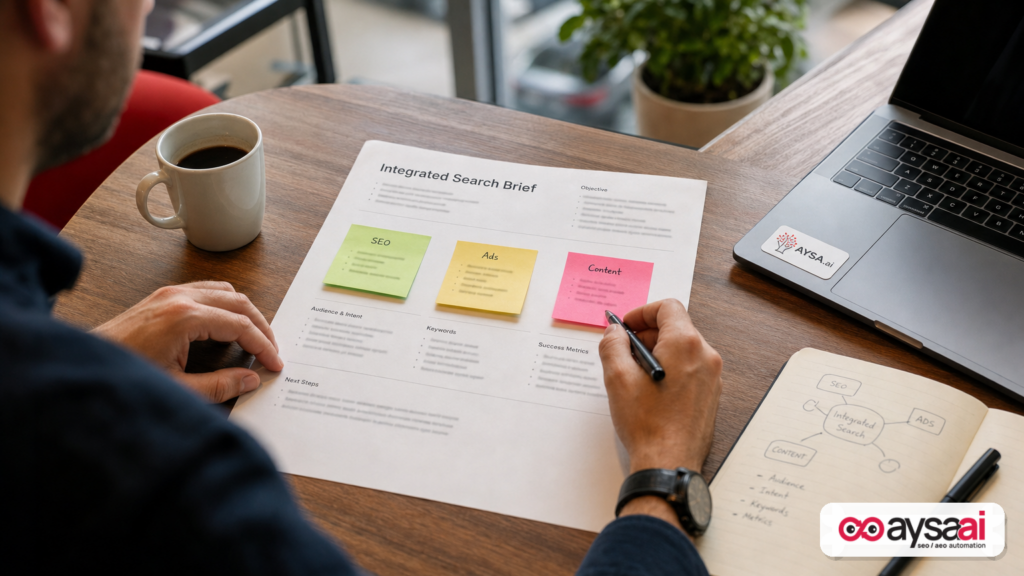
An integrated search brief is a single document used by everyone touching search demand—paid or organic—and everyone producing or approving content and website changes.
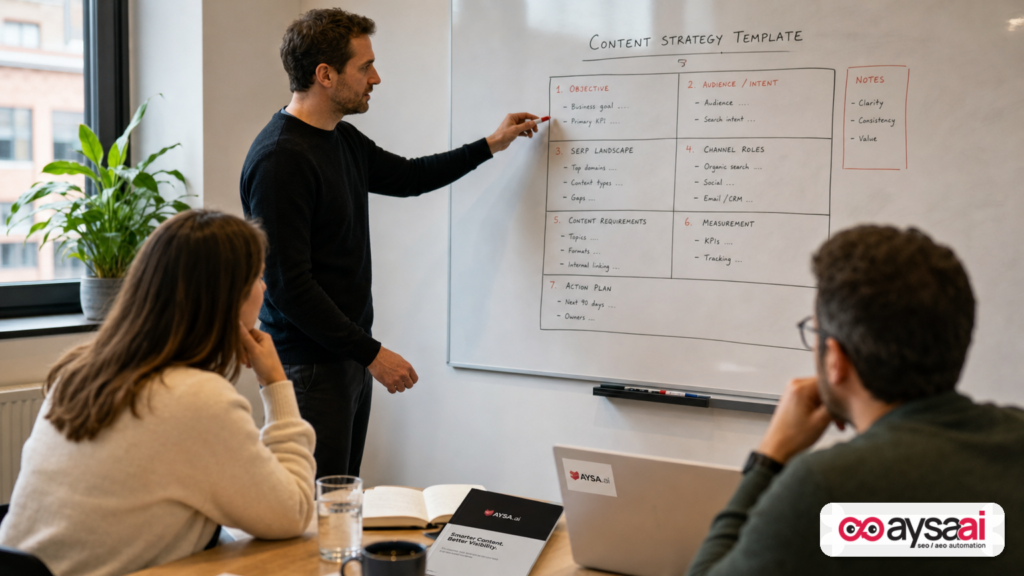
Done right, it answers seven questions in order:
- What outcome are we driving? (Business objective)
- Who are we targeting and what do they need? (Audience & intent)
- What does the SERP actually look like? (SERP landscape)
- What role does each channel play? (Channel roles)
- What content and pages must exist? (Requirements)
- How will we measure and decide? (Measurement)
- What exactly happens next? (Action plan)
This structure is adapted from the framework described by Corey Morris in Search Engine Journal (linked above) and expanded here with additional operational guidance for SMEs, agencies, and execution systems like AYSA.
1) Business objective: write outcomes, not tasks
The easiest way to spot a siloed plan is that it starts with a channel task:
- “Rank for [keyword].”
- “Launch ads for [service].”
- “Write three blogs about [topic].”
Those aren’t objectives. They’re outputs.
A real integrated brief starts with the business problem. That means describing:
- Business goal/outcome: what changes in revenue, pipeline, bookings, or retention?
- Audience segment: who exactly is the buyer/searcher?
- Desired action: what action should they take next (call, book, demo, quote, subscribe, visit store)?
- Primary KPIs: what metric will the business actually care about?
- Secondary/channel KPIs: what’s useful but not the end goal?
- Timeframe: when do we need signal vs certainty?
- Owner(s): who is accountable for decisions?
What this looks like for an SME
Instead of:
“We need to rank for ‘emergency plumber.’”
Write:
“Increase booked emergency jobs from homeowners within 10 miles during nights/weekends by improving visibility for urgent intent searches and reducing time-to-booking from landing pages.”
Now SEO, PPC, and content have a shared definition of success. And it immediately forces a practical conversation: urgent intent searches probably require ads and a conversion-focused page; informational queries may require content that builds trust and answers anxiety-driven questions (“cost,” “response time,” “what to do now”).
2) Audience & intent: define the searcher before you define the channel
Intent is the shared language that prevents channel arguments.
When SEO and PPC disagree, it’s usually because they’re each imagining a different searcher:
- PPC imagines a high-intent buyer ready to convert.
- SEO imagines a researcher building awareness.
- Content imagines a broader audience for thought leadership.
Sometimes all three are valid. The mistake is pretending they’re the same query cluster and the same page.
Fields to include (practical, not academic)
- Primary audience (industry, demographics, constraints)
- Buyer segment (SMB vs mid-market, consumer vs B2B)
- Buyer role (owner, marketing manager, operations leader, clinician, etc.)
- Stage (problem-aware, solution-aware, comparison, vendor selection)
- Topic/query cluster (group terms by intent, not by synonyms)
- Intent type (urgent, transactional, comparison, informational, navigational)
- Searcher need (what question are they trying to answer?)
- Likely AI behavior (does the query invite comparison/reasoning/follow-ups?)
My opinionated take
If you only do one thing differently in 2026 planning, do this: force the brief to name the “next question.”
AI Mode and AI Overviews reward content that anticipates follow-ups. If the query is “best accounting software for restaurants,” the next question is often “vs X,” “pricing,” “setup time,” “POS integration,” “tax support,” “multi-location,” “inventory,” and “what do I do if I already use QuickBooks?”
That’s not fluff. That’s decision support. And decision support is what wins in AI-shaped journeys.
3) SERP landscape: plan for the real page, not the spreadsheet
The integrated brief should include a SERP landscape snapshot for the query cluster—because SERPs define what “winning” can look like.
A keyword list doesn’t show you:
- Whether an AI Overview is present (and where it sits).
- How many ad blocks appear above the fold.
- Whether Google is pushing forums, videos, local results, or shopping.
- Whether the organic results are dominated by aggregators/review sites.
What to record in the brief
- Common SERP features present per query group.
- Observed content types that rank/appear (comparison pages, category pages, guides, product pages, tools, forums).
- Competitive reality (who owns visibility—brands, marketplaces, publishers, directories?).
- Implications (what assets are required to compete?).
Why this matters more in AI search
AI experiences can pull information from multiple sources and can encourage users to continue exploring rather than clicking. That pushes your strategy toward:
- clear, structured content that’s easy to interpret,
- coverage of subtopics that answer follow-up questions, and
- authority signals that help you become a credible source.
None of that is guaranteed. But if you don’t plan for the SERP reality, you are guaranteed to waste effort.
If you need ongoing SERP monitoring rather than occasional manual spot checks, that’s exactly the kind of operational gap we designed AYSA Monitoring to address—so you don’t discover a SERP shift three months after your content shipped.
4) Channel roles: stop fighting over ownership, start assigning roles
The integrated brief isn’t about making SEO and PPC do the same work. It’s about making them complementary.
Channel role examples (not rules)
- SEO role: build durable, crawlable coverage; strengthen internal linking; improve information architecture; make content eligible for rich results where applicable; develop topical depth.
- PPC role: cover high-intent and competitive terms; test messaging fast; ensure presence when organic is compressed by AI features; remarket and close loops where search alone is insufficient.
- Content role: create credible, brand-aligned decision support; produce assets that can be repurposed into ad creative, landing modules, FAQs, and sales enablement.
- Website/CRO role: ensure the experience converts for traffic from any surface; reduce friction; improve clarity; support multiple CTAs for different stages.
Dependencies to make explicit
- Who owns the final message hierarchy (headline, positioning, proof points)?
- Who can approve website changes, and on what timeline?
- What must be produced first: page, creative, tracking, analytics configuration?
- What does PPC need from SEO (or vice versa) to move faster?
One thing the source gets right: this brief becomes practical the moment it forces “roles and dependencies” onto paper. It prevents the most common SME failure mode: everyone is “busy,” but nothing ships in a coherent sequence.
5) Content & landing page requirements: build once, use everywhere
In 2026, “write a landing page” is not a requirement. It’s a label.
A real requirement is: what must the page contain to satisfy intent, compete in the SERP environment, and convert?
A practical requirements checklist
- SERP match: does the page type align with what appears to win on the SERP (comparison, category, guide, tool, local service page)?
- CTA match: is the CTA aligned to stage (book now vs get pricing vs download checklist vs talk to specialist)?
- Decision support: does the page answer the objections that stall conversion (cost, timeline, risk, proof, alternatives)?
- Modularity: can the content be repurposed (FAQ block, comparison table, testimonials, short claims for ads)?
- Shared usage: should paid and organic land on the same page, or do you need separate experiences?
- Internal paths: are there clear next steps for both fast converters and researchers?
My editorial stance: stop thinking “content length” and start thinking “content completeness”
AI-era content debates often collapse into “short vs long.” That’s the wrong axis.
The axis that matters is: Does the page fully support the buyer’s decision at this moment?
Sometimes that’s 600 words and a pricing module. Sometimes it’s a comprehensive comparison plus FAQs plus a “who it’s for” section plus proof points. The integrated brief is where you decide that intentionally, not accidentally.
If you’re specifically trying to improve visibility in AI-shaped journeys, see AYSA’s AI Search Visibility approach—because “eligible and understandable” content is now a competitive moat.
6) Measurement plan: align KPIs when AI blurs attribution
This is where integrated plans go to die: everyone measures what their channel makes easiest, not what the business needs.
Principles for a modern measurement plan
- One primary business KPI (the unifying metric): leads, bookings, revenue, qualified pipeline, subscriptions, etc.
- Channel KPIs that predict the outcome: SEO impressions/coverage, PPC conversion rate, cost per lead, landing page engagement, call tracking, etc.
- Leading indicators that give early signal: CTR changes after messaging tests, conversion rate lift after page changes, impression growth on priority query groups, etc.
- Baseline documentation before changes: current SERP features, current conversion rates, current spend/coverage.
- Decision rules: what triggers a pivot? What is “good enough” to scale?
Where GSC fits (and where it doesn’t)
Google Search Console is still essential for organic performance monitoring and debugging. But when AI surfaces are blended into web performance reporting, you should supplement with:
- query group tracking (not individual keywords),
- SERP feature tracking, and
- landing page conversion analytics (because fewer clicks means higher conversion demands).
If you need a central place to keep the strategy and the execution connected, start with a repeatable monitoring cadence. That’s why AYSA Monitoring exists—to reduce the lag between “SERP changed” and “we responded.”
7) Action plan: make it executable, testable, repeatable
A brief without an action plan is a memo. You need an operational plan with:
- Prioritized tasks by channel and dependency order
- Deliverables (pages, ad groups, creative variants, internal links, FAQs)
- Owners (one accountable person per deliverable)
- Timeline (sprints, review windows)
- Testing plan (what are we testing and why?)
- Review cadence (weekly PPC review, monthly SEO review, etc.)
- Decision authority (who can say “ship it,” “pause it,” “rewrite it”?)
- Documentation repository (so you don’t lose learnings)
The integration flywheel (practical example)
- PPC tests 5 messaging angles quickly.
- Winner angle becomes the H1/subhead language on the core organic page.
- The updated page improves conversion rate for both paid and organic traffic.
- Content team expands the winning angle into a comparison guide that targets broader queries.
- SEO links everything together to build topical depth and a coherent path.
That only works if the action plan explicitly says: “PPC insights must be reviewed and applied to page copy by date X,” instead of assuming collaboration will happen magically.
A concrete SME scenario: local clinic vs AI-heavy SERPs
Consider a realistic small business: a multi-provider physical therapy clinic in a mid-sized U.S. city. They want more new patient bookings for “back pain treatment,” “sports injury rehab,” and “sciatica therapy.”
What goes wrong in the old model
- SEO publishes blog posts targeting symptom keywords.
- PPC bids on “physical therapy near me” and sends traffic to a generic “Services” page.
- Content writes a brand story page about “patient-first care.”
None of this is inherently bad, but it’s disconnected. And the SERP may show AI answers that summarize symptoms and recommend “see a professional,” plus a local pack, plus forum content. Clicks are scarce and competitive. The clinic needs a tighter plan.
What the integrated brief changes
Business objective: Increase booked evaluations from adults within 8 miles searching for sciatica/back pain treatment options; reduce no-shows with clearer expectations and insurance guidance.
Intent mapping:
- Urgent/local: “PT near me,” “sciatica therapist near me” → PPC + local landing experience.
- Comparison: “PT vs chiropractor for sciatica” → content page that supports reasoning and follow-ups.
- Pre-visit concerns: “does PT help sciatica,” “how many sessions” → FAQ modules and expectation-setting.
SERP landscape: local pack is prominent; AI answer summarizes; organic shows hospital pages and high-authority medical sites; discussion content appears on some queries.
Channel roles:
- PPC covers local/high-intent queries and tests “same-week appointment,” “insurance accepted,” “doctor referral not required” messaging (if true).
- SEO focuses on service pages by condition + internal linking + localized relevance.
- Content produces decision-support pages (comparisons, expectations) with clinician review for accuracy.
Requirements: create a dedicated sciatica page with symptoms, treatment approach, what to expect, insurance info, FAQs, and clear booking CTA; add internal links to related pages; ensure the “Book evaluation” path is frictionless on mobile.
Measurement: bookings, call leads, and form completions as primary outcomes; PPC conversion rate and CPL as fast indicators; organic impressions and landing conversion rate as medium-term indicators.
Action plan: ship page improvements first (so paid traffic has a better experience), then scale PPC coverage, then publish comparison content and interlink it.
This is the difference between “doing marketing activities” and running an integrated search program.
Where integrated briefs fail (and how to prevent it)
I’ve seen teams adopt “unified briefs” and still not get results. The failures are predictable.
Failure mode #1: The brief becomes a one-time document
If it’s created at kickoff and never revisited, it can’t respond to SERP shifts, ad performance learnings, or seasonal demand changes.
Fix: treat the brief as a living document with scheduled review windows and decision rules.
Failure mode #2: It’s still secretly a keyword report
If 80% of the brief is keyword lists and 20% is strategy, you’ll default back to “publish more content” rather than “build the right experiences.”
Fix: keep keywords in service of intent and SERP reality. The brief is about decisions, not lists.
Failure mode #3: Ownership is unclear
Integrated doesn’t mean “everyone owns it.” It means responsibilities are explicit.
Fix: assign one accountable owner per deliverable and one decision-maker per domain (budget, brand, web changes).
Failure mode #4: No execution lane for website changes
This is the silent killer for SMEs. You can agree on everything, and still lose months waiting for a developer or for stakeholder approval.
Fix: adopt an approved execution workflow where changes can be proposed, reviewed, and implemented reliably.
What agencies should rethink in 2026 planning
If you’re an agency, AI-era search forces a few uncomfortable truths:
1) “SEO deliverables” aren’t enough
Clients don’t buy meta titles. They buy outcomes. Agencies need to package strategy as integrated demand capture: content, paid coverage, CRO, and measurement.
2) PPC learnings must feed SEO (and vice versa)
In many accounts, PPC is the fastest way to validate messaging. Treat it like a research lab. Then incorporate those learnings into landing pages and organic content modules.
3) Reporting has to evolve beyond isolated channel dashboards
The client cares about leads and revenue. When AI reduces clicks, “traffic” can become a vanity metric. Agencies must build reporting narratives that connect visibility, engagement, and conversion—without pretending attribution is perfect.
4) Execution velocity is a differentiator
As SERPs evolve faster, agencies that can ship changes safely will outperform agencies that only provide recommendations. This is where automation plus approval workflows can be a competitive advantage.
If you want a broader view of how automation can support SEO operations (without removing human approval), see AYSA AI SEO tools and our ongoing writing on the AYSA blog.
How AYSA Fits: From Brief To Approved Execution (Without Chaos)
An integrated brief aligns people. But alignment still doesn’t ship changes.
In the real world, most organizations fail at one of these steps:
- They don’t notice the SERP changed.
- They notice, but don’t translate it into a prioritized plan.
- They plan, but can’t get website updates approved and implemented.
- They implement, but don’t measure and iterate.
AYSA is designed to reduce that gap by functioning as an SEO/AEO/GEO execution system:
- Monitors site and search visibility signals over time (Monitoring).
- Prepares recommended changes that map to search realities and user needs (e.g., content modules, internal linking, structured content improvements).
- Asks for approval so changes don’t go live without oversight (brand, compliance, accuracy matter).
- Executes accepted website changes, turning the brief into shipped improvements.
That “approved execution” model is the difference between strategy as a document and strategy as a compounding system. If you’re evaluating whether it fits your org size and workflow, start at AYSA pricing to understand the packaging and constraints.
What to do next
If you want to implement this without a months-long process overhaul, do the following in the next two weeks.
Week 1: Build your first integrated search brief
- Pick one revenue-driving topic or service line.
- Write a business objective in outcome language (not keywords).
- Define 2–4 intent groups (urgent, comparison, informational, vendor selection).
- Review the SERP manually for each group and note the feature mix.
- Assign roles: what’s SEO doing, what’s PPC doing, what’s content doing, what website changes are required?
Week 2: Turn the brief into shipped changes
- Create or update the primary landing experience to match the dominant intent.
- Launch a small PPC message test tied to the same objective.
- Add one decision-support module to the page (FAQ, comparison block, proof points, next-step guidance).
- Set measurement: baseline + weekly review + decision rules.
- Document what you learned and feed it back into the brief.
If you need a system to keep that loop running—monitor, recommend, approve, execute—start with AI search visibility and monitoring, then explore AYSA’s tools.
Sources and further reading
- Search Engine Journal (Corey Morris): The Integrated Search Brief That Aligns SEO, PPC & Content In The AI Search Era
- Search Engine Journal: SEO coverage
- Search Engine Journal: PPC News
- Search Engine Journal: SEO News
- Google Search Console Help (documentation hub)
Related AYSA resources
Continue the AI search topic inside AYSA.
Use these pages to connect the article with AI SEO tools, AI visibility monitoring, AI Overviews and approved website execution.
Turn this topic into a website action plan.
Use these AYSA hubs to move from reading to technical fixes, AI visibility monitoring, research, glossary context and approval-first SEO execution.

