60% Read AI Summaries in Search: The New Reality for SEO, AEO, and Business Growth
Pew reports 60% of Americans read AI summaries in search results and 40% use chatbots for search. That’s not a trend—it’s a new distribution layer. Here’s what changed, why clicks are no longer the only KPI, and a practical playbook to win visibility in AI Overviews and chatbot answers without gambling your website.

AI summaries are no longer a novelty. They’re where many people start—and end—their search journey.
According to a Pew Research Center study highlighted by Search Engine Land, 60% of U.S. adults say they’ve read AI-generated summaries at the top of search results, and about 40% use chatbots for search. Half of U.S. adults now use AI chatbots, and roughly one in four uses them daily.
Those two numbers (60% and 40%) are the line in the sand: search has become a summary-first interface, and discovery has expanded beyond “ten blue links” into AI summaries and chatbot answers. If you’re still measuring success mainly as rankings and Clicks, you’re using yesterday’s scoreboard in today’s game.
I’m Marius Dosinescu, and at AYSA.ai we build an approved-execution system for modern search: we monitor what AI systems and SERPs are doing, prepare recommended site changes, ask for approval, and then execute the changes you accept. This editorial is the practical guide I wish every founder, marketing leader, and agency had before their next traffic report triggers panic.
Concise summary

- People are consuming answers inside search (AI summaries) and outside search (chatbots) at scale.
- Classic SEO still matters, but it’s no longer sufficient—visibility now includes being eligible to be summarized and selected to be cited.
- Clicks may fall while influence rises. Your new job is to connect AI visibility to leads, sales, and brand preference.
- Execution speed is becoming the moat: the businesses that monitor changes, ship improvements safely, and iterate win.
Key takeaways (read this if you’re busy)
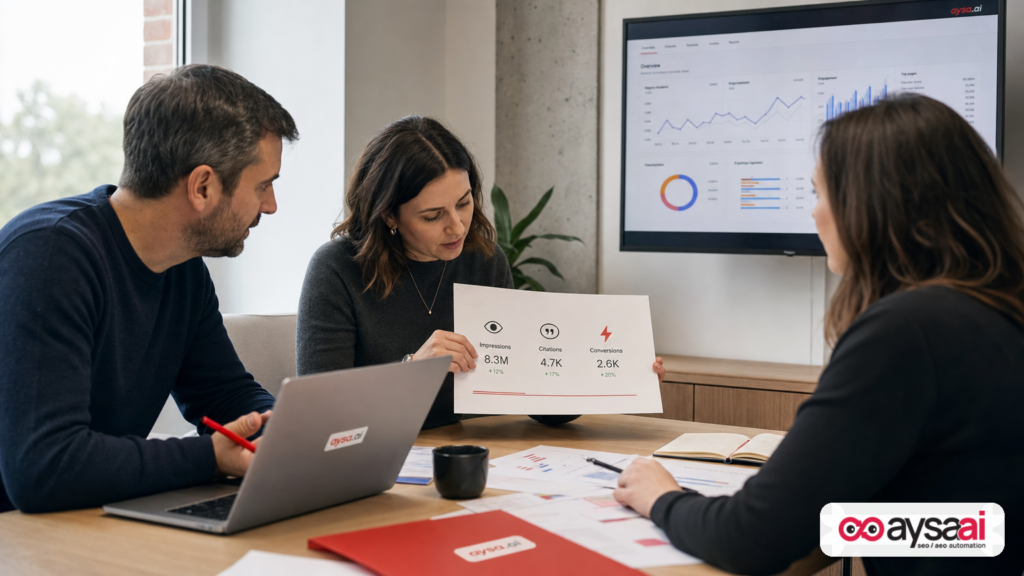
- AI summaries are now mainstream behavior. When 60% of adults say they read them, “we’ll ignore it until next year” is not a strategy.
- Chatbots are a parallel search channel. With 40% using chatbots for info lookup, your brand needs representation in both SERPs and conversational answers.
- Visibility ≠ ranking. Ranking #1 doesn’t guarantee you’re the source AI uses. Conversely, you can be cited without ranking #1.
- Measurement must evolve. Track more than clicks: Brand Mentions, citations, assisted conversions, call volume, and category demand.
- Operationally, this is an execution problem. Strategy is important, but the winners will be the teams that ship site improvements continuously and safely.
Table of contents
- What changed: Search became a summary-first interface
- What the Pew findings really mean for businesses (not just marketers)
- Trust is fragile: the risk side of AI summaries and chatbots
- Why clicks are no longer the only KPI (and may be the wrong one)
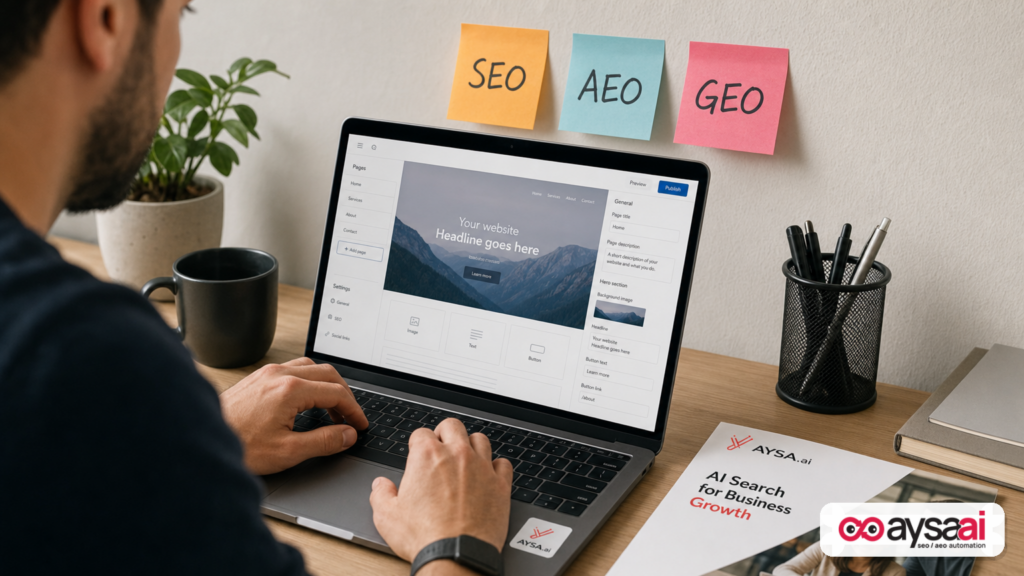
- The new optimization stack: SEO + AEO + GEO (and what each one really means)
- How AI summaries choose sources (what we can infer without pretending certainty)
- What changes for ecommerce, local services, SaaS, and publishers
- A concrete SME scenario: A local clinic competing in an AI-summary world
- What agencies must rethink: deliverables, proof, and execution
- The 90-day action plan: what to do now
- Where AYSA fits: monitoring, prepared changes, approved execution
- What to do next (checklist)
- Sources and further reading
What changed: Search became a summary-first interface
For two decades, the implicit “contract” of search looked like this:
- Users asked a question.
- Google (or another engine) returned a list of links.
- Publishers and businesses competed to earn a click.
- Websites turned that click into a lead, sale, subscriber, or some downstream value.
AI summaries break the contract in a subtle but profound way: they satisfy many intents before the click. The user still “searches,” but the interface behaves like a reader, not a directory.
That matters because most SMEs don’t actually need “traffic.” They need outcomes: booked appointments, calls, quote requests, purchases, and qualified pipeline. Historically, traffic was the reliable path to those outcomes. In a summary-first world, the path is less direct—and therefore easier to mis-measure.
It also means the competitive set changes. You’re not only competing with the business down the street or the site ranking above you. You’re competing with:
- Whatever sources the AI chooses to summarize.
- Whatever the AI decides is “enough” information.
- The user’s willingness to click at all.
From an operator’s perspective, the biggest shift is this: search results pages are now a product experience, not just a routing mechanism.
What the Pew findings really mean for businesses (not just marketers)
Let’s translate the Pew findings (as reported by Search Engine Land) into business implications.
1) AI summaries are not “early adopter behavior” anymore
If 60% of U.S. adults say they’ve read AI summaries at the top of search results, then the summary layer is now a mainstream touchpoint. For many categories, that layer will become the first brand impression—even if the user never visits your site.
That changes what “top-of-funnel” means. Your homepage and your blog are still important, but for a growing share of users your first impression is:
- a sentence in an AI overview,
- a bullet list in a summary,
- or a short citation line that may or may not even include your brand name prominently.
2) Chatbots are now a parallel channel for information lookup
Pew’s reported 40% using chatbots for search is not a rounding error. It’s a second discovery channel where the user intent is similar (“help me understand X” or “help me choose Y”), but the mechanics are different.
In a chatbot, the user rarely compares 10 tabs. They tend to:
- ask one question,
- get a synthesized answer,
- ask a follow-up,
- and only click if they need proof or next steps.
So the business question becomes: are you present in the conversation when customers ask for a recommendation?
3) User understanding of “what is AI” is still imperfect
Search Engine Land’s coverage notes that some people were unsure whether they had read AI summaries—suggesting the interface is not always clearly recognized as AI or the labeling isn’t sticking.
That matters because it changes how users assign trust and blame:
- If the AI summary is wrong, do they blame Google, the cited website, or “the internet”?
- If the AI summary is right, who gets credit?
Brands should assume that accuracy and clarity on your own site increasingly affects how you’re represented elsewhere—even if you don’t control the summary layer.
4) “Traditional ranking” no longer equals “traditional opportunity”
The Search Engine Land piece includes an important line: “A traditional search ranking may not reflect every place people now find answers.”
This is the part many teams miss. You can be “winning” in rankings and still “losing” in outcomes because the interface changed. Or you can be “losing” in rankings but still showing up in AI summaries and capturing demand.
The correct response is not to abandon SEO. It’s to expand it into a broader discipline: search visibility engineering across classic results, AI summaries, and conversational systems.
Trust is fragile: the risk side of AI summaries and chatbots
AI summaries feel authoritative. That’s their appeal and their danger.
Even when AI systems cite sources, users don’t always click those sources. So errors can be “sticky.” A wrong dosage, a misinterpreted policy, an outdated price range—these can spread at the speed of summaries.
Search Engine Land also points to a related piece, “AI search adoption rises as consumer trust declines: Study”. The tension is predictable: adoption grows because the experience is convenient, while trust wobbles because the experience can be inconsistent.
For businesses, that means two things simultaneously:
- Opportunity: AI summaries can compress the journey from “question” to “decision.”
- Risk: the wrong summary can compress the journey from “question” to “misinformed decision.”
Where things can go wrong (practical examples)
- Local services: AI summary says you serve a neighborhood you don’t, causing wasted calls and bad reviews.
- Ecommerce: AI summary implies a feature your product doesn’t have, increasing returns and support tickets.
- Medical/health: AI summary mixes general advice with your clinic’s services, triggering compliance issues.
- B2B SaaS: AI summary misstates pricing tiers, lowering trust during sales cycles.
The countermeasure is not “opt out of AI.” It’s to build a site and brand footprint that is easy to interpret correctly: explicit answers, structured information, consistent terminology, and strong authority signals.
Why clicks are no longer the only KPI (and may be the wrong one)
Most teams grew up in a world where the SEO KPI stack was simple:
- rankings → clicks → conversions
AI summaries complicate that by adding “zero-click satisfaction.” Users may get what they need without clicking. That doesn’t automatically mean you “lost.” It means you need to reframe what success looks like.
The KPI problem: you can’t optimize what you can’t see
If a user reads a summary, learns your brand is reputable, and later searches your brand name directly or returns via a different channel, your SEO dashboard may show “declining clicks” while your revenue holds steady.
That’s why modern measurement needs multiple layers:
- Visibility metrics: Impressions, presence in summary/citation environments (where measurable).
- Demand metrics: Branded Search volume trends, direct traffic trends (with caution), call volume.
- Outcome metrics: leads, purchases, booked appointments, qualified pipeline, retention.
Be careful with “AI traffic” narratives
Some teams will overreact in either direction:
- “Traffic is down, SEO is dead.” (often false)
- “AI summaries will cite us if we publish more content.” (often wishful)
The honest answer is messier: your category, your customer, and your site’s clarity determine whether AI search helps or hurts—and by how much.
A practical measurement reset for SMEs
If you’re a business owner and you don’t want an analytics overhaul, start with three questions:
- Are leads/sales down, or only traffic?
- Are branded searches up or down over the last 90 days?
- Did the mix of queries change (more informational, fewer transactional)?
If revenue is stable and branded demand is growing, declining informational clicks may not be a fire. But it’s still a signal: AI summaries are intercepting early-funnel discovery, and you need to ensure your brand is what the summary layer recommends, cites, or reinforces.
The new optimization stack: SEO + AEO + GEO (and what each one really means)
Buzzwords are cheap. Definitions matter.
SEO (Search Engine Optimization)
Still the foundation. SEO is about earning visibility in classic search results: Crawling/indexing, relevance, authority, and technical performance.
AEO (Answer Engine Optimization)
AEO focuses on making your content answer-ready—clear, direct, structured, and credible so it can be pulled into summary boxes, featured-like formats, and other answer interfaces.
GEO (Generative Engine Optimization)
GEO is about being represented accurately and competitively inside generative systems: how your brand, products, services, and comparisons show up when the system synthesizes an answer.
Here’s the operational reality: SEO, AEO, and GEO overlap on the same assets—your pages, your schema, your internal linking, your reputation signals—but they reward slightly different qualities.
Classic SEO often rewards breadth and relevance at scale. AEO/GEO reward clarity, explicitness, and corroboration.
What this means for content teams
- Stop writing content that “teases” answers to earn a click. AI summaries will often extract and paraphrase anyway.
- Start writing content that states the answer plainly, then backs it up with detail, context, and sources.
- Build content that can be quoted without becoming misleading when separated from the rest of the page.
How AI summaries choose sources (what we can infer without pretending certainty)
We should be careful here: different search products and chatbots use different methods, and we shouldn’t pretend we can see inside every model.
But we can still operate based on observable realities:
- AI summaries tend to prefer clear, structured explanations over vague marketing copy.
- They often rely on corroborated information that appears consistently across multiple reputable sources.
- They may include citations (when provided), but the presence and format vary.
Search Engine Land’s broader coverage hints at how messy this can be. For example, it references: “Google AI Overviews cite self-serving listicles, but recommend competitors 69% of the time”. The takeaway isn’t the specific statistic (don’t generalize it to your category), but the directional lesson: AI can cite one source while recommending another. Visibility and recommendation are not the same thing.
It also links to: “Google’s LLM patent suggests a new goal for SEO: Teaching AI who you are”. Even without leaning on patent speculation, the practical point holds: your brand identity needs to be machine-legible—consistent naming, consistent positioning, clear entity relationships (company → products → categories → use cases), and an on-site narrative that doesn’t contradict itself.
The simplest way to think about AI selection
In classic SEO, you often win by being the “best page.” In AI summaries, you often win by being the “best building block” for an answer.
That means you should engineer pages to provide:
- Definitions (what it is)
- Choices and trade-offs (when to pick A vs B)
- Steps (how to do it)
- Constraints (when it doesn’t apply)
- Evidence (why the claim is true)
What changes for ecommerce, local services, SaaS, and publishers
AI summaries don’t hit every business model the same way. The impact depends on whether the AI layer can satisfy the intent without sending the user to a site.
Ecommerce: expect fewer “research” clicks, fight harder for “purchase” clicks
AI summaries can handle a lot of product discovery questions: comparisons, sizing guidance, “best for” roundups, and feature explanations.
So ecommerce brands need to ensure that when AI summarizes the category, it doesn’t erase them. Two practical moves:
- Make PDPs and category pages answer common objections (compatibility, materials, shipping timelines, returns) in clear, extractable sections.
- Publish comparison and decision pages that are genuinely useful, not affiliate-style fluff.
If AI summaries reduce clicks for early research, you’ll need stronger on-site conversion once users do arrive. Better PDP clarity, better trust signals, better merchandising—because you’ll get fewer “free” visits.
Local services: the summary layer shapes calls, not just clicks
Local search is already a “zero-click” environment (maps, hours, phone numbers). AI summaries add another layer that can influence:
- who gets shortlisted,
- what price expectations people bring,
- and what services they think you offer.
Local operators should prioritize consistency: services, service areas, credentials, and policies must match across your site and prominent listings. If your story is inconsistent, the AI layer has more room to guess.
SaaS: AI summaries can pre-sell—or pre-disqualify—you
In B2B, buyers research for weeks. AI summaries can speed up “category education” and tool comparisons. That can help you if your differentiation is clear and credible.
But it can hurt you if:
- your positioning is vague,
- your pricing information is confusing,
- your documentation is thin,
- or your “why us” claims aren’t supported.
Make your product legible: use cases, integrations, security/compliance, and constraints should be spelled out in ways that can be summarized without distortion.
Publishers: the business model shock is real
Publishers rely on clicks for ad impressions and subscriptions. Summary-first search threatens that pipeline more directly than it threatens a plumber’s phone calls.
One strategic response publishers are pursuing is better control over AI crawlers and usage. Search Engine Land points to: “Cloudflare and beehiiv give publishers new AI crawler controls”. The details matter (and will vary by platform), but the high-level editorial lesson is: publishers are moving from passive indexing to active rights and distribution management.
If you run a content business, you need two things at once:
- A distribution strategy that assumes fewer free clicks.
- A product strategy that gives readers a reason to come directly (email, membership, tools, community).
A concrete SME scenario: A local clinic competing in an AI-summary world
Let’s make this real with a scenario that’s common across the U.S.
Business: a mid-sized local clinic offering dermatology and cosmetic services in a metro area.
Old world: they ranked well for “acne treatment [city]” and “dermatologist near me,” and their blog captured informational traffic like “what causes adult acne.”
New world: users search “best acne treatment,” see an AI summary that explains options (topicals, oral meds, lifestyle factors, specialist consult), and only later choose a clinic—sometimes without clicking the original articles.
What goes wrong if the clinic does nothing
- The AI summary mentions treatments but doesn’t surface the clinic, so the clinic loses “brand consideration” even if rankings remain decent.
- The AI summary implies services the clinic doesn’t offer (e.g., a specific laser), creating mismatch and friction.
- Competitors with clearer service pages become the default suggestions.
What the clinic should do (practical, non-hype)
- Rewrite core service pages for answer clarity: who it’s for, how it works, what results to expect, risks, typical timelines, and when to see a professional.
- Add “decision support” pages: “Acne treatment options: what works for which type,” written in plain language and medically cautious.
- Strengthen entity consistency: same clinic name formatting, physician bios, credentials, and service list everywhere.
- Improve conversion paths for fewer visits: online booking clarity, insurance/payment info, and prominent next steps.
Notice what’s missing: gimmicks. The winning move is operational discipline—tight, explicit information architecture that machines can interpret and humans trust.
What agencies must rethink: deliverables, proof, and execution
If you run or hire an agency, AI summaries change the agency-client relationship in predictable ways.
1) Reporting must move beyond rankings and clicks
Clients will ask: “Traffic is down—what happened?” Agencies must be able to explain the interface shift and connect efforts to outcomes.
That includes adapting to new measurement surfaces as they become available. Search Engine Land notes: “Google Search Console AI performance reports rolling out to more users”. When platforms add AI-related reporting, clients will expect agencies to interpret it—and act on it.
2) Strategy is cheap; shipping is rare
In 2026, many teams can produce a “GEO strategy deck.” Far fewer can implement changes week after week without breaking things.
Execution requires:
- technical hygiene (speed, indexation, canonicals, internal linking),
- content operations (briefs, updates, pruning, consolidation),
- and QA (brand, legal, medical, pricing, product accuracy).
This is why the market is moving toward systems and automation that reduce the cost of iteration without removing human oversight.
3) Build-versus-buy decisions become existential
Agencies and in-house teams are being forced to decide what to automate and what to keep manual. Search Engine Land points to: “How to approach build-versus-buy decisions for SEO”. The editorial truth is that modern search is too dynamic to manage with spreadsheets and quarterly site updates.
Agencies that thrive will package:
- a modern visibility strategy (SEO + AEO + GEO),
- continuous monitoring,
- and an execution pipeline that is safe and fast.
The 90-day action plan: what to do now
Most businesses don’t need a complete rebuild. They need a focused plan with a tight feedback loop.
Phase 1 (Weeks 1–2): Diagnose the real impact
- Separate “traffic decline” from “business decline.” Look at leads, sales, calls, bookings, and pipeline quality.
- Segment queries: informational vs commercial vs brand. If informational clicks fell first, AI summaries are a likely factor.
- Audit your top 20 pages that used to drive discovery. Are they still accurate? Are they answer-forward?
If you want a starting point for AI visibility monitoring, see AYSA’s AI search visibility and monitoring approach.
Phase 2 (Weeks 3–6): Make your content “summarizable without distortion”
This is where most sites fail. They write to persuade, not to clarify. AI systems summarize clarity.
- Add explicit definitions and direct answers near the top of key pages.
- Use structured sections: “What it is,” “Who it’s for,” “Cost factors,” “Timeline,” “Pros/cons,” “Alternatives.”
- Update outdated claims (prices, policies, feature lists, eligibility, availability).
- Reduce ambiguity. If you don’t serve a location or don’t support a feature, say so clearly.
This is also where content pruning and consolidation can matter, especially if you have many thin or overlapping pages. (Search Engine Land’s broader context includes content pruning guidance; use it as a strategic lead, but apply it carefully to your own site.)
Phase 3 (Weeks 7–10): Strengthen authority signals and corroboration
AI summaries tend to favor information that is consistent and corroborated. You can’t force that, but you can improve your footprint:
- Make your “about” and “credentials” pages strong. Who you are should be obvious.
- Build consistent entity references (company name, product names, service names) across your site.
- Publish evidence where appropriate: methodology, policies, documentation, clear citations for factual claims.
Phase 4 (Weeks 11–13): Build an execution cadence (the real advantage)
The teams that win in AI search won’t be the ones who do one big SEO project. They’ll be the ones who:
- monitor changes continuously,
- ship improvements weekly,
- and avoid risky changes without oversight.
This is exactly the gap AYSA is designed to fill—especially for SMEs who can’t hire a full search team.
Where AYSA fits: monitoring, prepared changes, approved execution
AI search creates a workload problem. Not just “write more content,” but:
- track what’s changing in SERPs and AI surfaces,
- identify which pages are losing visibility and why,
- turn insights into concrete changes,
- ensure changes are safe, on-brand, and compliant,
- and then actually implement them.
Most businesses break down at the last step. They know what to do; it never gets shipped.
AYSA’s model is simple and operational:
- Monitor your search and AI visibility signals (see Monitoring).
- Prepare recommended website changes (content updates, internal linking improvements, structural fixes) with clear rationale.
- Ask for approval before anything changes—so you stay in control.
- Execute accepted changes to keep momentum without creating a risky “auto-publish” system.
If you want to explore the tooling angle, start here: AI SEO tools. If you want to understand visibility tracking in AI-first search, see AI search visibility. For cost and packaging, see Pricing. For ongoing perspectives, see the AYSA blog.
Why “approved execution” matters more in an AI-summary era
Many businesses are tempted to fight AI with more AI—auto-generated pages, auto-updates, bulk publishing. That can backfire fast:
- Incorrect statements scale mistakes.
- Off-brand tone erodes trust.
- Compliance issues become legal risk.
The right approach is to use AI to increase throughput without removing human responsibility. That’s what approval gates are for: speed with control.
What to do next (checklist)
- Pick your top 10 revenue-driving topics (services, categories, products) and ensure each has a page that answers the core questions plainly.
- Update your “about” and “credentials” signals so it’s obvious who you are and why you’re credible.
- Consolidate overlapping content that creates ambiguity (two pages that answer the same question differently is a liability in summaries).
- Set a weekly execution cadence: one technical improvement + one content clarity improvement per week.
- Stop relying on click-based reporting alone. Add outcome metrics (leads, calls, bookings) and demand metrics (branded search trends) to the same dashboard conversation.
- Decide who owns AI search visibility internally—marketing, product, or revenue ops—and make it someone’s job, not everyone’s side quest.
Sources and further reading
- Search Engine Land: Pew: 60% of Americans read AI summaries in search results
- Search Engine Land: AI search adoption rises as consumer trust declines: Study
- Search Engine Land: Google AI Overviews cite self-serving listicles, but recommend competitors 69% of the time
- Search Engine Land: Google’s LLM patent suggests a new goal for SEO: Teaching AI who you are
- Search Engine Land: Google Search Console AI performance reports rolling out to more users
- Search Engine Land: Cloudflare and beehiiv give publishers new AI crawler controls
- Search Engine Land: How to approach build-versus-buy decisions for SEO
AYSA resources referenced: AI Search Visibility • Monitoring • AI SEO Tools • Pricing • Blog
Continue the AI search topic inside AYSA.
Use these pages to connect the article with AI SEO tools, AI visibility monitoring, AI Overviews and approved website execution.
Turn this topic into a website action plan.
Use these AYSA hubs to move from reading to technical fixes, AI visibility monitoring, research, glossary context and approval-first SEO execution.