
Cited but Not Chosen: Why Google AI Overviews Can Use Your “Best” Listicle to Recommend Competitors—and What to Do About It
A new analysis shows Google AI Overviews may cite your self-promotional “best” page yet recommend competitors most of the time. Here’s what changed, why citations aren’t wins, and the practical AEO/GEO playbook SMEs and agencies need to protect demand and revenue.

By Marius Dosinescu, AYSA.ai
For years, SEO teams optimized for a single primary outcome: the click. Rank well, earn the click, convert the visitor. But AI Search—and especially Google’s AI Overviews—changes what “winning” looks like. Your content can now be used to build the answer while your competitors get the recommendation, the shortlist placement, and the demand.
That’s not hypothetical. Search Engine Land covered a study by Lily Ray that found a recurring pattern in Google AI Overviews for B2B “best [category] software” searches: Google would cite a company’s own self-promotional “best” listicle, yet exclude that company from the tools it recommended in most cases—with competitors recommended 69% of the time when those self-serving listicles were cited.
This editorial is not about dunking on listicles. It’s about adapting to a reality: AI Overviews are a decision layer, not just a summary layer. And if you still run your content strategy like it’s 2019, you may be training the model to choose someone else.
Primary source: Search Engine Land — “Google AI Overviews cite self-serving listicles, but recommend competitors 69% of the time”.
Concise summary
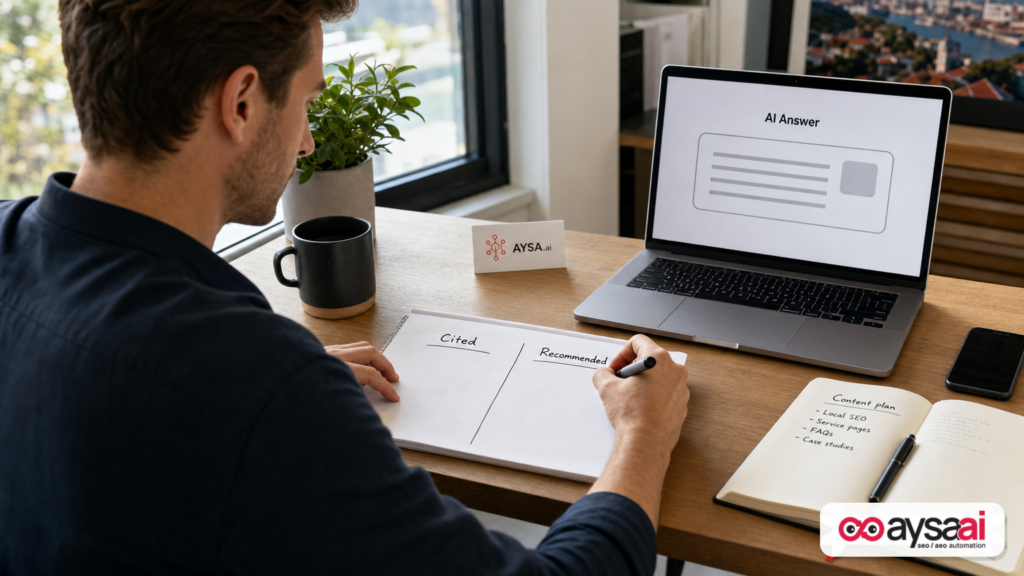
Google AI Overviews can cite your content as a source while recommending your competitors as the “best” options. A citation is proof you were used; a recommendation is proof you were chosen. Businesses that rely on self-promotional “best” pages may be unintentionally supplying the model with competitor lists, category definitions, and evaluation criteria—while losing the click and the customer.
Key takeaways
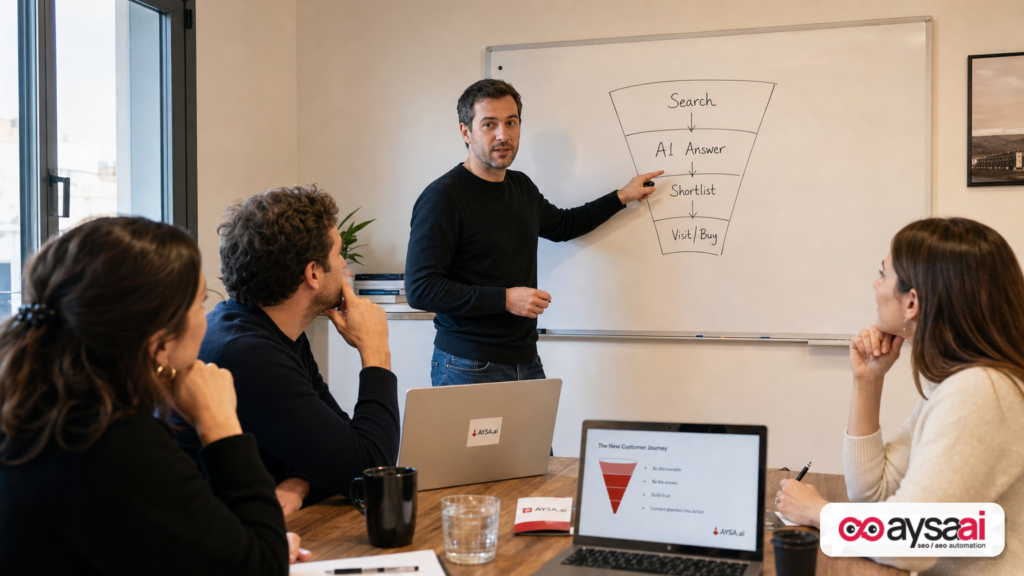
- Citations ≠ recommendations. Being referenced in AI Overviews is not the same as being selected as the answer.
- Self-serving “best” listicles are high-risk. They can be used as training data for the AI answer, and the AI may still prefer stronger, more widely corroborated brands.
- Authority signals appear to matter. Ray’s analysis notes that category-leading brands with broader third-party support and stronger link profiles were more likely to be recommended.
- Organic traffic can decline even if you’re cited. AI Overviews can satisfy intent without a click, and “best” queries compress consideration.
- Execution speed becomes strategic. The winners will monitor AI outputs, identify gaps, and ship structured, verifiable changes consistently—without rewriting the whole site every week.
Table of contents
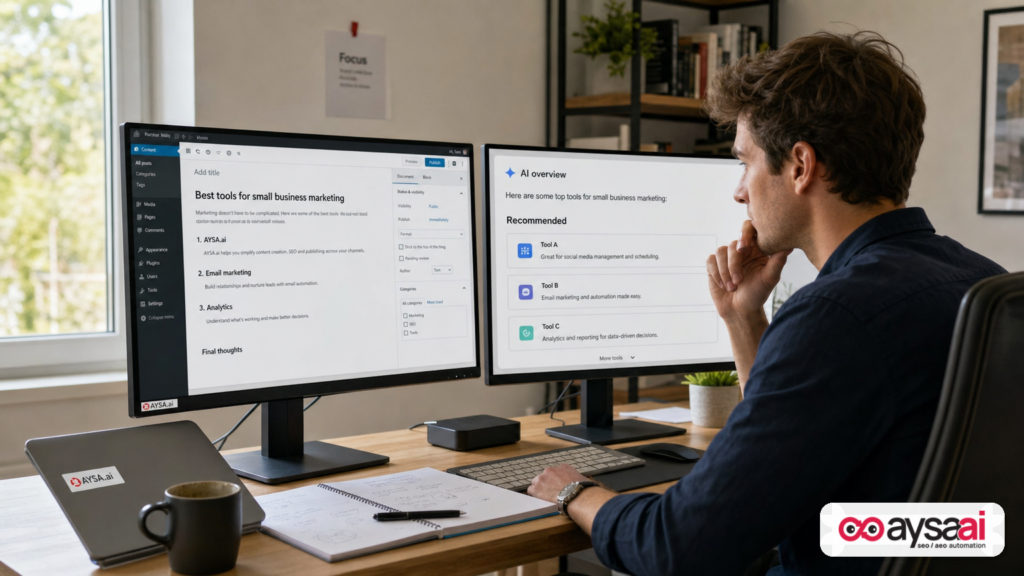
- The uncomfortable reality: a citation is not a recommendation
- What Lily Ray found—and what it implies for the rest of us
- What changed in AI search behavior (and why listicles are now a trap)
- How AI Overviews likely “decide” what to recommend (without pretending we know the algorithm)
- Why your page gets cited even when you don’t get recommended
- An SME scenario you’ll recognize: the “best software” page that backfires
- What to stop doing (and what to do instead)
- How to build “recommendation readiness” with proof, not hype
- Content architecture for AI search: fewer listicles, more evidence
- What you should monitor weekly (not quarterly) in the AI era
- What agencies should rethink: from rankings deliverables to decision-layer outcomes
- Where AYSA fits: monitor → prepare → approve → execute
- What to do next: a practical action list
- Sources and further reading
The uncomfortable reality: a citation is not a recommendation
In classic SEO, if Google ranked your page on page one, the value was obvious: you could earn traffic. In AI Overviews, the relationship between visibility and value is more complicated.
A citation tells you:
- Your page was eligible to be used as supporting material.
- Your page contained information the model considered relevant to the prompt.
- Your content likely influenced the shape of the answer.
A recommendation tells you something else entirely:
- The AI answer is willing to put your brand on the “shortlist.”
- The AI believes your brand is a good default choice for many users, not just a contextual reference.
- Your brand has sufficient corroboration to be suggested as an option—often in a small set of names.
The strategic consequence is blunt: you can “win” citations and still lose customers. In Ray’s dataset, Google frequently cited the brand’s own “best” page and then recommended competitors instead. The citation gave the brand the illusion of visibility; the recommendation gave the competitor the business outcome.
What Lily Ray found—and what it implies for the rest of us
Search Engine Land summarized Ray’s analysis of AI Overviews for 100 B2B software queries formatted like “best [category] software,” checked across three dates (April 15, May 15, June 8). Key points as reported:
- Out of the prompts that triggered an AI Overview, self-promotional listicles were cited hundreds of times.
- In many cases, Google cited the brand’s page but did not recommend the brand.
- Competitors were recommended instead—often those named inside the brand’s own article.
- Brands that already led categories and were mentioned broadly across third-party sources were more likely to appear in recommendations.
- Ray also observed organic declines for many sites that leaned heavily on these self-promotional “best” pages, with declines accelerating during Google’s May 2026 core update (as reported by Search Engine Land).
Two implications matter even if you don’t sell B2B software:
- AI can use your content against your business incentives. If your article lists competitors as “alternatives” or “top options,” you’re supplying the model with a structured candidate set.
- AI rewards corroboration and consistency. If the broader web signals point to other brands as category leaders, the AI can treat your site as a useful source while still “choosing” the more widely supported names.
And yes—Ray’s dataset is specific to B2B software “best” queries. But the underlying dynamic is not limited to SaaS. Any “best” or “top” query is fundamentally a selection problem. AI Overviews are designed to help users select quickly.
What changed in AI search behavior (and why listicles are now a trap)
Let’s describe the shift in plain business terms.
1) The search engine now “finishes the meeting” without you
In traditional search, the SERP was the lobby. Users clicked into multiple sites to do the real evaluation. In AI Overviews, Google tries to do the evaluation for them—at least enough to form a shortlist.
That means the most valuable real estate is no longer just position #1. It’s:
- Being named as a recommended option in the AI answer
- Being described accurately (positioning, strengths, “best for”)
- Not being framed as a niche fallback while a competitor is framed as the default
2) “Best” queries are becoming zero-click shortlists
For “best X” searches, many users don’t want to read 10 blog posts. They want the shortlist. AI Overviews is built to provide that. So even if your organic ranking is still decent, the user may never reach it.
3) Content that was once harmless is now a dataset
That “Best tools” post you wrote two years ago? It’s not just a blog post anymore. It’s a structured list of entities, attributes, comparisons, and positioning statements that can be extracted, summarized, and reused.
If your listicle includes:
- Competitor names
- Feature comparisons
- Pricing tiers
- “Best for” categories
…you’re giving the model a ready-made shortlist.
How AI Overviews likely “decide” what to recommend (without pretending we know the algorithm)
We don’t have Google’s internal weighting for AI Overviews. And you shouldn’t trust anyone who claims they do.
But we can reason from what Ray observed (as reported), and from how ranking systems generally behave: AI Overviews appear to separate two tasks:
- Retrieval / sourcing: Find pages that contain relevant information (your “best” page is perfect for this).
- Selection / recommendation: Choose a small set of options that best satisfy most users (this tends to favor well-corroborated, widely referenced brands).
In other words, you can be excellent at retrieval (you wrote a clear list), but weak at selection (the web doesn’t broadly agree you’re a top choice).
What “corroboration” can look like in practice
Without inventing metrics, think of corroboration as: “If we removed your site from the internet, would the rest of the web still describe you as a top option?”
Signals that often correlate with corroboration include:
- Consistent third-party mentions across reputable publications
- User-generated discussion (forums, communities) that mentions your brand in-context
- Reviews and comparisons that appear independent (and are clearly disclosed where relationships exist)
- A strong, natural Backlink Profile
- Clear entity identity: who you are, what category you’re in, what you do
Search Engine Land’s write-up also notes Ray found increased citations from third-party and user-generated sites for “best” queries—specifically mentioning domains like Reddit, Forbes, and YouTube as frequently cited. (That’s an observation from Ray’s study as reported, not a universal rule.)
Why your page gets cited even when you don’t get recommended
This is the part that frustrates founders—and it’s exactly why you need to reframe how you measure success.
You wrote the cleanest “map” of the category
Self-promotional “best” pages often include neat tables, headings, pros/cons, and a structured list of tools. That’s machine-friendly.
So Google can cite you as the source for:
- A category definition (“What is an LMS?”)
- A list of common features (“Look for SCORM support, certificates…”)
- A set of brand names (including your competitors)
But the recommendation layer is optimizing for user satisfaction and safety
When the question is “best,” the AI answer is implicitly making a judgment. It may lean toward brands with:
- Broader recognition
- More independent support
- Lower perceived risk for the average buyer
And if your listicle is obviously self-serving, the model may treat it as informational but not trustworthy enough to recommend you as the unbiased “best.”
Self-ranked listicles can also create compliance risk
Search Engine Land also flagged a separate risk: presenting company-controlled content as if it were independent reviews may create legal exposure under the FTC’s Consumer Review Rule if disclosures and substantiation are not handled correctly (as reported in their coverage). If your “Best X” page looks like a neutral review site but is controlled by the vendor, that’s not just an SEO issue—it’s a governance issue.
If you’re not sure where your pages fall, treat this as a cue to consult counsel. Don’t guess.
An SME scenario you’ll recognize: the “best software” page that backfires
Let’s make this real with a scenario I’ve seen in different forms across SaaS, ecommerce, and local services.
The business: A 12-person SaaS company selling appointment scheduling software for clinics.
The content plan (classic SEO thinking): Publish “Best appointment scheduling software” and rank the company #1. Add a comparison table with common competitors. Build internal links from blog posts. Update quarterly.
What happens in AI Overviews:
- Google’s AI Overview cites the company’s page as a source for “features to look for.”
- The AI Overview then recommends 3–5 tools that are mentioned inside the company’s listicle—competitors with stronger brand recognition and wider third-party references.
- The user never Clicks. The shortlist is formed at the AI layer.
The business impact:
- Traffic to the listicle drops.
- Demo requests drop—not because the product got worse, but because the discovery layer changed.
- The founder is confused: “We’re cited in the AI Overview—why are we losing?”
The underlying issue: The company optimized for being crawled and cited, not for being recommended. And they trained the AI on a competitor list while lacking enough independent corroboration to be chosen.
What to stop doing (and what to do instead)
If you currently publish self-ranked “best” pages, you don’t need to delete everything tomorrow. But you do need to stop treating this as a safe default tactic.
Stop #1: Publishing “best” pages that are basically a competitor index
If your article is mostly a list of competitors—with your brand at #1—you’re building the AI’s candidate set. If you don’t win the recommendation slot, you just did your competitors’ marketing for them.
Do instead: Create pages that demonstrate fit and proof. More on that below.
Stop #2: Assuming “we’re cited” means “we’re visible”
Being cited can be a vanity metric if it doesn’t translate into selection or clicks.
Do instead: Track AI recommendation presence for your key commercial prompts, plus how you are described (positioning, “best for,” and omissions).
AYSA is built for this kind of Monitoring and operational loop: AYSA Monitoring and AI Search Visibility.
Stop #3: Scaling content formats that look like manipulation
Search Engine Land’s summary notes Ray observed declines across sites that scaled “best” pages, comparisons, and AI-generated content at volume. You don’t need to moralize about it. You just need to recognize that high-scale, low-substantiation content is fragile in a world where AI answers compress attention.
Do instead: Ship fewer pages, but attach more proof to each: demos, docs, transparent disclosures, third-party references, and structured data.
How to build “recommendation readiness” with proof, not hype
To be recommended, your brand has to be easy to understand, easy to place in a category, and easy to trust. That’s a mix of content, technical signals, and off-site corroboration.
1) Tighten your “entity identity”
When AI builds answers, it needs to know who you are. Many SMB sites are surprisingly vague:
- Homepages full of slogans
- About pages that don’t specify category or ICP
- Feature pages that list benefits without grounding in use cases
Practical fixes:
- Make your category explicit (not just “platform” or “solution”).
- State “best for” honestly on your own site—backed by examples.
- Clarify geography, industries, compliance claims (only if accurate and provable).
If you want a structured approach, start here: AI SEO Tools.
2) Build independent corroboration (the unsexy moat)
You can’t “SEO” your way out of a reputation gap with on-site copy alone. If AI Overviews leans toward brands that are broadly cited elsewhere (as Ray’s analysis suggests), you need a plan to earn that third-party footprint.
Corroboration ideas that don’t require a Fortune 500 budget:
- Publish data studies or benchmarks that others will reference (and that you can substantiate).
- Get included in real partner pages (integrations, directories) where users expect to compare options.
- Encourage customers to discuss your product where they already talk (communities, forums)—without astroturfing.
- Pitch niche industry publications instead of chasing only “top tier” media.
Note: Search Engine Land’s summary observed increased citations from third-party and UGC sites like Reddit and YouTube for “best” queries. Don’t interpret this as “spam Reddit.” Interpret it as: the AI layer values signals it believes reflect independent perspective.
3) Rework “best” content into something AI can’t easily dismiss
If you need to cover “best” queries, the goal is to avoid looking like a self-awarded trophy page.
Better angles:
- “How to choose” guides with a transparent selection framework (and a disclosure if you sell a product in the category).
- Use-case pages (“Best appointment scheduling for multi-location dental groups”) where you can credibly compete.
- Comparison pages that are precise and fair, with evidence and last-updated dates.
- Implementation pages (“How to migrate from X”) that reduce switching friction and demonstrate real expertise.
4) Strengthen your “proof pack” across the site
AI answers tend to prefer claims that are easy to verify. Your site should make verification easy.
Proof pack components (choose what’s true for you):
- Case studies with clear context and constraints (avoid inflated promises).
- Transparent pricing or at least pricing ranges and plan boundaries.
- Documentation hubs that show depth (setup, security, integrations).
- Clear contact and support options.
- Editorial policy and review methodology pages (if you publish comparisons).
Content architecture for AI search: fewer listicles, more evidence
In the AI era, content strategy becomes “content architecture.” It’s not just what you publish, but how the set of pages communicates identity, credibility, and fit.
A practical content mix that tends to hold up better
- Category page: “What we are” in one clear sentence, plus who it’s for.
- Use-case clusters: Pages mapped to specific jobs-to-be-done and industries.
- Alternatives pages: “X alternatives” pages that can win when users are already considering switching (be careful to stay factual).
- Comparison pages: “Us vs X” for the few competitors that matter most.
- Decision support: RFP templates, checklists, implementation guides.
- Proof pages: case studies, docs, security, SLAs (when applicable).
What to do with your existing self-ranked “best” listicle
You have three reasonable options:
- Refactor it into a “how to choose” guide and move the shortlist framing to objective criteria.
- Split it into multiple pages by use case (where you can honestly be “best for”).
- Keep it but add heavy transparency: disclosure, methodology, and clear separation between educational content and your own positioning—plus a better internal linking path to proof pages.
This is where execution matters. Deciding is easy. Shipping the changes cleanly, consistently, and safely is the hard part.
What you should monitor weekly (not quarterly) in the AI era
AI search is dynamic. Prompts change, outputs shift, citations rotate, and the “recommended” set can be volatile. That volatility is not an excuse to do nothing; it’s a reason to monitor and respond quickly.
Monitor 1: AI recommendation presence for your money prompts
Make a list of prompts that actually drive revenue. For SaaS, it might include:
- “best [category] software”
- “[category] software for [industry]”
- “[competitor] alternatives”
- “[category] pricing”
For local services, it might be:
- “best dentist in [city] for [procedure]”
- “emergency plumber near me”
- “best wedding florist [city]”
Track whether AI Overviews appear, whether you’re cited, and whether you’re recommended (or even mentioned). AYSA is designed to help operationalize this: AI Search Visibility.
Monitor 2: How the AI describes you (positioning drift)
Even if you are recommended, you might be described in a way that hurts conversion:
- Wrong category (“CRM” vs “marketing automation”)
- Wrong audience (“enterprise” when you’re SMB)
- Missing differentiators
- Outdated limitations
Monitor 3: Which sources the AI uses to build the answer
If third-party sources dominate, your on-site content alone won’t fix the problem. If UGC sources are repeatedly cited, you may need a brand presence plan that is community-first rather than ad-first.
Monitor 4: Organic traffic patterns around “best” and “top” pages
Ray observed organic declines for sites relying heavily on these patterns (as reported). Whether or not your site is part of that trend, you should isolate performance for:
- “best/top” pages
- comparison pages
- alternatives pages
- pricing pages
The goal is not panic. It’s early detection: identify where AI Overviews is intercepting the journey and re-architect accordingly.
What agencies should rethink: from rankings deliverables to decision-layer outcomes
If you’re an agency, AI search changes how clients judge your value.
The old deliverables are becoming incomplete
- Rank tracking
- Traffic lifts
- Content velocity
These still matter, but they don’t fully explain pipeline anymore—especially for consideration queries.
New deliverables clients will ask for
- AI visibility reporting: where the brand is cited vs recommended
- Positioning control: correcting category and “best for” narratives
- Evidence upgrades: proof pack creation and corroboration plans
- Execution velocity: shipping changes weekly with approvals
Why execution velocity is the hidden differentiator
Many teams can produce a strategy deck. Fewer teams can turn it into clean website changes across templates, schema, internal linking, and content updates—without breaking conversions or causing compliance issues.
This is exactly the operational gap AYSA is built to close: monitor what’s happening, prepare the changes, ask for approval, then execute accepted updates. Not “AI that rewrites your site behind your back.” Approved execution.
Where AYSA fits: monitor → prepare → approve → execute
At AYSA.ai, we treat AI search as an execution problem, not just a reporting problem.
Here’s the practical loop:
1) Monitor what AI search is doing to your category
Track the prompts that matter, whether AI Overviews appear, who gets recommended, and what sources influence the answer.
- Learn more: AYSA Monitoring
- AI visibility focus: AI Search Visibility
2) Prepare changes that improve “recommendation readiness”
This can include content restructuring, entity clarity improvements, internal linking upgrades, or technical enhancements that reduce ambiguity. The goal is to make your site a better candidate for selection, not just a better source for citations.
Explore tools and workflows: AI SEO Tools
3) Ask for approval (because businesses need control)
AI can propose changes fast, but your team must control brand, legal, and product claims. AYSA is designed around that: we prepare, you approve, then we execute.
4) Execute accepted changes reliably
Winning in AI search won’t come from one “big redesign.” It will come from consistent, compounding improvements—executed safely.
If you’re evaluating fit and cost, start with: AYSA Pricing
For ongoing guidance and playbooks, see: AYSA Blog
What to do next: a practical action list
If you’re an SME founder, in-house marketer, or agency lead, here’s a clear next-step plan for the next 30 days.
Week 1: Audit your “best/top” footprint
- List every “best,” “top,” “recommended,” and “vs” page you own.
- Identify which pages name competitors and how prominently.
- Flag pages that could be mistaken for independent reviews without disclosures.
Week 2: Define your AI money prompts and measure reality
- Pick 20–50 prompts that map to real revenue, not vanity.
- Track: AI Overview presence, your citation presence, and your recommendation presence.
- Document how the AI describes you.
Week 3: Build your “proof pack” backlog
- Write down the 10 claims you want AI to be comfortable repeating about you.
- For each claim, list the proof: docs, case studies, third-party mentions, policies.
- Prioritize gaps where you currently rely on marketing copy alone.
Week 4: Refactor one risky listicle into a safer, stronger asset
- Convert “best” into “how to choose” with a transparent methodology.
- Split broad lists into use-case pages where you can legitimately win.
- Add disclosures and update signals (dates, authorship, editorial policy) where appropriate.
- Strengthen internal links to proof pages (docs, case studies, pricing, integrations).
Ongoing: Treat AI visibility as a KPI, not a curiosity
- Review AI recommendation presence weekly.
- Ship one set of improvements every sprint.
- When the AI narrative drifts, correct your entity identity and corroboration.
AYSA perspective: stop optimizing for the crawler; optimize for the chooser
The “best listicle” era was built on a simple assumption: if you can rank the page, you can influence the buyer. AI Overviews breaks that assumption. The buyer can now be influenced before they ever reach your site.
So the new goal isn’t “publish more content.” It’s:
- Make your brand easy to categorize
- Make your claims easy to verify
- Make your reputation hard to ignore
- Make your website updates easy to ship (with approvals)
If you take one idea from this editorial, let it be this: AI search is a decision engine. Don’t be satisfied that you were cited in its footnotes. Build the kind of digital footprint that earns a place in its shortlist.
Sources and further reading
- Search Engine Land: Google AI Overviews cite self-serving listicles, but recommend competitors 69% of the time
- Search Engine Land: Google’s LLM patent suggests a new goal for SEO: Teaching AI who you are
- Search Engine Land: AI search adoption rises as consumer trust declines: Study
- Search Engine Land: B2B brands rank in Google but appear in just 3% of AI Overviews
- Search Engine Land: Cloudflare and beehiiv give publishers new AI crawler controls
- Search Engine Land: How to approach build-versus-buy decisions for SEO
Related AYSA resources:
Continue the AI search topic inside AYSA.
Use these pages to connect the article with AI SEO tools, AI visibility monitoring, AI Overviews and approved website execution.
Turn this topic into a website action plan.
Use these AYSA hubs to move from reading to technical fixes, AI visibility monitoring, research, glossary context and approval-first SEO execution.

