
AI Search Visibility Is Now a Brand Problem (Not Just an SEO Problem): What Adobe’s Brand Visibility Signal Means for Every Business
AI answers are quietly choosing winners. Adobe’s new Brand Visibility product highlights the shift: you need to measure where your brand appears (and doesn’t) across ChatGPT, Google AI Mode, Copilot, and Perplexity—then fix the gaps with fast, approved execution. Here’s a practical playbook for SMEs and agencies.

AI Search didn’t just add a new channel. It changed the unit of competition. For many queries, users no longer see ten blue links and choose; they see one synthesized answer and follow its recommendations. That means your brand is competing to be included, trusted, and recommended inside AI-generated responses—often before a click ever happens.
That’s why Adobe’s recent move matters: it’s a public acknowledgement that measuring “rankings” alone is no longer enough. Adobe introduced a product called Adobe Brand Visibility aimed at tracking where brands win and lose across AI engines, using large-scale prompt data and competitive intelligence. The announcement, covered by Search Engine Land, signals a broader industry shift: AI visibility is becoming a first-class marketing metric—alongside traffic, Conversion rate, and Share of Voice.
I’m Marius Dosinescu, and at AYSA.ai we’ve been building for this moment: not just to monitor AI search visibility, but to close the gap between insight and execution. Because the hard truth is this: most businesses don’t lose in AI search because they lack dashboards. They lose because they don’t ship the right changes fast enough—safely, consistently, and with clear approvals.
Concise summary
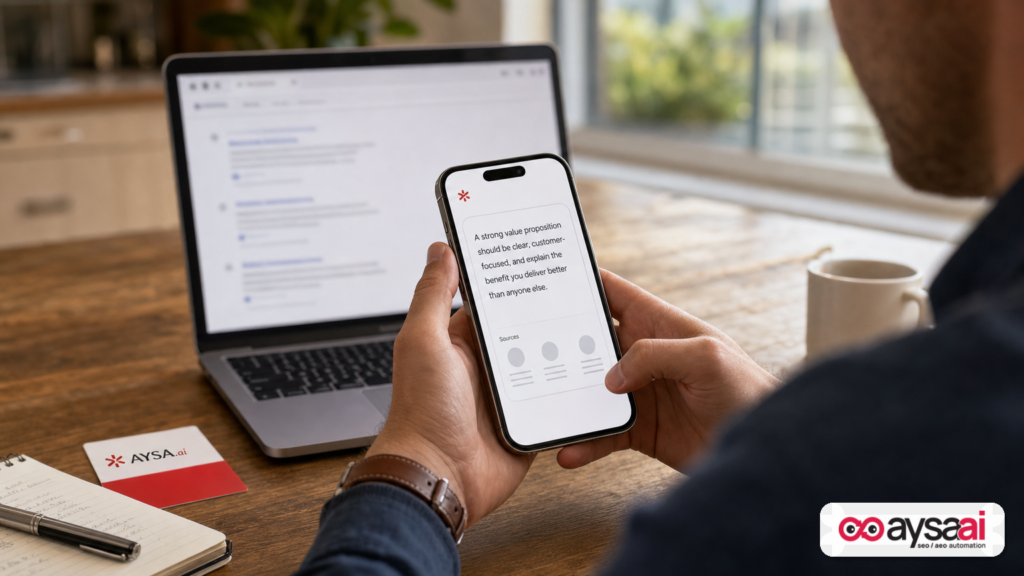
AI engines (and AI layers in traditional search) are increasingly acting like recommendation systems. Your brand’s success depends on whether these systems can accurately understand your entity, trust your expertise, and find clear, up-to-date content to cite. Adobe’s Brand Visibility product highlights three critical needs for businesses:
- Measure AI visibility across engines (mentions, share of voice, and gaps).
- Diagnose why competitors are being recommended instead of you.
- Execute improvements continuously (content, structure, trust, and technical foundations).
Key takeaways (for busy operators)

- AI search is not “SEO 2.0.” It’s a shift from ranking pages to being chosen as an answer ingredient.
- Traffic can decline even when rankings look stable if AI answers satisfy the query or recommend competitors.
- New KPIs matter: Brand Mentions, competitive share of voice in AI answers, and coverage of high-intent prompts.
- SEO fundamentals still matter (site quality, authority, clarity, Crawlability), but the output isn’t just “rank”—it’s “citation and recommendation.”
- Execution speed is now a competitive advantage. The best strategy doesn’t help if it takes 3 months to implement.
Table of contents
- What changed: from “ranking pages” to “being chosen”
- Why Adobe’s move matters (even if you’ll never buy Adobe)
- The new measurement stack: mentions, share of voice, and content gaps across AI engines
- How AI engines decide who gets recommended (in plain English)
- What can go wrong: the new failure modes of AI search
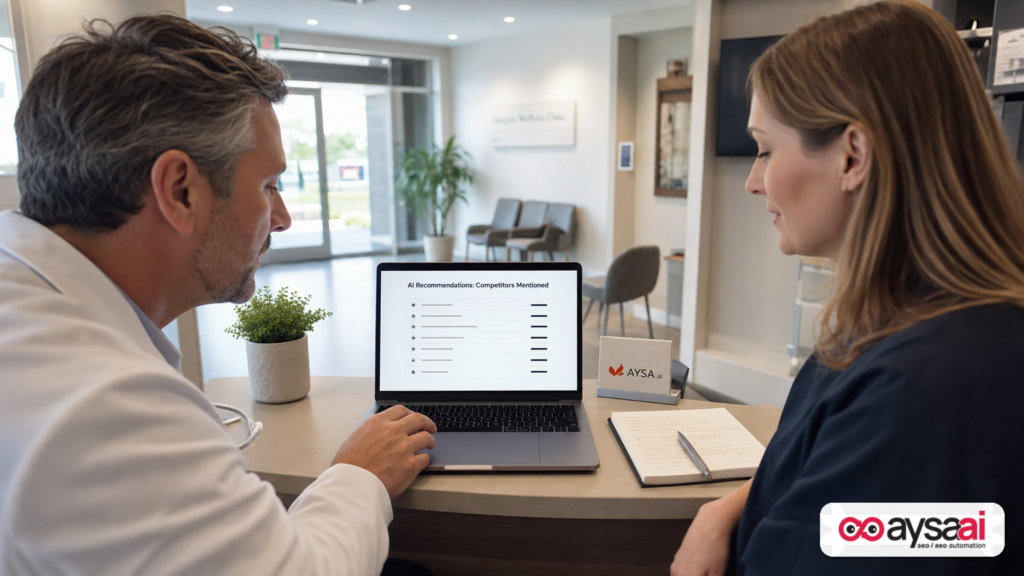
- A practical SME scenario: the local clinic that “ranked fine” but disappeared from AI recommendations
- What agencies must rethink: deliverables, KPIs, and operational cadence
- The AI visibility action plan (30/60/90 days)
- Where AYSA fits: monitoring + recommendations + approved execution
- What to do next
- Sources and further reading
What changed: from “ranking pages” to “being chosen”
For twenty years, the dominant mental model of search was simple:
- User searches.
- Search engine returns a list of links.
- User Clicks, compares, buys.
AI answers compress or skip steps 2 and 3. Instead of a list of options, the user sees:
- a synthesized summary,
- a set of recommended products/providers,
- sometimes citations, sometimes not,
- and increasingly, an embedded path to action (book, buy, contact).
In other words: the “SERP” is becoming an AI-mediated decision.
This is why many business owners feel like something is off:
- Rankings reports look okay.
- Google Search Console clicks soften.
- Fewer “comparison shoppers” land on your site.
- Sales team says leads “feel different.”
It’s not always a penalty. It’s often the interface changing. And your brand is now competing inside a new arena: the model’s “worldview” of your category.
Adobe’s announcement is notable because it treats this as measurable—because it is. The hard part is that measurement is only step one.
Why Adobe’s move matters (even if you’ll never buy Adobe)
Adobe introduced Adobe Brand Visibility as part of its CX Enterprise positioning, framed as a way for businesses to ensure they’re “visible, trusted, and chosen” across AI surfaces. As reported by Search Engine Land, the product combines prompt-scale data with Semrush-backed SEO intelligence and first-party signals to show how brands appear across AI engines like ChatGPT, Google’s AI experiences, Microsoft Copilot, and Perplexity.
There are three strategic signals in that move:
1) The market is formalizing “AI visibility” as a discipline
For a while, GEO/AEO lived in the land of experiments: prompt a model, see what it says, take screenshots, repeat. That doesn’t scale. A mainstream vendor building this into enterprise tooling is a clear marker that the measurement layer is becoming standardized.
2) Competitive intelligence is moving from “who ranks” to “who gets recommended”
Traditional competitive SEO asks: who outranks me for keywords?
AI visibility asks: who is the model suggesting as the right answer—and for which intents?
Those are different competitors. For example:
- A local dentist might “compete” with other dentists in Google Maps.
- In AI answers, they may compete with chain clinics, telehealth brands, or content sites that the model interprets as authoritative sources.
3) The combination of “owned data” + “web data” is the real leverage
Search Engine Land’s coverage highlights Adobe’s positioning around combining first-party signals (from owned channels) with large-scale prompt data and Semrush’s keyword/backlink intelligence.
Whether you use Adobe, AYSA, or something else, the lesson is the same: AI visibility cannot be managed by one data source. You need:
- what your site and customers are doing (first-party signals),
- what the web says about your entity (authority and corroboration),
- what AI engines are outputting (the “recommendation layer”).
The new measurement stack: mentions, share of voice, and content gaps across AI engines
If you’re an SME, you might be thinking: “I don’t need another metric.” Fair. But you do need the right metrics.
Here’s a practical measurement stack for AI search visibility—aligned with what’s emerging in the market (and reflected in Adobe’s stated metrics in the Search Engine Land write-up):
1) Mentions: are you included at all?
Mentions answer a binary question: do AI engines name your brand for the prompts that matter?
Track mentions by:
- engine (ChatGPT-style, Copilot-style, Perplexity-style, Google AI experiences),
- topic cluster (your core services/products),
- intent (informational vs “best” vs “near me” vs “pricing” vs “alternatives”).
What it tells you: whether you’re “in the conversation.”
2) Share of voice: how often are you recommended versus competitors?
Share of voice moves beyond “am I present?” to “am I winning?”
For SMEs, you don’t need 500 competitors. You need:
- your top 5 local competitors,
- your top 5 national/online substitutes,
- your category’s “default brands” that AI models love.
What it tells you: whether AI engines see you as a leader or a footnote.
3) Content gaps: what questions are being answered without you?
This is the most actionable metric. If the model recommends competitors for “best X for Y,” ask:
- Do we have a page that directly answers that?
- Does it include the specific criteria users care about?
- Is it structured and clear?
- Is it corroborated by other reputable sources?
What it tells you: what to create, update, consolidate, or remove.
4) Trust signals: are you “safe” to recommend?
Many brands underestimate trust as an AI visibility factor. AI engines tend to prefer sources that look reliable and verifiable.
For SMEs, trust signals are practical and often fixable:
- clear about page and company details,
- transparent pricing/terms where possible,
- expert authorship and editorial review for advice content,
- consistent NAP details for local businesses,
- policies (returns, shipping, privacy),
- up-to-date pages (nothing kills trust like stale content).
5) Outcome metrics: are AI recommendations driving business results?
You won’t always be able to perfectly attribute “an AI answer caused this conversion.” But you can measure leading indicators:
- direct traffic shifts,
- brand search demand,
- assisted conversions,
- changes in conversion rate from high-intent landing pages,
- changes in lead quality (sales feedback matters here).
Search Engine Land has also covered how AI recommendations can influence website visits in specific contexts, for example in its piece “ChatGPT recommendations drive more brand website visits: Study”. You don’t need to accept any single study as gospel; you should treat it as confirmation that AI surfaces can now materially affect demand flows.
How AI engines decide who gets recommended (in plain English)
We should be honest: no one outside the model providers knows the full ranking logic inside every AI engine. But we can still build a usable mental model, rooted in what we see repeatedly across clients and across AI answer patterns.
In practice, AI engines tend to recommend brands when they can do three things confidently:
1) Identify the entity (who you are)
The model needs to understand you as a distinct entity: what you sell, who it’s for, where you operate, what makes you different, and what you should be compared against.
This is where consistent naming, clear positioning, structured pages, and corroborating mentions elsewhere on the web matter.
Search Engine Land recently highlighted the concept of “teaching AI who you are” through coverage of Google’s research direction: “Google’s LLM patent suggests a new goal for SEO: Teaching AI who you are”. Whether you focus on patents or not, the theme is aligned with what practitioners observe: entity clarity is foundational.
2) Validate credibility (why you’re trustworthy)
AI engines are cautious about recommending low-trust sources—especially in categories that affect money, health, or safety. Even outside strict YMYL categories, they still prefer clarity and reputable corroboration.
Credibility typically comes from a mix of:
- on-site signals (quality content, transparency, policies, expertise, freshness),
- off-site signals (citations, reviews, press, backlinks, community discussion),
- technical signals (clean site, indexability, structured data where appropriate).
3) Match intent (why you’re the best fit for this user and prompt)
Many brands publish generic marketing pages and wonder why AI doesn’t recommend them. AI answers often favor sources that directly match the decision criteria in the query.
That means you need content that addresses prompts like:
- “best [category] for [use case]”
- “[brand] vs [brand]”
- “[category] pricing”
- “[category] for small business”
- “[category] near me” (local)
- “is [brand] legit?” (trust)
AI isn’t just summarizing; it’s assembling a recommendation set. Your job is to be the easiest legitimate recommendation to include.
What can go wrong: the new failure modes of AI search
Traditional SEO had predictable failure modes: indexing issues, poor content, thin pages, bad links, spammy tactics.
AI search introduces additional problems—some new, some amplified.
1) The “invisible competitor” problem
You may not lose to the business across the street. You might lose to:
- a marketplace listing,
- a directory,
- a media site with “best of” lists,
- a brand with stronger authority even if they’re less relevant locally.
Search Engine Land has explored this dynamic with AI answers citing listicles and often recommending competitors, in: “Google AI Overviews cite self-serving listicles, but recommend competitors 69% of the time”. You don’t need to adopt the exact percentage to understand the operational reality: AI citations and recommendations can skew toward aggregator content.
2) The “good rankings, bad representation” problem
Your site can rank for a term, but the AI summary might:
- misstate your pricing,
- confuse your service area,
- position you as a category you’re not,
- recommend you for the wrong use case (leading to low-quality leads).
This is not only a marketing issue; it’s a brand and customer experience issue.
3) The “content operations scale” trap
When businesses try to respond to AI search by publishing a lot more content, they often degrade quality and consistency. Search Engine Land has a useful lens on this broader operational problem in: “What breaks when content operations scale”.
AI engines don’t reward volume by default. They reward clarity, trust, and usefulness. Scaling content without governance can create contradictions across pages—exactly the kind of confusion that reduces recommendation likelihood.
4) Manipulation and “poisoned” recommendations
As AI agents and deep-research systems become more common, people will attempt to steer them using user-generated content edits and other tactics. Search Engine Land covered how small edits can influence deep-research agents in: “A 13-word edit can steer what deep-research AI agents recommend”.
From a business perspective, this means brand monitoring must expand beyond your own site. If your reputation or facts are being altered elsewhere, it can leak into AI answers.
5) Overreacting to volatility
AI answers can be inconsistent across sessions, users, and model updates. The biggest mistake I see is reacting to a single screenshot as if it’s permanent truth.
What you need instead:
- prompt sets (a stable list of queries you track),
- trend views (week-over-week, month-over-month),
- segmentation by intent and geography,
- an execution log (what changed, when, and what happened after).
A practical SME scenario: the local clinic that “ranked fine” but disappeared from AI recommendations
Let’s make this real with a scenario I’ve seen variations of many times.
The business
A local clinic (say: physical therapy + sports rehab) has:
- a decent website,
- good Google reviews,
- okay organic rankings for “physical therapy [city]”,
- steady appointment volume.
The symptom
Over a few months, they notice:
- fewer new patient inquiries from organic search,
- more people calling to ask basic questions (insurance, pricing, specialties),
- more “I saw online that…” misinformation.
What’s actually happening
Users are increasingly asking AI-style queries like:
- “Best physical therapist for runners in [city]”
- “Where can I get sports rehab quickly?”
- “PT clinic that takes [insurance] near me”
And AI answers are recommending:
- a large chain clinic,
- a hospital system,
- and a directory page.
Why the clinic loses in AI answers (common causes)
- Positioning is generic: the site says “we offer personalized care,” but doesn’t clearly signal specialties (runners, post-op, injury prevention).
- Insurance and pricing details are unclear: AI answers prefer sources that state constraints and policies plainly.
- Thin service pages: they list services, but don’t answer decision questions (timeline, what to expect, who it’s for).
- Weak corroboration: maybe they have reviews, but little authoritative mention elsewhere that reinforces expertise.
- Inconsistent entity details: name variants, old addresses, multiple phone numbers, outdated bios.
The fix (what works without “gaming” anything)
A realistic improvement plan would include:
- Rewriting the home page and key service pages to clearly define specialties and ideal patients.
- Adding FAQ sections that answer the exact questions patients ask (insurance, scheduling, what to bring, expected sessions).
- Publishing 3–6 “use case” pages (e.g., “Physical therapy for runners,” “ACL rehab timeline,” “Back pain PT program”).
- Cleaning up local business consistency (NAP, location pages, staff bios).
- Strengthening trust: credentials, clinical approach, citations to reputable medical sources where appropriate.
Notice what’s not on the list: “publish 100 AI-generated blog posts.” AI visibility is more often about precision and clarity than volume.
What agencies must rethink: deliverables, KPIs, and operational cadence
If you run an agency, AI search creates both risk and opportunity.
The risk: clients will judge you by outcomes you don’t currently measure
Historically, SEO reporting focused on:
- rankings,
- traffic,
- backlinks,
- conversions from organic.
Now, a client might say: “My neighbor asked ChatGPT and it recommended our competitor.” That’s anecdotal, but it’s emotionally persuasive—and it points to a real shift in buyer behavior.
The opportunity: package AI visibility as an ongoing operating system
The agencies that win won’t be the ones selling “GEO hacks.” They’ll be the ones selling:
- ongoing monitoring across AI engines,
- content and entity clarity improvements,
- technical and structured data hygiene,
- authority building and digital PR where relevant,
- and—most importantly—execution with cadence.
Because AI surfaces change quickly. Your operating cadence needs to be faster than quarterly SEO roadmaps.
New KPIs agencies can defend
- Prompt coverage: % of tracked prompts where the brand is mentioned.
- Competitive recommendation rate: mentions vs top competitors for high-intent prompts.
- Content gap closure rate: gaps identified vs gaps resolved (published/updated pages).
- Time-to-ship: average days from insight → approved change → live.
The last KPI is the one most teams avoid. It’s also the one that predicts who will win the next 12 months.
The AI visibility action plan (30/60/90 days)
Below is a practical playbook designed for SMEs and lean marketing teams. The goal is to move from “we’re worried about AI” to “we have a system.”
Days 1–30: establish a baseline and identify your “AI money prompts”
1) Build your tracked prompt set
- Start with 30–100 prompts (not 1,000).
- Include high-intent queries: “best,” “pricing,” “near me,” “alternatives,” “for [use case],” “reviews.”
- Include branded queries that test factual accuracy (hours, locations, services, return policy).
2) Define your competitor set
- Top 3–5 direct competitors.
- Top 3 indirect substitutes (marketplaces, directories, national brands).
3) Capture baseline outputs and patterns
- Where are you mentioned?
- Where are you absent?
- Which sources are cited when your competitor is recommended?
4) Audit your top landing pages for “AI-readiness”
- Are pages clear about what you do and who it’s for?
- Do they answer decision questions?
- Do they include trust elements (policies, credentials, proof)?
- Are they current?
AYSA helps here through continuous monitoring and AI visibility checks: AI Search Visibility and AYSA Monitoring.
Days 31–60: close the most valuable gaps (not all gaps)
1) Fix “entity clarity” first
- Homepage: sharpen positioning (category + differentiation + who it’s for).
- About page: who you are, where you operate, credibility signals.
- Contact/location pages: consistent details, embedded maps for local businesses, clear hours.
2) Upgrade 5–10 pages instead of creating 50 new ones
- Add FAQs that match real prompts.
- Add comparison/alternative context where appropriate (honest, not spammy).
- Add “how it works” explanations, constraints, and expectations.
3) Strengthen corroboration
- Earn mentions from reputable local or industry sources when possible.
- Make sure listings and profiles are consistent.
AYSA is built to prepare changes and request approval before executing—so businesses keep control while moving fast. This is the difference between “strategy decks” and shipped improvements. Learn more: AI SEO Tools.
Days 61–90: operationalize a cadence and measure lift
1) Establish a weekly monitoring + shipping rhythm
- Weekly: review AI visibility changes, new gaps, competitor shifts.
- Biweekly: approve and ship prioritized site updates.
- Monthly: review outcomes (leads, conversions, brand demand) and refine prompt set.
2) Create a “trust refresh” checklist
- Update stale content.
- Retire outdated offers.
- Ensure policies and pricing pages are consistent.
- Verify authorship and expertise signals on advice content.
3) Expand prompt coverage gradually
- Add long-tail use cases.
- Add seasonal prompts (holidays, local events, industry cycles).
- Add product-specific prompts for ecommerce.
If you need an idea of how to structure ongoing efforts and content, AYSA publishes additional guidance here: AYSA Blog.
Where AYSA fits: monitoring + recommendations + approved execution
Many tools can show you a problem. Fewer can help you fix it without adding operational drag.
At AYSA, our philosophy is simple:
- Monitor what matters continuously (AI visibility, site health, content changes, competitive shifts).
- Prepare prioritized recommendations you can actually implement.
- Ask for approval so the business stays in control.
- Execute accepted changes on the website reliably.
- Measure the impact and keep iterating.
This “approved execution” model matters because AI search is dynamic. If your workflow is:
- monitor → meeting → ticket → backlog → sprint → QA → publish (in 8–12 weeks)
…you are structurally disadvantaged.
If your workflow is:
- monitor → recommendation → approve → ship (in days)
…you can actually keep up.
Explore how AYSA approaches AI visibility and operational monitoring:
And if you’re evaluating costs and scope, you can review options here: AYSA Pricing.
How to think about GEO/AEO without chasing buzzwords
You’ll hear a lot of labels right now: GEO, AEO, LLMO, AI SEO, AI optimization. The label matters less than the operating principle:
- Make it easy for machines to understand who you are.
- Make it easy for humans to trust you.
- Make it easy for AI engines to match you to intents.
- Make improvements continuously, not once.
And keep your expectations realistic: AI visibility is not a switch you flip. It’s a competitive system you build.
What about SEO fundamentals—do they still matter?
Yes. In fact, AI search often rewards strong fundamentals because those fundamentals correlate with trust and usability.
Adobe’s product positioning (as described by Search Engine Land) explicitly includes SEO intelligence and emphasizes the ongoing importance of traditional search authority.
Here’s the balanced view:
- Technical SEO still matters because AI surfaces still rely on discoverable, indexable, high-quality pages.
- Content SEO still matters, but with higher emphasis on decision support and clarity.
- Authority building still matters because corroboration is crucial when AI engines choose what to cite.
- Brand consistency matters more than ever because AI systems are entity-driven.
What’s different is the goal. You’re not only optimizing for clicks. You’re optimizing for inclusion and recommendation inside answers.
What to monitor if you’re an SME (simple checklist)
If you’re a founder or operator, you don’t want a research project. You want a checklist.
AI visibility monitoring
- Are we mentioned for the 25–50 prompts most likely to drive revenue?
- Which competitors are mentioned instead—and for what reasons?
- Do AI answers misrepresent our offerings, pricing, or policies?
Website clarity and trust
- Do we clearly explain who we serve and what problems we solve?
- Do we answer the top 10 decision questions without forcing a call?
- Do we show proof (case studies, reviews, credentials, guarantees where appropriate)?
Operational cadence
- Can we ship improvements weekly or biweekly?
- Do we have an approval workflow that avoids bottlenecks?
- Do we track what changed and what happened afterward?
AYSA is designed specifically around this operating model—monitoring plus approved execution—because that’s what modern search demands.
What to do next
- Pick 30–100 prompts that represent real buying intent in your category.
- Track AI answers weekly (not once) and record which brands and sources show up.
- Fix entity clarity: homepage positioning, about page credibility, service/product specificity.
- Upgrade key pages with decision FAQs, comparisons, and constraints (pricing, service area, timelines).
- Create a shipping cadence so improvements don’t die in tickets and meetings.
- Use a system that executes safely—monitor, recommend, approve, ship, measure.
Sources and further reading
- Search Engine Land: New Adobe tool shows where brands win and lose in AI search
- Search Engine Land: Google’s LLM patent suggests a new goal for SEO: Teaching AI who you are
- Search Engine Land: Google AI Overviews cite self-serving listicles, but recommend competitors 69% of the time
- Search Engine Land: ChatGPT recommendations drive more brand website visits: Study
- Search Engine Land: A 13-word edit can steer what deep-research AI agents recommend
- Search Engine Land: What breaks when content operations scale
AYSA resources:
Continue the AI search topic inside AYSA.
Use these pages to connect the article with AI SEO tools, AI visibility monitoring, AI Overviews and approved website execution.
Turn this topic into a website action plan.
Use these AYSA hubs to move from reading to technical fixes, AI visibility monitoring, research, glossary context and approval-first SEO execution.

