
Ask YouTube Is Coming To Shorts: What It Changes For Discovery, AEO, And Video SEO (And What To Do About It)
YouTube is testing “Ask YouTube” inside the Shorts player—turning passive scrolling into interactive, AI-assisted discovery. Here’s what it means for creators, brands, and SMEs, and how to operationalize video AEO with approved execution.

YouTube is testing a feature that looks small on the surface—an “Ask YouTube” sparkle icon inside the Shorts player—but it signals something bigger: short-form video is becoming an interactive answer layer, not just entertainment. If you’re a business that relies on discovery (local services, ecommerce, SaaS, B2B, publishers), this matters because it changes where “intent” forms and how your brand gets explained in the moment.
I’m writing this from the perspective of building and operating AYSA.ai: we obsess over the gap between knowing what to do and actually shipping the changes that make you visible—across classic SEO and the emerging world of AI answers (AEO/GEO). Shorts getting AI Q&A is another step toward a web where the best prepared brands win, not the loudest brands.
Primary source: Search Engine Journal coverage of YouTube testing Ask YouTube inside the Shorts player. Everything below is original analysis and practical guidance based on what’s been reported plus how these systems typically change marketing operations.
The 30-second summary (concise, actionable)
- YouTube is planning a limited, English-only test of Ask YouTube inside the Shorts player, where viewers can tap a sparkle icon and ask questions about what they’re watching. (Reported by Search Engine Journal.)
- YouTube also says the watch-page Ask YouTube experience will reach Shorts and live streams—meaning Q&A could show up on more surfaces than just long-form video pages.
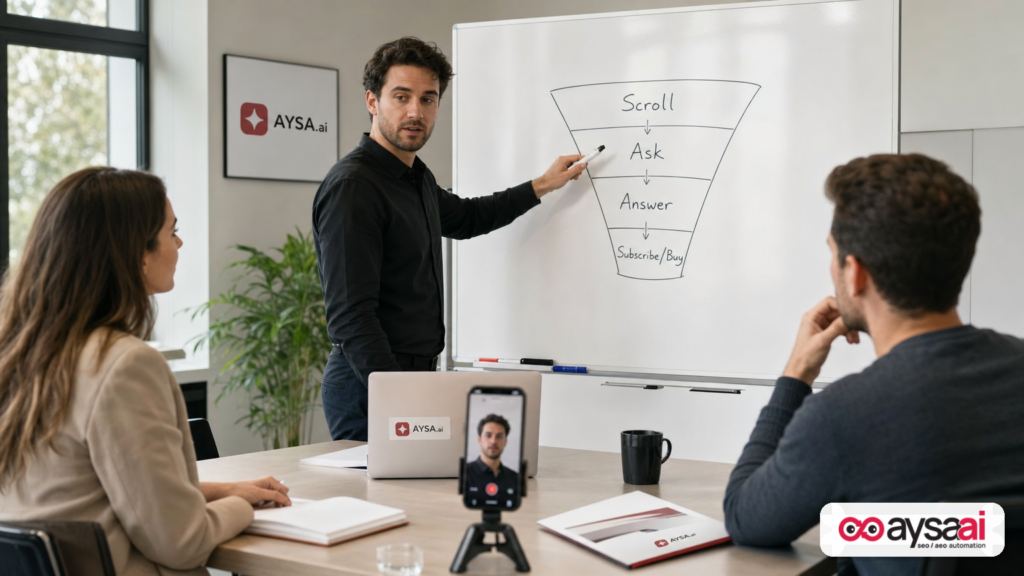
- This creates a new discovery behavior: scroll → ask → decide. That’s AEO (Answer Engine Optimization) playing out inside a social video product.
- Brands should treat “questions people ask while watching” as a new content spec: build question libraries, publish authoritative answers on your site, and produce Shorts that pre-answer the top prompts.
- AYSA fits here because winning won’t be about one-off optimizations—it will be about Monitoring what questions emerge, proposing site/content changes, getting approval, and shipping updates consistently: AYSA Monitoring.
Table of contents
- What changed: Ask YouTube moves from the watch page into Shorts
- What YouTube is actually testing (and what we know vs. what we don’t)
- Why this is happening now: AI answers are becoming the interface
- The new discovery loop: from “search” to “ask” to “suggest”
- Implications for creators, brands, and SMEs
- What can go wrong: misinformation, brand drift, and compliance risk
- Measurement reality: attribution gets harder before it gets easier
- The practical playbook: how to prepare for Shorts Q&A
- A concrete SME scenario: the local clinic that wins by answering questions before the appointment
- What agencies should rethink: deliverables, reporting, and content ops
- Where AYSA fits: monitoring + approved execution for AEO/GEO
- What to do next (action list)
- Sources and further reading
What changed: Ask YouTube moves from the watch page into Shorts

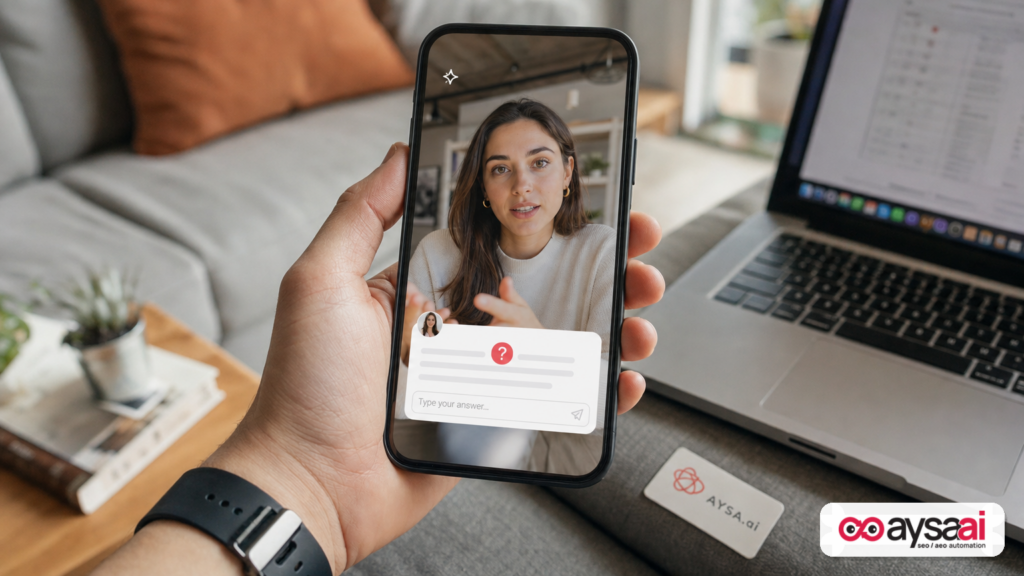
Ask YouTube already exists as a feature on some watch pages: a button that lets viewers ask questions and get AI-generated answers about the video they’re watching. The important shift is that YouTube is now testing that interaction inside the Shorts player—right where attention is most compressed and decisions are most impulsive.
According to the reporting in Search Engine Journal, YouTube described an experiment where viewers can tap/select a sparkle icon on select Shorts and either choose pre-populated prompts or ask their own free-form questions—then receive details about the Short on screen. The same reporting indicates YouTube said the watch-page feature will soon reach Shorts and live streams, expanding the surface area where AI answers influence what people learn and do next. Source: Search Engine Journal.
From an editorial standpoint, this is not just a “new feature.” It’s a redefinition of intent formation. Historically, YouTube discovery was:
- Search-led: type a query, choose a video, watch.
- Recommendation-led: get suggested videos, click, watch, binge.
Shorts added a third mode:
- Feed-led: swipe, swipe, swipe… occasionally follow or click through.
Now we’re seeing a fourth mode emerge:
- Question-led: swipe → get curious → ask → receive an answer that shapes the next swipe, the follow, or the purchase.
What YouTube is actually testing (and what we know vs. what we don’t)
Based on the available reporting, here’s what’s reasonably clear—and what remains unknown.
What we know (from the reported announcements)
- Limited experiment: A limited test on select Shorts, English-only, and available to viewers 18+ (as described in the Creator Insider video referenced by SEJ). SEJ source.
- Multiple devices: The feature is expected to appear in the Shorts player on desktop, TV, and mobile (per the reporting).
- Interaction design: A sparkle icon triggers pre-populated prompts and free-form questions; free-form prompts route to Ask YouTube. (Again, per the SEJ reporting.)
- Broader roadmap: YouTube said viewers will soon be able to use Ask YouTube directly from the watch page while watching Shorts and live streams.
- Scale signal: SEJ notes Alphabet CEO Sundar Pichai previously said that over 140 million users engaged with Ask YouTube on the watch page in June (as referenced by SEJ). We should treat that as a directional signal about adoption, not a promise about Shorts performance.
What we don’t know (and should plan around)
- Eligibility logic: How YouTube selects which Shorts qualify (“select Shorts” is vague).
- Creator controls: Whether creators/brands can opt in/out, customize prompts, or correct answers.
- Source of truth: Whether answers cite video captions, descriptions, comments, linked pages, or broader web data.
- UI placement and friction: Whether asking pauses the Short, opens a panel, or routes to a separate interface.
- Monetization impact: Whether this reduces watch time, increases retention, or changes ad exposure.
Operationally, uncertainty is normal. The smart move is to prepare for the most likely pattern: answers will be generated from a mix of video content (audio, captions), metadata (title/description), and other sources YouTube already associates with a topic. That means your “content hygiene” matters more than ever.
Why this is happening now: AI answers are becoming the interface
YouTube isn’t experimenting in a vacuum. Across major platforms, the product trend is consistent: instead of forcing users to translate curiosity into a perfect Search query, platforms let users ask questions in natural language in context.
Ask YouTube inside Shorts is the natural continuation of:
- Contextual AI assistance embedded where the user already is (not a separate search box).
- Compression of discovery time: remove steps between interest and information.
- Retention: if users can ask and get answers without leaving the feed, they stay longer.
From a business perspective, this matters because it changes the competitive set. You’re no longer only competing with the other videos in your niche; you’re competing with the answer the system chooses to generate—and whether your brand becomes part of that answer.
If you’ve been following AEO/GEO discussions, you already recognize the pattern: in AI-driven experiences, the “ranking” is often a sentence, not a list of links. Shorts Q&A is that pattern applied to video.
At AYSA, we frame this as AI Search visibility across multiple answer surfaces—not just Google. That’s why we talk about monitoring and execution systems, not “one-time SEO.” See: AI Search Visibility.
The new discovery loop: from “search” to “ask” to “suggest”
Here’s the behavioral loop I expect many users to follow once this rolls out more broadly:
- Scroll: A Short triggers curiosity (a product, a claim, a destination, a health tip).
- Ask: The user taps the sparkle icon and asks a question they might have typed into Google before.
- Answer: They get an AI response that frames what’s true, what’s important, and what to do next.
- Next action: Follow the creator, watch more, click through, search within YouTube, or abandon.
YouTube also referenced new feeds on Android/iOS that help viewers discover similar creators, related Shorts, and topics based on watch history (as described in the SEJ reporting). That’s important because it means questions may not just answer—they may also steer users into a neighborhood of creators and products.
For marketers, that suggests two parallel optimization problems:
- Answer inclusion: Are we represented accurately in the AI response?
- Neighborhood inclusion: Do we get pulled into “similar creators/related Shorts” clusters?
Those problems can’t be solved by “posting more.” They’re solved by disciplined information architecture across your web presence and your video presence.
Implications for creators, brands, and SMEs
Let’s break down what changes when viewers can ask questions mid-Short.
1) Metadata and clarity stop being optional
In classic Shorts strategy, you could get away with minimal descriptions because the feed did most of the distribution work. In a Q&A world, weak metadata becomes a liability. If the model can’t ground its answer in your content, it will improvise—or pull from somewhere else.
Practical shift: treat titles, descriptions, and captions as answer fuel, not as afterthoughts.
2) “Objection handling” moves up the funnel
Most SMEs handle objections later: on product pages, during sales calls, in email follow-ups. But Shorts Q&A brings objections forward. People will ask:
- “Is this safe?”
- “Does this work for my situation?”
- “How much does it cost?”
- “Is this legit or a scam?”
- “What’s the difference between A and B?”
If the answer isn’t grounded in your authoritative content, you lose control of the narrative at the moment of peak attention.
3) Brand trust becomes answer trust
On a traditional YouTube watch page, viewers could read comments, check the channel, and evaluate credibility. In an AI answer overlay, viewers may accept the response as “platform-truth.” That can help you if you’re prepared—and hurt you if you’re not.
4) New creative opportunities: Shorts designed to trigger good questions
There’s a counterintuitive upside: you can create Shorts that intentionally spark the “right” questions—then ensure the answers are accurate by aligning your on-site content and video framing.
Example: a home services company posts a Short showing a before/after HVAC repair. The question you want is: “How do I know if my unit needs this?” The question you don’t want is: “Is this a scam?” You can influence which question gets asked by what you show, what you say, and what you clarify.
What can go wrong: misinformation, brand drift, and compliance risk
Any AI answer system has two classes of risk: user risk (bad guidance) and brand risk (wrong association). Shorts increases both because the context is fast and users will ask impulsive questions.
Risk 1: The AI confidently “fills in” missing details
If your Short shows a result but doesn’t state constraints, the answer layer might assume universality. That’s dangerous in sensitive niches: health, finance, legal, safety, children’s products, supplements, etc.
Risk 2: Your brand gets misrepresented
If a viewer asks, “What’s the price?” and your pricing is not clearly accessible or varies by location, the system may guess—or pull outdated info from elsewhere.
Risk 3: Compliance and regulated claims
For clinics, med spas, supplements, and financial products, there’s a real chance that AI-generated summaries cross into prohibited claim territory—even if your original Short was compliant.
We don’t have official documentation in the provided research context about how YouTube’s system handles regulated categories inside Shorts Q&A. Until we do, the safe approach is to treat Shorts as a regulated marketing surface if you’re in a regulated industry: keep claims conservative, add clarifying language, and ensure your website hosts the full, compliant explanations.
Risk 4: Reputation attacks get easier
When “asking questions” is built into the player, hostile users can probe: “Is this company legit?” “Are they sued?” If you haven’t invested in reputation, authoritative pages, and transparent policies, you’re letting the platform answer on your behalf.
Measurement reality: attribution gets harder before it gets easier
AI features often break clean attribution because they insert a new layer between stimulus (your content) and action (a site visit, a call, a purchase). When users ask questions inside YouTube, some portion of their intent will be satisfied without a click.
That doesn’t mean there’s no value. It means you need new measurement habits:
- Brand lift indicators: increases in branded searches, direct traffic, or repeat exposure.
- Content-level leading indicators: saves, follows, profile visits, and watch-to-follow conversion.
- On-site readiness metrics: conversion rates when people do click through (because those clicks are higher intent).
And you need to accept a strategic reality: some “wins” will show up as fewer misunderstandings, fewer bad leads, and higher conversion quality—not just more sessions in analytics.
This is one reason we built AYSA around monitoring and execution, not just reporting. Monitoring isn’t useful if it doesn’t translate into shipped improvements. See: AYSA Monitoring.
The practical playbook: how to prepare for Shorts Q&A
If you’re a business owner or marketing lead, here’s the playbook I’d run over the next 30–60 days, even before the feature reaches your audience.
Step 1: Build a “viewer question inventory” (not a keyword list)
Keyword research is still useful, but Shorts Q&A is driven by natural language. You need a list of real questions in the way customers ask them.
Create categories like:
- Definition questions: “What is…?” “What does … mean?”
- Comparison questions: “X vs Y?” “Which is better for…?”
- Fit questions: “Is this good for me if…?”
- How-to questions: “How do I…?” “How long does it take?”
- Price/trust questions: “How much?” “Is it legit?” “Any side effects?”
Then map each question to an authoritative on-site answer. Not because “YouTube reads your site” (we can’t confirm that from the supplied context), but because your site is still the canonical place you control: it feeds sales, it supports citations, and it reduces inconsistency across channels.
AYSA tools and workflow can support this by tracking visibility and prompting execution-ready tasks. Start here: AI SEO Tools.
Step 2: Upgrade your on-site “answer infrastructure”
Most SMEs have websites that are built to look credible, not to answer questions clearly. In an AI answer era, clarity wins.
What to improve first:
- FAQ sections that are specific (not generic marketing fluff).
- Comparison pages (“X vs Y”, “Which plan is right?”, “Material A vs B”).
- Policies and trust pages (returns, warranties, shipping, cancellations, licensing).
- Pricing clarity (ranges, what affects price, what’s included).
- About / credentials (who you are, why you’re qualified).
This is also where execution bottlenecks kill momentum. If every change needs three meetings and a developer sprint, you’ll never keep up with AI-driven behavior changes. AYSA’s positioning is built for this: monitor, prepare changes, ask for approval, then execute what’s accepted—so teams can move faster without losing control. See: AYSA Pricing.
Step 3: Produce Shorts that are “question-complete”
In a Q&A-enabled Shorts environment, the best Shorts will be those that reduce uncertainty without being long or boring.
A strong template:
- Hook: show the result or the problem in 1–2 seconds.
- Context: say what the viewer is looking at (avoid ambiguity).
- Constraint: who it’s for / who it’s not for (reduces harmful questions).
- Next step: where to learn more (site page, longer video, consult).
This is not about cramming disclaimers. It’s about being explicit enough that the system (and the human) can’t easily misinterpret you.
Step 4: Assume your captions are a primary input
Even if you don’t know exactly what sources the AI uses, captions are the safest bet. They’re a clean textual representation of what you said.
Operational rule: never publish a Short without checking captions for:
- proper nouns (brand names, product names) spelled correctly
- numbers and units (prices, sizes, doses, timelines) correct
- location terms (city/service area) if relevant
- risk terms (medical/financial) phrased conservatively
Step 5: Build “answer-aligned” video series (not random posting)
Random Shorts can go viral. But businesses don’t build predictable revenue on randomness. Build series that correspond to question clusters:
- “Cost & timing” series
- “Mistakes to avoid” series
- “Before you buy” series
- “X vs Y” series
These series also create internal consistency: if the AI answer references the content of multiple Shorts, it’s more likely to converge on the truth you repeatedly state.
Step 6: Prepare for “similar creators” clustering
YouTube’s mention of new feeds for discovering similar creators/related Shorts suggests that topical clustering and viewer history will become more explicit. If you want to be in the right cluster:
- Be consistent in your topic vocabulary.
- Use repeatable formats that signal your niche.
- Collaborate or co-appear with adjacent, reputable creators (where appropriate).
Even if you never become a creator-first brand, you want to be in the right neighborhood when YouTube recommends “similar.”
A concrete SME scenario: the local clinic that wins by answering questions before the appointment
Let’s make this real with a scenario that isn’t “influencer marketing.”
Business: a local dermatology clinic (could also be a dental office, PT clinic, med spa—any appointment-based service).
Current state:
- They post occasional Shorts: “before/after,” a quick explanation of a procedure, a day-in-the-life clip.
- They get views, but leads are inconsistent. Staff complains about unqualified calls (“How much is it?” “Does insurance cover it?” “Is it painful?”).
What changes with Ask YouTube in Shorts:
- A viewer watches a Short about a procedure and asks: “Is this safe for my skin type?” “How long is recovery?” “Will it leave a scar?”
- If the AI answer is vague or wrong, the viewer bounces—or worse, shows up with unrealistic expectations.
What the clinic should do:
- Build 25–50 Q&As based on receptionist calls and consult questions.
- Create a site hub page for each high-demand service with clear “who it’s for” guidance and conservative language.
- Publish Shorts that pre-answer the top 10 “safety and recovery” questions—clearly and repeatedly.
- Use consistent phrasing across Shorts and site pages (e.g., “downtime typically ranges…” vs. “no downtime” hype).
- Operationalize updates: when new questions emerge, ship updates weekly.
This is exactly where execution systems matter. With AYSA, the clinic can monitor visibility signals, prepare content/site improvements, get approvals, and keep shipping. Start exploring: AI Search Visibility.
What agencies should rethink: deliverables, reporting, and content ops
If you’re an agency, Shorts Q&A is a deliverable disruption. Clients will ask: “Are we showing up in those answers?”—and you won’t be able to respond with a classic rank tracker screenshot.
1) The deliverable shifts from “content calendar” to “answer coverage”
Clients don’t need 12 random Shorts. They need coverage of the questions that drive revenue and reduce bad leads. Agencies should pitch:
- Question inventory + mapping
- On-site answer hub creation
- Shorts series production aligned to question clusters
- Monthly “new questions observed” iteration cycle
2) Reporting must include qualitative checks
AI answer experiences often require manual validation: is the answer correct, is it citing the right thing (if citations exist), is the brand framed correctly? Agencies need a lightweight internal QA process.
If you can’t instrument it perfectly, be honest about what’s measurable and what’s observational. The worst thing you can do is pretend this is a solved analytics problem.
3) Ops becomes your competitive advantage
In 2026 and beyond, agencies lose accounts because they can’t ship. “We recommended it” is not a result.
This is why we emphasize approved execution at AYSA: the system is designed to keep momentum—monitor, propose, approve, execute—without turning every change into a bottleneck. Learn more: AYSA Monitoring.
Where AYSA fits: monitoring + approved execution for AEO/GEO
YouTube’s Ask feature inside Shorts is a reminder that AEO/GEO isn’t a “Google-only” problem. Answers are becoming the interface across platforms. That means your job is to:
- Monitor where AI-driven discovery is happening and how you’re represented
- Prepare concrete improvements (pages, FAQs, clarifications, internal linking, content updates)
- Get approvals from the business (brand, legal, compliance)
- Execute quickly and safely
That’s the workflow we’re building at AYSA: a system for SEO/AEO/GEO execution that doesn’t die in project management. If you want the overview, start here:
And to be clear: you don’t need AYSA to do the strategy. But you do need a system to keep up with the pace of platform changes. The businesses that win won’t be the ones with the best slideshow—they’ll be the ones that ship improvements weekly.
What to do next (action list)
- Inventory 50 real customer questions (sales calls, support inbox, DMs, comments, live chat).
- Pick 10 “high-risk” questions (price, safety, eligibility, guarantees) and write authoritative on-site answers.
- Publish or refresh 5 core pages that AI systems can safely summarize: pricing, returns/policies, credentials, comparisons, FAQs.
- Produce a 10-Short series aligned to those questions (one question per Short).
- Caption QA every Short for proper nouns, numbers, and constraints.
- Set a monthly review where you document new questions appearing in comments/DMs and update site pages accordingly.
- Operationalize execution so changes don’t stall—use an approved execution workflow (this is where AYSA can help).
Sources and further reading
- Search Engine Journal: YouTube To Test Ask YouTube Inside The Shorts Player
- Search Engine Journal: AI Search category (context and ongoing coverage)
- Search Engine Journal: SEO category (broader strategy context)
- Search Engine Journal: SEO news
Note: The supplied research context references a YouTube help page about Ask YouTube and a Creator Insider video, but those URLs were not provided directly in the context. Rather than guessing links, I’ve limited citations to the provided SEJ source and its category pages, and I’ve framed uncertain implementation details as analysis instead of fact.
Continue the AI search topic inside AYSA.
Use these pages to connect the article with AI SEO tools, AI visibility monitoring, AI Overviews and approved website execution.
Turn this topic into a website action plan.
Use these AYSA hubs to move from reading to technical fixes, AI visibility monitoring, research, glossary context and approval-first SEO execution.