
When the Numbers Lie: How to Audit Rankings, AI Referrals, and AI Search Links in 2026–2027 (Without Losing the Plot)
Rank trackers showed “missing” usual results, ChatGPT UTMs briefly disappeared, and Google/Bing adjusted AI link placement and reporting. Here’s the practical playbook to cross-check every metric, protect decision-making, and operationalize fixes with approved execution.

Search used to be simple: you ranked, you got Clicks, and analytics roughly told the truth.
That world is gone.
In the last few weeks, we’ve seen three “small” measurement shifts that should change how every business reads SEO and AI performance reports:
- Automated Rank tracking data showed Google result pages where many “usual” sites seemed to vanish—then reappear later.
- ChatGPT referrals in GA4 appeared to drop sharply, likely because some links stopped carrying tracking tags for a period of time.
- Google and Bing adjusted how AI answers present links and how they report (or don’t report) performance.
None of these stories are just SEO drama. They’re a warning about operational risk: if your team treats every dip like truth, you will make expensive, unnecessary changes. If you ignore every dip, you’ll miss real revenue problems. The only sustainable answer is a cross-check discipline—paired with a system that can monitor, prepare fixes, and execute only after approval.
This editorial is my practical playbook for 2026–2027: how to interpret noisy data, how to validate what’s real, and what to do next as AI Search becomes less “one blue link” and more a bundle of experiences.
Concise summary
- Rank trackers can be wrong when SERP collection is disrupted (anti-scraping, volatility, different result templates). Baseline comparisons matter more than daily deltas.
- AI referral Attribution can break (e.g., missing UTM tags), and traffic may show up as Direct instead of “ChatGPT.”
- AI search Link Placement is changing, but reporting in tools like Search Console can compress multiple links into one “position,” so interpretation is tricky.
- Bing is moving toward topic-level AI reporting (directional metrics, opportunity queries). Treat it as strategy guidance, not accounting.
- Your best defense is a cross-check framework: confirm changes across GSC + GA4 + rank trackers + (when possible) server logs and SERP sampling before you act.
- AYSA fits where execution risk is highest: monitor, diagnose, propose changes, request approval, then execute accepted updates to your site—without knee-jerk reactions.
Table of contents
- The New Reality: You’re Measuring Multiple Search Products, Not “Google”
- What Happened With Rank Tracking: “Missing Usual Sites” and the Limits of Automated SERP Collection
- What to do about rank tracker anomalies (SMEs + agencies)
- The ChatGPT UTM Tag Incident: Why “Direct” Traffic Can Spike Overnight
- Attribution hygiene for AI referrals: UTMs, redirects, and reporting
- Google AI links are moving: why clicks may change even when “position” doesn’t
- Bing’s AI reporting shift: Topics portfolios and opportunity queries
- Discover and AI-generated content: why it matters even if you don’t publish news
- A Cross-Check Framework: How to Validate Any SEO or AI Metric Before You Act
- A concrete SME scenario: the ecommerce brand that “lost traffic” (but didn’t)
- Stop reporting vanity metrics: KPI models that survive AI search
- Where AYSA.ai fits: monitor → prepare → approve → execute
- What to do next (action list)
- Sources and further reading
The New Reality: You’re Measuring Multiple Search Products, Not “Google”
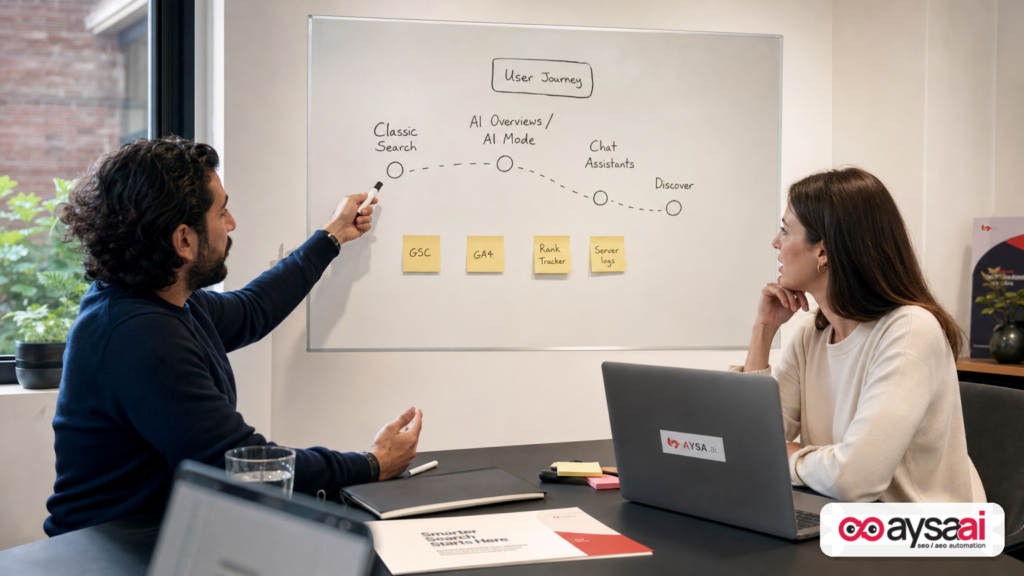
If you’re a founder or marketing lead, you may not care whether traffic came from “AI Overviews,” “AI Mode,” “classic SERPs,” “Discover,” “ChatGPT,” or “Bing Copilot.” You care about pipeline and revenue.
But you must care about those categories now because measurement and user behavior differ across each surface:
- Classic Google results still drive a lot of commercial intent, but the layout, features, and personalization can vary by user and context.
- Google’s AI experiences can answer questions without a click, or they can include multiple links—sometimes inline, sometimes grouped, sometimes hidden behind expansion.
- Chat assistants can send traffic, but attribution is fragile: referrers may be missing, and tracking parameters can change.
- Bing’s AI answers are increasingly measurable in their own ecosystem, but the metrics may be directional rather than exact.
- Discover is a different beast entirely: it behaves like a recommendation engine, and the reporting doesn’t look like search reporting.
The takeaway: any single metric (rankings, GA4 sessions, GSC clicks, “AI citations”) is now just one slice. The operational skill is not staring at the slice. It’s cross-checking slices fast enough that your team makes the right decision.
What Happened With Rank Tracking: “Missing Usual Sites” and the Limits of Automated SERP Collection
A recent SEO Pulse update from Search Engine Journal highlighted analysis from rank tracking provider Nozzle: across a period in September–October, they observed a meaningful share of tracked Google result pages where “most of the keyword’s usual sites” were missing—then those sites later returned on a subsequent check.
SEJ’s write-up frames this as a reminder to validate ranking anomalies against a baseline and against Google Search Console before treating the change as real performance loss. That’s smart advice—and it’s bigger than this one incident.
Why this matters for non-SEO teams: your board deck, your monthly client report, and your internal priorities can all swing based on rank trackers. When trackers misread reality, you can accidentally:
- Pause content production that was working
- Fire an agency or replace a strategy based on bad data
- Over-correct (sitewide changes, internal linking changes, title rewrites) that introduce real risk
Rank trackers are not “Google.” They’re a data collection method.
Rank trackers typically rely on automated queries and scraping-like collection methods. Even when a vendor is careful and compliant with their own policies, the underlying mechanism differs from a real user searching:
- Different IP ranges and request patterns
- Different user agents and cookies
- Different personalization signals
- Different SERP templates and experiments triggered by “non-human” patterns
So when SEJ reports that a rank tracker saw a jump in “missing usual sites,” it’s less useful to debate the exact label (“poisoning,” “anti-scraping,” “temporary SERP template changes”) and more useful to accept the operational lesson:
Your ranking report is an inference—validate it before you act.
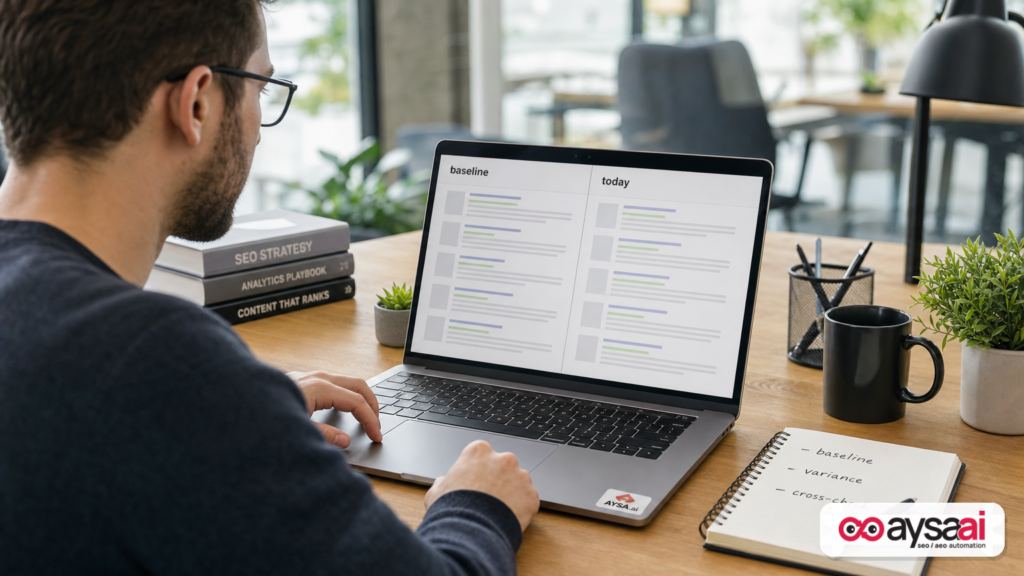
Baseline comparisons beat daily deltas
The most common reporting mistake I see: teams compare “today” to “yesterday” and treat the difference as a business event.
In a world with more SERP experiments, more AI features, more localization, and more anti-automation friction, baseline matters more than ever:
- Compare today against a stable pre-incident period for the same keyword set.
- Compare by query + page in Search Console, not just “average position.”
- Look for confirmation in impressions/clicks patterns before you rewrite strategy.
What to do about rank tracker anomalies (SMEs + agencies)
Here’s a pragmatic response plan when rankings “drop” suddenly, especially across many keywords at once.
1) Classify the drop: isolated, clustered, or systemic
- Isolated: a few keywords/pages moved. Often real competition or intent shift.
- Clustered: a category or template moved. Often internal changes, technical issues, or SERP feature shifts.
- Systemic: huge share of tracked keywords moved at once. Often measurement artifacts, tracking method changes, SERP experiments, or sitewide technical problems.
2) Cross-check in Google Search Console before writing the story
Rank trackers are useful, but they are not your ground truth for Google performance. For Google organic search, Search Console is the closest thing to a primary source you have.
Do this cross-check:
- Pick 10–20 representative queries and their landing pages.
- In GSC, compare the last 7 days vs prior 7 days (or similar windows) for impressions and clicks.
- If impressions/clicks are flat but rank trackers show chaos, treat the ranking movement as suspicious.
- If impressions and clicks fall in the same pattern, treat it as more likely real.
If your team doesn’t live in GSC, invest the time. It’s foundational. (If you need a broader AI visibility lens, see AYSA AI search visibility.)
3) Don’t optimize for the tool—optimize for business outcomes
Even if rank trackers are perfectly accurate, rankings are still a proxy metric. The business metric is:
- Qualified organic leads
- Non-branded demand captured
- Revenue and retention influenced
This is where automation helps: you can keep monitoring broad keyword sets while focusing human attention only when multiple signals agree. That’s the mindset behind AYSA Monitoring.
4) Document anomalies explicitly in reports
If you manage clients or report to executives, don’t bury the uncertainty. Put it on the page:
- “Rank tracker volatility detected; GSC does/does not confirm.”
- “Investigating potential measurement artifact; no site changes recommended until confirmed.”
This single habit prevents whiplash decisions.
The ChatGPT UTM Tag Incident: Why “Direct” Traffic Can Spike Overnight
SEJ also covered a sharp drop in ChatGPT-attributed sessions in GA4 that analysts connected to a tracking tag issue: inline links in ChatGPT answers temporarily stopped carrying a utm_source=chatgpt.com tag after a model rollout, and then a fix was reportedly deployed shortly after.
Two key business lessons come out of this:
- Attribution is not a fact. It’s a labeling system. When labels change, your charts change.
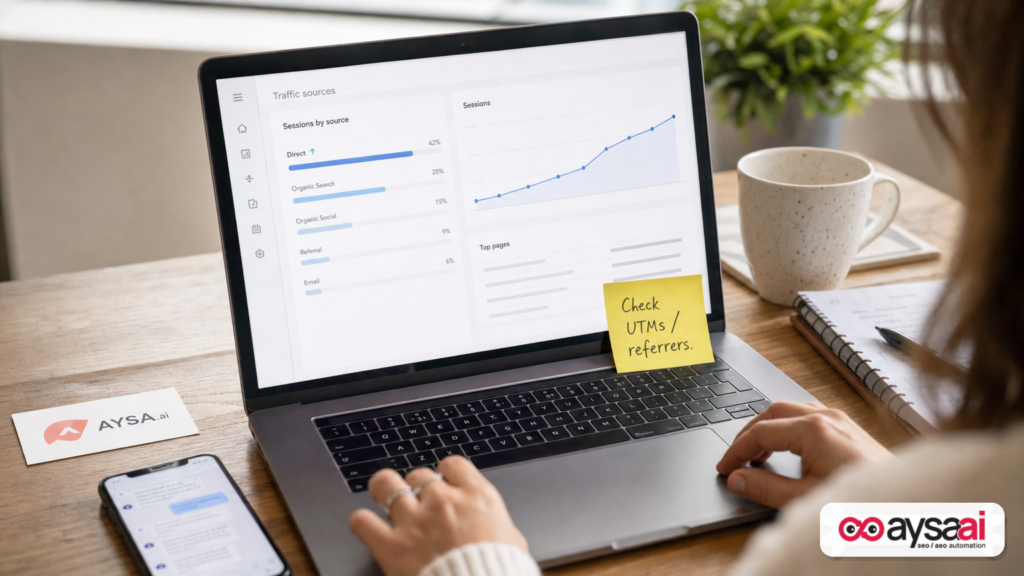
- “Direct” is a junk drawer. When referrers or UTMs disappear, traffic often gets dumped into Direct.
Why AI referrals are uniquely fragile
AI assistants sit in a gray zone between “referral traffic” and “dark social.” Depending on the product, the link type, and the handoff method:
- The referrer may not be passed consistently.
- Links may be rewritten or proxied.
- Tracking parameters may be added, removed, or normalized.
That means your AI traffic trend lines can break even if user behavior doesn’t.
What not to do when ChatGPT traffic “drops”
- Don’t assume your brand “lost visibility” in AI overnight.
- Don’t rewrite content purely to “win back ChatGPT,” especially based on one week of attribution noise.
- Don’t over-credit AI traffic spikes either—sometimes they’re also labeling artifacts.
Attribution hygiene for AI referrals: UTMs, redirects, and reporting
If you want to treat AI traffic like a real acquisition channel, you need channel discipline. Here’s a practical checklist that works for SMEs without requiring enterprise tooling.
1) Standardize UTMs for any AI initiatives you control
You don’t control how ChatGPT or other assistants tag links, but you do control your own campaigns:
- If you publish content meant to be cited, keep landing URLs stable.
- If you run partnerships, PR, or influencer placements, require UTM conventions.
When AI platforms fail to pass referrers, UTMs can be the only reliable discriminator—exactly the point called out in the SEJ coverage.
2) Audit redirects and canonicalization
Attribution often breaks through redirects:
- UTM parameters stripped during redirect rules
- HTTP → HTTPS chains that drop parameters
- Cross-domain flows that fail to preserve source/medium
This is a technical SEO and analytics crossover problem—and it’s common on Shopify, WordPress, and custom stacks. If your team needs a repeatable way to monitor and propose fixes, that’s a strong fit for AYSA AI SEO tools plus monitoring.
3) Create an “AI referrals” view that includes Direct context
Because some AI clicks may appear as Direct, you should build reporting that shows:
- ChatGPT source/medium (when present)
- Direct traffic to AI-targeted landing pages
- Time alignment with known incidents and releases
This doesn’t make attribution perfect, but it prevents your team from misreading the chart.
4) Write incident notes into your analytics narrative
If you know there was a tracking issue window (as SEJ reported), annotate it in your internal reporting. Businesses do this for paid media outages and email deliverability issues; SEO and AI referrals deserve the same maturity.
Google AI links are moving: why clicks may change even when “position” doesn’t
SEJ also noted Google’s adjustments to link placement in AI experiences—specifically, showing inline links higher in responses more often, and testing additional link sections for official tasks/pages.
Here’s the subtle but important part for measurement: in Google Search Console, links inside an AI Overview can share the same “position” as the overall overview. That means changes that affect user click behavior might not look like position changes in your reports.
What this changes for businesses
Historically, many teams relied on “average position” as the story. But in AI experiences:
- You might be “position 1” inside an AI module yet receive few clicks because the link is visually lower or requires expansion.
- You might be cited, but the user’s next action is satisfied without a click.
- You might see stable reported position while click-through rate shifts.
So your performance interpretation must move from “position-first” to “outcome-first.”
Preferred sources and eligibility: a new layer of operational SEO
SEJ’s write-up also referenced the concept of “Preferred Sources,” where users can see highlighted sources in carousels as they expand. The operational implication is that eligibility and inclusion in generative AI features becomes its own gate.
If you’re not eligible, you can’t benefit—no matter how good your content is.
For SMEs, this creates a new kind of technical/content checklist:
- Clean indexing and canonicalization
- Clear authorship and brand identity signals
- Content that matches the intents AI summaries are trying to fulfill
This is not “AI hacks.” It’s fundamentals executed consistently—exactly where a system that can prepare changes and request approval before publishing is valuable. (See AI search visibility and monitoring.)
Bing’s AI reporting shift: Topics portfolios and opportunity queries
Microsoft introduced a beta “Topics Portfolio” in Bing Webmaster Tools’ AI Performance reporting, grouping AI citations by broader topic and offering “opportunity queries” where others are cited and you are not. SEJ also noted Microsoft’s guidance: treat the metrics as directional, not absolute.
Why topic grouping matters more than keyword lists in AI search
AI answers don’t think in keywords; they think in concept coverage. Topic grouping is a better mental model for planning content and authority:
- Do you cover the topic deeply enough to be cite-worthy?
- Do you have a single strong page or a cluster that answers follow-up questions?
- Do you demonstrate real experience and specificity?
How to use “opportunity queries” without wasting time
Opportunity lists can be gold—or a trap. SEJ correctly warns that these lists may include irrelevant competitor brand terms.
Here’s the filter that works:
- Keep opportunities that align with your product, margins, and customer journey.
- Deprioritize competitor-brand queries unless you have a legitimate comparison page strategy.
- Cluster opportunities into 5–10 themes you can actually build around.
Then operationalize: convert clusters into content briefs, technical improvements, internal linking updates, and on-page enhancements. This is where execution systems beat “insights dashboards.” Insights without action are just expensive entertainment.
Discover and AI-generated content: why it matters even if you don’t publish news
SEJ highlighted job listings indicating Google is investing in AI-generated content and more proactive recommendation experiences in Discover and related surfaces.
I’m not going to speculate on the final product design or timelines—job postings don’t guarantee outcomes. But as a business operator, you should pay attention to the direction:
- Discover is positioning toward personalization and proactive delivery.
- AI-generated or AI-assisted content may play a bigger role in feed experiences.
- Measurement may stay limited (SEJ noted Discover’s generative AI reporting currently describes impressions as a metric).
Why SMEs should care
Even if you’re not a publisher, Discover can influence demand creation—especially for:
- Health and wellness clinics
- Travel and hospitality
- Home services with seasonal patterns
- Ecommerce brands with new product drops
- SaaS companies educating a category
If Discover becomes more AI-mediated and proactive, your brand’s “eligibility” and content quality signals matter—again pushing the market toward disciplined fundamentals.
A Cross-Check Framework: How to Validate Any SEO or AI Metric Before You Act
The theme SEJ closed with—a cross-check for every number—is the single best operating principle for modern search teams.
Here’s the AYSA-style framework: treat any surprising number as a hypothesis, then attempt to falsify it with independent sources.
Step 1: Define the metric and the decision it triggers
Bad reporting happens when metrics are detached from actions. Write this sentence:
“If this number is true, we will do X.”
If you can’t define X, the metric is noise.
Step 2: Identify the nearest “primary source”
- Google organic performance: Google Search Console (best available)
- On-site behavior and conversion: GA4 (imperfect but useful)
- AI assistant referrals: GA4 + UTMs + Direct context
- Bing AI citations: Bing Webmaster Tools AI reports (directional)
Step 3: Cross-check with an independent signal
Examples:
- Rankings down? Check GSC impressions/clicks for those query/page pairs.
- ChatGPT sessions down? Check Direct to the same landing pages; check whether UTM tagging changed; check annotation windows.
- Clicks down but position stable? Look for SERP layout changes (AI modules, carousels) and CTR changes.
Step 4: Timebox the investigation
Teams waste weeks chasing ghosts. Set a rule:
- 24–48 hours to classify as measurement artifact vs likely real.
- If unclear, pause major changes and increase monitoring frequency.
Step 5: Only then execute changes—with approval gates
This is where many organizations fail. They either:
- Overreact and push risky changes live immediately, or
- Get stuck in analysis paralysis and do nothing
The better model is: monitor → prepare recommended fixes → request approval → execute accepted changes → verify outcomes. That’s the operating model we built AYSA around.
A concrete SME scenario: the ecommerce brand that “lost traffic” (but didn’t)
Let’s make this real with a scenario you can recognize.
The situation
You run a $3M/year ecommerce store selling premium skincare. Your marketing manager sees:
- Rank tracker: 30% of tracked keywords drop out of top 10 over two days
- GA4: “ChatGPT” sessions drop 40% week-over-week
- Slack panic: “Google update?” “Competitor outranking us?” “AI killed SEO?”
The wrong response
- Rewrite product titles sitewide
- Change internal linking structure
- Pause all content work and shift budget to paid media immediately
Those actions might create real damage: crawling issues, relevance drift, conversion drops, brand inconsistency.
The cross-check response (what to do instead)
- Check GSC: Are impressions and clicks for the top product/category pages actually down? If not, treat rank tracker volatility as suspect.
- Check GA4 Direct: Did Direct traffic to blog guides and product pages rise as “ChatGPT” fell? If yes, attribution likely shifted.
- Sample SERPs manually: For 10 high-value queries, do you actually see competitors replacing you consistently, or is the SERP layout different?
- Timebox: If signals conflict, annotate the report and wait 48 hours with heightened monitoring rather than making sweeping changes.
Where AYSA fits in this scenario
AYSA can help by:
- Monitoring anomalies across query/page performance and surfacing issues that matter (not vanity noise): AYSA Monitoring
- Preparing a prioritized set of recommended fixes (technical, content, internal linking) aligned to business goals
- Requesting approval before making website changes—so you don’t “panic-ship” risky edits
- Executing accepted changes consistently, then validating outcomes
This is how you turn a chaotic week into a controlled operating rhythm.
Stop reporting vanity metrics: KPI models that survive AI search
If you want reporting that holds up in 2027, you need KPIs that don’t collapse when:
- AI link placement changes
- Rank trackers wobble
- Attribution tags disappear
Replace “average position” with a portfolio view
Better reporting structure:
- Demand capture: GSC clicks and impressions for non-brand, high-intent queries
- Visibility health: share of priority pages with stable impressions over time (volatility index)
- Conversion outcomes: organic-assisted revenue and lead quality (GA4 + CRM when possible)
Track “topic ownership,” not just keywords
AI search rewards coherent coverage. Build topic clusters and measure:
- How many pages support the topic
- Whether internal links create a clear hierarchy
- Whether the topic drives assisted conversions
This aligns with Bing’s topic-oriented reporting direction and with how AI summaries cite sources.
Instrument your site for trust and eligibility
As AI search expands, eligibility signals matter more:
- Clean technical foundation (indexing, canonicals, structured data where appropriate)
- Clear content intent and ownership
- Consistency across site templates
Execution consistency is often the bottleneck—which is why an approved execution system can become a competitive advantage.
Where AYSA.ai fits: monitor → prepare → approve → execute
Most SEO platforms do one of two things:
- They show you data and hope you act.
- They automate changes and hope nothing breaks.
Neither is good enough in a world where data is noisier and changes are riskier.
AYSA is built for the reality described above:
- Monitor: Always-on detection for meaningful shifts—not just “rank moved.” (Monitoring)
- Prepare: Turn signals into a concrete backlog: technical fixes, content improvements, internal linking, on-page enhancements. (AI SEO tools)
- Ask for approval: Humans stay accountable. You choose what goes live.
- Execute: Accepted changes get implemented efficiently and consistently.
That “approval gate” is not bureaucracy—it’s how you prevent panic-driven SEO while still moving faster than competitors.
If you want to explore how this works in practice, start here:
What to do next (action list)
- Audit your reporting stack: List which KPIs come from rank trackers, GA4, GSC, and any AI reporting tools. Identify where you’re relying on one source.
- Set a cross-check rule: “No strategic changes based on one metric.” Require at least two independent confirmations for major decisions.
- Create a baseline pack: For your top 20 money queries and top 20 landing pages, store baseline performance (impressions, clicks, conversions). Use it during volatility.
- Harden attribution: Standardize UTMs for campaigns you control; audit redirects and parameter handling; build an AI referral view that includes Direct context.
- Shift from keyword to topic planning: Use opportunity lists (like Bing’s) to build topic clusters you can win, not random keyword chases.
- Implement an approval-based execution workflow: Whether it’s internal process or a platform like AYSA, ensure changes are prepared, reviewed, approved, and then executed—without panic edits.
Sources and further reading
- Search Engine Journal: Rank Tracker Data, ChatGPT Tags & AI Search Links – SEO Pulse
- Search Engine Journal: AI Search coverage
- Search Engine Journal: SEO coverage
- Search Engine Journal: Technical SEO coverage
- Search Engine Journal: SEO Pulse series
Note: Several details referenced above (e.g., how Google reports AI Overview link positions in Search Console, Bing’s guidance that AI topic metrics are directional, and the reported window for the ChatGPT UTM tagging issue) come from the SEJ Pulse summary and its cited context. For any operational decision, validate against your own first-party data (GSC, GA4, and where possible, server logs) before taking action.
Continue the AI search topic inside AYSA.
Use these pages to connect the article with AI SEO tools, AI visibility monitoring, AI Overviews and approved website execution.
Turn this topic into a website action plan.
Use these AYSA hubs to move from reading to technical fixes, AI visibility monitoring, research, glossary context and approval-first SEO execution.