
B2B PPC Beyond Lead Volume: How to Optimize for Qualified Pipeline (and Prove It)
In long sales-cycle B2B, lead volume is a comforting metric—and a costly one. Here’s how to build a feedback loop that trains Google Ads toward qualified opportunities, connects paid search to revenue outcomes, and creates an execution system (not a reporting ritual) your team can sustain.

Concise summary: If you run B2B Google Ads and measure success primarily by lead volume (or even cost per lead), you’re training your budget to buy the cheapest form fills—not the best customers. In long sales-cycle B2B, the only way to scale responsibly is to build a feedback loop between your ads, your website, and your CRM that teaches Google Ads what a qualified opportunity looks like. This editorial explains what changed in how B2B buying and ad optimization works, why it matters, what can go wrong, and how to implement a practical system—without drowning in tracking complexity.
This article is informed by the premise discussed in Search Engine Land’s piece on moving beyond lead volume in B2B PPC, and expands it into an end-to-end operational playbook for SMEs and agencies. (Source: Search Engine Land.)
Key takeaways
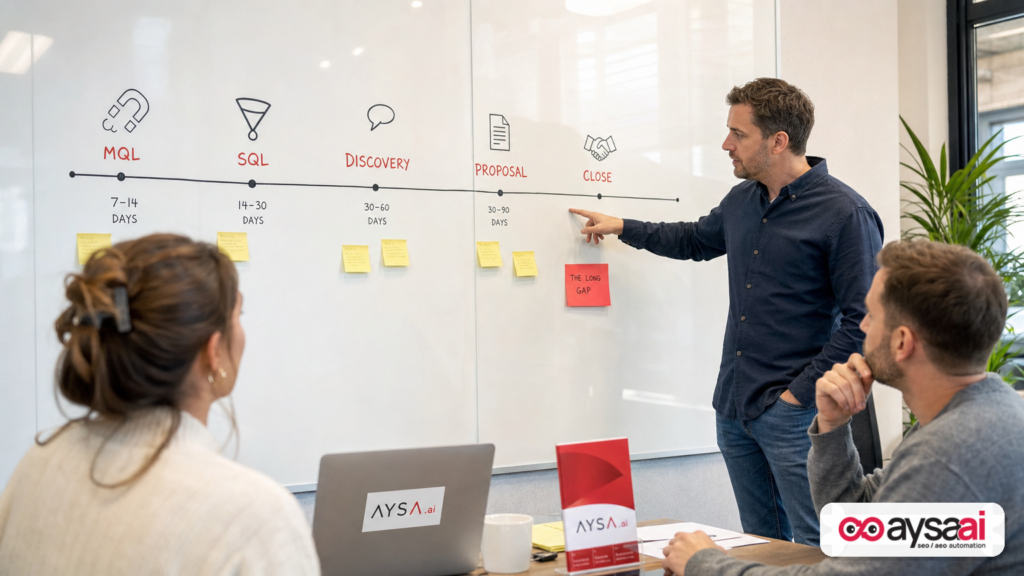
- Lead volume is a weak success metric when sales cycles are long and qualification happens after the form fill.
- Google Ads optimizes toward the conversions you define and feed back. If you only send “lead submitted,” you get more of that—regardless of deal quality.
- You need a conversion ladder: micro-conversions for intent, mid-funnel for sales-accepted, and bottom-funnel for opportunity/revenue signals.
- Offline conversion import is the bridge from CRM reality to ad optimization—if your CRM stages are trustworthy.
- Better qualification on the website can improve pipeline efficiency even if it lowers lead volume (and even if CPL rises).
- Execution is the hard part: keeping definitions stable, preventing sales/marketing drift, and Monitoring changes over time is where teams fail.
- AYSA fits as the execution system that monitors, prepares, requests approval, and then executes accepted site changes—so your measurement strategy actually becomes a repeatable operating model.
Table of contents

- What changed (and why lead volume stopped working)
- The core problem: long sales cycles break “lead volume” as a success metric
- The feedback loop: how Google Ads learns what you teach it
- A practical model: from leads → qualified conversations → pipeline → revenue
- Instrumentation without chaos: what to track (and what to avoid)
- Offline conversion imports: connecting CRM outcomes to Google Ads
- Landing pages that qualify (not just convert)
- Campaign structure and bidding when quality is the goal
- What goes wrong in real teams (and how to prevent it)
- Concrete SME scenario: B2B HVAC distributor selling to contractors
- What agencies should rethink: incentives, reporting, and retention
- Where AYSA fits: turning measurement strategy into approved execution
- Action plan: a 30/60/90-day roadmap
- What to do next
- Sources and further reading
What changed (and why lead volume stopped working)

Lead volume used to feel like a solid KPI because the mechanics were simpler:
- Searchers typed more explicit intent queries (“accounting software demo”).
- Landing pages were “fill the form, get the call.”
- Sales cycles were shorter in many categories, and Attribution felt closer to reality.
Now, for most B2B categories—even in SMEs—the path to revenue looks more like this:
- Multiple stakeholders and committees (finance, IT, ops, founder, compliance).
- Nonlinear research across search, video, communities, comparison sites, AI answers, and vendor content.
- Longer cycles, with more drop-off points between interest and purchase.
At the same time, ad platforms have become better at optimization within the boundaries of the signals you provide. Google Ads’ automated bidding strategies (e.g., Maximize Conversions, Target CPA, Target ROAS) rely on conversion data and its quality. When your “conversion” is a generic lead, you have effectively told the system: “Buy me more generic leads.”
That’s why the Search Engine Land article’s central message resonates: the longer the sales cycle, the less lead volume tells you, and the more you need a feedback loop to optimize for qualified opportunities. We’re going to take that idea and turn it into a complete operating approach.
The core problem: long sales cycles break “lead volume” as a success metric
In B2B, a “lead” is often just a moment of contact. It is not a vetted fit. It is not budget. It is not authority. It is not timing.
Lead volume fails as a KPI for three reasons:
1) It confuses activity with progress
It’s easy to produce leads by widening targeting, lowering friction, and offering a generic “free consultation.” But the extra leads don’t necessarily represent extra pipeline. They represent extra work.
2) It rewards the wrong behavior in both marketing and sales
Marketing gets celebrated for a lower CPL. Sales gets punished with more unqualified calls. The two teams quietly stop trusting each other. Eventually, either budgets get cut or the agency gets fired—not because the channel can’t work, but because the measurement system trained the channel in the wrong direction.
3) It makes optimization mathematically impossible
If your closing window is 90–180 days and you’re spending meaningfully each week, you can’t wait a quarter to learn which campaigns are producing real deals. You need earlier, reliable proxy signals that correlate strongly with pipeline quality—and you need to feed them back.
The feedback loop: how Google Ads learns what you teach it
Google Ads is not a mind reader. It optimizes using signals you provide (conversions), plus signals it can infer (device, location intent, time, query patterns, audience behavior). But the objective function—what it’s trying to maximize—is your job to define.
A practical way to think about it:
- If you optimize for form fills, you get more form fills.
- If you optimize for booked meetings, you get more booked meetings (assuming you track them accurately).
- If you optimize for qualified opportunities, you get more of the patterns and audiences that tend to produce qualified opportunities (again, assuming feedback is accurate and timely enough).
This is why conversion design matters more than ever. You need an intentional chain of events—from click to CRM outcome—that maintains meaning over time.
Google provides multiple ways to measure and activate conversions, including GA4 and Google Ads Conversion tracking, and the ability to import offline conversions. For official documentation, see:
The important editorial point: tracking is not the goal; training the system is the goal. Tracking is simply how you teach.
A practical model: from leads → qualified conversations → pipeline → revenue
If you’re an SME owner reading this, here’s the framework I want you to internalize:
Stop asking, “How many leads did we get?” Start asking, “How many qualified opportunities did we create—and at what cost?”
To get there, implement a conversion ladder (sometimes called a conversion hierarchy). Not every rung needs to be imported into Google Ads on day one, but you should define the ladder and align the team around it.
Level 1: Intentful actions (on-site)
These are not revenue. They’re signals:
- Pricing page views (for B2B SaaS)
- Calculator usage (for services)
- “Compare plans” Clicks
- High-intent scroll depth on solutions pages
- Chat initiated with specific topic selection
These help you understand whether you’re attracting the right attention, but they can be gamed by curiosity. Use them mostly for diagnosis, not as the primary bid target.
Level 2: Leads (but segmented)
Not all leads are equal. Split leads into categories you can action:
- Demo request
- Contact sales
- Request a quote
- Download spec sheet (potentially lower intent)
Even within “leads,” track the type and capture qualifying fields that matter (industry, company size, use case). If you only have one blob called “Lead,” you are voluntarily blind.
Level 3: Sales-accepted leads / qualified conversations
This is where B2B measurement starts to get real. Define what counts as a legitimate next step:
- Meeting booked and attended
- Discovery call completed
- Lead accepted by sales (SAL)
These are still not opportunities, but they filter out a lot of noise. They also tend to arrive faster than closed-won, which makes optimization possible.
Level 4: Qualified opportunities
A qualified opportunity usually means:
- A deal record exists in CRM
- It meets clear qualification criteria (budget range, fit, timeline, authority)
- It has progressed beyond “new” to a meaningful stage (e.g., proposal requested)
This is the sweet spot for many B2B PPC programs. Optimizing to “opportunity created” can align spend with pipeline creation even before revenue lands—if your CRM is disciplined.
Level 5: Revenue outcomes
Eventually, yes, you want closed-won revenue and ideally profit-adjusted value. But for many SMEs, the operational overhead of clean revenue import is real. The key is to build toward it, not pretend you can do it perfectly from day one.
Instrumentation without chaos: what to track (and what to avoid)
Most teams fail here by swinging between two extremes:
- Too little tracking: one “thank you page” conversion, no segmentation, no CRM feedback.
- Too much tracking: dozens of micro events, conflicting definitions, multiple sources of truth, constant tag churn.
The goal is a small set of stable conversions that you trust and can keep consistent across quarters.
Decide your source of truth
For paid search optimization, your source of truth should be the system that reflects business outcomes. That usually means:
- CRM stages (opportunity created, stage advanced, closed-won)
- Meeting outcomes (attended, qualified)
GA4 is excellent for behavioral analysis, but it’s not where “qualified opportunity” lives. GA4 helps you understand why visitors behave the way they do; CRM helps you understand which visitors became real deals.
For GA4 documentation, see: Get started with Google Analytics 4 (Google Help).
Conversion hygiene: keep the set small and meaningful
A practical “starter set” for many B2B advertisers:
- Primary conversion (bidding): Qualified opportunity created (offline import) or meeting held (if opportunity data is messy)
- Secondary conversions (reporting): lead types (demo request, quote request), key intent actions (pricing view)
- Diagnostics: form start rate, form completion rate, call connect rate
Be careful with “conversion inflation.” If you count every micro-action as a conversion and let it influence bidding, you can unintentionally train the system to optimize for easy behaviors rather than business outcomes.
Write definitions down (seriously)
It sounds basic, but it’s one of the highest ROI steps:
- What exactly is a “qualified opportunity”?
- When is it created in CRM?
- Which stages count? Which do not?
- Who owns updating it?
If you can’t explain your definitions on one page, you don’t have a measurement system—you have a reporting habit.
Offline conversion imports: connecting CRM outcomes to Google Ads
If you want Google Ads to optimize for pipeline quality, you must send it feedback that reflects pipeline quality.
That’s what offline conversion import does: it ties a click (or lead) to a later CRM outcome (like opportunity created or closed-won). Google’s documentation is the best place to confirm exact setup requirements and supported identifiers: About offline conversion imports.
What should you import first?
If you’re starting from “lead volume,” don’t jump straight to closed-won unless you have clean, timely data. Instead, pick the earliest stage that:
- Is consistently recorded
- Correlates with eventual revenue
- Occurs frequently enough to optimize (you need signal volume)
For many teams, opportunity created or meeting held is a strong first import conversion.
Timing: accept that feedback is delayed (and plan around it)
Offline conversions arrive later than clicks. That’s fine—Google’s models can incorporate delayed signals. But you need operating discipline:
- Don’t make massive budget changes every three days if the feedback you care about arrives in 21 days.
- Use leading indicators to catch disasters early (e.g., spike in junk leads), but hold strategic decisions until your quality signals mature.
Data quality: the CRM is the battlefield
This is where theory meets reality. If sales doesn’t update stages, your “optimization conversion” becomes random. And when the conversion becomes random, automated bidding becomes a coin flip.
If you’re an SME, this is the uncomfortable truth: your PPC performance is limited by your CRM hygiene.
Landing pages that qualify (not just convert)
The internet taught marketers to obsess over Conversion rate. But in B2B, the best landing page is often the one that produces fewer leads—because it deters the wrong leads.
Think of landing pages as a sales rep that works 24/7. A good rep doesn’t say “yes” to everyone. They qualify.
Use disqualifiers on purpose
Examples:
- “Minimum annual spend: $25k”
- “Available only in the U.S. and Canada”
- “Best for teams of 20+”
- “Not a fit for one-time projects”
Some marketers fear disqualifiers because they reduce lead count. But disqualifiers can raise qualified opportunity rate and reduce sales time waste—often making the channel more scalable.
Use qualifying fields carefully
Every extra field can reduce conversion rate. But in B2B, 2–4 well-chosen fields can increase qualification and routing speed. Examples:
- Company size range
- Primary use case
- Current solution
- Timeline (0–30 days, 30–90, 90+)
Don’t turn your form into an interrogation. If you need more detail, capture it post-submit via email or during scheduling.
Message match is not optional
If your ad says “ERP for manufacturers” and your landing page says “All-in-one business platform,” you will attract confusion. Confusion creates low-quality leads: people submit forms to “figure out what you do,” not because they are a fit.
This is one of the most common silent killers in B2B PPC: the ad is specific, but the page is generic (or vice versa). Fixing message match often improves quality faster than any bidding tweak.
Speed and UX still matter—because friction changes lead composition
Slow pages don’t just reduce conversions; they change who converts. The most determined visitors (often price shoppers or confused visitors) push through. The best-fit busy buyers bounce. This can skew lead quality in ways teams misdiagnose.
Campaign structure and bidding when quality is the goal
Once you have a conversion ladder and at least one quality-oriented conversion, you can align campaign structure accordingly.
Separate high-intent from exploratory intent
A practical split:
- High-intent search: “software + demo,” “vendor + pricing,” “request quote,” competitor alternatives.
- Exploratory/problem queries: “how to reduce churn,” “compliance checklist,” “manufacturing scheduling issues.”
High-intent traffic should be held to stricter conversion goals. Exploratory traffic can be evaluated through mid-funnel conversions (content engagement, newsletter, webinar) if you have a clear nurture path and eventual pipeline feedback.
Don’t mix conversion definitions across fundamentally different motions
If one campaign targets “book demo” and another targets “download guide,” combining them into a single bidding objective can cause the algorithm to chase the easiest conversion. Keep objectives aligned with the intent of the campaign.
Consider value-based bidding only after you trust your values
It’s tempting to assign values to conversions and push everything into Target ROAS. That can work—if your values represent true business value. If the values are guesses, you can end up optimizing toward the wrong persona or the wrong deal size.
If you’re not ready for values, start with a single quality conversion and Target CPA, then evolve.
What goes wrong in real teams (and how to prevent it)
Most B2B PPC programs don’t fail because the marketer didn’t know how to set up a campaign. They fail because the company couldn’t maintain a stable measurement and execution system.
Failure mode 1: Sales doesn’t trust the leads, so they stop following up
Then marketing blames sales for “not working leads,” and sales blames marketing for “sending garbage.”
Fix: define “sales-accepted” criteria and measure it. If sales rejects leads, require a standardized rejection reason. That becomes data for targeting and landing page refinement.
Failure mode 2: CRM stages are inconsistent
If one rep creates opportunities aggressively and another doesn’t create them until late, your optimization signals are noisy.
Fix: simplify stages, standardize rules, and audit a sample monthly. If you can’t enforce this, optimize to meeting held instead of opportunity created.
Failure mode 3: Ads and landing pages optimize for curiosity
Clickbait-y promises can inflate CTR and lead volume while crushing pipeline quality.
Fix: align ads to the real ICP and use explicit language about who it’s for. Reduce ambiguity. Ambiguity drives low-quality leads.
Failure mode 4: Reporting focuses on what’s easy to measure
Lead count, CTR, and CPC are easy. Opportunity quality is harder. Teams gravitate to easy.
Fix: force the weekly business review to include at least one pipeline quality metric (SAL rate, meeting held rate, opp created rate). If it’s not in the meeting, it doesn’t exist.
Failure mode 5: Too many changes at once
If you change bidding, landing pages, forms, qualification rules, and CRM stages in the same month, you’ll never know what caused what.
Fix: adopt a controlled experimentation cadence: one major change per cycle, documented, monitored, and reviewed.
Concrete SME scenario: B2B HVAC distributor selling to contractors
Let’s make this real with a scenario that’s common in the SME world.
Business: A regional HVAC equipment distributor that sells to contractors (B2B). They run Google Ads for “commercial HVAC supply,” “bulk HVAC units,” and “HVAC distributor near me.”
What they measure today: leads from a “Request a quote” form. Their agency reports:
- Leads up 30%
- CPL down 20%
What the owner feels: the phones are busy, but it’s mostly small one-off buyers, homeowners, or contractors outside their service range. Sales is frustrated. Good contractors complain response time is slow because reps are buried.
What changed?
- The form is too easy, with no qualification.
- The ads are broad and ambiguous (“Best prices on HVAC units”).
- Everything is counted as the same conversion: “Lead.”
The fix: build a quality loop in three steps
Step 1: Segment lead types and add lightweight qualification.
- Add a required field: “Are you a licensed contractor?” (Yes/No)
- Add “Service area” selector
- Add “Estimated order size” ranges
Step 2: Define a “qualified conversation” event.
- A lead becomes qualified only when a rep confirms contractor status + service area + order size threshold.
Step 3: Import the qualified event back to Google Ads.
- Use offline conversion import so Google Ads learns which clicks produce qualified conversations.
Expected outcome (without inventing numbers): lead volume may drop; CPL may rise; but sales efficiency and opportunity creation should improve because the system stops buying cheap noise and starts buying high-fit demand.
This is the mental shift: you’re not “making marketing worse” because leads fell. You’re making the business better because qualified pipeline rose.
What agencies should rethink: incentives, reporting, and retention
If you’re an agency, this topic is existential. Because the agency that keeps optimizing to leads will get replaced by the agency that ties spend to pipeline.
Stop selling “more leads.” Sell “better pipeline.”
“More leads” is a commodity promise. Every agency can claim it. “Better pipeline” is operational, cross-functional, and sticky—because it requires integration with CRM and sales process.
Change the reporting cadence and the scoreboard
Weekly: diagnose with leading indicators. Monthly/quarterly: judge with pipeline outcomes.
A practical agency scoreboard:
- Lead volume and CPL (still tracked, but no longer the headline)
- Sales-accepted rate
- Meeting held rate
- Opportunity created rate
- Opportunity cost (cost per opp)
Bake definitions into the agreement
If the client won’t commit to updating CRM stages, be honest: you can improve lead quality, but you cannot fully optimize bidding toward pipeline outcomes. Put the dependency in writing. It protects both sides.
Where AYSA fits: turning measurement strategy into approved execution
This is the part most teams underestimate: once you know what to do, you still need to do it consistently.
Quality-based PPC is not just an ads problem. It is a website problem (qualification, message match, page performance), an analytics problem (definitions, events), and a process problem (keeping changes stable).
AYSA is built for this reality: an Approved Execution system that monitors, prepares, asks for approval, and then executes accepted website changes. That matters because PPC quality improvement often requires iterative on-site changes that must be governed, documented, and reversible.
Where AYSA can support the system described in this editorial:
- Monitoring: Track critical pages used in PPC (landing pages, pricing pages) for changes, performance, and content drift. See AYSA Monitoring.
- AI SEO/AEO execution readiness: Prepare updates that improve clarity, message match, and entity understanding (important not only for SEO, but for landing page comprehension and conversion quality). See AYSA AI SEO Tools.
- AI search visibility context: Many B2B buyers now encounter AI answers during research; ensuring your site is readable, explicit, and credible improves both organic and paid post-click performance. See AYSA AI Search Visibility.
- Governance via approval: PPC landing page changes often involve compliance (claims, pricing, disclaimers). AYSA’s “prepare then approve then execute” flow reduces risk.
- Operational learning: Use the blog and internal playbooks to align teams. See AYSA Blog.
Important boundary: AYSA is not a replacement for your CRM, Google Ads, or your sales process. It’s the execution layer that helps you implement and maintain the site-side changes that make the feedback loop reliable—and makes improvements compound instead of resetting every quarter.
If you want to evaluate AYSA for your team’s workflow, start here: AYSA Pricing.
Action plan: a 30/60/90-day roadmap
Here’s a realistic implementation plan that respects how SMEs actually operate.
First 30 days: define and stabilize
- Write a one-page definition of: lead types, sales-accepted, qualified opportunity.
- Audit current conversions in Google Ads and GA4. Remove/disable anything misleading from bidding.
- Choose one “quality” milestone to operationalize first (meeting held or opp created).
- Update landing pages to improve message match and add 1–2 disqualifiers.
- Set up a weekly sales + marketing review with one quality metric on the agenda.
By 60 days: connect CRM outcomes
- Implement offline conversion import for your chosen quality milestone (follow Google’s official guidance). See Offline conversion imports.
- Create a “rejection reason” taxonomy for sales to tag unqualified leads.
- Split high-intent and exploratory campaigns so bidding goals align with intent.
- Begin a controlled landing page testing cadence (one change at a time).
By 90 days: optimize for pipeline creation
- Shift bidding to the imported quality conversion if volume supports it.
- Evaluate performance by cost per qualified opportunity and stage progression, not just CPL.
- Refine targeting using rejection reasons (geo, query themes, exclusions).
- Operationalize monitoring and approved execution for landing pages so changes are consistent and auditable. (This is where AYSA Monitoring becomes a system, not a one-off.)
What to do next
- Pick one quality metric you can trust within 30–45 days (meeting held or opp created).
- Write your definitions on one page and get sales + marketing to sign off.
- Segment your leads so “lead” stops being a single bucket.
- Add one disqualifier to your primary PPC landing page and track the effect on sales-accepted rate.
- Plan offline conversion import and commit to keeping CRM stages clean enough to be useful.
- Adopt an execution system for site changes so improvements compound. If you want AYSA’s approach—monitor, prepare, approve, execute—explore AYSA AI SEO Tools and Monitoring.
Sources and further reading
- Search Engine Land: How to move beyond lead volume in B2B PPC
- Google Ads Help: About conversion tracking
- Google Ads Help: About offline conversion imports
- Google Help: Get started with Google Analytics 4
- Google Ads Help Center
- Google Analytics Help Center
Internal AYSA resources:
Continue the AI search topic inside AYSA.
Use these pages to connect the article with AI SEO tools, AI visibility monitoring, AI Overviews and approved website execution.
Turn this topic into a website action plan.
Use these AYSA hubs to move from reading to technical fixes, AI visibility monitoring, research, glossary context and approval-first SEO execution.

