
Bing’s New AI Reporting (Intents, Topics, Citation Share): The Playbook for Winning Visibility When Clicks Disappear
Microsoft is expanding Bing Webmaster Tools’ AI Performance report with Intents, Topics, Citation Share, and Compare. Here’s what changed, why it matters for SMEs and agencies, and how to operationalize AI visibility as a measurable, improvable KPI—using AYSA’s monitoring and approved execution model.

AI Search is turning the classic SEO question—“How many Clicks did we get?”—into something more uncomfortable: “Did we even get mentioned?”
Microsoft just made that second question easier to answer. Bing Webmaster Tools is rolling out a preview update to its AI Performance reporting with four additions: Intents, Topics, Citation Share, and Compare. If you’re a business owner, marketer, or agency trying to understand visibility inside AI-generated experiences, this is not a cosmetic UI tweak. It’s a shift toward why you show up—how AI systems interpret your content, cluster it, and choose sources.
This matters because the future of search is increasingly answer-led. Users get what they need directly inside the search experience, and your brand’s presence becomes a blend of being cited, summarized, recommended, and only sometimes clicked. If you can’t measure that visibility, you can’t improve it. And if you can’t operationalize improvement, you’re stuck watching traditional Organic traffic slide with no plan.
Concise summary
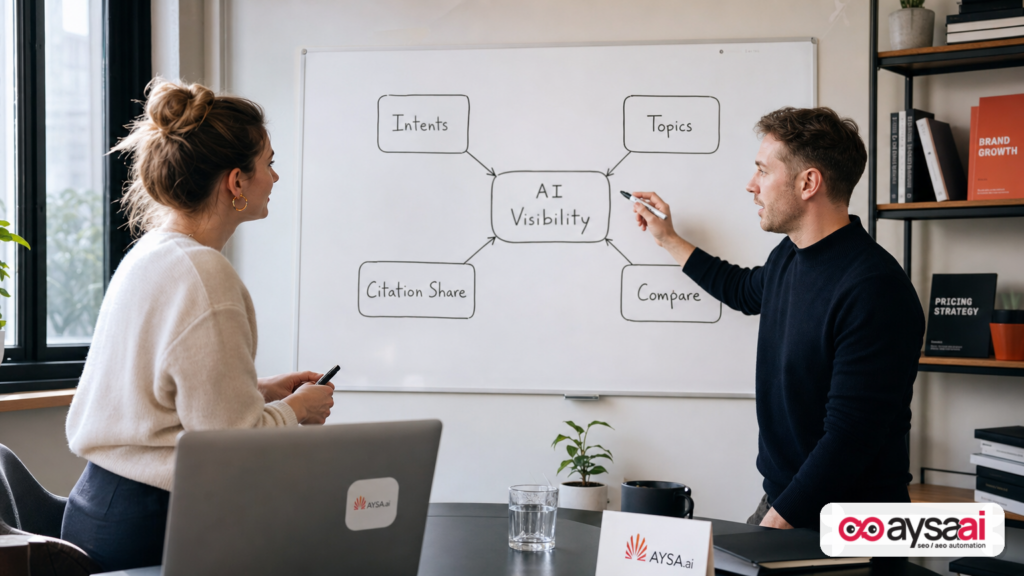
- Intents groups the prompts/grounding queries that cite you into broader categories (informational, commercial, local, etc.), making AI visibility easier to interpret than raw keywords.
- Topics clusters related grounding queries into themes, aligning reporting with how AI systems reason (concepts, not single keywords).
- Citation Share shows the proportion of citations your site receives for a given grounding query—useful trend telemetry, not traffic share.
- Compare lets you overlay time periods to see how AI visibility shifts as models, content, and demand change.
Key takeaways

- AI reporting is maturing from “you were cited” to “you were cited for these reasons, in these themes, at this consistency level.”
- SMEs should treat AI citations like brand distribution inside search—something you manage with content structure, technical clarity, and authority signals.
- Agencies should update deliverables: fewer rank screenshots, more intent/topic coverage, citation consistency, and execution velocity.
- Tools won’t save you if execution is slow. You need a system that monitors, proposes changes, gets approval, and ships improvements safely—this is exactly where AYSA fits.
Table of contents
- What changed in Bing Webmaster Tools (and what didn’t)
- Context: why AI reporting exists at all
- Intents: the missing layer between a keyword and an answer
- Topics: reporting that matches how AI systems group knowledge
- Citation Share: a new KPI—useful, but easy to misuse
- Compare: trend analysis in a world where the model changes weekly
- What can go wrong (and how to avoid false conclusions)
- A concrete SME scenario: local clinic + ecommerce add-on
- What agencies should rethink: deliverables, pricing, and accountability
- The practical action plan: what to do with these reports
- Where AYSA fits: monitoring → preparation → approval → execution
- What to do next (checklist)
- Sources and further reading
What changed in Bing Webmaster Tools (and what didn’t)
Microsoft is expanding Bing Webmaster Tools’ AI Performance reporting in preview with four capabilities:
- Intents: classification of grounding queries into broader intent buckets.
- Topics: thematic grouping of grounding queries into clusters.
- Citation Share: a percentage-based view of how much citation space your site receives for a grounding query.
- Compare: overlay two time periods to see changes.
This builds on Bing’s earlier AI performance reporting foundation. Search Engine Land reports this preview is rolling out globally and positions it as an evolution of reporting that began earlier this year. (Primary research lead: Search Engine Land coverage.)
What didn’t change: the big missing metric remains consistent across AI search reporting broadly: click and click-through rate data for AI answers. That’s not a nitpick—it’s the economic heart of why publishers and businesses care. But as long as clicks remain limited or obscured, visibility metrics become the next best proxy for brand impact, demand capture, and eventual conversions.
Context: why AI reporting exists at all
For 20+ years, Search analytics has been built around a stable funnel:
- Impression
- Click
- On-site behavior
- Conversion
AI-assisted search disrupts that funnel because the “answer” often appears before the click—or replaces it entirely. Your brand can be:
- cited (a direct link listed as a source),
- summarized (paraphrased without a prominent click),
- recommended (included in a short list),
- or excluded even if you rank well organically.
At the same time, users are adopting AI summaries inside search results. Search Engine Land referenced survey reporting that many Americans read AI summaries in search results (Pew-related coverage via Search Engine Land). Whether or not every user trusts them, the behavioral shift is real: more questions are resolved on-SERP, and fewer visits make it to your site for early-journey queries.
That’s why these reports matter. Not because they’re perfect—but because they’re the first serious attempt to provide instrumentation for a new kind of SERP.
And we should be honest: platforms have incentives to keep users inside their experience. That’s not “anti-publisher.” It’s product strategy. Which means businesses need to optimize for presence inside the answer—not just position in the ten blue links.
Intents: the missing layer between a keyword and an answer
Classic SEO often treats keywords like targets. But modern AI experiences treat queries like tasks. When Microsoft adds Intents to AI reporting, it’s acknowledging a basic truth: two prompts can use different words but represent the same underlying need, and AI systems increasingly optimize around that need.
In Bing’s updated AI reporting, grounding queries can be grouped into categories such as informational, commercial, navigational, research, local, and more (as described in the Search Engine Land report). This matters because it turns noisy data into a decision-making layer:
- If your citations skew informational, your content may be strong at explaining and defining.
- If your citations skew commercial or comparison, your product/category pages might be “AI legible” and competitively structured.
- If you’re missing local intent visibility, your location/service coverage might be incomplete—or the site may lack clear local signals.
Intent isn’t just “funnel stage” anymore
In a traditional funnel, “informational” equals top-of-funnel and “commercial” equals bottom-of-funnel. AI answers blur this. A user can ask a research-style question and still want a recommendation; they can ask a commercial question and still need an explainer.
For SMEs, this changes how you plan content:
- You don’t just need blog posts for informational queries—you need structured explanation sections on money pages.
- You don’t just need product pages—you need comparison-ready, constraint-aware content (price ranges, compatibility, timelines, guarantees, availability, geography).
- You need content that makes it easy for an AI system to pull a clean, grounded snippet without misrepresenting you.
How to use Intents practically (without overcomplicating)
Here’s a simple approach I recommend:
- Pick one revenue line (one service, one product category, one location).
- Map the intents you want to win (e.g., Commercial + Local + Learn/Solve).
- Audit your pages: do you have a clear “answer block” for each intent on the pages that matter?
- Ship improvements fast, then watch intent visibility trends over time using Compare.
This isn’t about chasing every intent. It’s about shaping your site into something AI can reliably cite when the user’s task matches what you offer.
Topics: reporting that matches how AI systems group knowledge
The Topics layer is the most strategically important addition for content teams.
Keyword reporting implies the web is a dictionary. AI systems behave more like a knowledge map. They connect concepts, cluster meaning, and pull from sources that cover a topic with clarity and breadth.
According to the Search Engine Land report, Bing’s Topics groups related grounding queries into thematic clusters to better reflect how AI systems reason across themes rather than isolated keywords.
Why Topics changes content planning
SMEs and agencies typically fail at “topic strategy” in one of two ways:
- They go too broad: publishing generic “ultimate guides” that don’t match a specific buyer context, geography, or constraint.
- They go too fragmented: dozens of thin pages targeting individual long-tail keywords without a coherent topical center.
Topic clustering can expose both problems:
- If your topic visibility is broad but shallow, you may show up sporadically with low citation consistency.
- If your visibility is fragmented, you may need consolidation, stronger internal linking, and clearer topical hubs.
Topic coverage vs. topic authority
Don’t confuse “we have articles about it” with “we’re a citable source.” AI systems tend to cite pages that are:
- specific (answers a bounded question),
- structured (clear sections, definitions, steps, pros/cons),
- grounded (verifiable claims, concrete details),
- consistent across the site (no contradictions),
- and supported by credible signals (expertise cues, citations, transparency).
Topics reporting is useful because it lets you manage content like a portfolio: which themes are growing, which are declining, which are unstable, and which themes you’re absent from entirely.
Citation Share: a new KPI—useful, but easy to misuse
Citation Share is the metric most likely to get misread in boardrooms, client calls, and Slack threads.
As described in the Search Engine Land reporting, citation share represents the percentage of citations attributed to your site out of all citations shown for a given grounding query. Microsoft also notes it is designed as an observational metric and not a competitive scoreboard.
That warning is important. Here’s how I’d translate it into business language:
- Citation Share is not your traffic share.
- It is not a ranking factor you can “game” directly.
- It is a signal of how consistently you’re being selected as a source when that query is used as grounding.
How to interpret Citation Share responsibly
Think of Citation Share like a “share of shelf” metric in retail:
- If your share is rising, you’re becoming a more common source for that question type.
- If your share is falling, you may be losing freshness, clarity, or topical fit—or the ecosystem changed.
- If your share is volatile, the AI answer may be pulling from many sources and the model is experimenting.
What you should not do is tie Citation Share directly to revenue without other evidence. You still need:
- brand search demand trends,
- direct traffic patterns,
- lead/conversion tracking,
- and qualitative checks (are you being cited accurately?).
Where Citation Share is most useful
I see three practical uses:
- Early detection: when your visibility drops before traffic drops (or when traffic is already low because users don’t click).
- Prioritization: focusing on topic clusters where you’re close to “owning” citation presence.
- Experiment evaluation: when you restructure pages, add comparison blocks, improve internal linking, or clarify entities—Citation Share can show directional impact.
Compare: trend analysis in a world where the model changes weekly
The new Compare feature overlays a prior time period on current reporting. That sounds basic—until you remember what we’re dealing with.
In AI search, volatility isn’t a bug. It’s the nature of systems that change based on:
- model updates,
- freshness signals,
- new content,
- user behavior shifts,
- and the broader web ecosystem.
Search Engine Land’s write-up highlighted that citation patterns can shift for many reasons, and Compare is meant to make those shifts easier to observe over time.
Trend reading rules (so you don’t panic every Monday)
For SMEs and agencies, I recommend a few rules of thumb:
- Use weekly views for detection, monthly views for decisions. Day-to-day changes can be noise.
- Look for theme-level movement (Topics) before you chase individual prompts.
- Correlate with releases you control: if you shipped changes, Compare helps you evaluate directionality.
- Expect some labels to be imperfect in preview. Don’t build your entire strategy on early taxonomy quirks.
What can go wrong (and how to avoid false conclusions)
AI visibility reporting introduces new failure modes. If you treat it like classic SEO reporting, you’ll draw the wrong conclusions and potentially make harmful changes.
Mistake #1: Treating AI citations like rankings
Rankings are (relatively) deterministic. AI citation selection is more contextual. It depends on how the model composes the answer, what it needs to cite, and which sources it trusts for that sub-claim.
Fix: Optimize for being a useful source—clear definitions, step-by-step methods, constraints, updated details, and strong topical cohesion.
Mistake #2: Optimizing only the content, ignoring the structure
Many businesses respond to AI changes by publishing more. Volume is not the lever. Structure is.
Fix: Add “answer blocks” and comparison-ready sections to your important pages. Improve internal linking so topic hubs connect to detailed subpages. Make sure each page has a distinct purpose and clear entity context.
Mistake #3: Chasing every topic cluster
Topic reporting makes it tempting to expand into adjacent themes. That can dilute authority and confuse users.
Fix: Choose topic clusters aligned with products/services you can actually deliver—and where you can be a credible source.
Mistake #4: Assuming “no citations” means “no demand”
A lack of citations could mean the model is citing other sources, or it could mean your content isn’t structured for grounding. It does not automatically mean people aren’t searching.
Fix: Use AI reporting alongside classic SEO keyword research and performance data (where available). Use it as an additional lens, not a replacement.
Mistake #5: Confusing visibility with business outcomes
Visibility can create brand lift, trust, and downstream conversions—but you still need a conversion strategy, a site experience that closes, and tracking that connects the dots.
Fix: Keep your measurement stack multi-layered: AI visibility + traditional search performance + conversion tracking + qualitative review of how you’re being represented.
A concrete SME scenario: local clinic + ecommerce add-on
Let’s make this real with a scenario I see constantly: a local business that also sells online.
Business: A regional dermatology clinic with two locations that also sells dermatologist-approved skincare products online.
Goal: Grow new patient bookings + increase product sales.
What they see in AI search
- Users ask: “best treatment for adult acne,” “how to reduce hyperpigmentation,” “is retinol safe during pregnancy,” and “best moisturizer for rosacea.”
- AI answers summarize advice and cite a mix of medical sites, publishers, and sometimes clinics.
- Clicks are inconsistent because many users get enough information on the SERP to keep browsing without visiting a clinic site.
How Bing’s new reporting helps
Intents might show the clinic that most citations happen in Research/Learn intents, but they’re weak in Local intent (“near me” type tasks). That’s a signal to strengthen local service pages with clearer coverage: insurance, appointment types, wait times, and location-specific FAQ.
Topics might reveal strong visibility in “Acne Treatments” but weak in “Rosacea” despite offering rosacea services. That becomes an editorial and page-structure priority.
Citation Share might show they appear occasionally but not consistently—suggesting they’re not a go-to source yet. That can be improved by consolidating thin content, adding medically reviewed sections, and improving internal linking between condition pages and treatment pages.
Compare can show whether those changes improved visibility over a month, without requiring click data that may never appear.
What they should do (in plain English)
- Decide the outcomes: bookings and product purchases.
- Pick 2–3 topic clusters: Acne, Hyperpigmentation, Rosacea.
- Build topic hubs (not just blog posts): definitive condition pages with structured answers, plus supporting subpages for treatment options and product recommendations.
- Make local intent unmissable: location pages that actually answer real booking questions.
- Measure citation trends by topic and intent, and ship improvements on a cadence.
What agencies should rethink: deliverables, pricing, and accountability
AI visibility reporting is going to expose a painful truth: many SEO retainers are built around activities, not outcomes—and often not even measurable intermediate outcomes.
When click data is limited, agencies can’t hide behind traffic graphs for top-of-funnel content that never converts. Clients will ask:
- “Are we being cited?”
- “For what themes?”
- “Is it improving?”
- “What did you change to cause the improvement?”
New deliverables that actually matter
If you’re an agency, consider shifting monthly reporting toward:
- Intent coverage: which intents you’re winning/losing.
- Topic coverage and depth: which topic clusters are growing.
- Citation consistency: where visibility is stable vs. volatile.
- Execution log: what changes shipped (and what’s pending approval).
- Business tie-in: correlations to leads, calls, demo requests, or sales—where tracking allows.
The execution bottleneck (why most teams won’t capitalize)
The biggest constraint is rarely insight. It’s implementation:
- Marketing sees the opportunity.
- SEO creates recommendations.
- Dev backlog pushes changes out 6–12 weeks.
- By the time changes ship, the model shifted and the moment passed.
This is exactly why I believe “SEO” is turning into an operations problem. Winning visibility in AI search will require a system that closes the loop from detection to execution.
The practical action plan: what to do with these reports
Let’s turn the four new features into a repeatable process.
Step 1: Pick your “money themes” first
Start with the themes that drive revenue or high-LTV customers. If you’re a florist, don’t start with “flower meanings.” Start with:
- wedding bouquets (local + commercial),
- same-day delivery (local + transactional),
- sympathy arrangements (local + urgent).
Topics reporting should validate whether you have visibility in those themes. If you don’t, the reporting just gave you a prioritized gap list.
Step 2: Use Intents to fix mismatched pages
When you see that citations happen mostly under informational intent, but your business needs commercial/local intent performance, you likely have:
- informational content that’s easy to cite, but
- service/product pages that are too thin, confusing, or missing answers.
Upgrade money pages by adding:
- pricing ranges (where appropriate),
- service area and delivery boundaries,
- availability and lead times,
- comparison guidance (who it’s for / not for),
- clear policies (returns, refunds, cancellations),
- FAQ sections written for real user constraints.
Step 3: Use Topics to design a hub-and-supporting-pages system
For each priority topic cluster:
- Create/upgrade a hub page (the authoritative overview).
- Create/upgrade 4–10 supporting pages that answer specific sub-questions.
- Link them together with descriptive internal links.
This isn’t just good SEO. It makes your site easier for AI systems to interpret as a coherent source on a theme.
Step 4: Use Citation Share as directional validation, not a scoreboard
For a set of grounding queries in a topic:
- Track Citation Share trends over time.
- Look for stability and upward direction after changes ship.
- When it drops, review what changed: your site, competitor content, or the ecosystem/model.
Step 5: Compare periods tied to release cycles
Compare is most useful when you align it to your release cadence:
- Compare “pre-site update vs post-site update.”
- Compare “last month vs this month” while tracking what was published/edited.
- Compare “seasonal windows” for businesses with cyclical demand (travel, HVAC, gifts).
Where AYSA fits: monitoring → preparation → approval → execution
Most businesses don’t fail at AI visibility because they lack ideas. They fail because execution is scattered across too many tools and too many stakeholders.
AYSA is built to make SEO/AEO/GEO execution operational:
- Monitors your search visibility and site health signals continuously.
- Prepares specific, actionable website changes (content, technical, internal linking, structure).
- Asks for approval so changes remain safe, compliant, and on-brand.
- Executes accepted changes to remove the implementation bottleneck.
Relevant AYSA resources
- AI search visibility: what to track and how to improve it
- Monitoring: stay ahead of changes instead of reacting late
- AI SEO tools: turn insights into execution
- Pricing: choose a plan that matches your execution pace
- AYSA blog: strategy and implementation playbooks
How we think about Bing-style signals
Even without direct access to every platform’s internal AI data, the reporting direction is clear: search is moving toward intent and topic understanding plus visibility telemetry. AYSA’s role is to translate that into:
- a prioritized change list tied to business outcomes, and
- a safe mechanism to ship improvements quickly.
In practice, when you notice visibility dropping in a topic cluster, you shouldn’t need a quarter to respond. You should be able to monitor, diagnose, propose fixes, approve, and ship improvements in days—not months.
What to do next (checklist)
- Open your AI visibility reports (where available) and identify your top 3 topic clusters by business value.
- Review intent mix: are you showing up where people decide to buy/book?
- Pick one topic cluster and build a hub + supporting page system around it.
- Upgrade money pages with structured answer blocks (pricing ranges, constraints, comparisons, FAQs).
- Track citation trends monthly using Compare—align it to your release cadence.
- Create an execution log: what changed, when, and why.
- Close the loop: use a system like AYSA to move from insight to approved execution faster.
Sources and further reading
- Search Engine Land: Bing Webmaster Tools updates AI reporting with Intents, Topics, Citation Share and Compare
- Search Engine Land: Pew: 60% of Americans read AI summaries in search results
- Search Engine Land: How AI is merging paid and organic visibility
- Search Engine Land: USA Today vs. Google AI Overviews: A World Cup battle for breaking news traffic
- Search Engine Land: Google AI Overviews cite self-serving listicles, but recommend competitors 69% of the time
- Search Engine Land: New Adobe tool shows where brands win and lose in AI search
Note: This editorial is based on the reporting and context available in the supplied source materials. Where primary platform documentation is not included in the research context, we avoid asserting product specifics beyond what’s reported and focus on practical operational guidance.
Continue the AI search topic inside AYSA.
Use these pages to connect the article with AI SEO tools, AI visibility monitoring, AI Overviews and approved website execution.
Turn this topic into a website action plan.
Use these AYSA hubs to move from reading to technical fixes, AI visibility monitoring, research, glossary context and approval-first SEO execution.

