Why “Topic Ownership” in ChatGPT Is So Rare (and What SMEs Must Do Instead of Classic SEO)
Semrush data suggests only a small share of categories have a stable “owner” in ChatGPT answers—and traditional SEO metrics don’t reliably predict who wins. Here’s the practical playbook for building durable AI search visibility through entity clarity, mentions, and operational execution.

By Marius Dosinescu, AYSA.ai
“Topic ownership” inside ChatGPT sounds like the next holy grail: if your brand becomes the default answer for your category, growth gets easier—fewer Clicks needed, less dependence on rankings, and a stronger brand moat.
But the data coming out of the industry paints a different picture. A recent analysis covered by Search Engine Land (based on Semrush research with Kevin Indig) suggests clear, stable “owners” are uncommon across categories in ChatGPT. Even more important: classic SEO strength doesn’t reliably explain who becomes the AI’s go-to brand. Mentions matter more than citations, and narrow leaders often change—meaning AI brand authority is more volatile than most businesses are ready for.
This article is an editorial resource for SMEs, marketers, and agencies who need an execution-ready plan—not a hype cycle. We’ll unpack what “topic ownership” actually means, why it’s rare, why SEO alone doesn’t control it, and what you should do to build durable AI visibility without gambling your pipeline on a single model’s shifting answers.
Concise summary
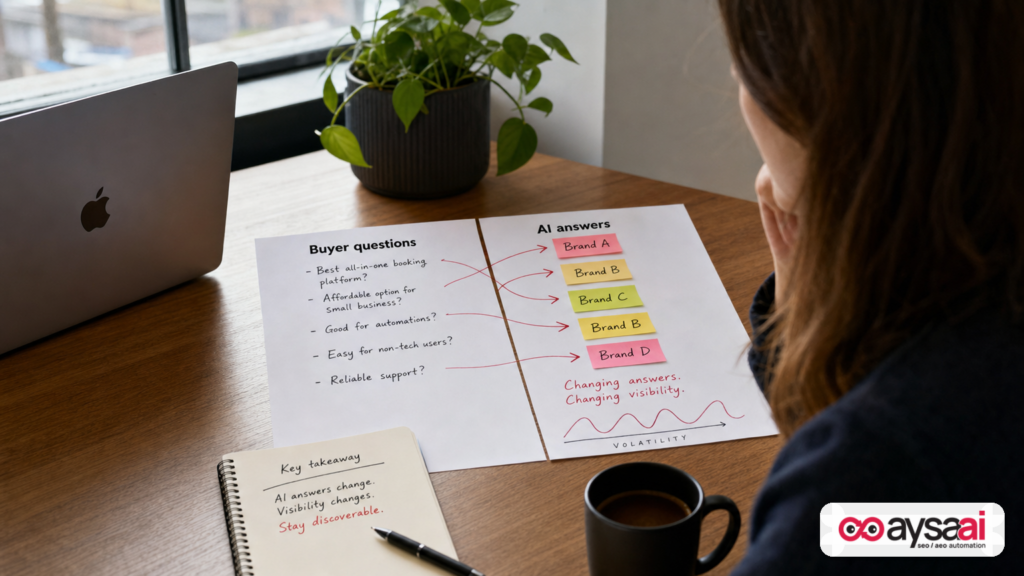
AI Search visibility is moving from “ranking pages” to “being the named brand in answers.” Semrush’s findings (as reported by Search Engine Land) indicate that only a minority of categories show a clear “owner” in ChatGPT; most categories are unsettled, and classic metrics like Organic traffic and authority score don’t consistently predict who wins. Businesses should shift from Keyword-only SEO to an entity-first, mention-driven, operations-led approach—Monitoring AI answers across related buyer questions, closing entity gaps, improving consistency across the web, and executing on-site changes quickly and safely.
Key takeaways (print this)
- “Owning” a topic in ChatGPT is rare. Most categories don’t have one dominant brand consistently mentioned across buyer questions. (Source context: Semrush study referenced by Search Engine Land.)
- Prompt-level wins don’t travel. Showing up once doesn’t mean you’ll appear for adjacent questions like comparisons, alternatives, or “best for X.”
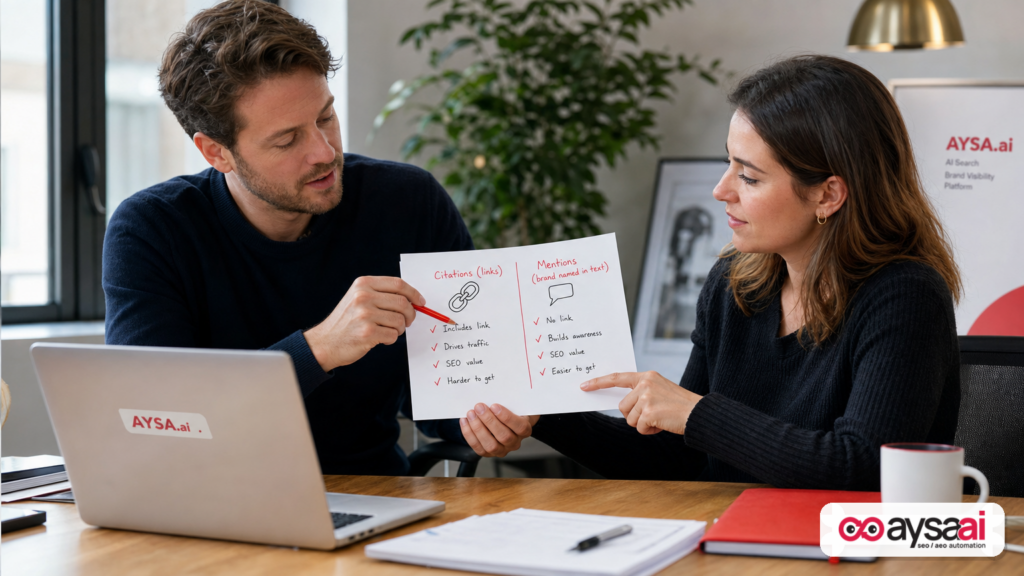
- Mentions often matter more than citations. The brand named in the text is not always the domain most cited via links.
- Traditional SEO metrics are not enough. Branded demand seems more predictive than generic SEO strength, but even that isn’t a full explanation.
- Volatility is the new normal. Narrow leads change more often; stability requires a real moat, not a temporary content spike.
- Execution speed becomes a competitive advantage. If you can’t implement changes (content, schema, entity data, trust signals), you can’t keep up with AI-driven market shifts.
Table of contents
- What changed: from rankings to AI answers
- What “ChatGPT topic ownership” really is (and what it isn’t)
- The uncomfortable truth: AI brand authority is unstable by design
- Mentions beat citations: the metric businesses are still not tracking
- Why SEO alone doesn’t explain AI visibility
- A practical framework: from “rankings” to “entity footprint”
- Content clarity in 2026: say less, mean more
- Schema for AI search: useful, but not magic
- Local businesses: verification and real-world consistency
- Monitoring AI visibility: what to track weekly vs monthly
- Concrete SME scenario: a clinic losing leads to AI answers
- What agencies must rethink: deliver execution, not decks
- Where AYSA fits: approved execution for AEO/GEO
- What to do next (action list)
- Sources and further reading
What changed: from rankings to AI answers
For 20+ years, the default growth model for many businesses looked like this:
- Find keywords with demand
- Create pages
- Earn links
- Rank
- Get clicks
- Convert
AI search changes the path. The customer journey increasingly looks like:
- Ask a question in an AI interface (ChatGPT, assistants, AI Overviews, etc.)
- Receive a synthesized answer
- See a short list of recommended options (sometimes with links, sometimes not)
- Act based on the answer—often without ever visiting ten blue links
That new path creates a new battleground: being the brand named in the answer. That is a different contest than ranking a page. And it creates a different kind of anxiety for SMEs: “If AI doesn’t recommend me, do I exist?”
The Search Engine Land coverage of Semrush’s analysis is important because it pours cold water on an overly simplistic narrative: “Just do SEO and you’ll be the AI answer.” It’s not that simple. In many categories, no one “owns” the topic at all—at least not consistently. In others, leadership is unstable.
What “ChatGPT topic ownership” really is (and what it isn’t)
Let’s define the idea in plain business terms.
Topic ownership means: across a set of related buyer questions in a category—definitions, comparisons, alternatives, use cases, buying decisions—one brand keeps showing up as the leading recommendation, not just once but repeatedly.
Per the Semrush approach described in the Search Engine Land piece, ownership was evaluated using multiple prompts per category and judged by mention share and consistency, not by “did you appear once.” That distinction matters because many marketers are currently celebrating single-prompt wins (screenshots, “we’re in ChatGPT!” posts) that don’t persist across adjacent queries.
What topic ownership is not:
- Not a single keyword ranking. It’s closer to brand-category association in a model’s response patterns.
- Not a single citation link. You can be cited and not mentioned, or mentioned without being cited.
- Not a permanent trophy. Even if you lead today, narrow leads can flip as models, sources, and prompt patterns shift.
If you’re an SME, here’s the practical translation: you’re not competing page-by-page; you’re competing for mental real estate in the machine’s “category memory.”
The uncomfortable truth: AI brand authority is unstable by design
Businesses are used to volatility in ads (bidding changes) and in social (algorithm changes). But classic SEO, for all its unpredictability, often had a kind of “inertia”: if you built a strong position, you could defend it for a while.
AI answers behave differently for a few structural reasons:
1) AI answers are synthesized, not retrieved
Instead of retrieving one page and ranking it, the model synthesizes an answer based on learned patterns and whatever retrieval layer it uses (which can vary). That means two adjacent prompts can produce different brand sets even if the user intent feels similar.
2) Category boundaries are fuzzy
Humans understand category nuance (what’s “email marketing” vs “marketing automation” vs “CRM”). AI models often blur these boundaries, especially in mid-market software and services. That blur widens the competitive set—so you’re not just fighting your obvious rivals.
3) The model’s “confidence” can be shallow
Semrush’s finding (via Search Engine Land) that many categories are unsettled suggests the model doesn’t have a strong, consistent association. In those situations, small changes in prompt wording or in available signals can alter outputs.
4) “Narrow leads” don’t hold
One of the most actionable lessons from the reported research: when leadership is narrow, it’s more likely to change. Translation: if you’re barely showing up more than the runner-up, don’t assume you’re safe.
Business consequence: AI search visibility requires ongoing monitoring and iterative improvement, not a one-time SEO project.
Mentions beat citations: the metric businesses are still not tracking
In traditional SEO, a link (citation) is a vote. In AI answers, a mention is identity.
The Search Engine Land coverage highlights a key mismatch: the most-cited domain is often not the most-mentioned brand. That’s a big deal because users don’t buy “domains.” They buy brands.
Why mentions can matter more than links in AI answers
- User perception: People remember the brand name in the paragraph, not the footnote link.
- Follow-up prompts: If a user asks “Compare X vs Y,” the brands the AI already introduced are more likely to be carried forward in the conversation.
- Offline conversion paths: In local and service businesses, the next action might be “call,” “visit,” or “search the brand,” not “click the cited URL.”
What counts as a “mention” (practically)
For SME operators, a mention is simply: your brand name appears in the answer text when a customer asks questions in your category.
That means you need to track AI outputs the way you track rankings or ad impression share. If you’re not measuring mentions, you’re not managing AI visibility—just hoping.
At AYSA, we treat this as a monitoring and execution loop: observe mention patterns, identify gaps, propose fixes, get approval, execute changes, and re-measure. (More on that later.)
Why SEO alone doesn’t explain AI visibility
The Search Engine Land piece summarizes Semrush’s comparison of “owners” versus “runners-up” across broad SEO metrics and finds limited predictive power. The key editorial insight isn’t “SEO is dead.” It’s this:
Classic SEO is necessary—but increasingly insufficient—because AI visibility is a multi-signal reputation system.
What SEO still does well
- Helps your site get crawled, indexed, and understood
- Builds topical coverage and internal consistency
- Earns links that remain foundational to web authority
Where SEO falls short for AI topic ownership
- Off-site narrative control: AI models learn from broad web text patterns—press, reviews, forums, directories, product listings—not just your site.
- Entity disambiguation: If your name is generic (“Prime Dental,” “Summit Roofing”), the model can confuse you with others unless your entity signals are strong.
- Category precision: Many sites describe themselves in vague marketing language. AI needs crisp category statements and proof.
What seems more predictive: branded demand
In the Search Engine Land write-up, branded search volume stood out as more significant than other broad metrics. Without over-reaching beyond the provided context, we can still make a grounded observation: brands people actively look for tend to become brands AI feels safer recommending.
That doesn’t mean “buy brand searches.” It means: build real brand demand through clear positioning, consistent presence, trust signals, and sustained mentions across the ecosystem.
A practical framework: from “rankings” to “entity footprint”
If you want a durable strategy that survives AI volatility, stop thinking like a keyword publisher and start thinking like an entity builder.
Your entity footprint is the set of consistent facts and associations about your business across:
- Your website
- Major platforms (profiles, directories, app stores, marketplaces)
- Reviews and third-party listings
- Press and partnerships
- Industry communities and forums
Semrush’s framing (via Search Engine Land) implies that topic-level visibility is the real game. Entity footprint is how you win topic-level visibility.
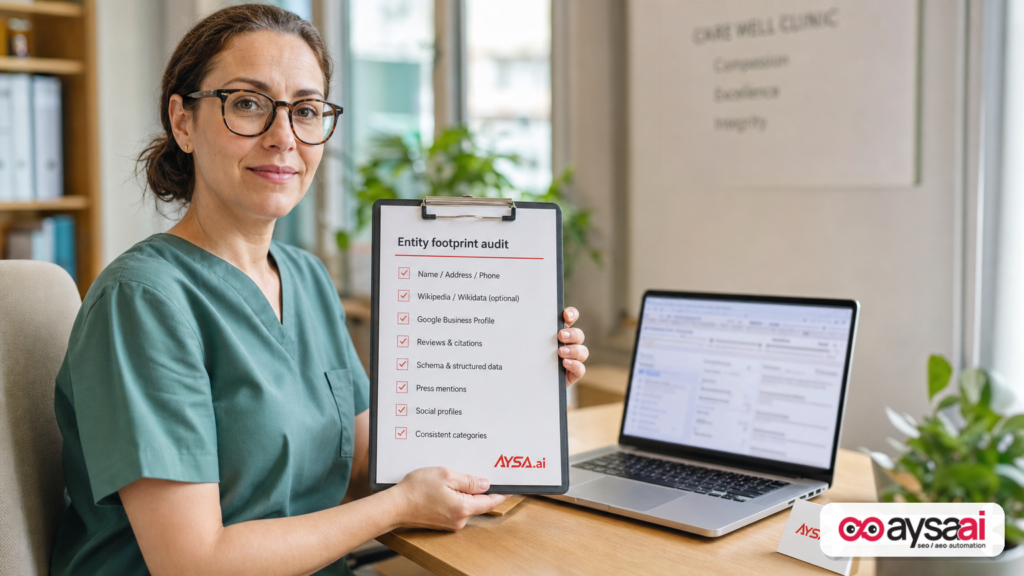
Entity footprint checklist (SME version)
Ask these questions and fix what’s unclear:
- Who are you? Legal name vs brand name; consistent spelling; consistent logo usage.
- What category are you in? One primary category; 2–3 secondary categories; no vague “solutions for everyone.”
- Where do you operate? Service areas, locations, countries, languages.
- What do you sell? Clear product/service list with plain-language definitions.
- What proof exists? Reviews, certifications, case studies, press coverage, third-party listings.
- How can you be verified? Contact info, address (if applicable), policies, owner/team pages, about page clarity.
If any of these are inconsistent, you may still rank in Google for some keywords, but you’ll struggle to become the default brand in AI answers because the model can’t reliably “pin” you to a category and context.
Content clarity in 2026: say less, mean more
The AI era punishes fluff. Not because AI “hates” it, but because fluff reduces signal strength. If your pages mix too many topics, too many audiences, and too many promises, AI systems have trouble extracting a crisp brand-category association.
Search Engine Land has separately emphasized “clarity” as a new rule for bloggers in AI search (see: The new SEO rules for bloggers in 2026: Why clarity matters in AI search). The same principle applies to SMEs: clarity isn’t a writing style—it’s an entity strategy.
Practical clarity upgrades (that SMEs can actually do)
- Rewrite your homepage hero. In one sentence: what you do, for whom, where, and the outcome.
- Create a “category page” that reads like a definition. Not a sales pitch. A clear explanation of the service/product and when it’s used.
- Build comparison and alternatives pages responsibly. If customers ask “X vs Y,” you should have a fair page that explains differences and when you’re the better fit.
- Reduce redundant content. If you have ten similar blog posts targeting variations, consolidate. Thin variations dilute signal.
AI topic ownership is often measured across buyer questions like “what is,” “best,” “alternatives,” “pricing,” and “for small business.” Your content architecture should mirror those buyer questions—without becoming spammy.
Schema for AI search: useful, but not magic
Schema markup is a way to communicate structured meaning: “this is an Organization,” “this is a Product,” “this is a Review.” It can help search engines and systems interpret your site, but it’s not a cheat code.
Search Engine Land has covered schema and entity gaps directly (see: Schema for AI search: How to identify and prioritize entity gaps). The key SME takeaway: schema is most valuable when it closes ambiguity, not when it’s used as decoration.
Schema that tends to be practical for SMEs
- Organization / LocalBusiness with consistent name, URL, logo, contact points
- Product / Service for core offers (when appropriate)
- FAQPage for real customer questions (not spammy Q&A)
- Review / AggregateRating only when compliant and accurate
Where schema goes wrong
- Markup that doesn’t match visible page content
- Fake or incentivized reviews (which can create compliance risk)
- Over-marking every block on the page without a meaning goal
Schema supports AI visibility best when it aligns with a broader entity footprint strategy: consistent facts everywhere, with your site as the canonical source.
Local businesses: verification and real-world consistency
Local SEO is where AI search can become brutally practical. If the AI can’t verify your business, it will hesitate to recommend you—or recommend a competitor with cleaner signals.
Search Engine Land has highlighted that AI search may struggle to verify businesses and that local profile changes can disrupt rankings. Two relevant references from their coverage list include:
- AI search can’t verify your business — here’s how to fix it
- Why Google Business Profile address changes can disrupt local rankings
Even if you’re not obsessing over map pack rankings, these issues matter because they’re signals of real-world legitimacy. AI systems gravitate toward entities that look stable, well-documented, and widely corroborated.
Local “AI readiness” checklist
- Consistent NAP (name, address, phone) across your website and major profiles
- Clear service area and hours
- High-quality reviews that mention specific services (organic language)
- Location pages that actually describe the location and offerings
- Staff/doctor/team pages where relevant (trust + disambiguation)
For local service businesses (roofing, dental, HVAC, medspa, legal), the combination of reviews + consistent listings + clear category definition is often your best “mention engine.”
Monitoring AI visibility: what to track weekly vs monthly
AI search is not one query. It’s a cluster of buyer questions. That’s why topic-level monitoring is the right abstraction.
At minimum, you need a repeatable way to answer:
- Do we show up in AI answers for our category?
- Do we show up across related buyer questions, not just one?
- Are we mentioned or only cited?
- Did our visibility change month over month?
- Which competitors are being named—and in what context?
Semrush’s dataset approach described in the Search Engine Land coverage (multiple prompts per category) is directionally what businesses should do, even if you execute it with a different toolset or a smaller scope.
Weekly monitoring (small team friendly)
- Check top 5–10 “money” buyer questions (best, pricing, alternatives, for small business, near me)
- Record: mention yes/no; position in list; context (positive/neutral/negative)
- Note competitor shifts
Monthly monitoring (strategic)
- Expand prompt set to cover the full category journey
- Track mentions vs citations
- Map which pages and which off-site assets correlate with improvements
- Prioritize next month’s entity/content/schema tasks
AYSA supports this approach through Monitoring and dedicated AI search visibility workflows—so you’re not manually screenshotting answers and guessing what to fix.
Concrete SME scenario: a clinic losing leads to AI answers
Let’s make this real with a scenario that mirrors what we’re seeing across service businesses.
Business: A mid-size dermatology clinic in a metro area with two locations.
What they notice: Website traffic looks “fine,” rankings for a few treatment keywords look stable, but new patient calls for high-margin procedures decline. The front desk starts hearing, “ChatGPT said you’re more of a general dermatology clinic. It recommended X for cosmetic procedures.”
What’s actually happening:
- The clinic’s website describes services broadly, with cosmetic procedures buried under generic “Services.”
- Most third-party mentions (local directories, old press) talk about general dermatology.
- Reviews mention “rash” and “eczema” far more than “laser resurfacing” or “Botox.”
- Competitors have clearer cosmetic landing pages, more consistent service naming, and more patient stories that match the buyer questions people ask AI.
How to fix it (without chasing fantasies):
- Clarify category positioning on-site. Create a cosmetic dermatology hub page with definitions, candidacy, outcomes, and safety info.
- Build buyer-question content. “Laser resurfacing vs microneedling,” “best treatment for acne scars,” “alternatives to Botox.”
- Improve entity proof. Team credentials, clinic locations, policies, before/after galleries where compliant, and authoritative references.
- Align off-site mentions. Update profiles and listings; pursue local press/partners that mention cosmetic expertise; encourage reviews that naturally reference the specific procedure (without scripting or incentives).
- Monitor AI answers as a category set. Not one prompt; a whole cluster of prompts tied to the clinic’s revenue services.
This is not “gaming ChatGPT.” It’s normal brand building and information hygiene—executed with AI-era measurement.
What agencies must rethink: deliver execution, not decks
Most agencies are still organized around deliverables that made sense in classic SEO:
- Audits
- Keyword research
- Content briefs
- Monthly reports
Those deliverables aren’t worthless. But in AI search, the bottleneck is frequently implementation: schema updates, page rewrites, internal linking, canonicalization, About page clarity, product/service definitions, structured data compliance, and the long list of “small” fixes that create strong entity signals.
Search Engine Land has emphasized organizational alignment between SEO and PPC (see: SEO and PPC alignment starts with your org chart). The same organizational point applies here: AI visibility is cross-functional. You can’t treat it like “content marketing only.”
AEO/GEO demands a new agency operating model
- From deliverables to outcomes: mention share, topic coverage, conversion quality.
- From one-time audits to feedback loops: measure → change → re-measure.
- From “recommend” to “execute safely”: reduce client dev dependency.
And if you’re an in-house marketer at an SME: you need the same shift. Your job becomes less “publish more” and more “publish with precision, then iterate relentlessly.”
Where AYSA fits: approved execution for AEO/GEO
At AYSA.ai, our thesis is simple: strategy without execution is just a document. And AI search is moving too fast for document-only SEO.
AYSA is an SEO/AEO/GEO execution system designed to:
- Monitor performance and AI visibility signals over time (Monitoring)
- Prepare specific website changes (content improvements, internal links, structured data, entity clarity fixes)
- Ask for approval before touching your site (so nothing “mysteriously changes”)
- Execute accepted changes reliably—so improvements don’t sit in a backlog
In practice, this matters because the Semrush findings summarized by Search Engine Land imply a harsh reality: many categories have no stable owner, and visibility can change. If the game is iterative, the winners will be the teams that can iterate.
If you want to explore capabilities, start here:
What AYSA is not
- Not a “prompt hack” generator
- Not a tool that claims to control a model’s output with gimmicks
- Not a replacement for brand strategy
AYSA supports what actually works: clarity, consistency, implementation, and measurement.
What to do next (action list)
If you’re an SME owner or operator, here is a realistic plan you can run in 30–60 days without turning your business into a research project.
Week 1: Define your topic set (stop guessing)
- List your top 3 revenue categories (not 20 services—3 categories).
- For each category, list 10 buyer questions: definition, best, price, alternatives, vs, for small business, for my city, risks, timeline, warranty/guarantee, etc.
- Check whether your brand is mentioned across these questions (not just cited).
Weeks 2–3: Fix entity clarity on your website
- Rewrite homepage positioning for one primary category.
- Create or improve category hub pages.
- Add clear About/Team/Location/Contact proof.
- Clean up internal linking so category pages are unmistakably important.
Weeks 4–6: Build mention-worthy assets
- Publish 3–5 buyer-question pages that match the AI prompt set (comparisons and alternatives are usually high leverage).
- Improve your off-site presence: key directories, partnerships, and credible mentions that reinforce the same category identity.
- Encourage authentic reviews that naturally reference the service/product customers bought (no scripts, no incentives).
Ongoing: Install the monitoring + execution loop
- Monitor topic-level AI visibility monthly.
- Turn findings into a prioritized backlog.
- Execute changes quickly—with approvals and safeguards.
This is where a system approach wins. You can run these loops manually, but it’s slower and easier to abandon. Or you can operationalize it with AYSA’s monitoring and approved execution workflows (Monitoring, AI search visibility).
What can go wrong (so you don’t waste a quarter)
AI visibility projects fail for predictable reasons. Here are the big ones:
1) You chase one prompt
You celebrate being listed once, then visibility disappears for the next four buyer questions. Topic-level wins require topic-level consistency.
2) You publish more content instead of better content
Publishing thin variations can dilute your entity signal. Consolidate and clarify.
3) You confuse “links” with “mentions”
A link in citations is not the same as being named. Track mentions.
4) You neglect off-site signals
If the wider web describes you differently than your website, AI systems may follow the crowd.
5) You can’t execute
The best plan dies in a backlog. If approvals, dev bandwidth, and stakeholder alignment block changes, you’ll lose to faster competitors—even smaller ones.
My editorial perspective: stop trying to “win AI,” start building a brand AI can’t ignore
“Topic ownership” is a useful concept, but it can be a trap if you interpret it as a new version of “rank #1.” The more realistic goal for most SMEs is:
- Be consistently mentioned for your true category across buyer questions.
- Be verifiable as a real, stable entity (especially local and regulated industries).
- Be chosen because your brand is clear, trusted, and easy to evaluate.
If the Semrush findings reported by Search Engine Land tell us anything, it’s that AI brand authority is still forming. That’s good news: the window is open. But it’s also dangerous news: the ground is moving. The winners will be the businesses with the best execution loop—not the biggest keyword spreadsheet.
Sources and further reading
- Search Engine Land: ChatGPT topic ownership is rare, and SEO alone doesn’t explain it (primary research lead for this editorial)
- Search Engine Land: The new SEO rules for bloggers in 2026: Why clarity matters in AI search
- Search Engine Land: Schema for AI search: How to identify and prioritize entity gaps
- Search Engine Land: How to audit your AI entity footprint
- Search Engine Land: AI search can’t verify your business — here’s how to fix it
- Search Engine Land: Why Google Business Profile address changes can disrupt local rankings
- Search Engine Land: 7 feedback loops for self-improving AI content workflows
Related AYSA resources:
Continue the AI search topic inside AYSA.
Use these pages to connect the article with AI SEO tools, AI visibility monitoring, AI Overviews and approved website execution.
Turn this topic into a website action plan.
Use these AYSA hubs to move from reading to technical fixes, AI visibility monitoring, research, glossary context and approval-first SEO execution.