
ChatGPT Traffic ‘Dropped’ in GA4—Or Your Tracking Broke. Here’s How to Measure AI Referrals Reliably (and What to Fix Now)
A sudden decline in ChatGPT-attributed sessions may be a measurement issue, not a demand issue. Here’s what likely changed, why it matters to SMEs and agencies, and a practical action plan to regain trustworthy AI referral attribution—without guessing.
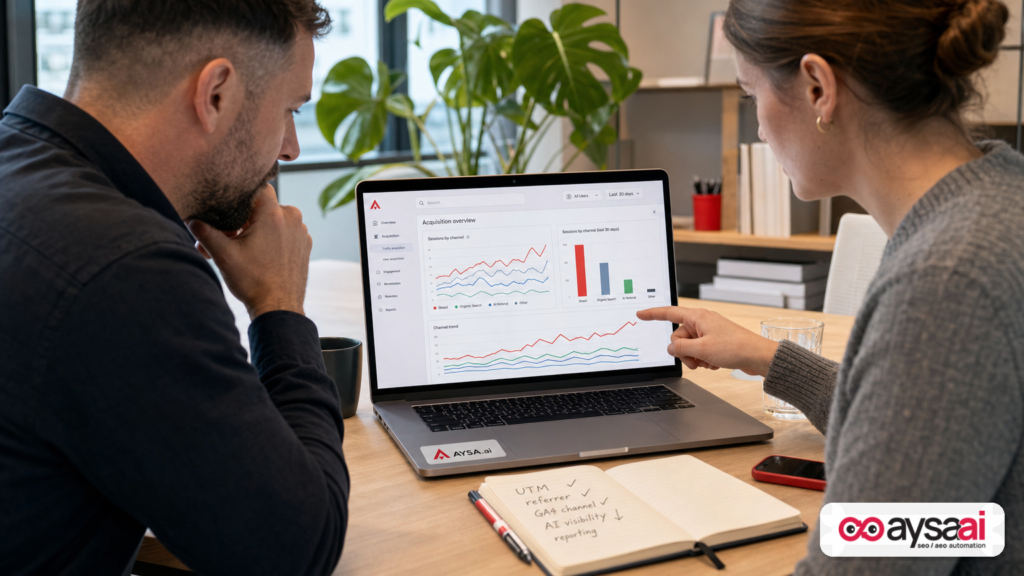
AI referral reporting is entering its “browser privacy” era—fast. If you opened GA4 this week and saw ChatGPT-attributed sessions drop 20–50% overnight, there’s a good chance you didn’t lose demand. You lost Attribution.
Multiple measurement teams observed a pattern after a recent ChatGPT rollout: some Clicks from ChatGPT answers began landing on websites without a referrer and without the familiar utm_source=chatgpt.com tag. When that happens, GA4 can’t reliably classify the session as coming from ChatGPT. Many of those visits can be bucketed into Direct instead, which makes the AI channel look like it collapsed even if overall traffic stayed steady.
This editorial breaks down what likely changed, why it matters to businesses that don’t have a dedicated analytics engineer, and the concrete steps you can take right now to (1) stop misreading your performance, (2) restore continuity in reporting, and (3) build a more resilient measurement stack for AI discovery going forward.
Primary research input: Search Engine Journal coverage of the suspected ChatGPT tracking issue.
Concise summary

- What changed: Some ChatGPT answer links (especially inline links) may have opened without referrers and/or without
utm_sourcetagging—so GA4 can’t attribute those sessions to ChatGPT. - What you’re seeing: “ChatGPT traffic down” paired with “Direct traffic up,” often concentrated on the pages ChatGPT used to send traffic to (and sometimes the homepage).
- What it means: Don’t treat this as a demand crash until you reconcile Direct + AI traffic patterns, annotate your reporting, and validate at the landing-page level.
- What to do now: Annotate the affected window, compare ChatGPT and Direct side-by-side, focus on landing pages and conversion rates, and implement a durable Monitoring approach.
- How AYSA fits: AYSA monitors these anomalies, prepares fixes (tracking, content, technical), asks for your approval, and executes accepted website changes—so measurement chaos doesn’t become strategy chaos.
Table of contents

- The problem: when “AI traffic drop” is actually a tracking drop
- What actually changed: link handling, referrers, and UTM tags
- Where the visits likely went: the Direct bucket (and why that’s messy)
- Why this matters (even if total traffic didn’t change)
- AI Search context: attribution is now part of AEO/GEO strategy
- An SME scenario: the ecommerce brand that thought demand collapsed
- How to diagnose it without guesswork (GA4 patterns to check)
- The practical measurement playbook (what to do in GA4, GSC, and your site)
- What agencies should change in reporting and retainer scope
- What to prioritize next: resilient measurement + AI visibility execution
- Where AYSA fits: monitoring → recommendations → approved execution
- What to do next (action list)
- Sources and further reading
The problem: when “AI traffic drop” is actually a tracking drop

Business leaders don’t lose sleep over a channel label. They lose sleep over the decisions that label drives: budget cuts, content pivots, agency blame, hiring freezes, and “we need a new strategy” meetings.
So when a reporting tool suddenly shows “ChatGPT sessions down 40%,” the natural reaction is: we’re losing relevance.
But in analytics, dramatic week-over-week shifts often come from:
- Tracking changes (tags, referrers, cookies, consent)
- Platform behavior changes (apps, webviews, link routing)
- Attribution/marketing channel grouping updates
- Reporting lag or sampling differences
The SEJ reporting and the analysts cited there point to a very specific culprit: how ChatGPT opens links, and whether it passes referrer information or UTM tags (SEJ).
If the platform stops sending referrers and stops appending UTMs to certain link types, analytics tools can’t classify the visit as coming from ChatGPT. The session doesn’t disappear—your ability to label it disappears.
What actually changed: link handling, referrers, and UTM tags
To understand why this is happening, you only need a simple mental model of how attribution works in modern analytics:
- Referrer: the browser signal that says “this user came from that page/domain.”
- UTM parameters: query string tags marketers add (e.g.,
?utm_source=chatgpt.com&utm_medium=referral) to explicitly label the click.
When either is present, GA4 has more context. When both are missing, GA4 often falls back to Direct. That’s not a moral judgment. It’s simply the “we don’t know” bucket.
According to the SEJ coverage, several teams observed that:
- Inline links in ChatGPT answers sometimes opened without the
utm_source=chatgpt.comtag that historically helped attribution (SEJ). - Some links opened in ways that withheld the referrer, which can also push visits into Direct.
- Not all links behaved the same (e.g., “Sources” panel links may have differed from inline answer links in the observations referenced by SEJ).
Two important implications follow:
- Your “AI channel” number can drop even if human behavior doesn’t change.
- The more your reporting depended on platform-added UTMs, the more fragile your measurement is.
This is why I treat AI traffic attribution as a capability—not a metric. Metrics can lie when the instrumentation changes; capabilities survive platform volatility.
Where the visits likely went: the Direct bucket (and why that’s messy)
The interesting part of the SEJ reporting wasn’t only the “ChatGPT down” headline—it was the “Direct up” pattern observed by at least one large measurement sample in the coverage (SEJ).
Here’s the nuance that trips teams up:
- Direct is huge. On many SMB sites, Direct traffic can dwarf referrals from any single source.
- Direct includes multiple realities. True “typed URL,” bookmarks, apps that don’t pass referrers, email clients, PDFs, some messaging apps, some privacy settings, and more.
- Small absolute changes can be hard to detect. If you add 500 sessions/day into Direct, it might barely move the percentage if Direct is already 20,000 sessions/day.
So you may see:
- ChatGPT referral sessions appear to crater
- Total sessions remain stable
- Direct sessions creep up—or don’t appear to, depending on scale
This is also why “channel-level panic” is the wrong response. You need to go one level deeper: landing page and behavior.
Why this matters (even if total traffic didn’t change)
Even if your total traffic is stable, attribution instability creates real business problems:
1) Budgeting and channel investment decisions get distorted
If leadership thinks “AI traffic is collapsing,” the next question becomes “why are we investing in AI visibility at all?” The right answer might still be “we should,” but you won’t win that argument with broken charts.
2) Agency/client trust takes collateral damage
When measurement breaks, every stakeholder assumes someone messed up:
- “Did the agency lose us rankings?”
- “Did our devs break tracking?”
- “Did GA4 change something again?”
Sometimes all three are false. The platform behavior changed upstream.
3) A/B tests and content experiments become hard to interpret
If you’re testing new content designed to earn AI citations, and your “ChatGPT sessions” metric is suddenly undercounted, your experiment readout is compromised. You might kill winners.
4) Forecasting becomes fiction
If you’ve started building AI visibility into your forecast model—even informally—this kind of break creates phantom declines.
Bottom line: attribution problems don’t stay in analytics. They leak into strategy.
AI Search context: attribution is now part of AEO/GEO strategy
AI Search isn’t just a new “referral source.” It’s a new discovery layer, and it behaves differently than traditional search:
- Users may not click at all (answers satisfy intent immediately).
- When they do click, the click often happens after the user has already “pre-qualified” your brand by reading an AI summary.
- Some AI interfaces are app-based, in-app browsers, or special webviews where referrers are inconsistent.
That means a modern AEO/GEO program needs two things at once:
- Visibility execution: content and technical changes that increase your odds of being selected/cited.
- Measurement resilience: a way to detect impact even when referrer/UTM behavior changes.
At AYSA, we frame this as: monitor what platforms do, then operationalize the response. That’s exactly what this incident represents.
If you want the broader foundation on AI visibility, start with:
An SME scenario: the ecommerce brand that thought demand collapsed
Let’s make this real with a scenario I see constantly in the market.
Business: A 12-person ecommerce brand selling specialty home fitness accessories.
Setup:
- GA4 installed, basic event tracking, purchase tracking works.
- They’ve been investing in content like “best wrist wraps for…” and “how to fix grip pain.”
- They noticed “ChatGPT” started appearing in their reporting and felt optimistic—finally, proof AI is sending buyers.
What happened:
- One Monday, ChatGPT-attributed sessions appear down ~45% week over week.
- Paid spend is steady, email is steady.
- Revenue is roughly stable, but the marketing manager panics because AI was “the growth story.”
The bad decision path: They cut AI content production, reallocate budget to short-term paid campaigns, and stop improving product guides—because “it’s not working.”
The better decision path: They check:
- Are the same landing pages still receiving sessions, but under Direct?
- Did conversion rate and AOV change for those pages?
- Did time on page, scroll depth, or add-to-cart rates shift?
If those metrics are stable, it’s a reporting issue. You don’t change strategy because your labels broke.
How to diagnose it without guesswork (GA4 patterns to check)
You don’t need perfect data to make good decisions—you need consistent data and sensible checks. Here’s a practical diagnostic sequence you can run in under 60 minutes.
Step 1: Annotate the suspected change window
In the SEJ coverage, analysts suggested annotating early October as the period when attribution behavior changed (SEJ).
Whether the exact dates match your property or not, the rule is simple: mark the window so future stakeholders don’t interpret it as performance collapse. In analytics programs, annotations are part of governance.
Step 2: Compare landing pages, not channels
Pull a list of landing pages that historically received “ChatGPT” traffic (or “AI Assistant” traffic if you’re using that concept). Then compare:
- Landing page sessions by day
- Direct sessions to those same pages by day
- Conversions, conversion rate, revenue per session (as applicable)
If you see the same pages still performing, but with a channel label shift, you’re seeing reclassification—not disappearance.
Step 3: Watch for homepage bias
The SEJ summary referenced observations that ChatGPT might be displaying more direct URLs, often pointing to homepages (SEJ). Whether that persists or not, the diagnostic is useful:
- Did Direct traffic to the homepage rise?
- Did Direct traffic to informational guides rise?
- Did the share of “new users” among Direct change?
Homepage-heavy “Direct” increases are a common signature of attribution loss.
Step 4: Compare engagement behavior profiles
If you segment users landing on those pages by channel grouping, do the “new Direct” users behave like historical AI users?
- Similar engagement rate?
- Similar path to conversion?
- Similar device mix (often mobile-heavy)?
You’re not proving causality—you’re building confidence in your explanation.
Step 5: Break out mobile vs desktop
AI assistants are disproportionately used on mobile, and mobile attribution is disproportionately fragile (apps, webviews, privacy settings). If the shift is more dramatic on mobile, that supports the “link handling” hypothesis.
The practical measurement playbook (what to do in GA4, GSC, and your site)
Here’s the playbook I want SMEs and agencies to adopt. It’s designed for imperfect conditions.
1) In GA4: build a side-by-side view for AI vs Direct
Create an exploration (or a saved report) that shows, by landing page:
- Sessions from ChatGPT (or AI channel labeling you use)
- Direct sessions
- Total sessions
- Key conversions
Then compare week-over-week and day-over-day. If ChatGPT drops and Direct rises on the same landing pages, that’s your first-order explanation.
2) In GA4: document your channel definitions
Many teams don’t realize how much “channel” is just a rule-set. When upstream behavior changes, the rule-set becomes fragile.
If your organization is using custom channel groupings, document them. If you’re relying on default groupings, at least document the assumption: “AI referrals depend on referrer/UTM behavior we don’t control.”
3) In Google Search Console (GSC): don’t confuse search demand with AI referral changes
GSC won’t show you “ChatGPT traffic.” But it does tell you whether Google search demand and performance changed during the window.
If your GSC clicks/impressions are stable while GA4 shows an “AI traffic collapse,” that’s another hint that you’re observing a labeling issue—not a broad interest drop.
If you’re new to building durable visibility monitoring, this is exactly the kind of operational layer AYSA supports via ongoing monitoring and anomaly detection: AYSA Monitoring.
4) On your site: improve first-party measurement hygiene
You can’t force third-party apps to send referrers. But you can improve your ability to interpret traffic by strengthening your own instrumentation:
- Ensure your key conversions are tracked reliably (form submits, calls, purchases).
- Confirm cross-domain tracking if your checkout or booking engine lives elsewhere.
- Validate consent mode behavior if you operate in regions requiring consent banners.
This won’t “bring back” lost ChatGPT attribution. But it prevents a worse outcome: losing both attribution and conversion truth.
5) Treat UTMs as a convenience, not your foundation
The SEJ reporting suggests the platform-provided UTM tag was a key mechanism for attribution in many setups (SEJ). That’s fine—until it isn’t.
Durable measurement should also lean on:
- Landing page cohorts (which pages AI tends to cite/send clicks to)
- Conversion outcomes tied to those cohorts
- Content visibility monitoring (are you being cited/linked in AI answers?)
This is where AI visibility work becomes less about “did we get a referral?” and more about “did we win the answer and the next step?”
6) Update your reporting narrative: add an “attribution reliability” note
In executive reporting, add a short, plain-English note:
- “AI assistant traffic may be undercounted due to upstream link tagging/referrer behavior. Review Direct + AI together for continuity.”
This reduces panic and builds credibility.
What agencies should change in reporting and retainer scope
If you run an agency, this incident is a warning: AI-era SEO retainers that only include “rankings and traffic” reporting will not survive. The work now includes:
1) Measurement incident response as a service
Your clients won’t care whose bug it was. They’ll care that you can:
- Identify likely attribution breaks quickly
- Explain the impact in business terms
- Provide a short-term workaround
- Restore continuity and confidence
2) Cross-functional collaboration (analytics + SEO + content)
AI visibility and AI attribution touch:
- SEO/content teams (what gets cited)
- Analytics teams (how it’s measured)
- Web engineering teams (consent, tagging, performance)
In many SMB and mid-market orgs, those roles are fragmented or part-time. Agencies that can operationalize across them will win.
3) New deliverables: “AI visibility + attribution” dashboards
Even without perfect click attribution, you can report on:
- Which pages are getting AI-driven attention
- Whether those pages convert
- Whether Direct traffic patterns align with AI visibility changes
The retainer value shifts from “we got you traffic” to “we kept you measurable and competitive while platforms changed.”
What to prioritize next: resilient measurement + AI visibility execution
Once the panic is contained, the strategic question is: what should you build so this doesn’t derail you again?
Priority 1: Monitoring that detects anomalies early
Set up monitoring that watches for:
- Sudden drops in AI-attributed sessions
- Sudden rises in Direct to AI-heavy landing pages
- Device-specific shifts (mobile anomalies)
AYSA’s monitoring layer is designed for exactly this operational need: AYSA Monitoring.
Priority 2: Content structured to win AI answers (not just rankings)
If AI assistants increasingly summarize and route users differently, your content needs to be:
- Clear, specific, and entity-rich (so systems can attribute claims correctly)
- Organized around tasks and decisions (so it’s useful in “answer mode”)
- Supported by credible signals (about pages, policies, author info, references where appropriate)
That’s AEO/GEO in practice: being the best candidate for the assistant to use.
Related AYSA resources:
Priority 3: Execution speed—with governance
When platforms change, the winners are the teams that can:
- Detect the change
- Decide what to do
- Implement safely
- Verify impact
The trap is rushing changes without approvals and breaking something else (tracking, templates, conversion flow). The other trap is moving so slowly that you lose months of learning.
This is why AYSA’s model matters: prepare recommendations, request approval, then execute accepted website changes—so you get speed and control.
Where AYSA fits: monitoring → recommendations → approved execution
Here’s what this incident looks like through the AYSA lens.
1) Monitor the symptoms continuously
When a platform changes link behavior, you often see consistent symptoms:
- AI assistant sessions down
- Direct sessions up
- Landing pages stable
AYSA’s monitoring layer helps surface those anomalies early so you can investigate before leadership rewrites the strategy: Monitoring.
2) Prepare fixes and measurement adjustments
Depending on your setup, “fixes” can include:
- Reporting annotations and updated dashboards
- Landing page cohort reports to reduce reliance on channel labels
- Site instrumentation hardening (conversion events, cross-domain, consent checks)
- Content and internal linking improvements so AI-driven visits land on pages that convert
3) Ask for approval (because measurement changes can be risky)
Analytics and tracking changes can have unintended consequences. The right operational posture is: propose, review, approve, deploy.
That’s the “approved execution” system we insist on—especially for SMEs who don’t want surprises.
4) Execute accepted website changes quickly
When you approve, AYSA executes the accepted changes efficiently—so you spend less time coordinating and more time learning from outcomes. If you want to understand packaging and options, see: AYSA Pricing.
What to do next (action list)
- Annotate the window: Mark the suspected attribution-change dates in your reporting so no one misreads the dip as demand loss.
- Run the landing-page cohort check: For pages that used to get ChatGPT traffic, compare total sessions, Direct sessions, and conversions week-over-week.
- Segment by device: Check whether the attribution shift is stronger on mobile, where AI app behavior is most likely to distort referrers.
- Update executive reporting: Add a one-line “attribution reliability” note and report Direct + AI together for continuity until signals stabilize.
- Strengthen first-party measurement: Validate conversion tracking, cross-domain flows, and consent behavior so you can trust outcomes even when channel labels drift.
- Build resilient AI visibility measurement: Track which pages AI tends to cite and whether those pages convert—don’t rely on one channel label.
- Operationalize it: Put monitoring and an incident-response playbook in place (or use a system like AYSA to monitor, prepare, approve, and execute changes).
Sources and further reading
- Search Engine Journal: ChatGPT Traffic Drop Appears To Be A Tracking Problem (research input)
- Search Engine Journal: AI Search category (related coverage hub)
- Search Engine Journal: Technical SEO category (related measurement/implementation topics)
- Search Engine Journal: SEO category (broader SEO context)
Note on sourcing: The research input references observations and platform behavior changes discussed publicly, but the supplied context does not include official OpenAI documentation or release notes confirming the underlying implementation details. Where official primary sources are not present in the research context, this article treats explanations as informed analysis and focuses on practical diagnostics you can run on your own data.
If you want help turning this into an operational system—monitoring, playbooks, and approved implementation—start here:
Continue the AI search topic inside AYSA.
Use these pages to connect the article with AI SEO tools, AI visibility monitoring, AI Overviews and approved website execution.
Turn this topic into a website action plan.
Use these AYSA hubs to move from reading to technical fixes, AI visibility monitoring, research, glossary context and approval-first SEO execution.