The ‘Client Brain’ for SEO: How to Give AI Real Context (and Actually Ship Better Work)
AI can draft audits, briefs, and content faster than any team—until it lacks the account history, brand rules, and technical constraints that make SEO work correct. A “client brain” is a practical, structured memory system that keeps AI grounded and makes execution scalable for SMEs and agencies.

AI has become the fastest way to produce SEO “work.” It’s also become the fastest way to produce the wrong work—confidently, repeatedly, and at scale.
The problem isn’t that large language models can’t write. The problem is that most SEO outcomes depend on context that never makes it into a prompt: the brand lines you can’t cross, the Keyword bets you already abandoned, the technical constraints your dev team won’t touch, the compliance issues that force a different approach, and the internal politics that decide what can ship.
Search Engine Land recently framed this as a hidden “context tax,” and proposed a practical solution: a per-client memory system, sometimes called a “client brain,” that gives AI the grounded account context it needs to be useful instead of noisy. I agree with the premise—and I’ll take it further: in 2026, the winners will be the teams that combine a client brain with Approved Execution. Not just “better prompts,” but a system that monitors, prepares changes, asks for approval, and executes safely.
This editorial explains what changed, why it matters for SMEs and agencies, how to build a client brain without overengineering, what can go wrong, and where AYSA fits as an execution system designed for the reality of AI Search and modern SEO.
Concise summary

- AI fails at SEO when it lacks account memory. Brand voice, campaign history, and technical limitations are the difference between a useful draft and costly rework.
- A “client brain” is structured memory, not more documentation. It’s a small set of files AI reads before it works.
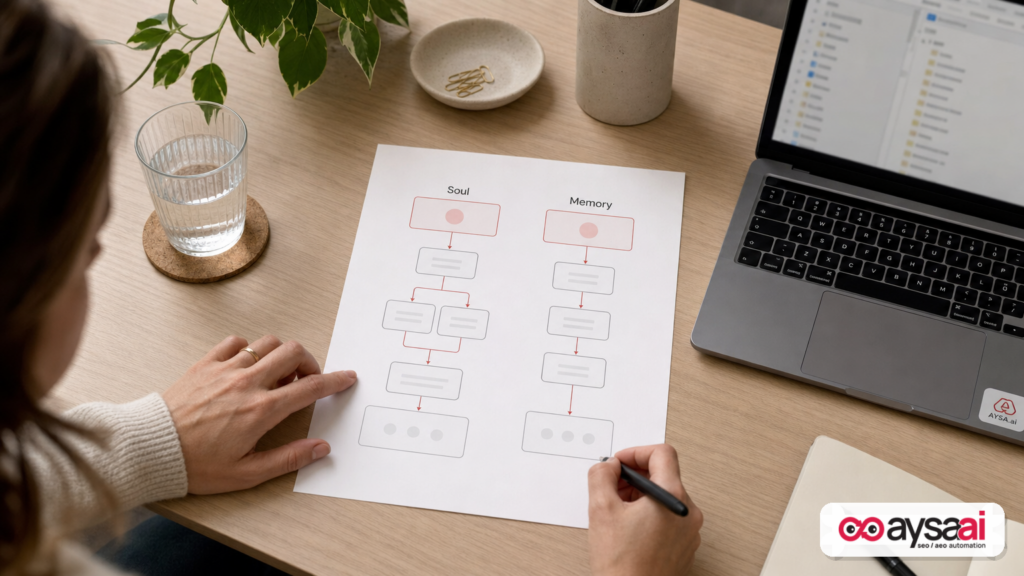
- Separate identity from history. Keep stable guidance (“soul”) apart from dynamic learnings (“memory”).
- Governance matters. A stale brain can be worse than no brain because AI will be confidently wrong.
- Execution is the bottleneck. The payoff comes when AI can move from recommendations to approved changes that actually ship—tracked and monitored.
Key takeaways (for busy owners and operators)
- Most SEO delays are not “lack of ideas.” They’re lack of shared context and safe execution.
- Don’t make AI guess. Give it the handful of truths and constraints that shape decisions.
- Document decisions with “why,” not just “what.” The reason is what stays valid when the situation changes.
- Keep sensitive data out of the brain. Store lessons and constraints, not raw exports, credentials, or private documents.
- Build a workflow that ships. Monitoring → prepare changes → approval → execute → measure. This is where ROI appears.
Table of contents

- The context tax: why AI makes SEO feel faster—but not easier
- What changed in search (and why context is now the moat)
- What a “client brain” is (and what it is not)
- Soul vs. memory: the split that keeps AI grounded
- Anatomy of a client brain: the files that prevent AI from freelancing
- The memory layer: decisions, patterns, logs (and how to keep them useful)
- How AI should read the brain: load-all vs. task-based vs. retrieval
- What goes wrong: stale brains, context pollution, and compliance landmines
- A concrete SME scenario: local clinic SEO with real constraints
- Agency workflow: reducing drift across strategists, writers, analysts, and tech SEO
- How to build a client brain in 90 minutes (then maintain it)
- Where AYSA fits: from “client brain” to approved execution at scale
- What to do next (action list)
- Sources and further reading
The context tax: why AI makes SEO feel faster—but not easier
Every team that tries to operationalize AI in SEO hits the same wall: the first few outputs feel magical, then you realize you’re spending more time correcting, re-briefing, and re-aligning than you saved.
That happens because SEO isn’t just a set of tasks. It’s a chain of decisions made inside constraints:
- Brand constraints: voice, positioning, claims you can’t make, competitors you won’t mention.
- Strategic constraints: which keyword themes matter, which ones are distractions, what “good traffic” means.
- Operational constraints: CMS limitations, dev backlog, template restrictions, legal review, product availability.
- Historical constraints: experiments that failed, angles that got rejected, content formats that did or didn’t convert.
Humans onboard to these constraints through conversations and repetition. AI does not. Unless you provide structured context, the model behaves like it’s “day one on the account” every time it helps.
Search Engine Land described this as a hidden cost of AI adoption in agencies and proposed a “client brain” as a per-client memory system that keeps AI grounded in brand guidance, campaign history, and technical limitations. That framing is worth reading in full: How a ‘client brain’ gives AI the context SEO work needs.
My take: the context tax is real, and it’s bigger than most teams think. But context alone doesn’t create growth. Execution does.
What changed in search (and why context is now the moat)
SEO used to be (mostly) about publishing the right pages, earning authority, and iterating based on rankings and Clicks. Those fundamentals still matter. But the environment around them has changed:
- Search behavior is fragmenting. Customers don’t only “Google then click.” They ask AI tools, compare in marketplaces, consult social, and bounce between channels.
- AI answers and agentic experiences reduce Attribution. Even when your content influences a decision, you may not get a clean click trail.
- More work is delegated. People increasingly outsource research and decision-making to AI systems, which elevates the importance of consistent, correct, brand-aligned information across the web and your site.
Search Engine Land has been covering adjacent shifts that point to the same operational reality: visibility measurement is changing, schema and Structured data matter in new ways, and teams need better systems—not just better tactics. Relevant related reading from the same publication includes:
- 4 ways to track AI search visibility when attribution falls short
- How to use schema markup to optimize for the agentic web
- Delegation search: Why users outsource decisions to AI
As visibility becomes harder to measure and decisions become more automated, teams default to “produce more.” More pages, more briefs, more audits, more analyses. AI makes that easy.
But “more” is not the same as “better.” The moat becomes correctness under constraints: can you ship the right changes, consistently, without breaking the brand, wasting dev cycles, or repeating mistakes?
That’s why structured client memory is not an agency luxury. It’s now an operating requirement.
What a “client brain” is (and what it is not)
A client brain is a structured, per-client knowledge base that AI reads before it starts work. It’s not a 60-slide brand deck. It’s not a folder of random exports. And it’s not a dumping ground for sensitive documents.
Think of it as a minimal set of truths and constraints that prevents AI from freelancing.
What it is:
- Small: written for utility, not for internal impressiveness.
- Structured: consistent file names, predictable sections, easy for humans and machines.
- Action-oriented: includes what to do, what not to do, and why.
What it is not:
- A data lake: don’t store raw exports, credentials, or private docs.
- A static “set and forget” artifact: if it isn’t maintained, it becomes dangerous.
- A replacement for strategy: it’s infrastructure that helps strategy travel through workflows.
If you’re an SME, this can live as a simple set of docs. If you’re an agency, it becomes the shared memory that reduces drift across roles and deliverables.
Soul vs. memory: the split that keeps AI grounded
The most important design decision in the client brain concept is the split between:
- Soul: stable identity-level knowledge (brand, voice, audience, positioning, keyword framing, non-negotiables).
- Memory: dynamic experience-level knowledge (decisions, experiments, failures, objections, blockers, implementation lessons).
This matters because SEO work compounds over time. If you put everything into one doc, two bad things happen:
- Signal gets buried: the stable brand guidance gets lost under meeting notes.
- Old decisions masquerade as current strategy: AI cannot reliably tell what is “historical” vs. “still true.”
Separating soul and memory makes both usable. The soul becomes a stable pre-read. The memory becomes a searchable log of “what we learned” and “why we decided that.”
Anatomy of a client brain: the files that prevent AI from freelancing
The Search Engine Land piece suggested a pragmatic implementation: a folder of plain-text Markdown files—no custom database, no special interface required. That simplicity is the point. You want something that survives tool changes and is easy to update.
Here’s a practical version of the “soul” layer for most SMEs and agencies:
1) Company profile (operating truth)
This is not marketing copy. It’s the honest “operating version” of the business:
- What you really sell (and what you don’t)
- Who you serve (and who you don’t)
- How you win (differentiators that can be supported)
- Where you compete (and where you’re not trying to play)
Why it matters: AI can generate plausible positioning that is strategically wrong. This file prevents it.
2) Style guide (concrete, with examples)
Most style guides fail because they’re vague: “warm but professional.” AI needs constraints and examples:
- Tone rules (short sentences? direct? playful? formal?)
- Vocabulary preferences (terms you use vs. avoid)
- Claims policy (what you can say without proof or legal review)
- 2–3 “good” paragraphs and 2–3 “bad” paragraphs
Why it matters: brand voice isn’t aesthetic; it’s trust. In AI search, trust signals increasingly come from consistency across surfaces.
3) Audience (worries, objections, language)
Demographics don’t create great SEO content. People do.
Capture:
- What your customer is afraid of getting wrong
- What they misunderstand
- What makes them trust an answer
- The phrases they actually use (and the phrases they hate)
Why it matters: AI can write “helpful” content that doesn’t match buyer reality. This file anchors it.
4) Keyword map (strategy, not a spreadsheet)
You don’t need to paste a 500-row export. You need to capture the category framing:
- Primary terms you aim to own
- Secondary terms you want to grow into
- Competitor-owned terms you approach carefully
- Terms you avoid (low-quality leads, wrong geography, wrong intent)
Why it matters: SEO is as much about saying “no” as it is about targeting opportunities.
5) Never-do list (the highest ROI file)
This is the list that stops teams from repeating conversations. Include:
- Brand-level no’s: claims you won’t make, positioning you reject
- Operational no’s: tactics that require legal, dev, or approvals you don’t have
- Strategic no’s: markets you don’t serve, product categories you don’t want
Why it matters: AI is very good at resurrecting dead ideas. This file turns “we already decided no” into reusable context.
The memory layer: decisions, patterns, logs (and how to keep them useful)
Once the soul is written, the memory layer is how you keep compounding learning instead of losing it in Slack, email, or meeting recordings.
A simple structure works well:
- Decisions: what you decided and why
- Patterns: repeatable learnings by task type (audits, briefs, link building, reporting)
- Logs: chronological notes and meeting summaries
Write decisions with “why” (this is non-negotiable)
If you only record the outcome (“don’t target X”), AI will treat it as permanent truth. But strategies change. Markets change. Product availability changes. The reason is what stays valid longer than the choice.
In practice, each decision entry should include:
- Date
- Decision
- Reason
- Source (ticket, meeting note, email thread)
- Tags (optional): task type, channel, page type, geo
Patterns are how teams stop re-learning the same lesson
Patterns are especially useful for operational SEO tasks, where you repeat similar work every month:
- What breaks when you run technical audits
- Which content formats convert for this audience
- Where internal approvals slow down publishing
- Which schema types you can safely deploy with your CMS
These are not “SEO tips.” They’re account-specific operating knowledge.
Logs are a safety net (not a reading assignment)
Most log entries won’t be read again—and that’s okay. Logs are there so that when something breaks or a stakeholder asks “why did we stop doing that,” you have a trail.
One important caution from the original client brain framing: don’t store raw sensitive data in the brain. Store the lesson, not the export. Store the constraint, not the credential.
How AI should read the brain: load-all vs. task-based vs. retrieval
Once you have a client brain, the operational question becomes: how much should the AI read before doing a task?
There’s no single answer, but there are three common patterns:
Option A: Load everything
AI reads the entire brain (soul + memory) for every task. This is simple and often works early on, when the brain is small. As memory grows, it can become inefficient or muddy.
Best for: new accounts, small brains, low-risk tasks.
Option B: Task-based pre-reads
AI reads the soul plus only the relevant memory sections based on the task type:
- For a content brief: style-guide, audience, keyword-map, relevant content decisions
- For a technical audit: company profile constraints, tech decisions, patterns from previous audits
- For reporting: goals, KPI definitions, what leadership actually cares about
Best for: growing accounts, multiple roles, higher output volume.
Option C: Retrieval-based (RAG-style) selection
This is where a system retrieves only the most relevant brain chunks for the task. It can be powerful, but it’s also where teams start overengineering. If you’re not careful, you build a complex pipeline that’s harder to maintain than the problem it solves.
Best for: large agencies, many clients, long memory histories, mature operations.
My bias: start with task-based pre-reads. It yields most of the benefit without the complexity tax.
What goes wrong: stale brains, context pollution, and compliance landmines
A client brain isn’t automatically “good.” It’s a system, and systems fail in predictable ways. Here are the biggest risks—and how to avoid them.
Failure mode #1: The stale brain
If the brain reflects last quarter’s strategy, AI will produce last quarter’s work—confidently.
Fix: a lightweight maintenance routine:
- Biweekly cleanup for memory duplicates and contradictions
- Quarterly soul review: “Is anything here no longer true?”
Failure mode #2: Context pollution
When every comment becomes “truth,” the soul gets polluted. AI then treats a passing preference as a permanent rule.
Fix: increase friction for soul changes. The account lead (or business owner) should own it.
Failure mode #3: Sensitive data leakage
If you dump transcripts, exports, or private documents into the brain, you create security and compliance risks—and you make the brain harder to use.
Fix: store constraints and learnings, not raw artifacts. Keep private docs in a secure repository with proper access controls.
Failure mode #4: “Looks right” output
AI can produce output that reads like expert work while being strategically wrong. A client brain reduces this risk, but it doesn’t eliminate it.
Fix: pair the brain with an approval workflow and measurable checkpoints: did we ship the change, did it index, did it improve the metric we care about?
A concrete SME scenario: local clinic SEO with real constraints
Let’s make this tangible with a realistic example: a local dental clinic with two locations.
The clinic’s reality:
- They offer premium services and don’t accept certain insurance plans.
- They have strict compliance constraints about claims and outcomes.
- Their website is on a CMS with limited template flexibility.
- They’ve tried “near me” content and got low-quality leads.
- The owner insists on a calm, non-salesy tone.
What happens without a client brain:
- AI drafts service pages that use aggressive sales language.
- AI recommends targeting high-volume “near me” keywords that attract the wrong audience.
- AI proposes technical fixes the CMS cannot support (or dev won’t implement).
- Each new freelancer, writer, or team member repeats the same mistakes.
What happens with a client brain:
- The style guide anchors tone and prohibited claims.
- The keyword map and never-do list prevent low-quality intent targeting.
- The memory decisions explain why certain keywords were rejected (so AI can propose better adjacent terms).
- The technical constraints reduce unshippable recommendations.
Result: fewer rewrites, fewer internal debates, and a faster path from idea → page → measurement.
Agency workflow: reducing drift across strategists, writers, analysts, and tech SEO
Agencies feel the context tax the hardest because SEO work is rarely owned end-to-end by one person. A typical chain looks like:
- Strategist defines direction
- Content lead builds briefs
- Writer drafts
- Editor adjusts to voice
- Analyst reports outcomes
- Technical SEO reviews implementation feasibility
If context lives in heads, every handoff introduces drift. Drift shows up as:
- Content that doesn’t match strategy
- Technical recommendations that ignore known blockers
- Reporting that highlights the wrong KPIs
- Re-litigation of decisions made months ago
A client brain doesn’t eliminate collaboration. It makes collaboration consistent. It’s the difference between “we have smart people” and “we have a system that stays smart across time.”
How to build a client brain in 90 minutes (then maintain it)
You don’t roll this out to every client on day one. Start where context loss is already costing you time or money.
Step 1: Pick the right starting account
Choose a client/business with:
- Strong brand voice or compliance constraints
- Multiple people touching the work
- A history of rejected ideas or “never again” lessons
Step 2: Block 90 minutes and write the soul together
Get the account lead plus one other key contributor (strategist or owner). Write the five soul docs in plain sentences. Include examples. Don’t aim for perfection—aim for utility.
Step 3: Decide where it lives (one brain, one source of truth)
The storage tool matters less than the rule. Options include:
- Shared drive/workspace
- Notion (if you can keep structure consistent)
- Version control (for technical teams)
What matters is that everyone trusts the same place.
Step 4: Set ownership rules
- Soul: high friction, owned by account lead/owner.
- Memory: low friction, anyone can add entries—with a source and reason.
Step 5: Schedule maintenance
Two lightweight habits keep it healthy:
- Biweekly: clean duplicates, consolidate notes, resolve conflicts.
- Quarterly: soul review and reality check.
Where AYSA fits: from “client brain” to approved execution at scale
A client brain improves the quality of thinking and drafting. But most businesses don’t struggle with having drafts. They struggle with shipping.
That’s the gap AYSA is built to close.
AYSA operates as an approved SEO/AEO/GEO execution system: it monitors, prepares, requests approval, and executes accepted website changes—so improvements don’t die in docs, tickets, or “someday” backlogs.
Here’s how the pieces connect:
- Monitoring: detect changes, issues, and opportunities early. Start here: AYSA Monitoring.
- AI search visibility focus: understand whether AI experiences recommend or reference your brand, beyond clicks. Learn more: AI Search Visibility.
- Tools and workflow support: use AI SEO capabilities without losing control of brand and constraints: AYSA AI SEO Tools.
- Approved execution: changes aren’t “auto-published” in the dark. They’re prepared, presented, and shipped after approval—reducing risk while increasing throughput.
- Operational clarity: align stakeholders on cost and scope: Pricing.
And if you want more on how we think about AI search, execution, and operations, our ongoing editorial work lives here: AYSA Blog.
Why execution is now strategic (not “just operations”)
In AI-influenced search environments, the advantage goes to teams that can:
- Respond faster to what’s changing (content expectations, technical requirements, competitive narratives)
- Keep messaging consistent across pages, templates, and entities
- Ship improvements reliably—with governance
A client brain makes AI outputs more accurate. Approved execution makes them real.
How to operationalize the client brain + AYSA workflow
If you’re adopting both ideas together, the pragmatic approach looks like this:
- Define soul constraints first. This reduces risky suggestions.
- Use memory to prevent repeats. Each rejection becomes a reusable “why.”
- Monitor continuously. Catch technical regressions and performance shifts early.
- Prepare change sets, not just recommendations. Turn “should” into “ready.”
- Approve deliberately. Keep humans accountable for brand, legal, and business risk.
- Execute and validate. Ensure changes shipped, indexed, and are measurable.
What to do next (action list)
- Choose one account/site where context loss hurts the most. Don’t start with everything.
- Create the five soul files. Company profile, style guide, audience, keyword map, never-do.
- Write 10 memory entries from the last 60 days. Focus on decisions and “why.”
- Define ownership. One person owns soul; everyone can add memory with sources.
- Adopt task-based pre-reads. Don’t load everything by default if the brain is growing.
- Add maintenance to the calendar. Biweekly cleanup and quarterly soul review.
- Connect context to shipping. If you want SEO to drive outcomes, pair your brain with monitoring and approved execution so changes actually go live and get measured.
- Explore AYSA’s execution workflow. Start with Monitoring and AI Search Visibility, then review Pricing based on your scale.
Sources and further reading
- Search Engine Land: How a ‘client brain’ gives AI the context SEO work needs
- Search Engine Land: 4 ways to track AI search visibility when attribution falls short
- Search Engine Land: How to use schema markup to optimize for the agentic web
- Search Engine Land: Delegation search: Why users outsource decisions to AI
- Search Engine Land: AI in the wild: Confident, wrong, and weirdly expensive
Note: This editorial intentionally avoids adding unverified metrics or claims beyond the provided research context. If you want deeper citations from official documentation (e.g., Google Search Central) for specific implementation details, we recommend compiling those primary sources as part of your internal playbook.
Continue the AI search topic inside AYSA.
Use these pages to connect the article with AI SEO tools, AI visibility monitoring, AI Overviews and approved website execution.
Turn this topic into a website action plan.
Use these AYSA hubs to move from reading to technical fixes, AI visibility monitoring, research, glossary context and approval-first SEO execution.