
Cloudflare Writing Your Robots.txt Is a Wake-Up Call: AI Crawl Policy Needs Governance, Not Toggles
Cloudflare’s Bot Preference Sync aims to eliminate a dangerous gap: what your robots.txt says vs. what your edge actually enforces. But turning AI crawler policy into three category toggles—then writing those choices into a public policy file by default—forces businesses to treat robots.txt like governance, not housekeeping. Here’s how to audit the risk, choose a policy that matches your business model, and operationalize it with approved execution.

Cloudflare’s decision to automatically write Robots.txt entries based on edge settings is not just a technical convenience. It’s a forcing function: it pushes every business to treat AI crawler access as a governed policy, not a “set it and forget it” file.
That’s the right direction—because the gap between what your robots.txt says and what your infrastructure does has become a real operational and legal vulnerability. But the way Cloudflare is packaging the decision (three category toggles, applied by default for new customers) also exposes a new risk: your website can end up publicly stating a position you didn’t mean to make, can’t express precisely, and may not revisit for years.
This editorial breaks down what’s changing, why it matters for SMEs and agencies, what can go wrong, and how to implement a defensible AI crawl policy that aligns your robots.txt, your edge controls, and your business model. I’ll also show how an approved-execution system like AYSA fits into the reality of modern SEO/AEO/GEO: monitor continuously, prepare changes, get approval, and execute safely.
Concise summary

- Robots.txt is a public statement of intent; edge/WAF rules are your actual enforcement. When they contradict, you create ambiguity that some crawlers (and attorneys) can use against you.
- Cloudflare’s Bot Preference Sync (as described in the source) aims to sync those two worlds by generating robots.txt entries from Cloudflare AI bot policy settings. That reduces drift.
- The tradeoff: category-based policy (Search/Agent/Training) can’t express many real-world strategies that are per company (e.g., allow GPTBot but block Bytespider). If your business logic is granular, automation can misrepresent you.
- Default-on policy is governance debt: a setting accepted during onboarding can become a public position in robots.txt without a human ever reading the file.
- Action: Audit your robots.txt vs. edge policy, decide your “value-for-access” framework, document it, and implement it with Monitoring and change control.
Table of contents
- What changed: Cloudflare writing robots.txt from edge settings
- The real problem: your robots.txt is a public promise, your edge is the bouncer
- Why this matters now: AI search, agents, and “training” blurred the old crawler model
- Category-based policy vs. per-company policy: where it breaks
- Default settings are not neutral: they become your published position
- Robots.txt stops the bots that want to be stopped (and that’s still valuable)
- A practical policy framework: decide what you’re selling, what you’re protecting, and what you’ll trade
- Measurement challenges: citations, clicks, and the new crawl-to-visibility pipeline
- An SME scenario: an ecommerce brand with ads, affiliates, and a thin margin for mistakes
- What agencies should rethink: policy, proof, and change management
- A 10-step action plan (with decision checkpoints)
- Where AYSA fits: monitoring + approved execution for AI crawl policy
- What to do next
- Sources and further reading
What changed: Cloudflare writing robots.txt from edge settings

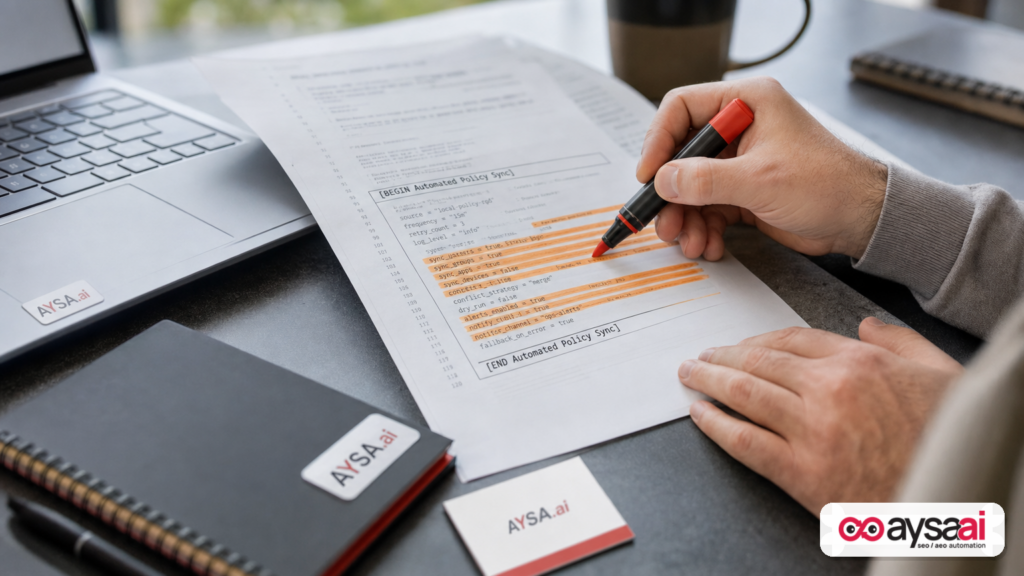
Search Engine Journal covered Cloudflare’s announcement of Bot Preference Sync, which (as described) automatically generates robots.txt directives based on AI bot policy settings inside Cloudflare and prepends them into the site’s robots.txt between markers, preserving the rest of the file underneath.
The motivation is straightforward: many sites enforce bot restrictions at the edge (WAF/CDN) but forget to update the robots.txt file. Over time, the file drifts and can end up welcoming bots the site owner would rather restrict—or vice versa. Cloudflare’s pitch is that contradictory signals can lead some crawlers to disregard preferences or attempt to bypass enforcement.
You can read the original reporting and analysis here: Search Engine Journal: “Cloudflare Will Write Your Robots.txt, And It Has A Point”.
At a high level, syncing policy and file is a net positive. The controversy isn’t about automation—it’s about how the policy is modeled (category-based rather than per-crawler) and how it’s rolled out (default-on for new customers, per the source).
The real problem: your robots.txt is a public promise, your edge is the bouncer
Most business owners treat robots.txt like plumbing: important, but not strategic. Historically, that was reasonable. Robots.txt was mostly about search engines Crawling efficiently, not about what your content could be used for in downstream AI systems.
Today, robots.txt has become more like a publicly posted policy sign on the front door of your building. Meanwhile, your edge rules—CDN firewall policies, bot management, rate limiting—are the bouncer deciding who actually gets in.
When those two disagree, you have at least four problems:
- Operational confusion: teams don’t know the real policy. Marketing thinks “we allow,” security thinks “we block,” and nobody has a single source of truth.
- Compliance and reputation risk: you may publicly state that training is disallowed while still permitting certain crawlers—or the opposite.
- Dispute risk: in any conflict over access or usage, inconsistency weakens your position. (I’m not offering legal advice—just a practical reality: inconsistencies get exploited.)
- Measurement noise: if AI crawlers are partially blocked, your attempts to measure AI visibility or citations become harder to interpret.
Cloudflare’s core point—that mismatches create a problem—is valid. But syncing robots.txt to edge settings only helps if the edge settings truly reflect your desired policy.
Why this matters now: AI search, agents, and “training” blurred the old crawler model
The classic mental model was simple:
- Search engines crawl to index and rank pages.
- Robots.txt helps them crawl responsibly.
- If you block crawling, you accept reduced visibility.
AI changed that model in three ways:
1) Discovery and answers are decoupled from traditional search clicks
Businesses now care about being cited or recommended by AI assistants—not only ranking on page one. That’s why AEO (Answer Engine Optimization) and GEO (Generative Engine Optimization) entered the conversation. Whether your content can be accessed by certain systems becomes part of growth strategy, not just “technical SEO.”
AYSA’s take: the question is no longer “Will Google index me?” It’s also “Where will customers discover me next?” Start here if you’re building a visibility strategy across AI surfaces: AI Search Visibility.
2) The same company may crawl for multiple purposes
Some systems crawl content for search-like retrieval and also for training or fine-tuning models. That creates policy complexity: you may want to be discoverable but not trainable—or you may accept training as the price of distribution.
The source article describes Cloudflare’s policy interface as three broad categories (Search, Agent, Training) with limited options, which can’t always represent a company-by-company business decision.
3) “Agents” introduce new crawl patterns that look like abuse
Agentic browsing can produce bursts of requests, deep fetches, and non-traditional navigation paths. Some of that is legitimate (e.g., summarization, price comparisons, research). Some of it is scraping or credential hunting. Your site needs a policy stance and a technical posture that can separate “useful automated access” from “harmful automated access.”
Robots.txt is only part of that posture, but it’s the part the world can read.
Category-based policy vs. per-company policy: where it breaks
Cloudflare’s approach (as described in the SEJ piece) is category-based: you decide what to do with broad groups of AI bot behavior. The underlying bot list decides which user agents fall into each category.
That’s convenient for two kinds of organizations:
- Organizations with a single principle: “Allow everything,” or “Block training,” or “Block everything.”
- Organizations that don’t want to own the decision and are willing to accept a vendor’s classification system.
But many businesses now operate on per-company economics, not per-category ideology. A practical example—mirroring the kind of situation discussed in the source analysis—looks like this:
- Allow certain crawlers because they drive meaningful discovery (citations, referrals, brand impressions that turn into demand).
- Block others because they take content, don’t send anything back, and increase scraping risk.
That’s not a moral stance. It’s a supplier relationship stance. You’re deciding who gets access to your “inventory” (content, product data, pricing, FAQs, expertise) and what you get in return.
When your policy is per-company, a three-toggle interface can force you into one of three bad outcomes:
- Over-blocking: you block beneficial crawlers because they’re lumped into a category you want to restrict.
- Under-blocking: you allow crawlers you’d rather restrict because they’re categorized alongside a bot you want to allow.
- Public misstatement: your robots.txt says something broad that isn’t what you enforce, reviving the mismatch problem that sync was supposed to solve.
The key governance question is simple: Can the vendor’s policy model express your real intent? If not, syncing a mis-modeled policy into robots.txt automates the wrong thing.
Default settings are not neutral: they become your published position
Defaults matter because most websites—especially SME sites—run on autopilot. Not because owners don’t care, but because they’re busy. Robots.txt is rarely revisited once the site is live unless something breaks.
According to the source reporting, Cloudflare planned default behaviors for new domains that could block certain categories (and tie a monetization question to a training stance). That means a business can “agree” to a position without understanding that it becomes a public statement in robots.txt.
Here’s how that plays out in real life:
- A founder sets up Cloudflare for performance and security.
- They answer a question about ads/monetization during onboarding.
- Months later, someone notices AI traffic is missing—or notices their robots.txt asserts a policy they never consciously adopted.
This is not a Cloudflare-only issue. It’s a modern SaaS pattern: “default-on convenience” increases adoption and reduces support. But when defaults alter public-facing policy, you need governance around it.
My position: if a setting creates a public statement, it should be treated like publishing. Publishing requires review, ownership, and a change log.
Robots.txt stops the bots that want to be stopped (and that’s still valuable)
We need to keep one thing clear: robots.txt is not a security system. It is a standard that compliant crawlers follow.
The source text makes this point bluntly: malicious actors hunting for secrets (credentials, env files, keys) aren’t going to respect a politely written rule in robots.txt. For those threats, edge enforcement, authentication, proper secret management, and application security matter far more than directives.
So why does robots.txt matter at all?
- It reduces load by discouraging compliant bots from hammering your site.
- It communicates intent to reputable companies and to the broader ecosystem.
- It creates consistency when aligned with server-side enforcement.
- It’s a governance artifact: a single, inspectable file that expresses policy.
Done right, robots.txt becomes a stable interface between your business policy and the automation that interacts with your site.
A practical policy framework: decide what you’re selling, what you’re protecting, and what you’ll trade
Most businesses approach AI crawler rules backwards. They start with “Which bots are good or bad?” That’s a never-ending list management problem.
Start instead with three business questions:
1) What asset is being accessed?
- Public educational content (blogs, guides)
- Product catalog data (SKUs, pricing, availability)
- User-generated content (reviews, Q&A)
- Premium content (courses, gated materials)
- Brand content (policies, terms, clinic services)
Different assets justify different access rules. A clinic’s service pages might be open for discovery; their patient portal should never be crawled; their blog might be open but rate-limited.
2) What value do you receive in return?
Value can be:
- Traffic (clicks, referrals)
- Citations/mentions that drive branded search or direct demand
- Commercial partnership (licensing, syndication)
- Visibility reporting (proof of how content is used)
- Control (opt-outs that don’t destroy traditional search presence)
Notice how this aligns with the disclosure expectations referenced in the source: transparency, opt-outs, URL-level visibility, and reassurance that choices won’t punish traditional search performance.
3) What risk/cost does access create?
- Content duplication and competitive scraping
- Infrastructure load and performance hits
- Loss of differentiation (your unique info becomes generic training data)
- Legal/compliance ambiguity (especially in regulated spaces)
- Revenue leakage (ads/affiliate content being summarized without clicks)
Once you map assets, value, and risk, you can adopt a simple policy stance:
- Open (allow and monitor)
- Selective (allow some companies, block others, different rules by section)
- Closed to training (if you can do so without harming essential discovery)
- Closed (only allow major search engines or none, plus strict edge enforcement)
Then the technical question becomes: can Cloudflare’s category toggles express this? If yes, sync helps. If no, automation should be disabled and replaced with a controlled, documented robots.txt plus edge rules.
Measurement challenges: citations, clicks, and the new crawl-to-visibility pipeline
Even if you pick the right policy, you still need to know whether it’s working.
Historically, SEO measurement lived in two places:
- Rankings
- Search Console impressions/clicks + analytics sessions
AI search expands the measurement surface area:
- Mentions/citations in assistants (which may or may not produce clicks)
- “Agent” traffic that behaves like automated browsing
- Search vs. training ambiguity (the same crawler may do multiple things)
So when you change robots policy, you should track at least:
- Requests by user agent (volume, paths, frequency)
- Response codes for bots (200/301/403/429)
- Crawl concentration (which sections get hit)
- Performance impact (latency, origin load)
- Downstream outcomes (brand demand, referral changes, citations where measurable)
This is exactly the kind of multi-source monitoring problem that SMEs struggle to operationalize. It’s also where an execution platform matters more than another dashboard screenshot.
If you’re building an AI visibility program, start with the tooling and workflow layer, not just recommendations: AI SEO Tools and AYSA Monitoring.
An SME scenario: an ecommerce brand with ads, affiliates, and a thin margin for mistakes
Let’s make this concrete with a realistic SME: an ecommerce brand selling specialty home fitness equipment.
Business reality:
- They run shopping ads and SEO for demand capture.
- They publish buying guides and comparisons that earn affiliate revenue and email signups.
- They can’t afford traffic loss because margins are tight.
- They also can’t afford uncontrolled scraping because competitors copy pricing and content.
What goes wrong with default, category-based toggles:
- The business answers an onboarding question about monetizing pages with ads.
- A default “block training on ad pages” stance is enabled.
- Robots.txt is updated automatically to reflect that stance.
- But their actual business policy is more nuanced: they want to allow certain discovery bots because those citations create upper-funnel demand, even if the pages have monetization elements.
What they should do instead:
- Decide which sections of the site are “inventory”: guides, product pages, reviews.
- Decide which automated access creates value: discovery/citations vs. pure extraction.
- Implement a section-based policy: allow discovery for guides, stricter rules for price/availability endpoints, and aggressive blocking for suspicious user agents.
- Ensure robots.txt matches edge enforcement (or clearly documents differences).
- Monitor bot traffic and update policy quarterly.
Notice the outcome: the brand isn’t trying to win an ideological fight about “AI training.” They’re trying to protect their economics while still getting discovered.
What agencies should rethink: policy, proof, and change management
Agencies and consultants have a new deliverable: AI crawler policy governance.
In the old world, robots.txt updates were occasional technical tasks. In the new world, they sit at the intersection of:
- Business development (where do leads come from?)
- Brand strategy (do we want AI assistants to cite us?)
- Content strategy (what’s our proprietary advantage?)
- Security operations (scraping and abuse prevention)
- Technical SEO (indexing, crawl budget, discoverability)
That means agencies need to evolve their process in three ways:
1) Treat bots like partners, not just traffic
If a crawler takes content and returns value (citations, clicks, reporting), you can make an informed choice. If it takes and returns nothing, you can block with confidence. But that requires an agency to define “value returned” in terms a client can agree to.
2) Demand verifiable controls and transparency
The source analysis points to a vendor attaching blocking behavior to disclosure conditions. Whether you agree with those specific conditions or not, the concept is sound: businesses need proof that an opt-out does what it claims and doesn’t punish unrelated visibility.
If an AI ecosystem can’t provide clear opt-outs and clear reporting, agencies should consider a conservative stance and revisit later as the market matures.
3) Build a change management workflow
Robots.txt cannot be a one-off deliverable. It needs:
- Ownership (who decides policy?)
- Review cadence (quarterly, at minimum)
- Change control (approval before publishing)
- Monitoring (alerts when behavior deviates)
This is where “approved execution” becomes more than a slogan. It’s the difference between policy and reality.
A 10-step action plan (with decision checkpoints)
If you’re running a business site on Cloudflare (or any CDN/WAF), here’s a practical, non-theoretical plan.
Step 1: Read your current robots.txt like a contract
Open it. Print it if you have to. Pretend a partner, regulator, or competitor will read it. Because they can.
Step 2: Inventory your enforcement layers
- CDN/WAF bot rules
- Firewall rules (403/429)
- Rate limiting
- Application-level checks
Step 3: Compare “what you say” vs. “what you do”
This is the mismatch Cloudflare is trying to solve. Identify every place where:
- robots.txt allows but edge blocks
- robots.txt blocks but edge allows
Step 4: Decide whether your policy is category-based or per-company
Decision checkpoint:
- If you can honestly say “the same rule applies to everyone in category X,” category toggles may be fine.
- If you make value judgments per company, you need manual control and a policy document.
Step 5: Create a one-page AI crawl policy
It doesn’t need to be legalese. It needs to be readable by:
- Owner/founder
- Marketing
- IT/security
- Your agency
Include:
- Goals (discovery, citations, traffic, protection)
- Allowed classes (search indexing, assistant discovery, training)
- Blocked classes (unknown/opaque, high-frequency scrapers)
- Escalation rules (when to block, when to review)
Step 6: If using sync, verify what it writes
If an automated system writes robots.txt, you must treat it like a deployment. Check the generated block and confirm it matches your policy.
Step 7: Implement section-based controls where needed
Many SMEs don’t need bot-by-bot micromanagement, but they do benefit from section-based thinking:
- Allow guides/blog content broadly (with monitoring)
- Restrict internal search results and faceted navigation
- Protect endpoints that expose pricing/availability at scale
- Block crawling of non-public areas (logins, carts, portals)
Step 8: Add monitoring and alerting
At minimum, you need alerts for:
- New high-volume user agents
- 403/429 spikes
- Unexpected crawling of sensitive paths
AYSA’s monitoring layer is designed for exactly this kind of operational SEO reality: AYSA Monitoring.
Step 9: Build a review cadence
Set a quarterly calendar reminder: “Review AI crawler policy.” Make it part of your technical SEO hygiene.
Step 10: Document and log changes
If you ever need to explain why you allowed or blocked a crawler, “we clicked a default toggle in 2026” is not a great answer. Keep a short change log: date, reason, expected impact, and who approved it.
Where AYSA fits: monitoring + approved execution for AI crawl policy
Most teams don’t fail because they can’t write a robots.txt file. They fail because they can’t operate robots.txt as a living policy artifact.
AYSA is built for that operating reality: it monitors, prepares changes, asks for approval, and executes accepted website updates—so your intent doesn’t drift from your implementation.
Here’s what that looks like in practice:
1) Continuous monitoring, not quarterly panic
Instead of waiting until traffic drops or a security issue appears, you monitor bot behavior and policy drift as an ongoing system. Start with: AYSA Monitoring.
2) Prepare policy-aligned changes
When monitoring detects a mismatch (robots.txt allows a bot the edge blocks, or a new bot appears), AYSA can prepare a proposed change set aligned to your documented policy—without immediately publishing it.
3) Human approval before publishing
Public policy changes should be approved. That includes robots.txt updates, meta directives, indexation rules, and content changes that affect AI visibility. This is the “approved execution” model in action: speed without recklessness.
4) Execute cleanly and consistently
Once approved, changes get executed so the site’s public statements and enforcement posture stay aligned. That’s how you prevent drift—even when vendors, defaults, and dashboards change underneath you.
If you want to understand how AYSA approaches AI search visibility end-to-end, read: AI Search Visibility.
If you’re evaluating tooling cost vs. operational benefit, see: AYSA Pricing.
And if you want more editorials and practical playbooks like this, browse: AYSA Blog.
What to do next
- Today: Open your robots.txt and your edge bot settings side by side. Identify mismatches.
- This week: Decide whether your policy is category-based (simple toggles) or per-company (manual governance).
- This month: Write a one-page AI crawl policy and assign an owner.
- Ongoing: Monitor bot behavior and set a quarterly review cadence.
- If you want operational help: Implement monitoring and approved execution so changes don’t drift. Start here: AYSA Monitoring.
Sources and further reading
- Search Engine Journal — Cloudflare Will Write Your Robots.txt, And It Has A Point (primary source for this editorial’s trigger and described product behavior)
- Search Engine Journal — AI Search category (ongoing context and industry reporting)
- Search Engine Journal — Technical SEO category (additional technical implementation context)
Notes on sourcing: The SEJ article references Cloudflare’s product announcement and describes policy categories and disclosure expectations. This editorial does not claim direct verification of Cloudflare UI behavior beyond what is stated in the provided source context. If you need a formal, current specification, consult Cloudflare’s official documentation and changelogs directly.
Continue the AI search topic inside AYSA.
Use these pages to connect the article with AI SEO tools, AI visibility monitoring, AI Overviews and approved website execution.
Turn this topic into a website action plan.
Use these AYSA hubs to move from reading to technical fixes, AI visibility monitoring, research, glossary context and approval-first SEO execution.

