
Competency Questions: The Missing Step in AI Search Visibility (and the Only One That Makes Tracking Meaningful)
Prompt tracking without defined requirements is measurement theater. Competency questions—an older knowledge-engineering method—turn AI visibility into a testable plan: which buyer questions matter, what “correct” means, who owns the truth, and how to operationalize fixes with approved execution.

AI Search visibility has created a new industry reflex: track prompts, score answers, report deltas. The reporting looks scientific—lots of runs, lots of charts, weekly cadence. But most teams are still skipping the one step that makes measurement meaningful: defining what questions should be in the set and what a correct answer actually is.
That “missing step” isn’t new. It was formalized in the mid‑1990s by knowledge engineering as competency questions: a method for stating requirements first (the questions your knowledge model must answer), then using those questions as acceptance tests. Duane Forrester recently brought this concept back into the AI visibility conversation, and it’s the most practical upgrade prompt tracking has needed. You can read the original inspiration here on Search Engine Journal: The Missing Step In Prompt Tracking Was Written Down In 1995.
My take: prompt tracking is not the strategy. It’s the instrumentation. Without a measurement plan, you’re just instrumenting noise—and automating the wrong work. Competency questions turn AI visibility from a “score” into a business system: prioritized buyer scenarios, requirements with owners, negative tests for what must never be said, and a closed loop from Monitoring to Approved Execution.
Concise summary
- Prompt lists are not requirements. They’re test cases. If you can’t explain why a prompt exists and what “correct” means, your score is precise but meaningless.
- Competency questions create a measurement plan. Start from real buyer scenarios, then define questions the AI ecosystem must answer correctly about your business.
- You need expected answers + owners. Someone must be accountable for what is true (and what is not true) about your products, services, policies, and constraints.
- Test your site before you test the model. If your own content can’t answer the question clearly, model results tell you very little.
- Execution is the advantage. Monitoring is only valuable if it reliably produces approved, implemented improvements—where AYSA.ai fits.
Table of contents
- What changed: from “ranking” to “answers” (and why it breaks old tracking)
- Why prompt tracking feels precise—but still fails the business
- Competency questions, explained like you’re running a business (not a lab)
- Requirements vs. prompts: the shift that fixes your measurement
- The two-layer test: verify your content first, then test AI engines
- The overlooked requirement: “must-not-say” negative tests
- Who owns truth? Why expected-answer ownership is non-negotiable
- A concrete SME example: a local clinic trying to be “recommended” safely
- What agencies should rethink: deliverables, accountability, and reporting ethics
- What to measure (instead of vibes): practical KPIs tied to competency questions
- A practical workflow you can implement in 30 days
- Where AYSA fits: monitoring → recommendations → approval → execution
- What to do next
- Sources and further reading
What changed: from “ranking” to “answers” (and why it breaks old tracking)
Traditional SEO measurement assumed a relatively stable chain:
- You publish pages.
- Search engines crawl, index, and rank those pages.
- Users click results.
- Analytics attributes sessions and conversions.
AI search and AI-powered assistants disrupt that chain. Users increasingly want a synthesized answer—often without clicking. Whether you call it AI Overviews, AI Mode, Conversational search, or simply “asking ChatGPT,” the shared behavior is: the engine becomes a summarizer and recommender, not just a directory.
That changes measurement in two important ways:
- Visibility is answer-level, not URL-level. You’re measuring whether the system mentions you, describes you correctly, and recommends you in the right scenarios.
- Correctness is now part of the KPI. In classic SEO, “ranking #1” was the win. In AI search, “being mentioned incorrectly” can be worse than not being mentioned.
This is why prompt tracking emerged: it tries to observe how AI engines talk about you in the wild. That’s directionally correct. The execution has been the problem.
Why prompt tracking feels precise—but still fails the business

Most prompt tracking programs fail in a predictable, human way: teams measure what’s easy to measure, not what’s necessary to measure.
Here’s what “easy” looks like:
- Generate hundreds of prompts from Keyword lists.
- Run them on a schedule.
- Score whether the brand is present, absent, or positive.
- Publish a single “AI visibility” number.
And here’s what’s missing:
- Why those prompts represent real buyer situations.
- What “correct” means for each query.
- Who is accountable for stating and maintaining the correct answer.
- What actions will be taken when answers are wrong.
Duane Forrester’s SEJ piece calls out the core gap: prompt tracking matured on the sampling side (how often to run, multiple phrasings, branded vs unbranded separation) but not on the scoping side (which questions belong and what the correct answer is). That’s not a tooling issue. It’s a requirements issue.
From a business perspective, this is the critical point: if you can’t explain your prompt set, you can’t defend your score. And if you can’t defend your score, you can’t justify budget, strategy, or operational changes based on it.
Competency questions, explained like you’re running a business (not a lab)
Competency questions come from knowledge engineering—the discipline behind structured knowledge models and ontologies. The premise is simple and surprisingly modern:
- Start with motivating scenarios (real situations where someone needs information).
- Write down the questions your knowledge system must answer to support those scenarios.
- Use those questions to test whether your system is “competent.”
In the original framing summarized in the SEJ article, the questions are written before building the model and then used as an acceptance test afterward. This “test-first” mentality is familiar in software development: you define expected behavior first, then build to meet it.
Translated for AI search visibility, competency questions do something prompt tracking alone cannot: they define the requirements of how the AI ecosystem should represent your business.
That matters because AI answers aren’t just “traffic.” They are brand statements. And brand statements need governance.
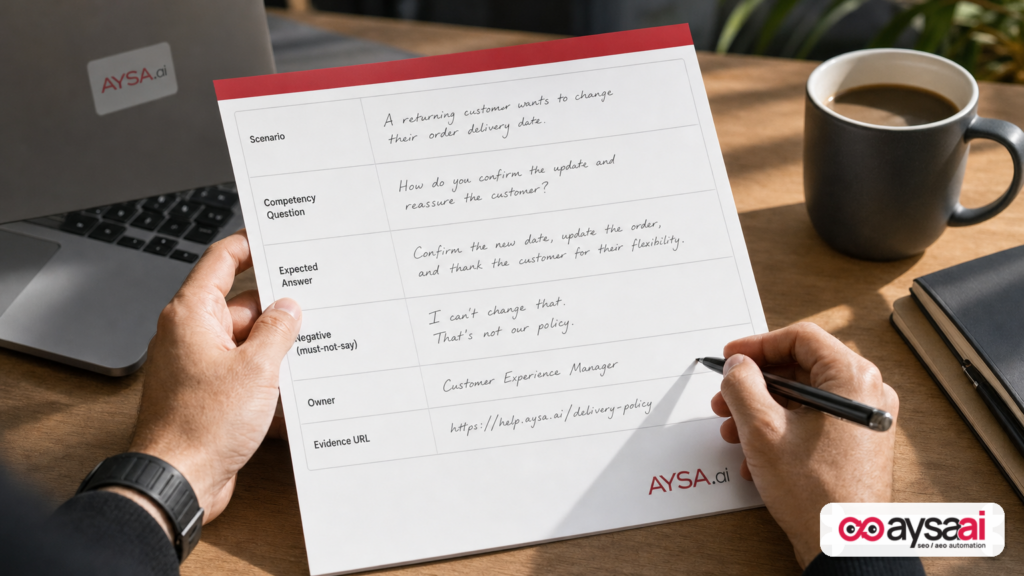
What a competency question set looks like (in business terms)
A usable set is not a list of 300 prompts. It’s a short, prioritized list of information needs, each tied to:
- Scenario: a real buying/support/compliance situation
- Competency question: what the buyer needs to know
- Expected answer: what “correct” means (finite, checkable)
- Negative constraint: what must not be claimed
- Owner: the internal person accountable for truth
- Evidence: where on your site or authoritative sources this is stated
Once you have this, you can generate multiple prompt phrasings as test cases—but the requirement stays stable.
Requirements vs. prompts: the shift that fixes your measurement
This distinction sounds subtle but changes everything:
- Competency question = requirement. It defines what must be true in representation and retrieval.
- Prompt = test case. It’s one way of asking the requirement to see if the system returns the expected outcome.
Without requirements, teams accidentally do three damaging things:
- They confuse volume with coverage. 300 prompts might represent 30 real information needs (or 10).
- They optimize for “mentions,” not correctness. That creates risk, not value.
- They freeze the wrong list. Because the list wasn’t scenario-driven, changes in product strategy, policies, or market demand don’t naturally update measurement.
Competency questions fix all three because they force you to define scope, correctness, and ownership.
The two-layer test: verify your content first, then test AI engines
One of the most practical adaptations in the SEJ article is the idea of running each competency question through two tests, in a fixed order:
- Content test (deterministic): Can a human find the expected answer clearly on a page you control (or a source you can influence)?
- AI engine test (probabilistic): Across multiple phrasings and runs, how often do the engines return the expected answer?
This order matters because it prevents a common misdiagnosis: blaming the model for not knowing something you never stated clearly.
Why your content is often the first bottleneck
SMEs routinely assume they “have that information on the site.” But in practice, the information is:
- buried in a PDF,
- split across three pages,
- explained only in sales calls,
- hidden behind a login,
- or written ambiguously to “sound good.”
If your content can’t pass the deterministic test, then prompt tracking outputs mostly reflect content gaps—not AI behavior. The fix is straightforward: make the truth easy to retrieve, quote, and summarize.
This is where structured thinking meets execution. And it’s why I keep coming back to automation: the biggest blocker isn’t insight—it’s throughput. Teams know what to fix, but they don’t ship the fixes.
AYSA.ai is built for exactly that: monitor, prepare changes, ask for approval, execute accepted website changes. You can explore the system here: AI search visibility and Monitoring.
The overlooked requirement: “must-not-say” negative tests
Most teams track for presence: “Are we mentioned?” Some track sentiment: “Is it positive?” Very few track the scariest class of errors:
Claims that are plausible, flattering, and wrong.
Forrester highlights negative questions as a missing element. This is not academic. If an AI answer suggests your business offers a service you do not offer, you create:
- support load (“Why can’t I book this?”),
- sales friction (“Your assistant said you do X…”),
- brand damage (“They misled me”),
- and in some industries, regulatory or legal exposure.
Negative tests should be explicit requirements. Examples (generic, but common):
- “Do you ship internationally?” Expected answer: “No, domestic only.”
- “Do you accept insurance X?” Expected answer: “No.”
- “Does your software support feature Y?” Expected answer: “Not currently.”
- “Are you open 24/7?” Expected answer: “No, hours are…”
These are the questions that protect a business, not just promote it.
Who owns truth? Why expected-answer ownership is non-negotiable
A competency question without an owner is a meeting note. It becomes operational only when someone is accountable for the expected answer.
Why?
- Truth changes. Pricing, policies, product capabilities, and hours evolve.
- Teams disagree. Sales says one thing, support says another, the website says a third.
- AI systems amplify ambiguity. If your own materials are inconsistent, summarizers will pick a version—often the wrong one.
The SEJ article references research arguing that AI-generated text lacks the testimonial grounding traditional documents have unless a person takes responsibility for it. Whether or not you follow that academic framing, the business conclusion is the same: you need a witness for the expected answer.
Ownership also prevents a subtle failure mode: the metric team becomes the “truth team.” They shouldn’t be. Marketing can measure; product/compliance/operations must own what’s true.
A concrete SME example: a local clinic trying to be “recommended” safely

Let’s make this real with a scenario I see constantly: a local clinic (dental, physio, dermatology—pick your category) wants to show up when people ask AI assistants things like:
- “Who’s a good clinic for X near me?”
- “Do they take my insurance?”
- “Can I get an appointment this week?”
- “Is this procedure safe?”
In classic SEO, you’d focus on local rankings, reviews, and service pages. Still important. But in AI search, the clinic also needs to ensure assistants don’t invent services, overpromise availability, or misstate policies.
Step 1: Write motivating scenarios (not prompts)
Examples:
- Scenario A (new patient): A parent needs a clinic that treats children, accepts a specific insurance, and has evening hours.
- Scenario B (urgent need): A patient has pain and wants to know whether walk-ins are accepted.
- Scenario C (procedure-specific): A patient asks about a treatment the clinic does not provide (negative requirement).
Step 2: Define competency questions + expected answers + owners
Example set (illustrative):
- CQ1 (scoping): “Which clinics near [city] offer pediatric appointments and evening hours?”
Expected outcome: Clinic is included when it qualifies.
Owner: Marketing manager. - CQ2 (validating): “Does [Clinic] accept insurance plan [X]?”
Expected answer: Yes/No with plan list reference.
Owner: Billing lead. - CQ3 (validating): “What are [Clinic]’s hours on weekdays?”
Expected answer: Exact hours.
Owner: Operations manager. - CQ4 (negative): “Does [Clinic] offer 24/7 emergency walk-ins?”
Expected answer: No; provide emergency guidance and after-hours policy.
Owner: Operations manager. - CQ5 (negative): “Does [Clinic] provide [procedure not offered]?”
Expected answer: No; provide referral guidance if appropriate.
Owner: Clinical director.
Step 3: Run the two-layer test
- Content test: Are insurance plans listed clearly? Are hours and after-hours policy on a crawlable page? Are services and non-services explicit?
- AI engine test: With multiple phrasings (3–5+), do the engines return the expected answers at a reasonable rate?
What you typically find: the clinic has “insurance accepted” mentioned on a single image, or only in a PDF, or outdated. That’s not an AI problem. That’s an execution problem.
And that’s where a system like AYSA helps: it can monitor, prepare content updates (service pages, FAQs, policy pages, schema and on-page clarity where applicable), request approval from the clinic owner, and then execute the accepted changes—without waiting three weeks for someone to “get to it.” See: AYSA AI SEO tools.
What agencies should rethink: deliverables, accountability, and reporting ethics
If you run an agency, competency questions force a healthy uncomfortable question: what are you actually selling?
Many agency deliverables in “AI visibility” are measurement deliverables:
- prompt sets,
- run frequency,
- scores,
- share-of-voice charts.
But as soon as you adopt competency questions, the deliverable becomes a hybrid of strategy and governance:
- scenario mapping,
- requirements definition,
- expected answers,
- owner assignment,
- evidence URLs,
- and an execution backlog.
That’s harder to productize—but it’s also harder to fake.
The agency risk nobody wants to say out loud
When agencies pick prompts without defensible buyer grounding, they can unintentionally manufacture outcomes:
- Pick prompts your client already wins → great score, low value.
- Pick prompts that rarely matter → stable score, low impact.
- Pick prompts biased toward branded queries → inflated visibility.
Competency questions reduce this risk because every question must map to a scenario. If you can’t explain the scenario, you probably shouldn’t measure it.
Agencies also need to rethink “who owns truth.” Your client must own expected answers. If the agency owns them, you’ve created a fragile dependency—and a liability.
What to measure (instead of vibes): practical KPIs tied to competency questions
Once you treat competency questions as your measurement plan, better KPIs fall out naturally. Here are KPI categories that SMEs and agencies can defend in a board meeting.
1) Coverage rate (scoping questions)
Definition: In scenarios where you should be included, what percent of runs include you in the answer/recommendations?
Why it matters: This is “are we in the consideration set?”—the new version of visibility.
2) Accuracy rate (validating questions)
Definition: When the engine mentions you, how often does it state the expected answer correctly?
Why it matters: Wrong details create churn, refunds, support cost, and reputation damage.
3) Safety rate (negative constraints)
Definition: How often does the engine avoid stating disallowed claims?
Why it matters: This is risk management—not marketing.
4) Evidence readiness (your content test)
Definition: For each competency question, do you have a single, canonical evidence URL that answers it plainly?
Why it matters: If you can’t point to your own truth, you’re hoping the ecosystem guesses it.
5) Fix throughput (execution KPI)
Definition: From issue detected → change drafted → approved → shipped. How long does it take?
Why it matters: The best measurement program is useless if nothing gets implemented.
AYSA’s positioning is strongest here: most teams can “monitor.” Few teams can reliably execute improvements week after week without bottlenecks. That’s the difference between reporting and growth.
A practical workflow you can implement in 30 days
This is a realistic path for an SME, in-house team, or agency. The goal is not perfection—it’s a defensible system you can iterate.
Week 1: Build your first competency question set (start with 10)
- Pick one product line or location (don’t boil the ocean).
- Write 3–5 motivating scenarios (sales, support, compliance).
- For each scenario, draft 2–4 competency questions.
- For each question, write a finite expected answer and assign an owner.
- Add at least 2 negative constraints (must-not-say) for the same scope.
Week 2: Run the content test and create canonical evidence URLs
- For each question, identify the best existing page that supports the expected answer.
- If it doesn’t exist, create or improve a page so a human can find the answer in under 30 seconds.
- Reduce ambiguity: add precise language, lists, and clear constraints.
- Create a simple internal log: question → URL → owner → last reviewed date.
This is often the highest ROI work. AI engines and assistants draw on many sources, but your own site remains the only source you can fully control.
Week 3: Convert each competency question into multiple prompt test cases
- Create 3–5 phrasings per competency question (more for high-stakes topics).
- Separate branded vs unbranded tests.
- Document test conditions: engine, date, whether web browsing/search is enabled (if applicable), and geography where relevant.
Note: I’m not prescribing exact tooling here because I’m not going to invent capabilities that weren’t provided in your research context. The key is disciplined logging so results are comparable over time.
Week 4: Turn failures into an execution backlog (and ship fixes)
- Prioritize failures by business impact: revenue, compliance, reputation, support load.
- For each failure, identify root cause: content gap, clarity issue, inconsistent claims, missing policy page, outdated information.
- Draft changes, route them for approval, and publish.
This is the loop AYSA was built to support end-to-end. Start here if you want the system view: Monitoring and AI search visibility.
Where AYSA fits: monitoring → recommendations → approval → execution
Most platforms in the AI visibility space lean heavily toward measurement and reporting. That’s useful, but it’s incomplete. The operational reality for SMEs is:
- They don’t have time to translate insights into tickets.
- They don’t have in-house technical staff to implement consistently.
- They can’t risk unreviewed changes touching pricing, compliance, or medical/legal claims.
AYSA’s model—monitors, prepares, asks for approval, executes accepted website changes—matches what competency questions demand:
- Monitoring: detect gaps against your competency question set (and the evidence readiness behind it).
- Preparation: propose updates (new FAQs, clarified service descriptions, policy pages, internal linking improvements, structured content).
- Approval: keep humans accountable for truth (owners approve what is correct).
- Execution: ship the change, so measurement improves for the right reason.
If you want to understand how AYSA approaches AI-driven SEO operations more broadly, start here: AI SEO Tools. If you’re evaluating whether it’s right for your business size and constraints, pricing is here: AYSA Pricing. More editorials and how-to resources are on the AYSA blog: AYSA Blog.
The real advantage: speed with governance
AI search changes faster than traditional SEO norms. But you still can’t let an automation layer publish “truth” unchecked. Competency questions create governance; approved execution creates speed. Together, they produce compounding returns:
- Less time arguing about “what to track.”
- Less time debating whether an AI answer is “wrong.”
- More time shipping clarity, accuracy, and buyer-relevant information.
What to do next
- Audit your current prompt set. For each prompt, write the scenario it represents. If you can’t, it’s probably not a requirement.
- Create 10 competency questions. Add expected answers, an owner, and a canonical evidence URL for each.
- Add 2 negative constraints immediately. Pick the two most damaging “wrong claims” your business could receive.
- Run the content test first. Fix clarity gaps on your site before blaming AI engines.
- Convert each requirement into 3–5 prompt variations. Now your sampling has meaning.
- Turn failures into a backlog and ship weekly. If you don’t have execution throughput, measurement becomes entertainment.
- Close the loop with approved execution. If you want AYSA to help operationalize this, start with AI Search Visibility and Monitoring.
Sources and further reading
- Search Engine Journal: The Missing Step In Prompt Tracking Was Written Down In 1995
- Search Engine Journal: AI Search category
- Search Engine Journal: SEO category
- Search Engine Journal: Technical SEO category
- Search Engine Journal: Local SEO category
Note: The SEJ source references additional academic studies and historical publications. Those primary links were not included in the provided research context for this assignment, so I have not linked to them directly here. If you want, we can add primary citations once you provide the URLs or citations to the original papers (e.g., the ICLR 2024 formatting sensitivity study and the 1995 competency question publication).
Continue the AI search topic inside AYSA.
Use these pages to connect the article with AI SEO tools, AI visibility monitoring, AI Overviews and approved website execution.
Turn this topic into a website action plan.
Use these AYSA hubs to move from reading to technical fixes, AI visibility monitoring, research, glossary context and approval-first SEO execution.