Ecommerce AI Search Isn’t Won on PDPs Alone: How to Build the “Evidence Layer” That Gets Cited (and Clicked)
AI search is citing far more than product and category pages—and the pages that get cited aren’t always the pages that get clicked. Here’s a practical playbook for ecommerce teams to build an evidence layer that reduces buyer uncertainty across verticals, earns AI citations, and captures measurable GenAI traffic.

Search used to reward the page that matched the query. AI Search increasingly rewards the brand that resolves the buyer’s doubt.
That’s the shift hiding in plain sight across today’s “AI shopping” conversations. Yes—product detail pages (PDPs), category pages (PLPs), feeds, and Structured data still matter. But the AI systems generating answers don’t only need a SKU and a price. They need evidence that a recommendation is correct, safe, and suitable for a specific person in a specific context.
And the uncomfortable part? The pages AI systems cite as evidence are often not the same pages users click after reading an AI answer.
This editorial is inspired by and built on the analysis published by Aleyda Solis on ecommerce AI search citation and GenAI traffic patterns across five subverticals (general marketplaces, beauty/skincare, fashion/apparel, consumer electronics, sports/outdoors). You should read the original research for the full methodology and patterns: Ecommerce AI Search Optimization: What Citation and AI Traffic Patterns Across 5 Subverticals Tell Us About Going Beyond PDPs and PLPs.
My perspective (Marius Dosinescu, AYSA.ai): if you want AI search visibility that translates into revenue, you need to build what I’ll call the Evidence Layer—the network of pages, data, policies, guides, and third-party corroboration that makes an AI system comfortable citing you and makes a user comfortable clicking you.
Concise summary
- AI citations are broader than PDPs/PLPs. Utility pages (returns, shipping, sizing, compatibility, support, repairs) and buying guides frequently carry “decision weight.”
- Citations and Clicks are different signals. A page can be cited heavily and get little traffic; another can get GenAI clicks without being the most-cited “evidence.” You need to optimize for both layers.
- Verticals don’t share uncertainty. Beauty is about suitability; fashion is about fit/returns; electronics is about specs/support; marketplaces are about trust/logistics; outdoors is about use-case and preparation.
- Third-party ecosystems matter. Platforms like YouTube and Reddit show up across subverticals as corroboration sources (not as a hack, but as real-world validation).
- Execution is the bottleneck. Most ecommerce teams don’t fail on ideas—they fail on shipping changes across templates, policies, Internal linking, and content ops. AYSA exists to monitor, prepare changes, ask for approval, and execute accepted updates.
Table of contents
- What changed in ecommerce search (and why PDP-only optimization is a trap)
- From “rank pages” to “win decisions”: the new map is Evidence → Answer → Click
- What AI systems cite in ecommerce is broader than PDPs and PLPs
- The shared citation layer: the same sources appear, but their roles differ by category
- The five uncertainty patterns (and why your vertical changes the playbook)
- Citations vs. GenAI traffic: what each metric tells you (and what it hides)
- The Evidence Layer Audit: a practical checklist for ecommerce teams
- Architecture matters again: internal linking and “extractable clarity”
- Build content like a system: libraries, templates, and refresh cycles
- Third-party corroboration without cringe: PR, creators, and community
- A concrete SME scenario: specialty footwear ecommerce
- What agencies should rethink: deliverables, reporting, and ops
- How AYSA fits: monitor, prepare changes, ask for approval, then execute
- What to do next (action list)
- Sources and further reading
What changed in ecommerce search (and why PDP-only optimization is a trap)
The classic Ecommerce SEO narrative is clean:
- Create indexable category pages.
- Make PDPs unique.
- Add schema.
- Keep feeds clean.
- Earn links and authority.
That playbook is still useful. But it assumes a simple mechanism: the engine ranks pages; users click; your PDP converts.
AI search changes the mechanics in two ways:
- The engine now “answers” instead of only “listing.” The user may never click if the answer is complete enough.
- The engine now “argues” instead of only “matching.” It’s not just matching keywords. It’s trying to assemble a confident recommendation using evidence: specs, policies, social proof, usage context, and corroboration.
If you only polish PDPs, you’re optimizing the last 10% of the journey. AI systems (and buyers) are spending more time earlier—deciding if the product fits, if the seller is legitimate, if returns are painless, if the shade matches, if the device is compatible, if the gear is safe for the activity, and so on.
Aleyda’s research points at this directly: AI systems frequently cite pages that reduce uncertainty (support resources, policies, guides, sizing) and the sources users actually click from AI answers can differ from the sources AI cites.
So the question shifts from “How do I rank my PDP?” to “How do I become the most credible and useful next step for the decision the buyer is making?”
From “rank pages” to “win decisions”: the new map is Evidence → Answer → Click
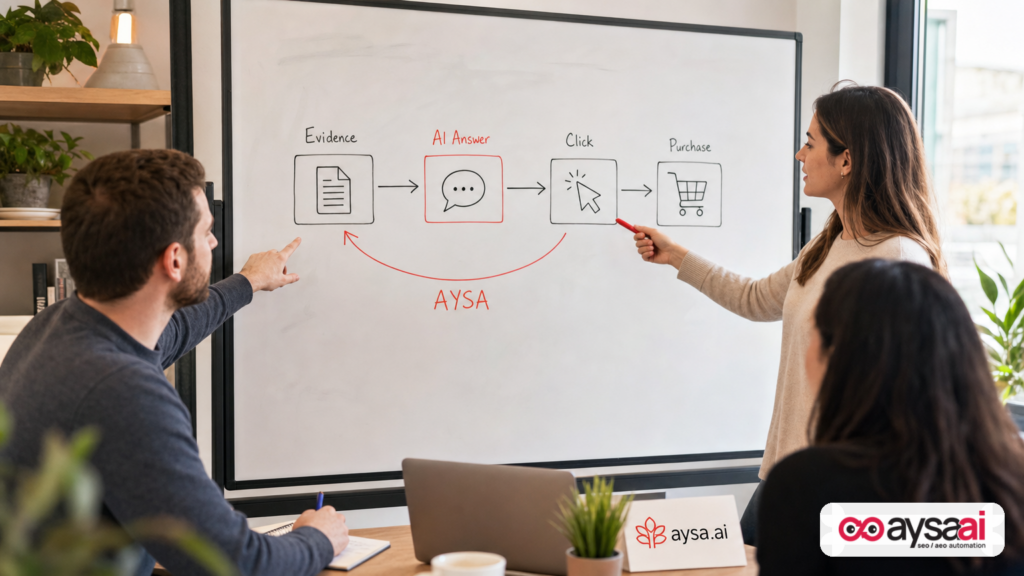
Think of AI search as a funnel with three distinct layers:
- Evidence layer: the sources an AI system uses to justify an answer (your pages + third parties).
- Answer layer: the formatted response (bullets, tables, product cards, merchant links, comparisons, follow-ups).
- Click layer: what a user chooses to visit next (and whether they visit anything at all).
The mistake is collapsing all of that into one KPI like “citations” or one tactic like “add more schema.”
Why this matters operationally: your team can do everything right on PDP templates and still lose visibility if your evidence layer is weak or contradictory. You can also win citations and still lose revenue if your click layer routes users to dead ends (thin pages, unhelpful policies, out-of-stock categories, or pages that don’t match the next-step intent).
The practical consequence: ecommerce SEO, AEO (Answer Engine Optimization), and GEO (Generative Engine Optimization) aren’t separate projects anymore. They are a single system problem: build evidence, earn inclusion, convert the click.
What AI systems cite in ecommerce is broader than PDPs and PLPs
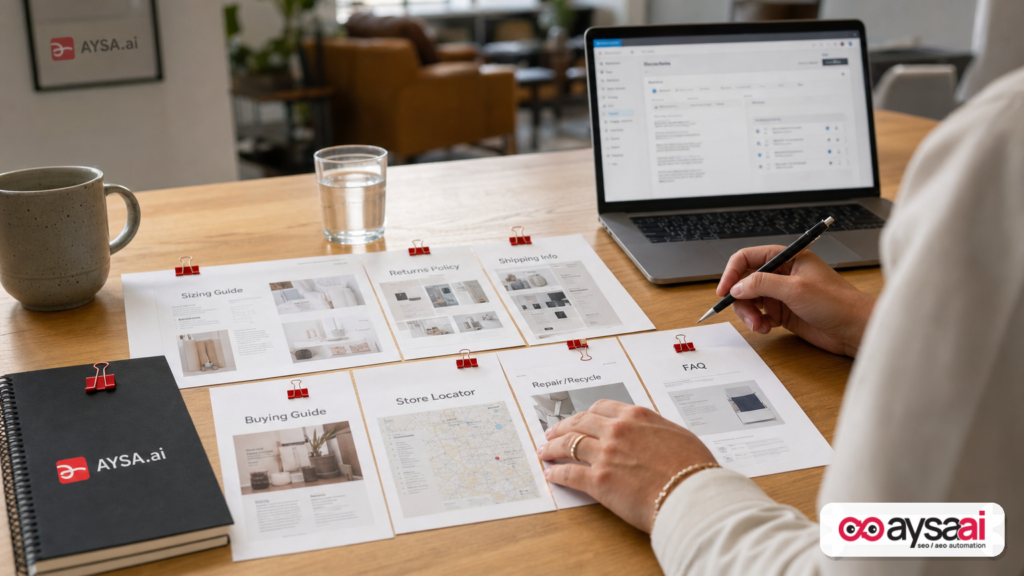
In many ecommerce orgs, “real pages” are the pages that sell: PDPs and PLPs. Everything else is treated as support content—important, but not strategic.
AI search flips that hierarchy.
In Aleyda’s analysis, commonly cited page types include (paraphrased):
- Size and fit guides (fashion, footwear, outdoors)
- Shipping and returns policies (fashion, marketplaces)
- Support and troubleshooting (electronics)
- Repair, recycling, warranty resources (electronics, outdoors)
- Buying guides, checklists, tutorials (outdoors, electronics)
- Store locators / local availability pages (retailers with physical footprint)
- Offers / coupons / promotions pages (some verticals and brands)
These pages do something PDPs often can’t do well: they answer the real question behind the purchase.
AI shopping is risk management
Most ecommerce purchases carry “risk.” Not financial risk only—also:
- Fit risk: “Will this fit me?”
- Suitability risk: “Will this work for my skin type / use-case?”
- Compatibility risk: “Will it work with my device?”
- Authenticity risk: “Is it real?”
- Logistics risk: “Can I return it easily?”
- Trust risk: “Is this seller legit?”
If an AI assistant is trying to reduce risk in its response, it will naturally lean on pages and sources that describe how risk is handled: policies, guarantees, support, and real-world experiences.
Implication: stop treating policy and support pages as “legal” or “customer service” only
Many policy pages are written for the business, not the buyer: vague, hard to skim, inconsistent, or missing edge cases. In AI search, that’s not just a CX issue—it’s a visibility issue.
Same with sizing: plenty of brands have a size chart, but not a usable fit guide that answers “I’m between sizes” or “I have wide feet” or “how does this brand compare to X.”
Those are exactly the questions AI systems get prompted with.
The shared citation layer: the same sources appear, but their roles differ by category
One of the most important takeaways from the underlying research is that across verticals, a recurring set of third-party domains appear as citations—marketplaces, social/video platforms, forums, reference sources.
But it’s a mistake to interpret this as “go spam Reddit” or “post more TikToks.” The point is simpler and more strategic:
AI systems look for corroboration in the places people already use to corroborate.
In the cited research, platforms like YouTube and Reddit appear across all five subverticals as recurring sources. The “why” differs by category:
- Beauty: routines, shade matching, real-world wear tests, ingredient concerns, before/after expectations.
- Fashion: try-ons, styling, fit notes, authenticity discussions, returns experiences.
- Electronics: setups, troubleshooting, compatibility, long-term reliability discussions.
- Outdoors: real use in terrain/weather, skill-level guidance, gear testing, packing lists.
- Marketplaces: trust and legitimacy conversations, shipping experiences, counterfeit concerns.
For operators, this is a diagnostic: if your brand story and your customer reality diverge on those platforms, AI systems may learn (and repeat) the customer reality.
This becomes a team sport: SEO + CX + Merch + PR
Traditional SEO could be “owned” by one person. AI search visibility can’t. The evidence layer is spread across:
- Website content and templates (SEO/content/engineering)
- Policies and operations (CX/ops/legal)
- Inventory and assortments (merchandising)
- Support documentation (support/product)
- External reviews and press (PR/brand)
- Community and creator ecosystems (social/community)
If you want to win AI answers, those teams have to stop working as separate departments with separate goals.
The five uncertainty patterns (and why your vertical changes the playbook)
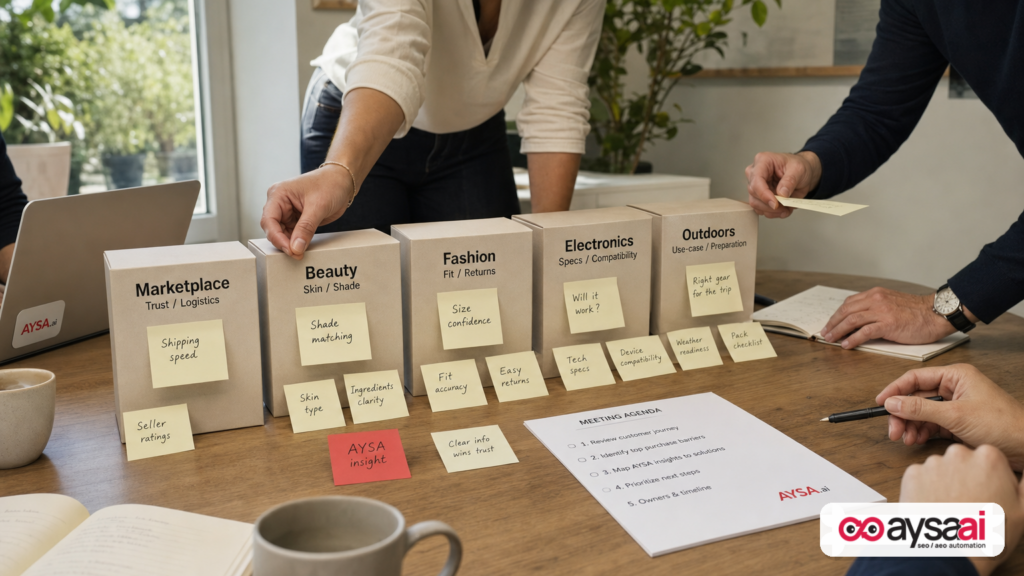
The most useful strategic frame from the source research is this: every subvertical has its own “buyer uncertainty pattern.” That’s what AI systems try to resolve with citations.
Here’s a practical version of that model for operators:
1) General marketplaces: trust, logistics, and legitimacy
If you’re a marketplace (or even a multi-brand retailer), a surprising share of “shopping” queries are really trust queries:
- “Is this site legit?”
- “How do returns work?”
- “Are there counterfeit items?”
- “How does shipping and seller protection work?”
Your evidence layer here is not just “products.” It’s mechanics: policies, protection, verification, dispute resolution, and clarity on how the marketplace operates.
2) Beauty & skincare: suitability and outcomes
Beauty is personal and subjective. Users ask prompts like:
- “Best moisturizer for oily acne-prone skin.”
- “Foundation shade match for medium olive undertone.”
- “Is ingredient X safe for sensitive skin?”
Evidence that matters includes routine guides, ingredient explainers, shade/undertone education, and real-world usage validation.
3) Fashion & apparel: fit, returns, authenticity
Fashion has three conversion killers:
- Fit uncertainty (size charts aren’t enough)
- Returns friction (fees, timelines, exceptions)
- Authenticity risk (especially resale)
That’s why size guides, fit advice, returns/shipping pages, and authentication content can become top evidence assets.
4) Consumer electronics: specs, compatibility, support
Electronics buyers fear “it won’t work with what I have” and “I’ll be stuck if something breaks.” So they ask:
- “Does this router work with my ISP?”
- “Is this laptop good for video editing?”
- “How do I set this up?”
Evidence assets include compatibility matrices, setup guides, troubleshooting, warranty clarity, repairability, and long-form comparisons.
5) Sports & outdoors: use-case, preparation, and safety
Outdoor gear is tied to context: terrain, skill level, weather, trip length, safety. That drives prompts like:
- “What sleeping bag rating do I need for 20°F?”
- “Best trail running shoes for wide feet and rocky terrain.”
- “Beginner backpacking checklist.”
Evidence here is often educational: checklists, packing guides, sizing, maintenance, and “what to choose for X scenario.”
Bottom line: stop copying competitors outside your category
If you run a beauty store and copy an electronics content strategy, you’ll publish a lot of “spec-like” content nobody needs. If you sell electronics and copy fashion, you’ll invest in lifestyle content while ignoring compatibility and support—exactly what users and AI systems require.
The correct playbook starts with uncertainty, not with templates.
Citations vs. GenAI traffic: what each metric tells you (and what it hides)
Here’s the mindset shift that matters for leaders: AI visibility has at least two layers of measurement.
What citation data can tell you
- Which sources AI systems lean on to justify answers
- What types of pages AI systems consider “evidence”
- Where your brand is missing from the narrative (because others are used instead)
But citation data can also mislead you into celebrating the wrong thing. A policy page might get cited because it’s definitive, but the user may not click—because the AI summarized it well enough.
What GenAI traffic can tell you
- Which pages people actually choose to visit after an AI interaction
- Which intents generate clicks (transactional, navigational, comparison) versus “zero-click” answers
- Which parts of your site act as the best next step (PDPs, categories, home, store pages, guides)
But traffic can also mislead you. A PDP might get clicks because the answer UI shows product cards and merchant links, not because your PDP is an evidence leader.
The operational rule
Use citation analysis to strengthen credibility. Use traffic analysis to strengthen conversion pathways. Don’t treat them as the same KPI.
If you want a simple executive dashboard, it’s this:
- Evidence KPI: Are we present among cited sources for our key decision prompts?
- Click KPI: Are the pages that receive GenAI visits aligned to the next-step intent (and do they convert)?
Aleyda’s write-up is explicit about this separation—citations show the evidence layer, GenAI traffic shows the click layer—and that distinction is a major unlock for ecommerce teams.
The Evidence Layer Audit: a practical checklist for ecommerce teams
If you want to “do AI search optimization” without vague AI hype, run this audit. It’s designed for SMEs and mid-market ecommerce teams who need practical steps, not research theater.
1) Map your decision prompts (not just keywords)
Start with 30–60 prompts that reflect real buyer doubts. Pull them from:
- Site search queries
- Support tickets
- Product reviews (“I wish I knew…”)
- Sales team notes (if applicable)
- Category Q&A sections
Examples by category:
- Fashion: “Does this brand run small?” “How do returns work?”
- Beauty: “Best for rosacea?” “Is this fragrance-free?”
- Electronics: “Will this work with Mac?” “How do I set it up?”
- Outdoors: “What do I need for a first backpacking trip?”
2) Identify your evidence pages (owned)
List the pages you want an AI system to use as evidence. This includes:
- PDPs and category pages
- Buying guides and comparisons
- Size and fit library
- Returns, shipping, warranty pages
- Compatibility tables, manuals, setup guides
- Store locator and availability info (if applicable)
If you don’t have these pages, that’s not a “content gap.” It’s a trust gap.
3) Make the evidence extractable
AI systems can’t cite clarity that doesn’t exist. “Extractable clarity” means:
- Clear headings that mirror real questions (H2/H3 like “Does it run true to size?”)
- Specific, non-legalistic policy language (fees, timelines, exceptions)
- Structured lists and tables where appropriate (compatibility, sizing, specs)
- Consistent naming of attributes across pages (materials, ingredients, model numbers)
This is where classic content SEO meets AEO/GEO: format matters because it influences how reliably a system can pull the right snippet.
4) Connect the evidence with internal linking
Most ecommerce sites bury their best evidence. A size guide exists, but it’s two clicks deep and not linked from PDPs. Returns info exists, but it’s not visible on categories where users hesitate.
Build a deliberate internal linking system:
- PDP → relevant fit guide / care guide / warranty
- Category → buying guide / “how to choose”
- Support article → related products and accessories
- Policy pages → FAQs and “what happens if…” clarifications
Internal linking isn’t just for crawlability. It’s how you teach both humans and machines what the authoritative path is.
5) Check third-party corroboration quality
You can’t control what others say, but you can control whether your brand has accurate, high-quality external references that match your claims.
Do a “corroboration scan” for your core products and categories:
- Are there credible video demos or reviews?
- Are community discussions mostly positive, mixed, or warning-heavy?
- Do major marketplaces represent your product accurately (titles, variants, specs)?
- Are there recurring misconceptions your site should explicitly address?
In Aleyda’s research, a shared third-party layer appears across verticals. Your job is to ensure that layer supports, not undermines, your narrative.
6) Validate the click layer: where does AI traffic land?
If you have any GenAI traffic data (even directional), evaluate:
- Which URLs receive GenAI visits?
- Do those pages satisfy the “next step” intent?
- Do they load fast, explain clearly, and offer a frictionless path to purchase?
This is where teams often discover something painful: AI visitors are landing on pages you didn’t expect—homepages, store-locator pages, policy pages, or a random help article.
That’s not bad news. It’s a map of what users actually need.
Architecture matters again: internal linking and “extractable clarity”
For years, ecommerce architecture conversations were dominated by crawl budget, faceted navigation, and index management. Those remain important. But AI search adds another reason architecture matters:
AI answers prefer deterministic, unambiguous statements.
That doesn’t mean “write for robots.” It means stop hiding important details inside:
- Accordions with vague labels (“Details”)
- Images that contain text (size charts as PNGs)
- PDFs that aren’t integrated into the site
- Legal pages written like contracts rather than customer promises
Where schema fits (and where it doesn’t)
Structured data is part of the machine readability story. It helps disambiguate entities and attributes. But schema won’t rescue you if the content is missing, inconsistent, or untrustworthy.
Use schema to reinforce a clear evidence layer, not to substitute for it.
Stop classifying pages as “money pages” vs. “non-money pages”
In AI search, a returns page can be a money page. A sizing guide can be a money page. A troubleshooting article can be a money page (especially in electronics). Treat them like tier-one assets with owners, KPIs, refresh cycles, and QA.
Build content like a system: libraries, templates, and refresh cycles
The worst response to AI search is “publish more content” without a system. You’ll end up with:
- duplicative guides
- conflicting policy statements
- stale compatibility info
- thin FAQs that don’t resolve uncertainty
Instead, build an Evidence Library with templates.
A practical evidence library by category
Here’s what that can look like (adapt to your vertical):
- Fit & sizing hub: measurement instructions, brand-to-brand comparisons, “between sizes” guidance, width/length notes.
- Returns & shipping hub: simple summary + edge-case FAQ (“final sale,” “international,” “used/worn”).
- Buying guide hub: “how to choose” + “best for X” + decision tree.
- Compatibility hub (electronics): models supported, setup steps, known issues, troubleshooting.
- Care/maintenance hub: cleaning, storage, lifespan expectations.
- Authenticity & trust hub (marketplaces/resale): verification processes, how to spot fakes, dispute resolution.
Refresh cycles: the unsexy moat
AI systems and buyers punish staleness. A 2021 compatibility article can be worse than no article, because it creates false confidence.
Set refresh cadences:
- Policies: quarterly (or any time ops changes)
- Compatibility/spec content: per product cycle
- Buying guides: semi-annually
- Sizing: annually + whenever assortment shifts
This is where automation and monitoring become competitive advantages.
Third-party corroboration without cringe: PR, creators, and community
Let’s be direct: you can’t “SEO” your way into trust if your external reputation contradicts your claims.
Aleyda’s research shows a shared citation layer with sources like YouTube and Reddit appearing across verticals. The wrong takeaway is “go manipulate those platforms.” The right takeaway is:
Earn the type of independent validation your category requires.
Three credible ways to build corroboration
- Creator partnerships with educational intent: demos, routines, setup, real-world testing—aligned to uncertainty, not just hype.
- Specialist media and reviewers: especially in electronics and outdoors where expert evaluation reduces risk.
- Community participation as customer success: answering questions accurately, publishing clarifications on your own site, and using recurring questions to improve your evidence pages.
Guardrails: don’t build an AI strategy on platforms you don’t own
Third-party sources can support your evidence layer, but they shouldn’t be the foundation. Your owned site should contain the canonical answers, in a form that’s easy to cite and easy to click.
A concrete SME scenario: specialty footwear ecommerce
Let’s make this real.
Imagine an SME ecommerce brand: a specialty footwear store selling running shoes and hiking boots online, with a small team and limited dev resources.
Their old SEO plan:
- Optimize category pages like “Trail Running Shoes”
- Write unique PDP descriptions
- Add Product schema
Their AI search reality:
- Customers prompt: “Best trail running shoes for wide feet and rocky terrain under $150.”
- AI answers cite: YouTube reviews, community threads about durability, and brand fit notes.
- The customer’s next question: “Can I return them after trying them indoors?”
What the Evidence Layer plan looks like
- Fit hub: “Wide feet guide,” “How this brand compares to Brand X,” “Sock thickness and fit.”
- Use-case guides: terrain-based recommendations, beginner trail running checklist.
- Returns clarity: a buyer-friendly summary on PDPs and a detailed returns FAQ.
- Durability & care: cleaning and lifespan expectations by outsole type.
How they measure success without chasing vanity metrics
- Evidence presence: Do AI answers for fit/use-case prompts cite the fit hub pages?
- Click outcomes: When GenAI sends traffic, does it land on the guide/PDP combo that matches intent?
- Business outcomes: Lower return rates on specific models, fewer sizing-related tickets, higher conversion for uncertain buyers.
This is the kind of SME strategy that doesn’t require a massive content team—but it does require disciplined execution across a handful of critical evidence assets.
What agencies should rethink: deliverables, reporting, and ops
If you’re an agency, AI search breaks the “deliverables comfort zone.” Monthly blog posts and technical audits won’t be enough if the real visibility is determined by policy clarity, support docs, and corroboration ecosystems.
What an AI-aware ecommerce retainer should include
- Prompt library + intent mapping (decision prompts, not just keywords)
- Evidence layer audit (owned pages + internal linking)
- Third-party corroboration review (what shows up and why)
- Citation vs. click reporting (two-layer measurement)
- Execution pipeline (changes shipped, not just recommended)
The hard truth: strategy is cheap; shipping is expensive
Most ecommerce teams already “know” their sizing guide is weak and their returns page is confusing. They don’t fix it because:
- legal approvals take weeks
- engineering is busy
- no one owns the page
- changes are risky
That’s why AI search becomes an operational advantage for teams that can execute safely and repeatedly.
How AYSA fits: monitor, prepare changes, ask for approval, then execute
At AYSA, we treat AI search as an execution problem, not a theory problem.
Our model is simple:
- Monitor what matters (visibility signals and page performance).
- Prepare recommended website changes (content updates, internal links, on-page structure, technical fixes).
- Ask for approval—because ecommerce sites have real brand, legal, and ops constraints.
- Execute accepted changes quickly and safely.
In the context of this article, AYSA helps ecommerce teams operationalize the evidence layer by:
- Flagging gaps on pages that should reduce buyer uncertainty (returns, shipping, sizing, compatibility, support)
- Recommending structural improvements (headings, formatting, internal linking) to make answers extractable
- Keeping an ongoing cadence so the evidence library stays current
If you want to explore how we approach this, start here:
The advantage isn’t that AYSA “knows AI.” The advantage is that AYSA helps you ship the changes that make your site more credible, more extractable, and more aligned with how AI answers route users.
What to do next (action list)
- Pick one category and one uncertainty pattern (fit, suitability, compatibility, trust, use-case).
- Create a 30-prompt library based on real customer questions.
- Inventory your evidence pages (guides, policies, support, sizing) and assign owners.
- Rewrite for extractable clarity: headings that mirror questions, concrete policy details, tables where useful.
- Fix internal linking so PDPs/PLPs connect to the evidence library and vice versa.
- Measure two layers: citations (evidence) and GenAI landing pages (clicks), then align your next-step pages.
- Establish a refresh cadence for policies, compatibility, and guides.
- Use AYSA to operationalize execution: monitor, prepare, approve, ship—repeat.
Sources and further reading
- Aleyda Solis: Ecommerce AI Search Optimization: What Citation and AI Traffic Patterns Across 5 Subverticals Tell Us About Going Beyond PDPs and PLPs
- Semrush Enterprise (AIO data reference as mentioned in the source)
- Similarweb digital intelligence
- AYSA: AI Search Visibility
- AYSA: Monitoring
- AYSA: AI SEO tools
- AYSA: Pricing
- AYSA: Blog
Continue the AI search topic inside AYSA.
Use these pages to connect the article with AI SEO tools, AI visibility monitoring, AI Overviews and approved website execution.
Turn this topic into a website action plan.
Use these AYSA hubs to move from reading to technical fixes, AI visibility monitoring, research, glossary context and approval-first SEO execution.