Google’s New Era for AI Search: What Changes for SMEs, SEO, and the Future of “Being Found”
Google is rebuilding Search around AI Mode, agents, and personal context — and that shifts what “visibility” means for every business. Here’s what changed, why it matters, and a practical execution plan for SMEs and agencies (including how AYSA turns monitoring into approved site changes).

By Marius Dosinescu / AYSA.ai
Google just signaled the most important Search interface change in decades: AI is no longer a feature layered on top of the results page — it’s becoming the way you ask, refine, and complete tasks. At Google I/O 2026, Google described a Search experience where AI Mode is the default for many journeys, the search box itself becomes an “intelligent” input that accepts everything (text, images, files, video, even Chrome tabs), and agents can monitor the web on your behalf and return synthesized updates or help you take action.
For small and mid-sized businesses, this isn’t a “future trend.” It’s a shift in distribution. Your potential customer may not read 10 pages of results anymore; they may accept one synthesized answer, one comparison, one shortlist, or one booking flow — and move on.
This editorial is a practical guide to what changed, why it matters, what can break, and exactly what to do next if you want to stay visible when Search becomes more conversational, more agentic, and more personalized.
Concise summary

- AI Mode is scaling fast, and Google is upgrading the default model inside it (Gemini 3.5 Flash) while redesigning the Search box for richer, multi-modal prompts. Source: Google Search Blog, “A new era for AI Search.” Google Search I/O 2026 AI Updates
- Search agents shift discovery from “pull” (you search) to “push” (your agent alerts you). This creates a new optimization target: being the best-cited, most up-to-date, most trustworthy source when an agent synthesizes information.
- Agentic booking and calling makes Search more transactional. If the “action layer” belongs to Search, businesses must ensure their availability, pricing, policies, and local signals are machine-readable and consistent.
- Agentic coding + generative UI suggests Search will increasingly answer with interactive tools and dashboards. Format and structured content become competitive advantages, not just “nice to have.”
- Personal Intelligence expands: Search answers can incorporate a user’s context (with permission), meaning two people can get different “best” answers. You can’t optimize for one static SERP anymore.
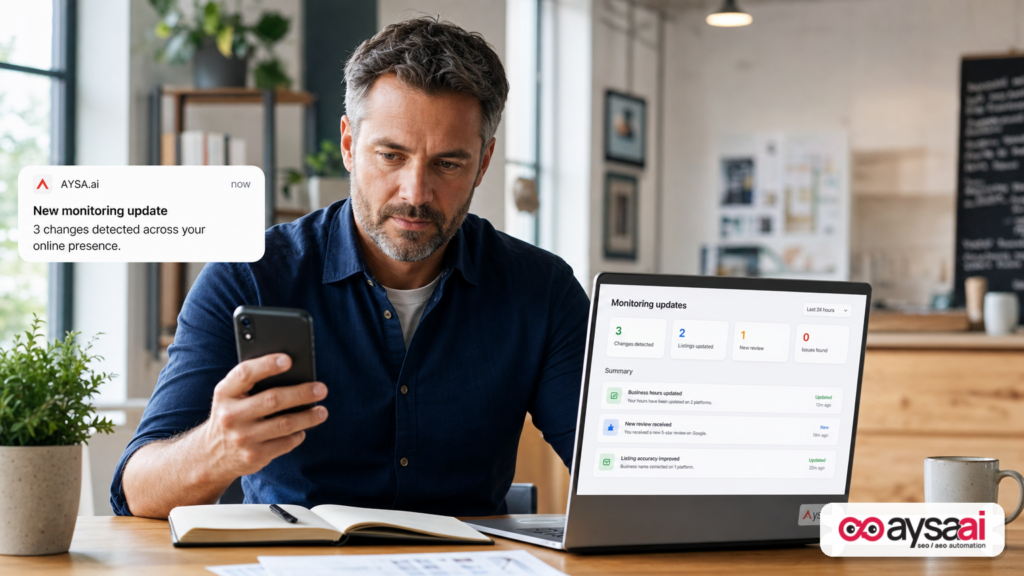
- Execution speed becomes strategy. Monitoring, drafting fixes, and shipping changes quickly (with approvals) becomes the difference between being cited vs being invisible. That’s where AYSA fits: AYSA Monitoring
Table of contents
- Context: why Google is rebuilding Search around AI
- The shift: from “search results” to “search outcomes”
- The intelligent Search box: the new front door to discovery
- Follow-ups everywhere: the new default is a conversation
- Search agents: the new distribution channel you don’t control (but must earn)
- Agentic booking & calls: local and services businesses get disrupted first
- Shopping implications (even if you don’t sell products)
- Agentic coding + generative UI: why “format” becomes a ranking factor
- Personal Intelligence: visibility meets privacy and permissions
- What can go wrong: the new failure modes in AI Search
- A concrete SME scenario: a local clinic competing in AI Mode
- What to monitor weekly (SMEs) and daily (agencies)
- A practical 90-day action plan
- Where AYSA fits: monitoring → recommendations → approval → execution
- What to do next
- Sources and further reading
Context: why Google is rebuilding Search around AI
For most of Search history, “how you ask” mattered less than “what you type.” Keywords were the interface. You adapted to the machine, and the machine returned a ranked list.
But Google’s I/O 2026 framing makes one thing clear: the interface is flipping. Search is adapting to you — including messy prompts, multi-step tasks, and queries that look less like keywords and more like a brain dump.
In Google’s announcement, they positioned this as “bringing together the best of a search engine with the best of AI,” combining retrieval (the web’s breadth, freshness, and diversity of sources) with advanced model capabilities (reasoning, summarization, planning, tool use). The official post is here: Google Search Blog.
Two strategic ideas are embedded in that framing:
- Search is moving up the funnel and down the funnel at the same time — from answering questions to helping complete tasks (bookings, calls, shopping actions, dashboards, trackers).
- Search is becoming more personalized and persistent. Instead of isolated sessions, it can hold context and follow you through a journey.
That changes the job of “SEO.” The job is no longer “rank page X for Keyword Y.” The job becomes: make sure your brand’s information is the most reliable building block for AI-driven outcomes — citations, shortlists, comparisons, bookings, calls, and next-step recommendations.
The shift: from “search results” to “search outcomes”
If you run a business, you don’t ultimately care if Google shows your website. You care if you get:
- a call,
- a lead form,
- a booking,
- a sale,
- or a qualified email subscriber.
Classic search was a “click economy.” AI Search is becoming an “outcome economy.” Google’s post describes a more seamless path from AI Overviews to follow-up questions and into AI Mode conversations — with context retained. In other words: less bouncing around, more guided steps.
For businesses, that means:
- Visibility is no longer one moment (the click). It’s multiple moments (the initial answer, the follow-up answer, the shortlist, the action).
- Your content may be used without being visited. It can be cited or paraphrased, and the user may take action elsewhere.
- Brand trust becomes a ranking factor you can feel. If the AI is synthesizing multiple sources, “which sources are safe to rely on?” is a core selection problem.
This is why we talk about AEO/GEO (Answer Engine Optimization / Generative Engine Optimization) alongside SEO. Not as buzzwords — as a real shift in how searchers consume information. AYSA’s approach is to treat AI visibility as an execution problem: monitor, prepare changes, request approval, then ship accepted updates. See: AI Search Visibility.
The intelligent Search box: the new front door to discovery
Google is calling this the biggest upgrade to the Search box in over 25 years. That’s not just UI drama — the input method shapes what people ask.
In the I/O 2026 announcement, Google describes a Search box that:
- dynamically expands to encourage longer prompts,
- helps users formulate questions with AI-powered suggestions beyond classic autocomplete,
- accepts multiple modalities: text, images, files, videos, and even Chrome tabs as inputs,
- and still returns a range of results (not just an AI answer).
Why this matters to SMEs:
- Longer prompts mean fewer “head keywords”. People will describe a situation (“I need a private karaoke room for six that serves food late”) instead of typing “karaoke near me.” Google explicitly used a scenario like this for agentic booking.
- Multi-modal queries explode “how-to” discovery. A customer can upload a photo of a broken faucet part, a screenshot of an error message, or a document — and ask, “What do I do?” If you’re a local plumber, a SaaS support site, or a parts retailer, your discoverability now depends on being the best match to those mixed signals.
- Intent becomes richer and more specific. This can be good news for small businesses: specificity favors specialists. But only if your site content and structured data reflect that specificity.
Practical implication: you should stop thinking of your site as “pages for keywords” and start thinking of it as a knowledge base for situations. The more your content answers real-world scenarios with clear constraints (location, timing, pricing, requirements, availability, policies), the easier it is for AI to select and reuse it.
Follow-ups everywhere: the new default is a conversation
Google described a flow where users can ask follow-up questions right from an AI Overview and move into AI Mode while keeping context — across desktop and mobile. The effect is subtle but huge:
- Users won’t restart searches from scratch as often.
- They’ll refine inside one thread.
- The “winner” is the brand that stays relevant as the question evolves.
In classic SEO, you might win “best running shoes for flat feet” but lose the next query “good for marathon training under $150” because it’s a different keyword set. In conversational search, the user asks once, then iterates. That iteration can either narrow to your product/service — or narrow away from it.
So what do you optimize for?
- Coverage of follow-up questions: FAQs, comparisons, constraints, and edge cases.
- Consistency: the same facts across your site, listings, and policies.
- Evidence: clear sourcing, documentation, and strong “why trust this” signals (especially for health, finance, and safety-sensitive categories).
AI Overviews have already pushed websites to write for clarity and citation. This I/O 2026 direction suggests that requirement intensifies: if your content can’t survive follow-up questions, it won’t stay in the thread.
Search agents: the new distribution channel you don’t control (but must earn)
Google’s post introduces “the era of Search agents” — with the first wave being information agents that run in the background and monitor the web, then send “intelligent, synthesized” updates with the ability to take action.
Two examples Google used:
- Apartment hunting: you provide detailed requirements, and the agent scans continuously for matching listings.
- Tracking athlete sneaker collaboration drops: the agent notifies you when something new lands.
Notice the pattern: the user is not searching repeatedly. The agent is doing repeated retrieval. That changes discovery in three ways.
1) “Freshness” becomes a competitive moat
If an agent is monitoring the web, the best source is the one that updates reliably and predictably. That’s not always the most “authoritative” domain; sometimes it’s the business that keeps its site current.
For SMEs, this is both an opportunity and a threat:
- Opportunity: if you update your inventory, services, hours, policies, and pricing quickly, you can outcompete bigger brands that move slowly.
- Threat: if your information is stale, agents may learn to ignore you.
2) Being cited matters as much as being clicked
When an agent sends a synthesized update, it can include links — but the user may not open them. Your “visibility” could be a mention, a citation, or inclusion in a shortlist.
This is why “AI search visibility” needs its own measurement discipline. AYSA focuses on monitoring and execution loops that improve the underlying site signals that make citations more likely over time. Start here: AI Search Visibility.
3) The battleground shifts to machine readability
Agents can’t reliably interpret messy websites. They prefer structured, consistent, parseable information: clear headings, tables, policies, locations, services, product specs, and structured data where appropriate.
That’s why the “unsexy” work matters more:
- clean site architecture,
- stable URLs,
- fast pages,
- consistent entity naming,
- and structured content patterns (FAQ blocks, steps, definitions, comparisons, and summaries).
In plain English: if your site is hard for a human to skim, it’s likely hard for an AI to trust.
Agentic booking & calls: local and services businesses get disrupted first
Google also described expanding “agentic booking capabilities” to more tasks — local experiences, services — and highlighted that for some categories (home repair, beauty, pet care) users can ask Google to call businesses on their behalf.
This is where AI Search becomes operationally disruptive.
Why this matters
- Lead flow changes shape: instead of “visit website → call,” you may get “Google calls you → confirms details → user books.”
- Availability becomes marketing: if the system is pulling pricing and availability from providers, businesses with accurate, structured availability will be favored.
- Your first impression may be your operations: if Google calls on behalf of a user, how you answer, what you confirm, and how consistent your policies are can directly affect conversion.
What SMEs should fix now
Even without deep technical work, you can harden your presence for agentic booking and calling:
- Make service pages explicit: what you do, what you don’t do, the service area, hours, response time, pricing ranges (when possible), and booking requirements.
- Make policies unambiguous: deposits, cancellations, emergency fees, after-hours rates, insurance accepted, warranties, etc.
- Align your site with your real operations: the fastest way to lose trust is mismatched info between your site and reality.
- Strengthen local “consistency”: business name, address, phone, and hours (where applicable) should be consistent across your web presence.
If you manage multiple locations or franchise-like setups, the operational advantage will go to teams that can ship updates quickly across many pages. This is exactly where automation plus approvals becomes essential: AYSA monitors and prepares changes, then executes only what you accept. Learn more: AI SEO Tools.
Shopping implications (even if you don’t sell products)
Google’s post references new agentic shopping capabilities and points readers to Google’s Shopping blog post (not included in the supplied research context). Rather than speculate about features beyond the official mention, here’s what we can responsibly infer from the direction:
- Search is moving closer to purchase decisions.
- AI will likely summarize options, tradeoffs, and constraints (price, delivery, availability, returns) faster than a user can compare manually.
Even if you don’t run an ecommerce store, shopping logic affects you:
- Service businesses are “shopped” too: customers compare packages, availability, and policies like products.
- B2B buyers behave similarly: they want shortlists, feature comparisons, implementation timelines, and pricing ranges.
So the ecommerce playbook becomes universal: clarity, structured information, transparent policies, and minimal friction to take the next step.
Agentic coding + generative UI: why “format” becomes a ranking factor
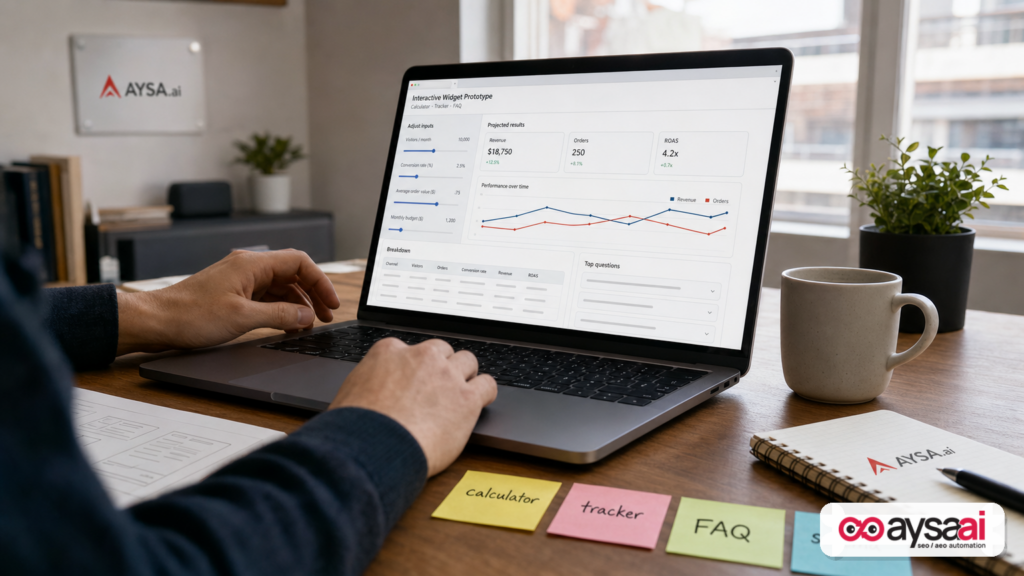
One of the most consequential parts of Google’s announcement is the idea that Search can “build the ideal response, in the right format” — generating custom UI such as interactive visuals, tables, graphs, and simulations in real time. Google also described that for ongoing tasks, Search could build custom dashboards or trackers that users return to — like mini apps — and that users may be able to build custom experiences with “Antigravity” in Search (described in the post as part of bringing agentic coding capabilities into Search).
Regardless of the internal branding, the editorial takeaway is clear: answers become interfaces.
What changes for content strategy
Historically, most SEO content was:
- a blog post,
- a category page,
- a service page,
- and maybe an FAQ.
In AI Search, you should also think in “components” that an AI can reuse:
- Calculators (pricing estimators, dosage/coverage estimators with safety disclaimers where needed, ROI calculators)
- Checklists (moving checklist, wedding planning timeline, “what to bring” for an appointment)
- Comparisons (plan A vs plan B, service tiers, product versions)
- Decision trees (“If X, then Y” troubleshooting)
- Structured FAQs that directly address follow-ups
Even if Search generates the UI itself, it still needs reliable inputs. Your website can become that source of truth — but only if it’s structured, consistent, and explicit.
A new KPI: “toolworthiness”
I’ll use a blunt term: toolworthiness. When AI builds dashboards and trackers, it will favor sources that provide:
- clear variables (inputs),
- clear rules (logic),
- clear outputs (results),
- and clear constraints (limitations, disclaimers, eligibility).
That’s not just good UX — it’s machine-ready knowledge.
If you want an execution system that helps you identify content that should be upgraded into reusable components, and then deploy those changes with approvals, start with AYSA’s monitoring approach: AYSA Monitoring.
Personal Intelligence: visibility meets privacy and permissions
Google also described expanding “Personal Intelligence in AI Mode” to more people in nearly 200 countries and territories and 98 languages, without subscription, and noted that users can securely connect apps like Gmail and Google Photos (and later Google Calendar). The post emphasizes transparency, choice, and control.
This introduces a major concept for businesses: the answer can depend on who is asking.
What personalization could mean (without over-claiming)
We should be careful not to invent specifics beyond what’s stated. But conceptually, if a user gives Search permission to use personal context, then:
- someone’s travel email confirmations could shape follow-up suggestions,
- someone’s photos could help identify an item, place, or product,
- someone’s calendar could shape “best time” recommendations.
For SMEs, the implication is not “you can optimize your website for someone’s inbox.” You can’t. The implication is: generic content gets relatively weaker when the platform can provide personalized, context-aware guidance.
How to win when answers are personalized
- Be the best option for a specific need (narrow positioning beats vague claims).
- Make it easy for the system to validate you: reviews, credentials, clear policies, clear pricing ranges, photos that match reality, clear contact methods.
- Offer “next step” clarity: booking flow, consultation steps, requirements, expected timelines.
Personal context makes discovery more efficient for users. But it raises the bar for businesses: you must be unambiguous and trustworthy enough to be recommended quickly.
What can go wrong: the new failure modes in AI Search
When Search becomes conversational, agentic, and personalized, new failure modes appear. These are the issues we expect SMEs and agencies to wrestle with — and why execution discipline matters.
1) “We’re ranking, but we’re not getting mentioned anymore”
In AI-driven results, the user might not scroll. They might accept the summary. If your site isn’t being cited or used in the synthesis, classic ranking reports can look fine while your leads decline.
What to do:
- Track business outcomes (calls, forms, bookings) alongside traffic.
- Track appearance in AI-driven surfaces where possible, and monitor brand queries and conversion paths.
- Improve “citation readiness”: clear definitions, structured facts, concise summaries, and transparent sourcing.
2) Inconsistent facts get you filtered out
If your hours differ across pages, your pricing contradicts your policy page, or your service area is unclear, an agent has to decide: is this trustworthy? Often, the safe move is to pick a competitor with cleaner data.
What to do:
- Run a consistency audit across key pages (services, contact, policies, FAQs).
- Standardize templates for service/location pages.
- Implement a “single source of truth” for business facts.
3) You become a commodity in summaries
AI summaries can collapse differentiation. If every dentist is “friendly, modern, gentle,” then the “best option” becomes whoever has the clearest evidence for a specific scenario (emergency slots, sedation options, insurance accepted, pediatric specialization, etc.).
What to do:
- Shift from generic marketing language to scenario-based differentiation.
- Publish concrete constraints, timelines, and eligibility criteria.
4) Your content is too unstructured to be reused
If your pages are walls of text, AI can still summarize them, but it may not trust them as “building blocks” for dashboards, comparisons, or checklists.
What to do:
- Add scannable sections with clear headings.
- Use tables where comparison matters.
- Create “at a glance” summaries at the top of key pages.
5) Slow execution kills compounding
AI Search raises the pace of change: new surfaces, new behaviors, new expectations. If your process is “audit quarterly, implement next quarter,” you’re essentially opting out.
What to do:
- Adopt a weekly execution rhythm.
- Automate monitoring and drafts.
- Keep humans in approval — but don’t let humans be the bottleneck.
This is the operational heart of AYSA: prepare changes, ask for approval, execute accepted website changes — continuously. Start with the platform overview and tools: AI SEO Tools.
A concrete SME scenario: a local clinic competing in AI Mode
Let’s make this real with a scenario that’s common, high-stakes, and easy to understand.
Business: a mid-sized physical therapy clinic with two locations.
Old world (classic SEO): they target “physical therapy near me,” “sports injury physical therapy,” and location keywords. They publish blog posts and hope to rank.
New world (AI Mode + follow-ups): A potential patient asks:
- “I tweaked my knee running. I have a half marathon in 8 weeks. Can I still train? What’s the safest plan? Also I have [insurance]. Find me a clinic that can see me this week after 5pm near [neighborhood].”
That prompt contains:
- a symptom/injury context,
- a timeline constraint (8 weeks),
- a service need (assessment + plan),
- availability constraints (after 5pm, this week),
- insurance constraints,
- location constraints.
In AI Search, the system can respond with:
- a safe general guidance summary (with disclaimers),
- follow-up questions,
- and a shortlist of clinics that match the constraints.
So what should the clinic do to win?
Clinic content upgrades that map to AI behavior
- Create scenario pages (runner’s knee assessment, return-to-running plans) that clearly state what the clinic can do, what a first visit includes, and what outcomes look like.
- Publish availability logic: evening hours, typical wait times, urgent slots (if offered), and how to request them.
- Insurance clarity: accepted plans, how verification works, what to bring, and common patient questions.
- Location clarity: service areas, parking, public transit, accessibility notes, and location-specific hours.
- Trust signals: therapist credentials, specialties, patient education approach, clear safety disclaimers.
Operational upgrades that influence outcomes
- Fast update workflow: if evening slots change, the site must reflect it quickly.
- Consistency: same facts across the two locations and across pages.
- Conversion readiness: low-friction appointment request, clear next steps.
This is where most SMEs struggle: they can write content, but they can’t keep it consistent and current across dozens of pages. That’s an execution problem — and it’s solvable with monitoring + approved automation. See AYSA monitoring: AYSA Monitoring.
What to monitor weekly (SMEs) and daily (agencies)
In AI Search, you don’t want to “audit everything.” You want to monitor what moves revenue and trust.
Core monitoring for SMEs
- Top converting pages: service pages, product pages, booking pages. Are they accurate and scannable?
- Business facts: hours, phone, address, policies, pricing ranges, availability statements. Do they match reality?
- AI-intent queries: the longer, scenario prompts customers actually ask your team on the phone.
- Reviews and reputation: not for vanity — because AI needs trust signals to recommend confidently.
- Competitor comparisons: if AI shortlists “best options,” what criteria is it using in your category?
Agency-level monitoring (multi-client reality)
- Template drift: did one location page template change and break consistency?
- Programmatic content quality: is scaled content becoming thin, repetitive, or contradictory?
- Structured data health (where applicable): is it valid, consistent, and aligned with page copy?
- Site changes: new CMS releases, new plugins, theme changes that affect indexing and content rendering.
- Outcome tracking: not only rankings — leads, bookings, calls, assisted conversions.
If you’re trying to do this with spreadsheets and quarterly audits, AI Search will outrun you. That’s why AYSA exists as an execution engine — not a reporting dashboard. Start exploring here: AI SEO Tools and AYSA Blog.
A practical 90-day action plan
Most businesses don’t need a massive “AI search project.” They need a disciplined sequence of improvements that compound.
Days 1–14: Fix the basics that agents will punish
- Choose 10 money pages (top service/product/location pages) and make them unambiguous: who it’s for, what it includes, how pricing works, how booking works.
- Create a facts sheet (hours, phone, address, policies) and enforce it across the site.
- Add “at a glance” blocks at the top of key pages: summary, key constraints, next steps.
- Reduce contradictions: remove outdated claims, old promos, expired pricing, unclear service areas.
Days 15–45: Build scenario coverage for AI Mode follow-ups
- List 30 customer questions your team hears repeatedly (calls, emails, chat logs).
- Turn them into scenario pages, not fluffy blog posts. Each page should include constraints, steps, costs (ranges), timelines, and “when to call us.”
- Write for comparison: “Option A vs option B,” “DIY vs professional,” “same-day vs scheduled,” “basic vs premium.”
Days 46–90: Improve machine reuse and conversion outcomes
- Structure content into components: tables, checklists, decision trees, definitions.
- Create one simple calculator or estimator if your category supports it (even a lightweight interactive element can clarify decision-making).
- Optimize for action: clearer CTAs, better booking flows, faster mobile UX, better contact paths.
- Implement a weekly content and consistency cadence: assign ownership and ship small changes continuously.
If this feels like a lot, it’s because the hard part isn’t “knowing what to do.” It’s shipping it reliably. AYSA was built for that operational gap: monitor issues and opportunities, draft fixes, ask for approval, and execute accepted changes on the site. Pricing and packaging here: AYSA Pricing.
Where AYSA fits: monitoring → recommendations → approval → execution
AI Search raises the stakes on speed, accuracy, and consistency. But most SMEs and many agencies operate with a broken pipeline:
- data scattered across tools,
- audits created but not implemented,
- changes stuck waiting for developers,
- or risky “auto changes” pushed without business context.
AYSA’s model is intentionally different: approved execution.
- Monitor your site and visibility signals continuously: Monitoring
- Prepare proposed improvements (content, technical fixes, structured clarity) based on what’s changing in search behavior and what your business needs
- Ask for approval so humans keep control of brand, compliance, and messaging
- Execute accepted changes on your website so improvements compound rather than rot in a backlog
In the era of AI Mode, this workflow matters because the “right answer” is dynamic. Your best response isn’t one page updated once — it’s an evolving system that stays current as the world (and Google’s interfaces) changes.
If you want to dig into how we think about visibility in AI answers specifically, start here: AI Search Visibility. If you want the toolset overview: AI SEO Tools.
What to do next
- Pick 10 pages that matter most (revenue pages) and make them “agent-ready”: clear, current, structured, and consistent.
- Write for scenarios, not keywords. Build pages around constraints and follow-up questions.
- Turn differentiation into facts: availability, policies, service boundaries, timelines, pricing ranges.
- Implement a weekly execution cadence so your information stays fresh enough for monitoring agents.
- Adopt approved execution so changes ship quickly without losing human control. Start with AYSA monitoring: AYSA Monitoring.
- Train your team (front desk, sales, support) to capture real customer questions; feed them into your content plan every month.
Sources and further reading
- Google Search Blog (The Keyword): “A new era for AI Search” (May 19, 2026). Google Search I/O 2026 AI Updates
- Google DeepMind blog (official). Google DeepMind Blog
- Google Research blog (official). Google Research Blog
- Google Developers blog (official). Google Developers Blog
- Google Cloud blog (official). Google Cloud Blog
- AYSA.ai: AI search visibility. AI Search Visibility
- AYSA.ai: AI SEO tools. AI SEO Tools
- AYSA.ai: Monitoring. AYSA Monitoring
- AYSA.ai: Pricing. AYSA Pricing
- AYSA.ai blog. AYSA Blog
Note: Google’s post references additional details (e.g., shopping-related agentic capabilities) via other Google properties. Those specifics were not included in the supplied source context for this assignment, so this editorial avoids claims that require that extra documentation.
Continue the AI search topic inside AYSA.
Use these pages to connect the article with AI SEO tools, AI visibility monitoring, AI Overviews and approved website execution.
Turn this topic into a website action plan.
Use these AYSA hubs to move from reading to technical fixes, AI visibility monitoring, research, glossary context and approval-first SEO execution.