
Ecommerce SEO in Romania: Old SEO Is Dead, Execution Speed Is the New Advantage
A deep look at ecommerce SEO in Romania: market pressure, catalog complexity, AEO, AI search, agency limits, and why online stores need approved execution instead of static reports.
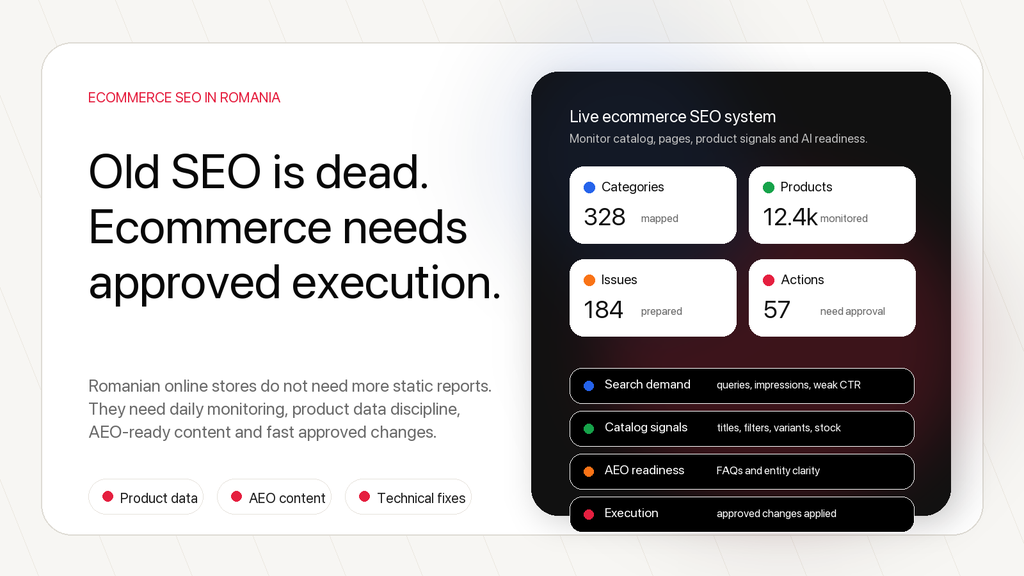
Executive summary: Ecommerce SEO in Romania is entering a harder phase. The market is no longer only about adding category text, fixing a few titles and waiting for rankings. Romanian online stores now compete with marketplaces, aggressive international players, richer Google shopping surfaces, faster content cycles, AI-assisted search, review-driven discovery and customers who compare options before they ever land on a product page.
The uncomfortable truth is not that SEO is dead. SEO is not dead. But old ecommerce SEO is dead: slow audits, static reports, generic category copy, one-off technical fixes and monthly task lists cannot keep up with how fast ecommerce changes. The winning model is continuous Monitoring, prioritization, approval and execution.
Romanian ecommerce is not early anymore
Romania is not a tiny experimental ecommerce market anymore. Industry sources such as GPeC, ARMO and MerchantPro have consistently described a market in the multi-billion-euro range, with 2024 showing stable growth even as costs, competition and consumer expectations became more difficult. MerchantPro described Romanian ecommerce in 2024 as a market with stable growth above 8%, but also one that requires strategic adaptation rather than simple expansion.
That matters for SEO because mature ecommerce markets do not reward lazy visibility. When more shops sell similar products, when marketplaces absorb demand, when delivery expectations rise, and when Google surfaces richer product information directly in search, the old playbook becomes too slow.
Eurostat data also shows that online shopping has become normal across Europe, even if Romania still has room to grow compared with more mature EU markets. That gap is important: it means there is upside, but it also means Romanian merchants are competing in a market where consumer behavior is still changing quickly. The businesses that build systems now will have an advantage over businesses that treat SEO as a quarterly cleanup.
In practical terms, ecommerce SEO in Romania is now a volume problem and a speed problem. A store may have hundreds of categories, thousands of products, seasonal inventory, duplicated descriptions, filters, variants, stock changes, supplier feeds, marketplace pressure, paid search costs, Google Merchant Center requirements, local trust signals and customer reviews. One consultant or one agency team can advise on these issues. But advice is not the same as execution.
Old ecommerce SEO is dead, but SEO is not
When I say old SEO is dead, I do not mean search is dead. I mean the slow operational model is dead. Old SEO was comfortable with a familiar rhythm: audit the website, export Keyword data, write recommendations, send a deck, wait for implementation, check again later. That worked better when websites changed slowly and Google search looked simpler.
Modern ecommerce does not move like that. Product pages appear and disappear. Categories split. Suppliers change feeds. Reviews accumulate. Filters create crawl paths. Internal links drift. Competitors publish new buying guides. Search intent changes. Google tests new experiences. AI Overviews and AI Mode push search toward answers, summaries and recommendations. Customers ask more specific questions before buying.
A Romanian store that treats SEO as a monthly report is already behind. The issue is not intelligence. Many agencies and consultants are smart. The issue is throughput. The number of things that must be monitored, prepared, approved and executed is too high for a purely manual workflow.
Good ecommerce SEO now needs a system that can run continuously: detect issues, understand priority, prepare changes, explain business impact, protect approvals, execute accepted updates and learn from results.
The biggest ecommerce SEO problems in Romania
1. Category pages are often thin or generic
Many Romanian online stores have category pages that look like product grids with a short paragraph added for SEO. That is not enough anymore. A strong category page should help the buyer choose. It should explain product differences, use cases, filters, delivery considerations, price ranges, compatibility, materials, sizes, seasonal context and related categories.
For example, a category page for flowers should not only say “buy flowers online.” It should help people choose flowers by occasion, delivery area, freshness, budget, color, arrangement type and urgency. A page for electronics should help users compare specifications, compatibility, warranty and practical trade-offs.
2. Product data is messy
Google’s ecommerce documentation puts significant emphasis on product structured data, merchant listings, pricing, availability and product information. Product visibility is no longer only about text on the page. It is about the machine-readable and user-visible product record: title, description, images, variants, price, availability, reviews, shipping and return policy signals where applicable.
Many stores still treat product data as a supplier-feed problem. But supplier feeds are rarely SEO-ready. Titles are duplicated. Descriptions are copied across retailers. Variant logic is inconsistent. Out-of-stock pages are handled poorly. Images are too heavy or not descriptive enough. Reviews are missing or not integrated properly. These are not small details. They influence discovery, trust and conversion.
3. Faceted navigation can waste crawl resources
Ecommerce filters are useful for users and dangerous for SEO if they are unmanaged. Size, color, brand, price, sorting and availability filters can create many URL combinations. Google’s documentation on faceted navigation explains how parameter combinations can create crawl inefficiency and duplicate or low-value URLs if not handled carefully.
For Romanian stores, this is a common hidden problem. The site may look clean to a user, but search engines may see thousands of crawlable URLs that do not deserve indexing. A serious ecommerce SEO system must decide which filtered pages should exist, which should be canonicalized, which should be blocked or noindexed, and which deserve custom content because they match real search demand.
4. Technical debt compounds quietly
Technical SEO is not glamorous, but ecommerce stores accumulate technical debt fast. Broken links, redirect chains, duplicate title tags, missing canonical tags, slow templates, poor mobile experience, JavaScript rendering issues, index bloat, sitemap noise and internal linking gaps all reduce performance over time.
The problem is that these issues rarely appear one by one. They appear continuously. A new campaign creates landing pages. A plugin changes templates. A supplier import creates duplicates. A category is renamed. A product line is discontinued. A developer fixes one issue and creates another. A monthly audit cannot keep up unless the implementation loop is also fast.
5. Content is not mapped to the buying journey
Ecommerce SEO is not just product pages. Stores need awareness content, comparison content, category buying guides, product education, reviews, FAQs, shipping and return information, local delivery pages where relevant, and post-purchase support content.
This matters even more in AEO and AI search. Answer engines need clear, structured, trustworthy information to understand what a business offers and when it is relevant. If the website only has product grids and generic category text, it gives search systems less to work with.
6. Internal linking is underused
Internal linking is one of the most controllable ecommerce SEO levers, but it is often neglected. Related categories, buying guides, product comparisons, seasonal pages, bestselling collections and informational content should reinforce each other. Without that structure, important pages may be too deep, isolated or unclear.
7. Authority building is misunderstood
Backlinks still matter, but ecommerce link building is often either ignored or treated as a risky shortcut. The better framing is authority building: relevant mentions, publisher opportunities, useful content assets, partnerships, digital PR and carefully approved placements. For AYSA, this is where the Adverlink ecosystem matters: authority opportunities should be surfaced, reviewed and approved, not bought blindly.
8. Measurement is fragmented
Google Analytics, Search Console, Merchant Center, paid campaigns, CRM data and platform sales rarely match perfectly. That does not mean the data is useless. It means ecommerce teams need an operating layer that can interpret signals instead of chasing one perfect number. SEO work should be tied to search visibility, page improvements, ranking movement, CTR, assisted conversions, product visibility and actual business context.
Duplicates, variants, stock and weak product data.
High priority
Canonicals, redirects, speed and index bloat.
Needs monitoring
Category pages that do not help users choose.
Needs execution
Missing FAQs, comparisons and entity clarity.
Growing risk
Weak mentions and unmanaged link opportunities.
Approval needed
The agency problem: not competence, but operational capacity
This is where the conversation needs nuance. It would be unfair and inaccurate to say that SEO agencies cannot help ecommerce businesses. Good agencies can provide strategy, audits, content planning, technical guidance, link acquisition, reporting and experience across many markets. Some agencies are excellent.
The problem is not whether agencies know SEO. The problem is whether the traditional agency workflow can keep up with the volume and speed required by modern ecommerce. A store with thousands of products does not need a strategy deck every few months. It needs hundreds of small, correct, prioritized actions: title updates, meta descriptions, schema checks, category improvements, internal links, redirect decisions, canonical cleanup, content refreshes, missing FAQs, new buying guides, product data corrections and authority opportunities.
That is not a criticism of agencies as people. It is a criticism of a delivery model. If work depends on manual discovery, manual briefing, manual copywriting, manual developer tickets and manual follow-up, the bottleneck becomes inevitable. The ecommerce business waits. The market keeps moving.
The better model is hybrid: expert strategy plus automated monitoring and approved execution. Humans should make judgment calls. Systems should handle detection, preparation, workflow and repetitive execution. That is exactly where AI agents can become useful, as long as they are connected to real website data and controlled by approval.
AEO is not a buzzword; it is the answer layer of ecommerce SEO
Answer Engine Optimization is often presented as a new discipline separate from SEO. I think that is the wrong framing. AEO is not a replacement for SEO. It is an extension of SEO into answer surfaces. When users ask questions in AI-assisted search, AI Overviews, AI Mode or other answer engines, websites need to be understandable, structured, trustworthy and complete enough to influence the answer.
For ecommerce, that means pages should answer practical buying questions. Who is this product for? What is the difference between two variants? What size should I choose? What is included? Is it available in my city? How fast is delivery? What happens if I return it? Is this category better for beginners or experts? What alternatives exist?
Google’s expansion of AI Overviews and AI Mode shows the direction: search is becoming more assistive, more conversational and more capable of synthesizing information. Ecommerce pages that only contain product grids and thin SEO paragraphs will struggle to provide enough answer-ready context.
Old SEO says: “Add keywords to the category page.” Modern ecommerce SEO says: “Make the page useful enough for a buyer and clear enough for a search system to understand, cite and recommend.”
What Romanian ecommerce stores need instead
The new ecommerce SEO stack should not start with another dashboard. It should start with execution. A useful system should continuously monitor the website, detect opportunities, prepare work and ask for approval before important changes go live.
For a Romanian ecommerce business, that system should cover:
- Catalog monitoring: products, categories, variants, stock, titles, descriptions and duplicate patterns.
- Technical SEO: crawlability, indexability, canonicals, redirects, sitemaps, page speed and structured data.
- On-page SEO: category copy, product copy, metadata, headings, FAQs and internal links.
- Research: what people search for, what the website already ranks for, what competitors cover and what pages are missing.
- AEO and AI visibility: answer-ready content, entity clarity, FAQ opportunities, comparison content and brand discoverability.
- Authority building: relevant publisher opportunities, digital PR signals and approved link placements where appropriate.
- Approval workflow: no blind autopilot, but no endless manual copy-paste either.
Old ecommerce SEO
Audit, spreadsheet, recommendations, developer tickets, waiting, partial implementation, another audit.
Risk: the store knows what is wrong, but changes arrive too late.
Execution-led SEO
Where AYSA fits
AYSA is built around the idea that SEO should move from research to approved execution. For ecommerce, that means the agent can help understand the business, monitor the catalog, identify technical and content opportunities, prepare updates, explain why they matter, ask for approval and apply accepted changes inside the website workflow.
This does not replace strategic thinking. It replaces the slowest part of SEO: turning known work into shipped work. A business owner should not have to manage endless spreadsheets, copy-paste metadata, chase developers for small updates or wonder which SEO recommendation matters first. The agent should prepare the work and make the next action clear.
In Romania, that matters because many online stores are not enterprise SEO teams. They are SMEs with limited time, limited internal SEO knowledge and real pressure from marketplaces, paid ads and competitors. They need less SEO work and more organic growth.
What an ecommerce SEO operating plan should look like in Romania
A serious ecommerce SEO plan in Romania should be built around weekly execution, not occasional diagnosis. The store should know which categories deserve attention, which products are becoming search opportunities, which filters are creating useless crawl paths, which pages are losing clicks, which commercial queries are underserved, which competitors are publishing stronger buying guides, and which technical issues are preventing search engines from understanding the catalog.
The first layer is product and category hygiene. Every important category should have a clear purpose, a unique title, a useful description, crawlable products, internal links to related categories and enough information to help a buyer choose. Every important product should have usable product data, original description elements, strong images, correct availability, price consistency, structured data where appropriate and a logical relationship with variants.
The second layer is technical control. Ecommerce sites need continuous checks for index bloat, canonical mistakes, crawl traps, redirect chains, 404 pages, soft 404s, slow templates, broken internal links and sitemap pollution. This is not glamorous work, but it is the plumbing that keeps the store visible. A store can spend heavily on content and still lose organic growth if Google wastes time crawling low-value filter URLs or if important category pages are buried too deep.
The third layer is content mapped to buyer decisions. Romanian ecommerce stores often publish blog content that is too informational and too disconnected from commercial pages. A better content system connects buying guides to category pages, product comparisons to product pages, FAQ answers to conversion pages and post-purchase guides to retention. Content should not exist in isolation. It should create paths.
The fourth layer is AEO and AI visibility readiness. This does not mean stuffing pages with artificial Q&A blocks. It means making the website easier to understand. Pages should explain who the product is for, what problem it solves, how it compares, what constraints matter, what the buyer should check before purchasing and what trust signals support the recommendation. Search systems increasingly reward clarity because clarity is easier to retrieve, summarize and cite.
The fifth layer is authority and trust. Romanian ecommerce brands need more than product feeds. They need credible mentions, reviews, expert content, partnerships, useful resources and relevant publisher visibility. Link building should not be treated as a dark corner of SEO. It should be treated as controlled authority building: relevant opportunities, clear context, approval before spending and delivery tracking.
A realistic workflow for a Romanian online store
If I were advising a Romanian ecommerce business today, I would not start with “publish 100 articles.” I would start with a 30-day execution loop.
- Week 1: visibility and catalog audit. Identify category pages with impressions but weak CTR, product groups with duplicate metadata, index bloat, filter problems, missing structured data, slow templates and pages that should not be indexed.
- Week 2: category and product improvements. Rewrite the highest-value category titles and descriptions, improve internal links, prepare FAQ sections only where they answer real buyer questions, and clean obvious technical issues.
- Week 3: content and AEO gaps. Build buying guides, comparison pages and answer-ready sections around commercial questions. Connect them to category and product pages.
- Week 4: authority and monitoring. Review publisher opportunities, evaluate brand mentions, monitor rankings and CTR changes, and prepare the next set of approved actions.
The important detail is that the work should not stop after the first month. Ecommerce SEO is a loop. Search demand changes, stock changes, competitors change, Google changes and customers change. A store that works in loops will beat a store that waits for another audit.
This is where AI can help, but only if it is connected to the website and controlled by approval. A generic chatbot can draft text. It cannot understand the live catalog, monitor Search Console data, detect technical issues, prepare safe website changes and execute accepted updates without a connected workflow. That is the difference between AI content and an AI SEO execution agent.
Final point of view
Ecommerce SEO in Romania is not about choosing between agencies and AI. It is about choosing between slow execution and continuous execution. Agencies can still bring expertise. Consultants can still bring judgment. But the operational layer has to change.
Old SEO is dead because it was too slow. Modern ecommerce SEO is alive, but it needs to be connected, monitored, answer-ready and execution-led. The stores that understand this will not wait for the perfect quarterly report. They will build a system that finds the work, prepares it, gets approval and ships it.
Less SEO work. More organic growth.
Turn ecommerce SEO issues into approved website action.
AYSA monitors your website, prepares SEO, AEO and AI visibility work, asks for approval and executes accepted changes inside your website workflow.
Sources and further reading
- MerchantPro Compass: Romanian ecommerce in 2024
- GPeC: Romanian ecommerce industry events and market resources
- Eurostat: E-commerce statistics for individuals
- Google Search Central: Product structured data
- Google Search Central: Ecommerce SEO documentation
- Google Search Central: Faceted navigation best practices
- Google: Search I/O 2026 AI updates
- Google Search Central: Helpful, reliable, people-first content
Continue the AI search topic inside AYSA.
Use these pages to connect the article with AI SEO tools, AI visibility monitoring, AI Overviews and approved website execution.
Turn this topic into a website action plan.
Use these AYSA hubs to move from reading to technical fixes, AI visibility monitoring, research, glossary context and approval-first SEO execution.

