
Content Marketing Funnel: A Practical Guide for SMEs That Want Customers, Not Just Traffic
A practical content marketing funnel guide for small and medium-sized businesses: what to create at each stage, how to measure it, and how AYSA turns funnel gaps into approved SEO execution.
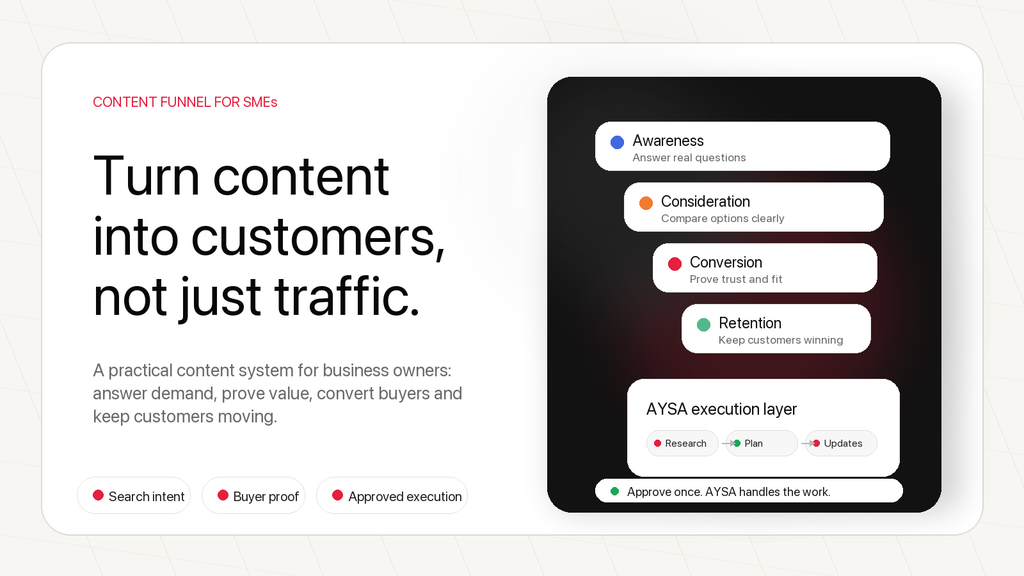
Executive summary: A content marketing funnel is not a diagram for marketers to admire. It is a practical way to answer the questions buyers have before they trust you. For SMEs, the goal is not to publish more content for the sake of traffic. The goal is to guide a stranger from “I have a problem” to “I understand my options” to “I trust this business enough to act.”
This article recreates the useful funnel logic from modern content marketing discussions in an AYSA style: simple stages, buyer questions, page examples, metrics, AI Search considerations and approved SEO execution. The point is not to copy a funnel template. The point is to build a system that helps real customers move forward.
What is a content marketing funnel?
A content marketing funnel is the path your content creates for potential customers. At the top, people are still learning. In the middle, they compare options. Near the bottom, they need proof and a reason to choose you. After purchase, they need help, confidence and reasons to come back.
The important word is “path.” Many websites publish isolated articles: one post about a definition, one page about a service, one FAQ, one pricing page, one case study. The pages may be useful individually, but they do not always guide someone from curiosity to decision. A funnel connects them.
Semrush’s content marketing funnel article explains the classic structure: awareness, consideration, conversion and retention. That structure is useful, but for small businesses it needs translation. A business owner does not wake up thinking about TOFU, MOFU and BOFU. They think: “How do I get people to trust my company before they call?”
That is the right question. A good funnel is not about pushing people aggressively. It is about reducing uncertainty at every stage.
Each stage has different questions. A beginner wants clarity. A buyer wants proof.
Guides, comparisons, service pages, case studies, FAQs and product education all play different roles.
The funnel improves only when gaps become website changes, not just recommendations.
The four stages of a useful content funnel
1. Awareness: help people understand the problem
Awareness content answers the early question. The user may not know your brand, your product or even the exact name of the solution. They are trying to understand what is happening.
Examples: “Why did my website Traffic Drop?”, “What is a Canonical tag?”, “How to choose a pediatric clinic?”, “What are backlinks?”, “Why is my WordPress site slow?”, “What is AI visibility?”
For SMEs, awareness content should be simple, practical and specific. Avoid sounding like a textbook. A parent looking for a pediatric clinic does not need a generic medical directory. A store owner trying to understand SEO does not need jargon. They need a clear explanation, examples and next steps.
2. Consideration: help people compare options
Consideration content supports evaluation. The user now understands the problem and wants to compare approaches. This is where many SMEs are weak. They publish service pages, but not comparison pages, buying guides or decision criteria.
Examples: “SEO agency vs AI SEO agent”, “WordPress SEO plugin vs SEO execution platform”, “local SEO tools for small businesses”, “what to check before choosing an Ecommerce SEO solution”, “content marketing funnel examples for clinics.”
This stage should be honest. Explain trade-offs. Who is the solution for? Who is it not for? What does the buyer need to know before spending money?
3. Conversion: help people trust and act
Conversion content removes the final doubts. It includes pricing, demos, case examples, testimonials, process, security, FAQs, onboarding steps, support expectations and clear CTAs.
For AYSA, this is where the distinction matters: the product is not only a reporting tool. It prepares SEO work, asks for approval and can execute accepted changes inside the website workflow. A buyer needs to understand that before registering.
4. Retention: help customers keep getting value
Retention content is often ignored, but it is part of growth. Tutorials, help docs, workflows, templates, release notes and educational content help customers use the product better. They reduce support pressure and increase trust.
In AI search, retention content can also support authority. A product that educates users clearly creates more useful pages, stronger internal links and better evidence of expertise.
Beginner guides, glossary pages, problem explainers and “why this happens” articles.
Comparisons, alternatives, checklists, buying criteria and use-case pages.
Pricing, demos, proof, FAQs, onboarding, security and contact pages.
Help center, tutorials, workflows, release notes and customer education.
What this means for a small business
A funnel becomes useful when it is applied to a real market. Here are practical examples.
Local clinic
Awareness content might explain symptoms, appointment types, emergency versus routine care and what parents should prepare before a visit. Consideration content might compare private clinic options, availability, specialties, location, reviews and when to choose a hospital. Conversion content should make booking easy and show trust signals. Retention content can include after-visit guidance and frequently asked questions.
Ecommerce store
Awareness content might explain how to choose a product category. Consideration content compares models, use cases, materials, sizes or delivery options. Conversion content includes product pages, category copy, reviews, return policy and shipping details. Retention content includes care guides, replacement parts, gift ideas and seasonal content.
SEO software or service
Awareness content explains concepts like technical SEO, AI visibility, backlinks or content strategy. Consideration content compares tools, agencies and execution platforms. Conversion content explains pricing, onboarding, approval workflows and what the product actually does. Retention content helps users understand credits, workflows and how to approve changes safely.
Voice of the user: buyers do not want more noise
Modern buyers increasingly research before talking to sales. Gartner has reported that many B2B buyers prefer a rep-free buying experience when possible, which means your content has to answer more questions before a person ever speaks to you. Think with Google’s “messy middle” research also shows that people explore and evaluate repeatedly before making decisions. The journey is not a neat straight line.
That matches what we see in SEO communities and customer conversations. People are not asking for more generic content. They ask: “Which option is right for my situation?” “What should I do first?” “What does this cost?” “Can I trust this?” “What happens after I sign up?”
A funnel should answer those questions in plain language. If your content sounds clever but does not reduce uncertainty, it is not doing its job.
How to measure a content marketing funnel
Traffic alone is a weak measurement. A top-of-funnel guide may bring traffic, but if it does not connect to the next step, it creates attention without movement. A conversion page may have less traffic but much higher business value.
Measure each stage differently:
- Awareness: impressions, organic clicks, query coverage, AI visibility mentions, engagement and internal link movement.
- Consideration: comparison page visits, repeat visits, scroll depth, clicks to pricing or examples, email signups and assisted conversions.
- Conversion: trial starts, demo requests, contact forms, calls, checkout starts and pricing CTA clicks.
- Retention: help article usage, feature adoption, support reduction, repeat purchases and customer expansion.
The best funnel measurement is not a single number. It is the relationship between questions answered and actions taken.
Stage health
Next actions
Add comparison pages, improve pricing clarity, link awareness guides to use cases, and update FAQs based on real buyer questions.
Status: Ready for approval
How AI search changes the funnel
AI-assisted search makes the funnel more important, not less. If answer engines summarize options, users may see fewer traditional blue-link results before forming an opinion. That means your content needs to be easier to understand, cite and recommend.
Classic SEO asks whether a page can rank. AI visibility asks whether a page is clear enough to be used as a source or influence an answer. A funnel built only around traffic misses that change. Each stage needs content that is direct, structured, trustworthy and connected to related entities.
Google’s guidance on helpful, reliable, people-first content is still relevant here. Pages should provide original value, complete explanations, trustworthy information and a good user experience. AI-generated content is not automatically bad, according to Google, but content created primarily to manipulate rankings or scaled without user value can create risk.
For SMEs, the practical rule is simple: publish pages that help a buyer make progress. Do not publish pages only because AI can produce them.
Where AYSA fits: from funnel gaps to approved execution
AYSA can help turn a content funnel from a strategy document into actual website work. It can monitor search performance, identify missing topics, detect pages that receive impressions but do not answer the query well, find internal link gaps, prepare page updates, suggest FAQs, improve metadata and connect related content.
The important part is execution. A funnel audit is useful only if it becomes action. AYSA prepares the work, explains why it matters, asks for approval and can execute accepted changes inside the website workflow.
For a business owner, that means less manual SEO work. You do not need to memorize funnel terminology. You need to know what page should be improved, why it matters, what should change and whether you approve it.
Final take
A content marketing funnel is not a marketing theory. It is the structure that helps your website answer the right question at the right time. Awareness content earns attention. Consideration content earns trust. Conversion content earns action. Retention content earns loyalty.
The businesses that win will not be the ones that publish the most pages. They will be the ones that make the buyer journey clearer, more useful and easier to act on.
Less SEO work. More organic growth.
Turn funnel gaps into approved website action.
AYSA monitors your website, prepares funnel and SEO improvements, asks for approval and executes accepted updates inside your website workflow.
Sources
Continue the AI search topic inside AYSA.
Use these pages to connect the article with AI SEO tools, AI visibility monitoring, AI Overviews and approved website execution.
Turn this topic into a website action plan.
Use these AYSA hubs to move from reading to technical fixes, AI visibility monitoring, research, glossary context and approval-first SEO execution.

