
Free AI SEO Tools Are Useful. Here’s Where They Stop.
Free AI SEO tools can help with ideas, audits, drafts and diagnostics. But SEO growth needs monitoring, approval and execution. Here is how to use free tools wisely without confusing assistance with results.
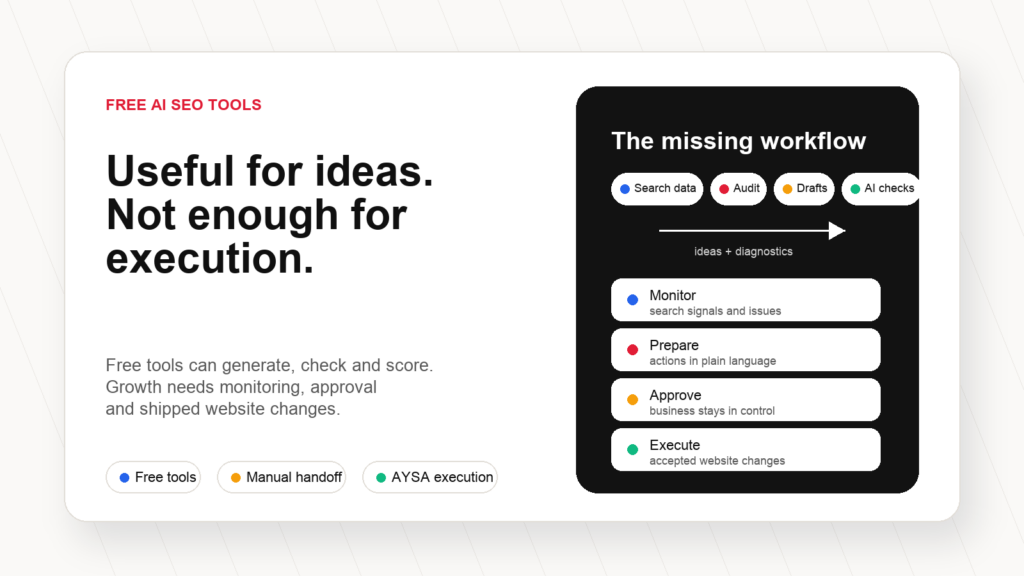
Summary: Free AI SEO tools are useful. They can help generate Keyword ideas, check technical issues, draft outlines, summarize pages, inspect titles, suggest content improvements and explain SEO concepts. For a business owner, that is valuable. The problem starts when “free tool” is confused with “finished SEO work.”
Most free tools produce ideas, scores or fragments. They rarely monitor your website continuously, understand your business deeply, prepare approval-ready actions, apply accepted changes and track what happened after execution. That gap is exactly where many SMEs lose time: they collect recommendations, but the website does not actually improve.
Why free AI SEO tools attract business owners
The appeal is obvious. SEO feels expensive, slow and complicated. Agencies can be difficult to evaluate. Enterprise tools can be overwhelming. A free AI SEO tool promises a shortcut: paste a URL, enter a keyword, get ideas, score a page, create a title, generate an outline or diagnose technical issues.
That is not useless. For many SMEs, free tools are the first moment when SEO becomes less abstract. A business owner can see that titles matter, pages need clear intent, technical errors exist, Google Search Console contains real search data, and content should answer specific questions. A free tool can start the conversation.
The Eesel article is interesting because it lists the category from the practical user perspective: people want tools that help with Keyword research, content generation, optimization, audits and analysis without paying upfront. That demand is real. The deeper question is not whether free tools are bad. The question is what kind of SEO work they can and cannot complete.
What free AI SEO tools do well
Free tools are strongest when the task is narrow. If you need a quick Page title variation, a Meta description draft, a content outline, a list of related topics, a rough Keyword cluster, a simple page audit or a first explanation of an SEO issue, they can be very helpful.
Google Search Console is especially important because it is not a generic AI guess. It provides direct data about queries, impressions, clicks, average position, indexing and technical signals from Google’s perspective. For any serious SEO workflow, Search Console should be treated as a foundation, not an optional extra.
AI writing and optimization tools can also help with speed. They can transform blank-page anxiety into a first draft. They can compare a page against obvious search intent. They can suggest headings, FAQs, semantic terms and missing sections. Used responsibly, they reduce friction.
Technical checkers are also useful. They can identify broken links, missing alt text, slow pages, duplicate titles, schema problems or crawlability issues. Even when the free version is limited, it can reveal enough to show that the website needs attention.
The best way to think about free tools is this: they are good assistants for isolated tasks. They are not usually a complete operating system for SEO execution.
Free AI SEO tools
- Generate ideas
- Score pages
- Suggest titles
- Create drafts
- Show diagnostics
Execution workflow
- Monitor real data
- Prioritize actions
- Prepare changes
- Ask for approval
- Publish accepted work
Where free tools stop
The limitation is not only pricing. The limitation is workflow. A free title generator does not know which page has impressions but poor CTR. A free outline generator does not know whether the page already ranks, whether competitors cover the topic better, whether internal links are missing, or whether the business can actually deliver the service described. A free audit tool may identify an issue, but it will not always translate that issue into a safe implementation plan.
There is also a quality problem. AI tools can sound confident while being shallow. A generic page about “best pediatric clinic in Bucharest” is not useful just because it contains the phrase. It should help a parent compare care options, understand when emergency care is needed, evaluate trust signals, review location and parking, see booking options and decide what to do next. A generic AI draft rarely reaches that level without business context and editorial judgment.
Free tools also create fragmentation. One tool suggests keywords. Another writes content. Another scores the draft. Another checks speed. Another tracks rankings. Another shows Search Console data. The user still has to interpret everything, decide what matters, copy-paste between systems, update WordPress, request approval and remember what changed.
For an SEO specialist, that may be manageable. For a business owner, it becomes manual SEO work disguised as automation.
The main categories of free AI SEO tools
Keyword and topic tools
These tools help discover phrases, related topics, questions and clusters. They are useful for ideation, but the business still needs to validate search intent, competition, relevance and commercial value. A keyword list is not a content strategy.
Content generators
AI writers can create outlines, drafts, titles, introductions and FAQs. The risk is generic content. Google’s guidance on helpful content focuses on creating people-first content that demonstrates usefulness, originality, experience and value. That requires more than producing words quickly.
On-page optimization tools
These tools compare a page against terms, headings, entities or competitor patterns. They can be useful, but they should not turn content into a checklist. The page must still serve a real user in a real context.
Technical audit tools
These tools can surface crawl, performance, schema, metadata, internal linking and indexation issues. The challenge is prioritization. Not every warning deserves the same urgency. The best technical SEO work connects the issue to crawl quality, user experience, revenue risk or AI readability.
AI visibility checkers
These tools test how brands appear in AI answers or answer engines. They are valuable, but outputs can vary by model, prompt, geography, timing and context. Treat them as signals, not absolute truth.
The missing workflow: from free tool output to shipped change
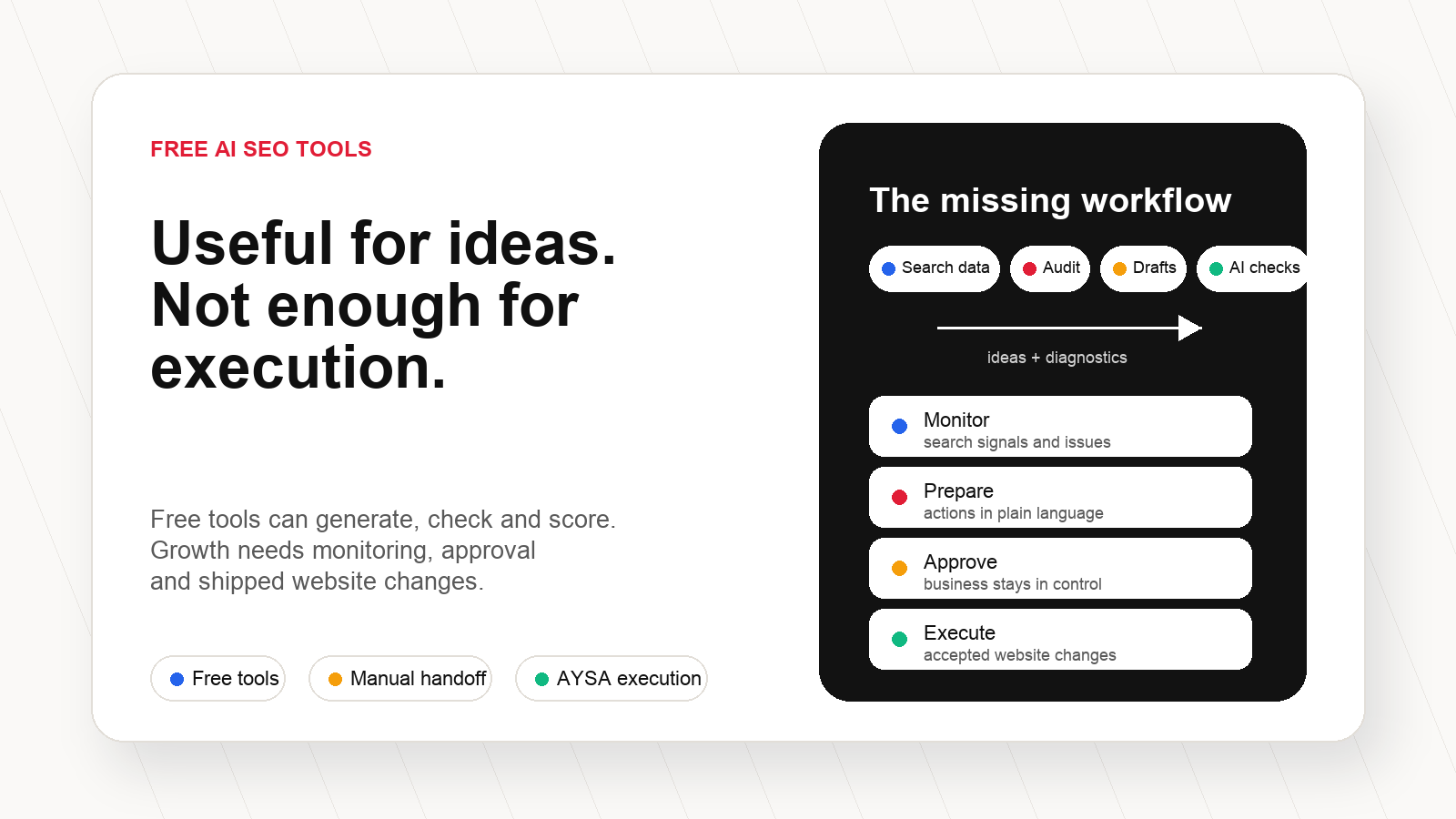
The real question is what happens after the tool gives you something. If the output is a list of ideas, who chooses the right one? If the output is a content draft, who checks accuracy and brand fit? If the output is a technical issue, who creates the fix? If the output is an AI visibility gap, who decides which page should be improved?
A complete SEO workflow needs these steps:
- Monitor search data, rankings, technical health and AI visibility signals.
- Understand the business context: products, services, location, audience, tone, competitors and goals.
- Prepare specific actions, not just broad advice.
- Explain why each action matters in plain language.
- Ask for approval before meaningful changes are applied.
- Execute accepted changes inside the website workflow.
- Track what was changed and continue improving.
That is the part most free tools do not cover. They help with fragments. They do not usually become accountable for the operational loop.
Where AYSA fits
AYSA is not positioned as another free prompt tool. It is an AI SEO execution agent. The difference matters. AYSA is built to learn the business, connect website and Google context, monitor opportunities, prepare SEO, AEO, GEO and AI visibility work, request approval and execute accepted changes inside the website workflow.
That does not mean free tools are useless. In my opinion, they are useful educational and diagnostic helpers. But for SMEs, the bottleneck is rarely “we could not generate one more idea.” The bottleneck is execution: which page should change, what should change, who approves it, and how does it get shipped without specialist overhead?
This is why the best use of free AI SEO tools is as a starting point, not the operating model. Use them to learn, test and explore. But do not confuse tool output with SEO progress. Progress happens when the website becomes clearer, faster, more useful, better linked, better structured and easier for search and AI systems to understand.
A practical checklist before relying on a free AI SEO tool
- Does the tool use real website or Google Search Console data, or only generic AI output?
- Does it explain why the recommendation matters?
- Does it identify the affected page, template or workflow?
- Does it help you prioritize by impact and effort?
- Does it produce an action you can approve and publish?
- Does it track what changed after implementation?
- Does it reduce work, or create more manual copy-paste tasks?
Sources and further reading
Less SEO work. More organic growth.
Move from free SEO ideas to approved website execution.
AYSA monitors your website, prepares SEO and AI visibility actions, asks for approval and executes accepted changes inside your website workflow.
Continue the AI search topic inside AYSA.
Use these pages to connect the article with AI SEO tools, AI visibility monitoring, AI Overviews and approved website execution.
Turn this topic into a website action plan.
Use these AYSA hubs to move from reading to technical fixes, AI visibility monitoring, research, glossary context and approval-first SEO execution.

