
AI Content Works Until It Doesn’t: Why Scaled Content Strategies Backfire
AI content can help teams move faster, but scaled publishing without business context, originality, quality control and execution discipline can create traffic spikes that disappear.
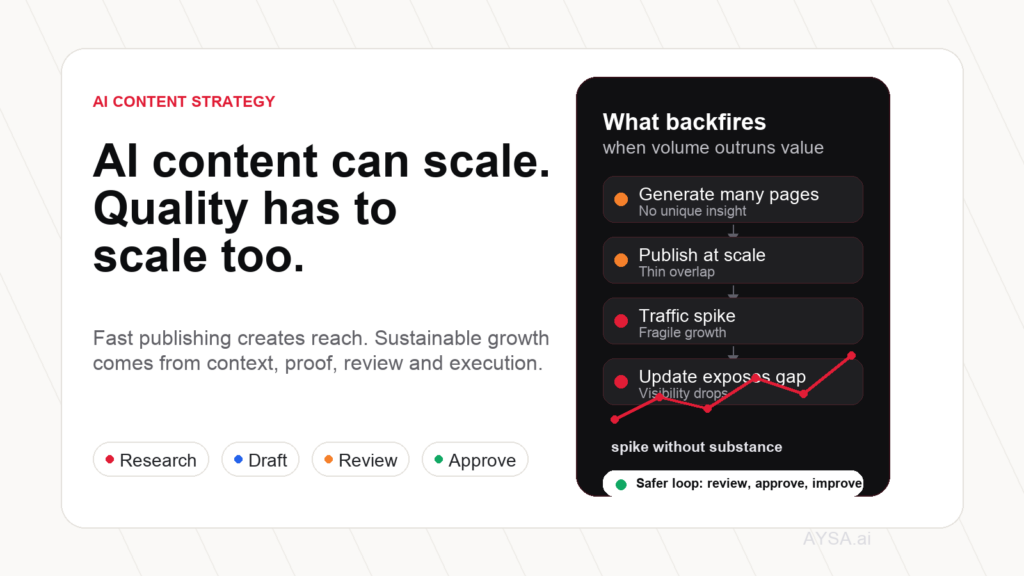
Executive summary: AI content can be useful, fast and commercially valuable. The risk is not the use of AI. The risk is scaling content faster than you scale research, business context, editorial judgment, user usefulness and execution quality.
The latest warning sign comes from Search Engine Journal’s analysis of AI content strategies that appear to work for a while, then lose visibility when the content system cannot support the growth it created. For SMEs, the lesson is simple: do not build a publishing machine that creates pages nobody would miss.
What the Search Engine Journal analysis is really warning about
Search Engine Journal recently covered a familiar SEO pattern: AI-assisted content programs that grow quickly, publish aggressively, win traffic for a period, and then lose a large part of that visibility when the underlying quality signals cannot hold. The important point is not that “AI content fails.” That would be too simple, and it would be wrong.
The more useful reading is this: publishing velocity can hide structural weakness. A website can create hundreds or thousands of pages, collect Impressions, and even generate traffic before the market, users, competitors or search systems expose the gap between volume and value.
That is why this topic matters for business owners. Many SMEs are not trying to manipulate Google. They are trying to grow. They hear that AI can produce content quickly, they see competitors publishing at scale, and they feel pressure to “cover more keywords.” The danger is that the publishing machine becomes disconnected from the business.
In practice, this usually looks like pages that answer the surface query but do not contain enough real experience, local context, product knowledge, pricing reality, service process, comparison logic, expert judgment or next-step usefulness. The page exists, but it does not help enough.
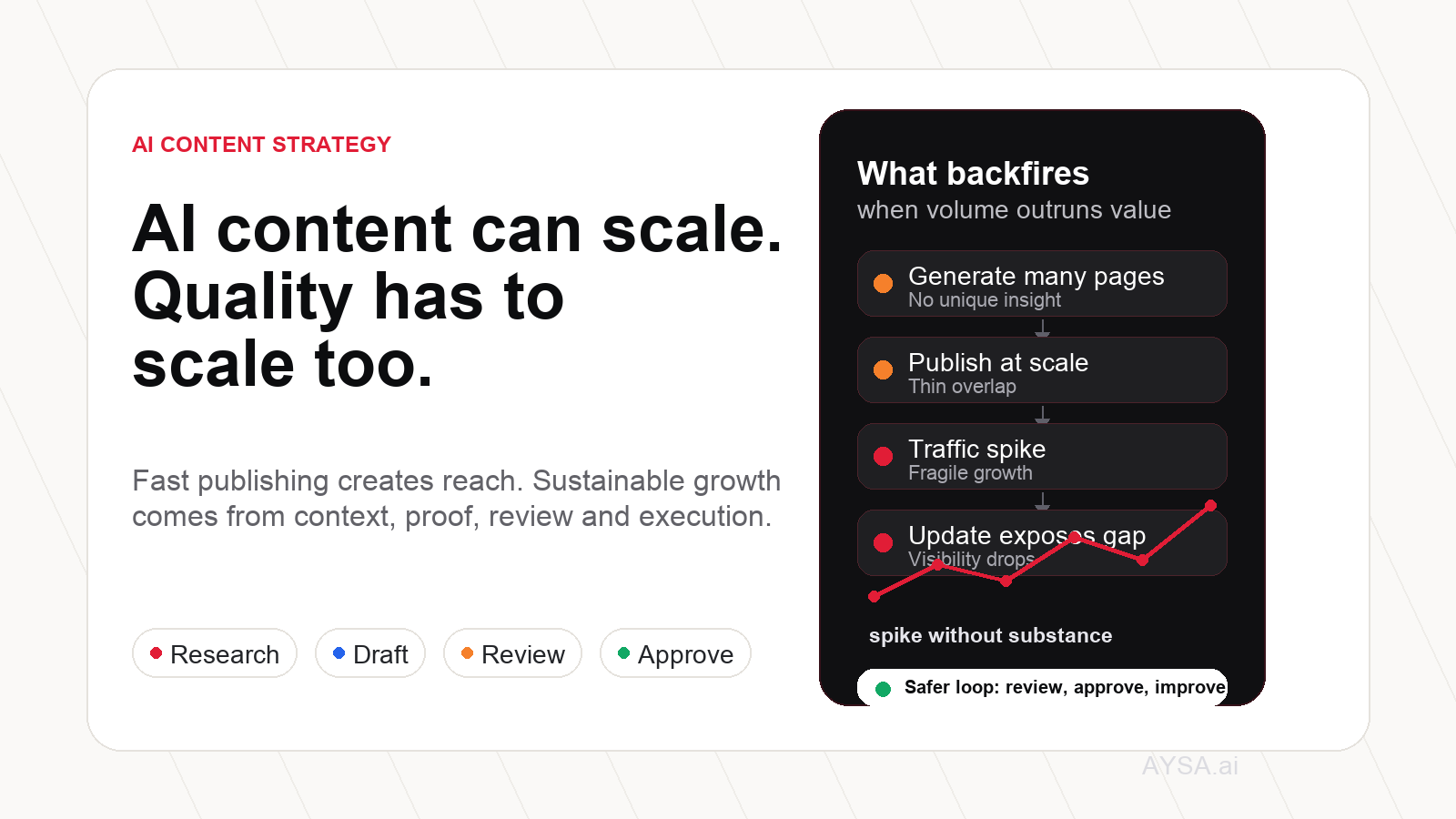
The problem is not AI content. The problem is ungoverned scaled content.
Google’s own documentation does not say that AI-assisted content is automatically bad. The quality question is whether the content is useful, reliable and created for people, not whether a specific tool helped produce it. Google’s people-first content guidance repeatedly points publishers back to the same practical question: does the page genuinely help the user, or was it created mainly to attract search visits?
Google’s spam policies also clarify the risk around scaled content abuse. The issue is not scale by itself. The issue is large-scale content creation that is designed to manipulate rankings and does not provide enough original value. That can happen with AI. It can also happen with cheap human rewriting, doorway pages, scraped content, programmatic templates, or thin location pages.
This distinction matters because the wrong conclusion leads to the wrong strategy. If a company says “AI content is dangerous,” it may avoid useful automation entirely. If it says “AI content is free traffic,” it may flood the site with weak pages. The mature position is different: AI can accelerate research, drafting, clustering, rewriting and optimization, but it needs a system that keeps the work grounded in facts, business context and user value.
Fragile content scale
- Start with Keyword volume only.
- Generate many similar pages.
- Publish with minimal review.
- Hope rankings survive.
Durable AI-assisted content
- Start with user need and business reality.
- Use data, Search intent and internal context.
- Review before publishing.
- Improve based on performance.
Why scaled AI content strategies backfire
Most failures are not caused by a single bad article. They are caused by a content operating model that rewards output before usefulness. When the system is built around “how many pages can we produce?” instead of “which pages deserve to exist?”, problems compound quickly.
1. The page answers the keyword, not the actual user
A keyword is not a customer. A Search query is not the full journey. For example, a parent searching for a private pediatric clinic in Bucharest may need more than a list of clinics. They may need criteria: emergency versus scheduled care, online booking, pediatric specialties, parking, reviews, insurance, location, waiting time and trust signals.
A weak AI page may produce a generic paragraph about “best pediatric clinics.” A useful page helps the parent compare options and decide what to do next. That difference is where durable content lives.
2. The site creates overlap faster than it creates authority
AI makes it easy to create ten pages that sound different but solve the same problem. That creates internal competition, diluted topical signals and pages that are hard to justify individually. A strong content system maps topics, clusters, entities and user intent before publishing.
For SMEs, this is especially important. A smaller site does not need thousands of mediocre pages. It needs the right pages: service pages, local pages, comparison pages, FAQs, buyer guides, problem pages, category pages and proof pages that work together.
3. The content lacks business-specific evidence
Generic AI output often misses the details that make a business trustworthy. It may not know the actual service area, delivery rules, appointment process, pricing model, guarantees, stock limitations, case studies, authority signals, certifications or customer objections.
This is why content quality is operational, not only editorial. A good SEO page often needs input from the business, Search Console, analytics, customer service, sales conversations, product data and competitive context.
4. Nobody owns the improvement loop
Publishing is not the end of SEO work. Search demand changes. Competitors improve. Google updates systems. AI Search surfaces new answer formats. A page that worked six months ago may need a better title, stronger intro, clearer schema, improved internal links, updated examples, better FAQs or a new section addressing a changed query pattern.
Scaled AI content backfires when teams treat publishing as a one-time event. Sustainable organic growth requires Monitoring and improvement.
5. The workflow skips approval and accountability
Many AI content programs fail because they move too fast for the business to trust them. The output goes from prompt to page without a clear approval step. That creates legal risk, brand risk, factual risk and SEO risk. A better system separates preparation from execution: the agent can prepare the work, but important changes should be reviewed and approved before they go live.
A safer AI content system for SMEs
SMEs should not try to copy enterprise content factories. They need a smaller, more practical system that turns AI into leverage without turning the website into a pile of generic pages.
A safer system starts with research. What do people actually search for? Which pages already receive impressions but underperform? Which topics are missing? Which competitors answer the question better? Which pages are thin, duplicated or poorly connected? Which local or industry details would make the page genuinely more useful?
Then comes content planning. Instead of publishing everything, the system should decide what deserves a page, what belongs inside an existing page, what should become a FAQ, what should become an internal link, and what should not be created at all.
Next comes review. The business owner or team should see what is being proposed, why it matters, what the expected benefit is, and what will change on the website. This is where AI becomes useful for non-specialists: it should explain the work in plain language, not bury the user in SEO jargon.
Finally, there is execution and monitoring. Approved changes need to be applied, tracked and improved over time. This is the step many SEO tools do not handle. They show the issue, but the business still has to interpret it, assign it, brief someone, copy-paste changes, test the page and monitor the result.
Where AYSA fits: from AI content volume to approved SEO execution
AYSA is built around a different assumption: SEO work should not stop at reporting or drafting. The system should learn the business, monitor the website, prepare useful actions, ask for approval and execute accepted changes inside the website workflow.
In the context of AI content, that means AYSA is not designed to flood a website with random pages. It is designed to identify where content work is actually needed: pages that receive impressions but do not satisfy the query, topics where the business lacks authority, missing pages that should exist, internal links that would clarify relationships, FAQs that make an answer easier to extract, and technical issues that reduce crawlability or indexability.
The important control layer is approval. AYSA can prepare titles, descriptions, content improvements, FAQs, internal links, content briefs and new content opportunities, but the business stays in control. Approved work can then move into execution without forcing the user to manually manage every SEO task.
That is the difference between “we used AI to publish more” and “we used AI to run a better SEO operation.” One creates volume. The other creates a controlled growth system.
A practical checklist before publishing AI-assisted content
Before publishing a new AI-assisted SEO page, ask these questions:
- Does this page solve a specific user need, or only target a keyword?
- Does it include business-specific information that a generic model would not know?
- Does it add something useful compared with the current top results?
- Is it connected to related pages through relevant internal links?
- Does it support SEO, AEO and AI visibility with clear structure and visible answers?
- Is the title written for click-through and accuracy, not just keyword inclusion?
- Are claims, examples and recommendations fact-checked?
- Has someone approved the page before publishing?
- Will the page be monitored after publishing?
If the answer is no to several of these, the page is not ready. AI can help improve it, but it should not be used as a shortcut around usefulness.
The strategic takeaway
AI content works until it doesn’t when the strategy is built on output instead of value. The next phase of SEO will not be won by the company that publishes the most pages. It will be won by the company that understands its customers, structures its knowledge clearly, keeps content useful, monitors change and executes improvements consistently.
For SMEs, that is good news. You do not need an enterprise content machine. You need a practical SEO operating system that helps you decide what to create, what to improve, what to approve and what to execute next.
Sources
Turn AI content into approved website execution.
AYSA helps SMEs monitor opportunities, prepare useful SEO and AI visibility work, request approval and execute accepted changes inside the website workflow.
Continue the AI search topic inside AYSA.
Use these pages to connect the article with AI SEO tools, AI visibility monitoring, AI Overviews and approved website execution.
Turn this topic into a website action plan.
Use these AYSA hubs to move from reading to technical fixes, AI visibility monitoring, research, glossary context and approval-first SEO execution.

