Rethinking Audience Targeting in the Signal-Loss Era
Signal loss is changing targeting. The practical answer for SMEs is not more dashboards, but better relevance, clearer intent, useful content, AI visibility and approved execution.
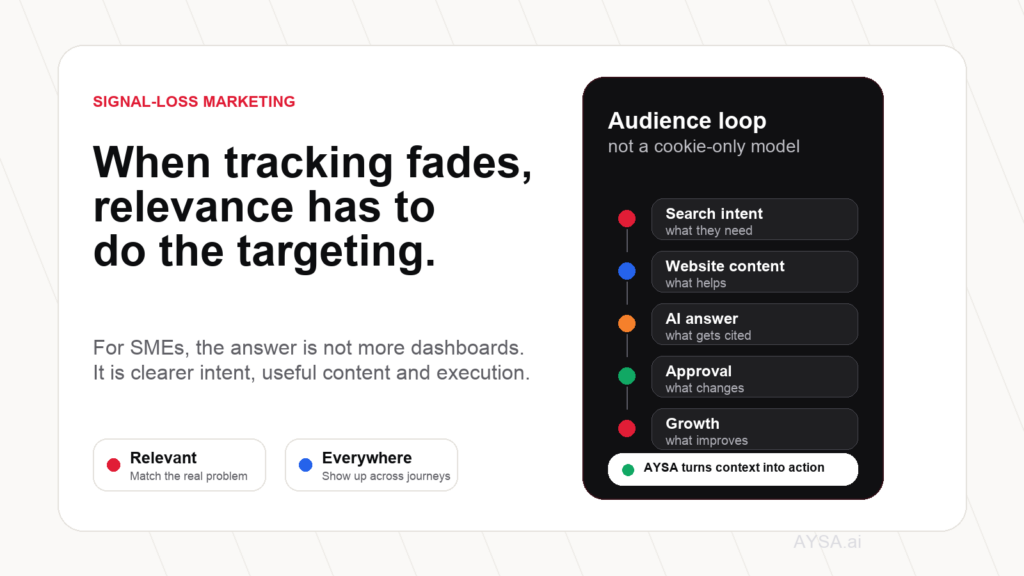
Executive summary: Audience targeting is becoming harder because marketers have less deterministic tracking, fewer clean user-level signals and more fragmented journeys. The answer is not to panic or chase every new platform feature. The answer is to build a relevance system: understand intent, create useful content, earn trust, measure what you can, and keep improving the website experience.
For SMEs, this matters because SEO, AEO and AI visibility are no longer separate from targeting. When people research, compare, ask AI assistants, read reviews and come back later, your website has to explain the business clearly enough to be found, understood, cited and chosen.
What signal loss changes
Search Engine Journal’s article about rethinking audience targeting in the signal-loss era points to a real shift: marketers can no longer assume that the same audience data, cookies, tracking signals and platform-level visibility will remain stable forever. Privacy changes, consent choices, browser restrictions, modeled conversions, fragmented journeys and AI-assisted discovery all make targeting less mechanical.
In the old model, a marketer could often think in terms of segments, pixels, retargeting pools and deterministic conversion paths. That world has not disappeared completely, but it is less reliable. More of the journey is now inferred, modeled or invisible. A user may discover a brand in TikTok, search on Google, ask ChatGPT for alternatives, read Reddit, visit comparison pages, ignore ads for a week, and then convert from a Branded Search or direct visit.
That is why the strongest marketing systems are moving from “who exactly can I track?” toward “what problem is this person trying to solve, and can my brand show up with the most useful answer at the right moments?”
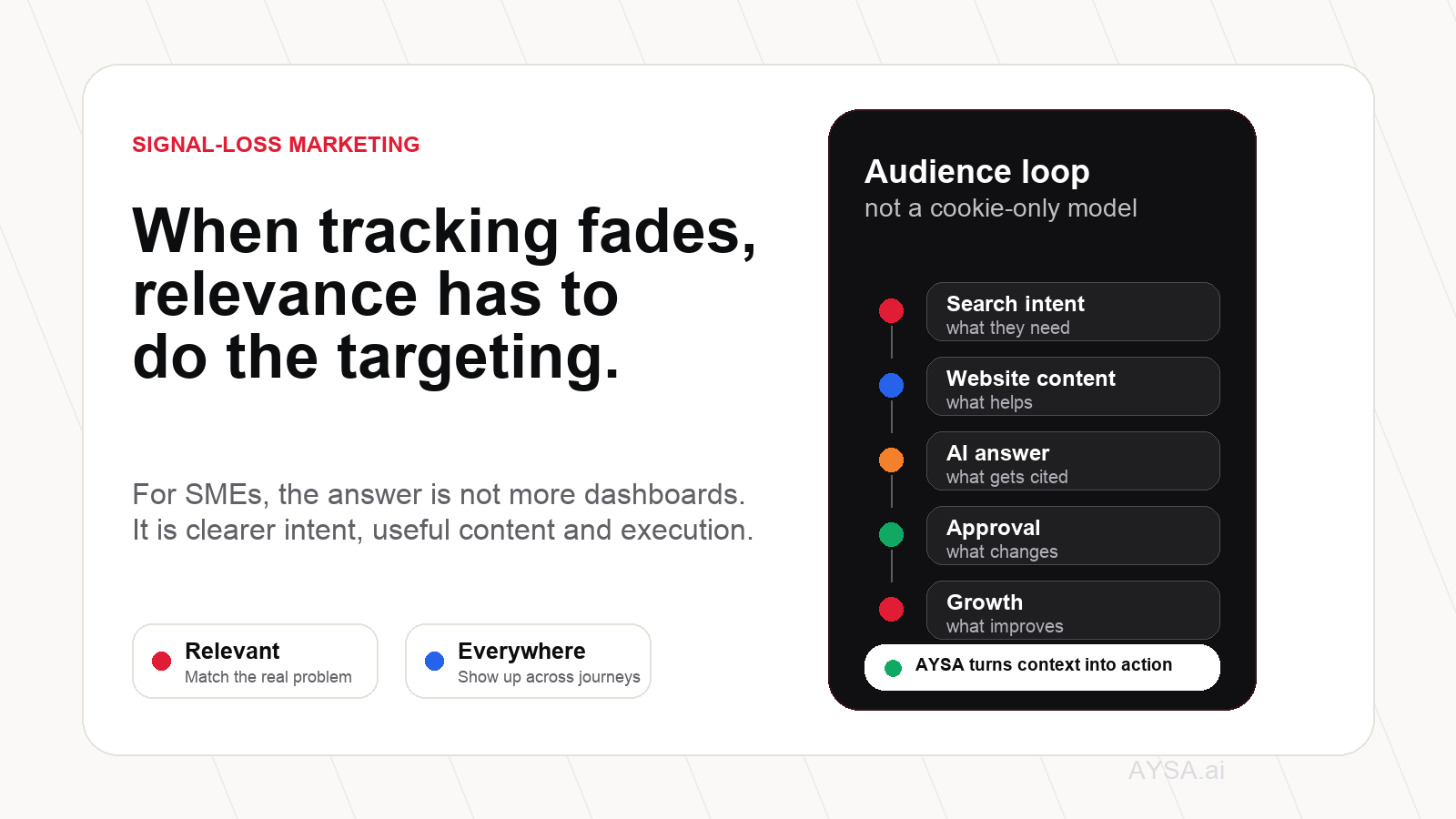
The REM idea: relevant, everywhere, memorable
The useful part of the REM framing is that it moves the conversation away from narrow targeting tricks. Instead of asking only “which audience can we target?”, it asks whether the brand is relevant, visible across the journey and memorable enough to be chosen when the user is ready.
Relevant means the message matches the real problem. If someone searches for “private pediatric clinic in Bucharest with online booking,” a generic clinic page is not enough. The user needs comparison criteria, trust signals, appointment options, location clarity, reviews, specialties and practical next steps.
Everywhere does not mean spamming every channel. It means the brand can be discovered and understood across the places where people evaluate options: Google Search, Google Business Profile, AI answers, review sites, social content, comparison pages, blog articles, landing pages and direct website visits.
Memorable means the user can understand why the business is different. In a signal-loss world, memory matters because you may not be able to follow every user with perfect retargeting. The website, content and brand evidence have to do more of the work.
Old targeting reflex
- Build more audiences.
- Retarget harder.
- Trust platform Attribution.
- Optimize only for tracked conversions.
Signal-loss response
- Map intent and decision stages.
- Create useful pages and proof.
- Measure with consent-aware tools.
- Improve the website continuously.
Where SEO, AEO and AI visibility fit
Audience targeting is not only an ads problem. It is also a search and content problem. If people cannot be tracked perfectly, the business has to become easier to discover when the user expresses intent. That is classic SEO. It also has to become easier to understand and cite when the user asks a more complex question in an AI interface. That is where AEO, GEO and AI visibility enter the conversation.
Google’s own research around the “messy middle” describes the complex space between trigger and purchase where people explore and evaluate. That model is useful because it explains why a user may move between channels repeatedly before deciding. In that environment, SEO content is not just a traffic acquisition layer. It is part of the decision system.
A good website helps users compare, understand risk, trust the business and take the next step. A weak website leaves too much work to ads and sales calls. In a world with weaker tracking signals, that difference becomes more expensive.
What SMEs should do instead of chasing perfect targeting
Small and medium businesses do not need to become data science departments. They need a practical operating model that connects marketing signals to website improvements.
Start with the questions customers actually ask. What do they compare before buying? What makes them hesitate? What proof do they need? Which service pages are unclear? Which Google Business Profile details are incomplete? Which pages get impressions but low click-through? Which topics are missing from the site? Which AI answers mention competitors but not your brand?
Then turn those insights into work: improve pages, rewrite titles, add comparison sections, answer questions, strengthen internal links, create content that covers real objections, clarify pricing or process where possible, and connect Google data to the website content plan.
This is not glamorous, but it is effective. The businesses that win in signal-loss marketing will be the ones that make themselves easier to choose, not only easier to target.
AYSA point of view: targeting becomes an execution problem
In our opinion, signal loss pushes marketing toward execution discipline. It is not enough to know that attribution is messy. It is not enough to say the customer journey is non-linear. The business still needs to improve the website, content, search visibility and AI visibility based on what the market is doing.
AYSA is built for that layer. It learns the business, reads website and Google performance context, identifies SEO and AI visibility opportunities, prepares approval-ready actions and executes accepted changes inside the website workflow. That means the business owner does not have to live in dashboards or manually translate every insight into implementation.
For a non-specialist, this is the important shift: AYSA does not ask you to become an SEO analyst, CRO expert, data engineer and content strategist at the same time. It turns audience and search context into concrete work that can be reviewed, approved and applied.
A practical signal-loss checklist for SMEs
- Make sure consent mode, analytics and conversion tracking are configured correctly.
- Do not judge performance from one dashboard alone.
- Build landing pages around real customer questions, not only campaign keywords.
- Improve Google Business Profile completeness for local discovery.
- Create comparison content for users in the evaluation stage.
- Monitor Search Console queries for intent shifts.
- Track AI visibility and whether your brand is easy to identify and cite.
- Use internal links to connect problem pages, service pages, guides and proof pages.
- Review important changes before publishing.
The strategic takeaway
Audience targeting is not dead, but it is changing. The more signals disappear or become modeled, the more valuable clear positioning, useful content, search visibility, AI visibility and website execution become.
The next competitive advantage for SMEs is not only better targeting. It is becoming the most understandable, helpful and trustworthy option when the customer is actively trying to decide.
Sources
Turn audience context into approved website action.
AYSA monitors search and AI visibility signals, prepares useful website improvements, asks for approval and executes accepted changes inside your website workflow.
Continue the AI search topic inside AYSA.
Use these pages to connect the article with AI SEO tools, AI visibility monitoring, AI Overviews and approved website execution.
Turn this topic into a website action plan.
Use these AYSA hubs to move from reading to technical fixes, AI visibility monitoring, research, glossary context and approval-first SEO execution.