GA4’s New Source Grouping & Hostname Filtering: The Attribution Cleanup Businesses Have Been Waiting For
Google Analytics is rolling out Source Grouping and hostname filtering—two small-sounding changes that can materially improve attribution, cross-channel reporting, and data quality. Here’s what changed, why it matters (especially with AI referrals like ChatGPT and Perplexity), and what SMEs and agencies should do next—with an execution plan you can operationalize inside AYSA.

Google Analytics just shipped two updates that look deceptively “minor” on a release note, but solve problems that quietly waste budget every month: Source Group (cleaner, standardized Source attribution) and hostname filtering (keeping unwanted domains out of your reporting).
If you’re a founder, marketer, or agency lead, here’s the uncomfortable truth: most Attribution debates aren’t really about attribution models—they’re about dirty inputs. When traffic sources splinter into dozens of labels (facebook vs fb vs m.facebook vs l.facebook, etc.), or your GA4 property collects events from staging domains and unknown hostnames, your dashboards turn into negotiation documents. Decisions slow down, confidence drops, and teams revert to “vibes” instead of evidence.
This editorial breaks down what changed, why it matters in a world that now includes AI-driven referrals (like ChatGPT and Perplexity), and what you should do next—especially if you’re trying to measure performance across SEO, paid, email, social, affiliates, and emerging AI discovery.
Concise summary
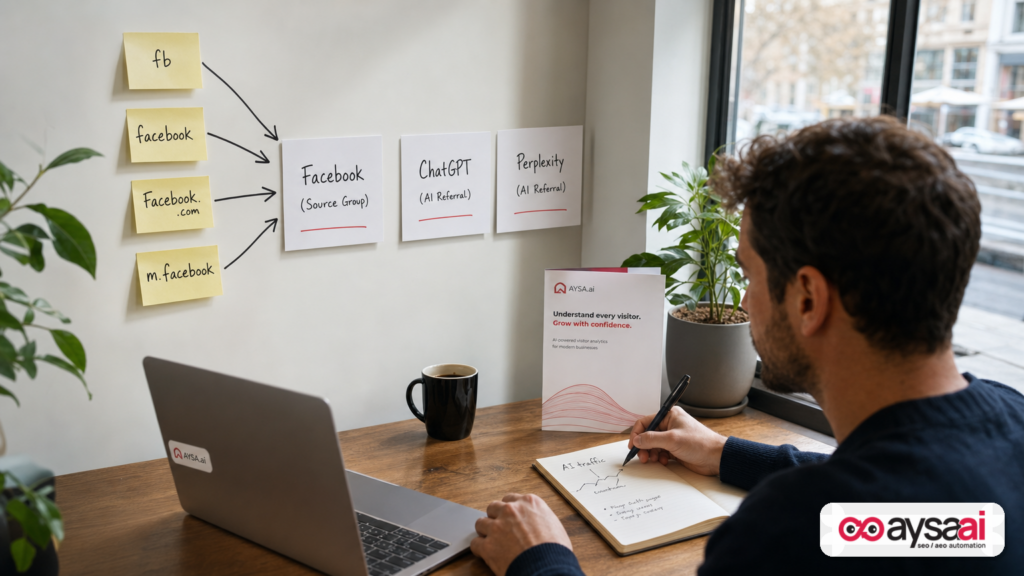
- Source Group is a new Google Analytics reporting dimension that consolidates messy source variations into standardized buckets, improving cross-channel reporting and attribution clarity.
- Hostname filtering gives you admin-level control to exclude events from unapproved domains before they pollute reporting—critical for data quality.
- The update explicitly recognizes AI traffic sources as part of modern acquisition, making it easier to track and compare them alongside traditional channels.
- None of this replaces good measurement governance: you still need UTM discipline, domain/checkout strategy, and ongoing Monitoring.
- AYSA’s strength here is operational: monitor → prepare → ask for approval → execute the fixes that keep your analytics decision-grade over time.
Key takeaways (for busy operators)

- Stop accepting fragmented channel reporting as normal. GA4 is moving toward standardization, and you should too.
- Data quality is now a competitive advantage. If competitors can see what works faster, they can out-iterate you.
- AI discovery is becoming measurable. Treat AI referrals like an emerging channel: track it, don’t guess.
- Hostname filtering is a governance tool. It’s not glamorous—but it prevents silent reporting corruption.
- Execution beats intention. Most teams know what to fix; few have a repeatable system to keep it fixed.
Table of contents

- What changed in Google Analytics (and what didn’t)
- Source Grouping: what it is, and why it matters
- AI referrals enter the attribution conversation
- Why hostname filtering is a bigger deal than it sounds
- Why Google is doing this now: fragmentation everywhere
- What can go wrong (even with the new features)
- A concrete SME scenario: the ecommerce brand that can’t explain revenue drops
- Agency implications: how reporting and strategy should change
- Build a measurement foundation that survives new channels
- A practical 30–60–90 day action plan
- The AYSA way: monitor → prepare → approve → execute (now applied to analytics hygiene)
- What to do next
- Sources and further reading
What changed in Google Analytics (and what didn’t)
According to Search Engine Land, Google Analytics is introducing two capabilities aimed at improving attribution analysis and data quality:
- Source Group: a new reporting dimension that standardizes multiple variations of the same traffic source into a single grouped value.
- Hostname filters: admin controls that let you exclude events from unapproved domains before those events enter reporting.
Also noted: Google is aligning its Source Platform field with the new grouping structure to keep classifications consistent across advertising channels.
What didn’t change: you still need to do the work of measurement design. GA4 can help you classify sources more cleanly, but it won’t magically fix:
- Broken or inconsistent UTM tagging
- Cross-domain tracking and checkout redirects
- Misconfigured referral exclusions
- Improper internal traffic filtering
- Undefined conversion events and poor event naming
In other words: GA4 just got better at turning chaos into order—if you set up guardrails.
Source Grouping: what it is, and why it matters
Source fragmentation is the unsexy problem behind many boardroom fights.
You’ve probably seen it:
- Facebook traffic appears as facebook, fb, m.facebook.com, l.facebook.com, Facebook, and more.
- Email traffic splits into newsletter, email, mailchimp, klaviyo, customer.io, and a dozen campaign-level naming patterns.
- Affiliate traffic shows up under inconsistent source values because partners tag links differently—or not at all.
The result isn’t just messy dashboards. It changes decisions:
- Budget misallocation: paid social “looks weak” because conversions are spread across multiple labels.
- False negatives: a channel appears to be shrinking when it’s actually being renamed.
- Argument-driven reporting: every monthly review becomes a debate about definitions, not outcomes.
Source Group’s purpose is straightforward: consolidate those variations into standardized categories so you can compare channels cleanly. Search Engine Land’s example: Facebook traffic can be grouped under one reporting value rather than scattered across multiple naming conventions.
One subtle but important detail: the update includes retroactive access to historical source group data (as reported), which means you can compare trends over time without rebuilding everything from scratch.
Why Source Grouping is strategic (not just cosmetic)
Channel reporting is the language your business uses to understand growth. When the language is inconsistent, the business becomes inconsistent.
Source Grouping improves three things that matter to SMEs:
- Speed: fewer hours spent cleaning exports and reconciling naming conflicts.
- Trust: teams can align on the same definitions and focus on performance.
- Comparability: you can evaluate TikTok vs Pinterest vs Facebook vs Amazon with less “apples-to-oranges” distortion—especially when Google standardizes beyond its own properties (as the source indicates).
In practical terms, this pushes businesses toward a better posture: use analytics to make decisions, not to justify decisions already made.
AI referrals enter the attribution conversation
The most future-facing piece of this update is not Facebook or TikTok. It’s the inclusion of AI traffic sources like ChatGPT and Perplexity in standardized source classification (as called out by Search Engine Land).
This matters because discovery is fragmenting beyond the classic “Google search → website” journey. Users increasingly:
- Ask AI assistants for recommendations
- Click through to sources selectively
- Compare options across multiple platforms before converting
And for many SMEs, the first sign of “AI as a channel” is confusing: a small trickle of referrals that no one owns, no one reports on, and no one optimizes.
GA4’s move toward standardizing these sources is a signal: AI discovery is becoming part of normal performance analysis, not a novelty.
What to measure (without overreacting)
If you’re an operator, the right approach is disciplined curiosity:
- Track AI referrals as a distinct line item so you can see trendlines.
- Measure quality, not just volume: engaged sessions, key events, assisted conversions.
- Compare landing pages: which pages get cited or clicked by AI-driven users?
AYSA’s angle here connects to AI visibility and execution: if AI tools are sending traffic, you want to ensure the pages they land on are fast, clear, and conversion-ready, and that your brand/entity signals are consistent. (More on that in the AYSA section.)
To explore the broader strategic implications of AI discovery, these research leads from the same Search Engine Land context may be helpful:
- Retrieval vs. citation: How AI search changes content strategy
- What new AI search data reveals about visibility and trust
- Claude visibility may depend heavily on Brave Search rankings, new data suggests
Those pieces aren’t required to understand GA4’s update—but they reinforce the same direction: AI visibility and AI referrals are becoming measurable work, not speculative talk.
Why hostname filtering is a bigger deal than it sounds
Hostname filtering is one of those features that only sounds boring if you’ve never had to explain a reporting anomaly to a CEO.
In plain English, your GA4 property can end up collecting events from places you don’t want, including:
- Staging sites and dev environments
- Scraped versions of your site
- Embedded experiences or misconfigured tags on partner domains
- Random hostnames that create “ghost” traffic patterns
Search Engine Land reports that Google is launching hostname filters in the Admin section so advertisers can exclude events from unapproved domains before they enter reporting.
That “before they enter reporting” part is the business win. It means:
- Cleaner KPIs (less junk inflating sessions, engagement, and event counts)
- Less time spent on forensic analysis
- More reliable conversion rates because denominators aren’t polluted
Hostname filtering as governance
If Source Grouping is about clarity, hostname filtering is about control.
Modern marketing stacks are messy: tag managers, consent tools, third-party pixels, embedded widgets, and multi-domain checkout flows. Over time, the surface area for measurement errors expands. Hostname filtering is a governance mechanism that helps keep GA4 aligned with business reality: “We measure these domains, and nothing else.”
Why Google is doing this now: fragmentation everywhere
This update isn’t happening in a vacuum. It’s a response to a market condition: the number of meaningful acquisition sources is exploding.
Even a small business might have:
- Google Search (SEO)
- Google Ads / Performance Max
- Meta paid + organic
- TikTok
- Affiliates
- Marketplaces (Amazon, etc.)
- AI referrals
Search Engine Land specifically notes standardization beyond Google properties, including platforms like TikTok, Pinterest, and Amazon, plus emerging AI-driven sources like ChatGPT and Perplexity. That’s an important acknowledgment: attribution has to work across the ecosystem, not just within Google’s walls.
The real problem GA4 is solving
Attribution isn’t hard because models are complex. It’s hard because naming and classification are inconsistent.
When your source data is fragmented, even the best model becomes unreliable. GA4 is trying to raise the floor by making source data more standardized by default.
What can go wrong (even with the new features)
These features help, but they won’t protect you from the most common measurement failures. Here are the failure modes I see repeatedly in real businesses—and how to think about them now that Source Grouping and hostname filtering exist.
1) UTM chaos still breaks everything
If one team uses utm_source=Facebook and another uses utm_source=fb, grouping will help, but you’re still creating avoidable ambiguity. UTMs are your contract with your future self.
What to do: create a one-page UTM policy (source, medium, campaign naming rules), and enforce it in every tool that sends links: email platform, social scheduler, influencer partnerships, affiliate templates.
2) Cross-domain journeys can still create attribution leaks
If you send users to a third-party checkout, payment portal, booking engine, or subdomain, your sessions and conversions can get split. Source Grouping doesn’t solve that; it only cleans up source labels.
What to do: map your top conversion journeys and list every domain involved. That same list becomes your hostname allowlist and your cross-domain measurement plan.
3) Over-filtering can hide legitimate data
Hostname filtering is powerful, and power cuts both ways. If you exclude a hostname that matters (for example, a booking domain, help center, localized subdomain, or a campaign landing domain), you can blind your reporting.
What to do: treat hostname filtering like production firewall rules: change it through a controlled process (review → approval → monitoring) and document why each hostname is included.
4) AI referrals can be misread as “the next big channel” too early
It’s tempting to see a new source (ChatGPT, Perplexity) and immediately shift strategy. The smarter move is to treat AI referrals as a signal: which pages, topics, or products are being surfaced—and what that implies about your content, authority, and brand clarity.
What to do: monitor AI referral landers and queries/themes; prioritize improvements that help users regardless of channel (clear product pages, stronger FAQs, better schema where appropriate, more trust signals).
A concrete SME scenario: the ecommerce brand that can’t explain revenue drops
Let’s make this real with a scenario I’ve seen variations of dozens of times.
Business: a $3–10M/year ecommerce brand selling specialty home goods.
Symptoms:
- The founder believes “Meta stopped working.”
- The performance marketer insists “it’s the checkout.”
- The operations lead says “returns are up, so ads must be attracting low-quality buyers.”
When we look at GA4, we see:
- Meta traffic split across multiple sources and referral patterns
- Email campaigns tagged inconsistently (some missing UTMs entirely)
- A staging domain sending events into the same GA4 property
- A new trickle of AI referrals landing on blog posts—untracked as a category
In that environment, everyone’s conclusion is plausible—and that’s the problem. When measurement is ambiguous, the loudest narrative wins. Not the most accurate one.
How these GA4 updates help:
- Source Grouping consolidates Meta source variants, so performance can be evaluated as a single platform line item.
- Hostname filtering blocks staging traffic and other unwanted hostnames, stabilizing baseline metrics.
- AI referrals become visible as a standardized source group, making it easier to monitor growth and landing-page quality.
What doesn’t automatically fix itself: email UTMs, checkout/cross-domain leaks, and Conversion event hygiene. That’s still on you (or your agency).
Agency implications: how reporting and strategy should change
If you run an agency, this GA4 change is not just “a new dimension.” It’s an invitation to modernize your reporting package.
Spend less time normalizing, more time optimizing
Historically, agencies have burned hours each month cleaning channel labels in spreadsheets or BI tools. Source Grouping should reduce that baseline cleanup. Use the reclaimed time for work clients actually feel:
- Landing page improvements
- Creative testing strategy alignment with outcomes
- Measurement design for new channels (AI referrals, retail media, etc.)
Add two sections to every monthly report
- Data quality / instrumentation status: hostnames, UTM compliance, conversion event integrity.
- Emerging channels watchlist: AI referrals trendline, engagement quality, and top landing pages.
This is how agencies move from “reporting numbers” to “owning a measurement system.”
Client trust is a measurement problem
In 2026, many clients are skeptical—not because agencies can’t drive performance, but because the client’s internal view of reality is fragmented. Cleaner source classification and hostname governance are trust multipliers.
Build a measurement foundation that survives new channels
GA4’s new features are useful—but they’re still features. The bigger win is using them as a reason to build a measurement foundation that survives the next wave of platform changes.
Measurement ops: the missing function in most SMEs
Most SMEs have marketing ops and sometimes RevOps, but almost nobody has “measurement ops.” Yet measurement touches:
- Budgeting
- Forecasting
- Hiring decisions
- Channel strategy
Source Grouping and hostname filtering push measurement ops closer to reality: define what you measure and keep it clean.
A practical minimum standard (SME-friendly)
If you want decision-grade analytics without turning into a data team, set these minimum standards:
- UTM policy: one page, enforced by templates and link builders.
- Hostname allowlist: all production domains and known necessary domains.
- Conversion definitions: a short list of outcomes that actually matter (purchase, lead submitted, booked call, etc.).
- Weekly anomaly review: 15 minutes to spot source spikes, hostname anomalies, and conversion drops.
- Quarterly measurement audit: revisit domains, platforms, and channel taxonomy.
A practical 30–60–90 day action plan
Here’s how I’d operationalize these GA4 changes without turning it into a six-month internal project.
First 30 days: stabilize the inputs
- Inventory your domains: primary site, subdomains, checkout/booking/help center, campaign landing domains.
- Turn on hostname filtering with an allowlist mindset (and document what you include).
- Audit top sources: list the top 30 sources in GA4; identify duplicates and obvious tagging problems.
- Define “AI referrals” reporting: add a simple line item in your channel review (even if volume is small).
Next 60 days: enforce naming discipline
- Publish a UTM naming policy and create templates for every team/vendor that shares links.
- Align internal reporting around Source Group as the default view for cross-channel comparisons.
- Fix cross-domain gaps that create self-referrals or session breaks in critical funnels.
By 90 days: turn it into a system
- Set monitoring alerts for new/unrecognized hostnames, source spikes, and conversion anomalies.
- Create an “instrumentation changelog” so every tracking change has an owner and a reason.
- Make AI visibility actionable: identify top AI referral landing pages and improve them (clarity, trust signals, FAQs, internal links, conversion UX).
The AYSA way: monitor → prepare → approve → execute (now applied to analytics hygiene)
I’m biased, but intentionally so: most businesses don’t fail because they lack recommendations. They fail because execution is inconsistent—and because changes happen without governance.
AYSA is built to operationalize SEO/AEO/GEO work the same way you’d want your analytics governance to operate:
- Monitor: detect issues and changes over time (traffic shifts, attribution anomalies, AI visibility signals). See how we think about ongoing oversight here: AYSA Monitoring.
- Prepare: compile what’s wrong, what to change, and the expected impact (no guessing; assumptions clearly labeled).
- Ask for approval: you stay in control—especially important for hostname filters and measurement rules that can hide data if misapplied.
- Execute accepted website changes: when the fix requires site updates (e.g., landing page improvements, internal linking, content clarification, technical cleanup), AYSA can execute the approved changes, removing the “we’ll get to it next sprint” bottleneck.
Where this intersects with the GA4 update:
- Cleaner sources make it easier to understand which pages and topics are pulling their weight—so execution priorities become clearer.
- Hostname governance reduces measurement noise—so you can trust your tests and content updates.
- AI referrals become measurable—so you can connect AI discovery to actual on-site outcomes and iterate accordingly.
If you want to explore the broader toolkit and visibility layer around AI-driven discovery, these AYSA resources are useful starting points:
Where execution matters most (and why I’m pushing this)
In the real world, attribution clarity only creates value if it changes what you do next:
- Which landing pages you fix
- Which content you expand or prune
- Which product pages you clarify
- Which channels you scale or pause
Source Grouping and hostname filtering make it more likely your “next step” is based on reality. AYSA is designed to make sure the next step actually happens—with approval and control.
What to do next
- Open GA4 and find the Source Group dimension in your reporting workflow. Compare it against your current default views.
- Create a hostname inventory of every legitimate domain in your customer journey (site, subdomains, checkout/booking, help center).
- Enable hostname filtering carefully (allowlist-first) and monitor for unintended exclusions.
- Audit your top sources and identify the “top 10” cleanup opportunities (UTM inconsistencies, self-referrals, partner traffic).
- Add AI referrals to your weekly channel review even if it’s small—trendlines matter more than today’s volume.
- Turn insights into execution: pick 3 pages that matter (top paid landing page, top SEO landing page, top AI referral landing page) and improve clarity + conversion UX.
- Operationalize it: set monitoring and a monthly instrumentation review so the data stays clean.
Sources and further reading
- Search Engine Land: Google Analytics adds source grouping and hostname filtering
- Search Engine Land: Retrieval vs. citation: How AI search changes content strategy
- Search Engine Land: What new AI search data reveals about visibility and trust
- Search Engine Land: Claude visibility may depend heavily on Brave Search rankings, new data suggests
- Search Engine Land: How travel brands can earn AI recommendations
Note: I’m intentionally not adding extra “official documentation” links here beyond the provided research context. If you want, I can revise this piece to include primary GA4 documentation links once you provide them in your research pack—without guessing or pretending to browse.
Continue the AI search topic inside AYSA.
Use these pages to connect the article with AI SEO tools, AI visibility monitoring, AI Overviews and approved website execution.
Turn this topic into a website action plan.
Use these AYSA hubs to move from reading to technical fixes, AI visibility monitoring, research, glossary context and approval-first SEO execution.