Claude, Brave Search, and the New Visibility Stack: How to Win When AI Answers Don’t Re-rank the Web
New data suggests Claude may rely heavily on Brave Search’s top results, often without re-ranking them. That changes what “AI visibility” means: it becomes measurable, monitorable, and—if you execute consistently—more winnable than many teams think.

AI answers are becoming the first “click” for a lot of customers. The uncomfortable part for business owners is that you can do everything right for Google and still feel invisible inside an AI assistant—or you can do very little and suddenly show up everywhere because your site happens to be one of the sources that assistant pulls from.
New analysis shared publicly suggests that Claude (Anthropic’s assistant) may depend heavily on Brave Search rankings when it does web search—and it may use the top results more literally than many marketers assumed. If true, that’s not a minor technical detail. It’s a roadmap for how AI visibility may work in practice: not as a mysterious “LLM vibe,” but as a pipeline from a real search index into AI answers with citations.
This article is my take (Marius Dosinescu, AYSA.ai) on what’s changing, why it matters to small and mid-sized businesses, how agencies should rethink deliverables, and how to build a measurable operating system for AI Search visibility—without chasing hype.
Concise summary
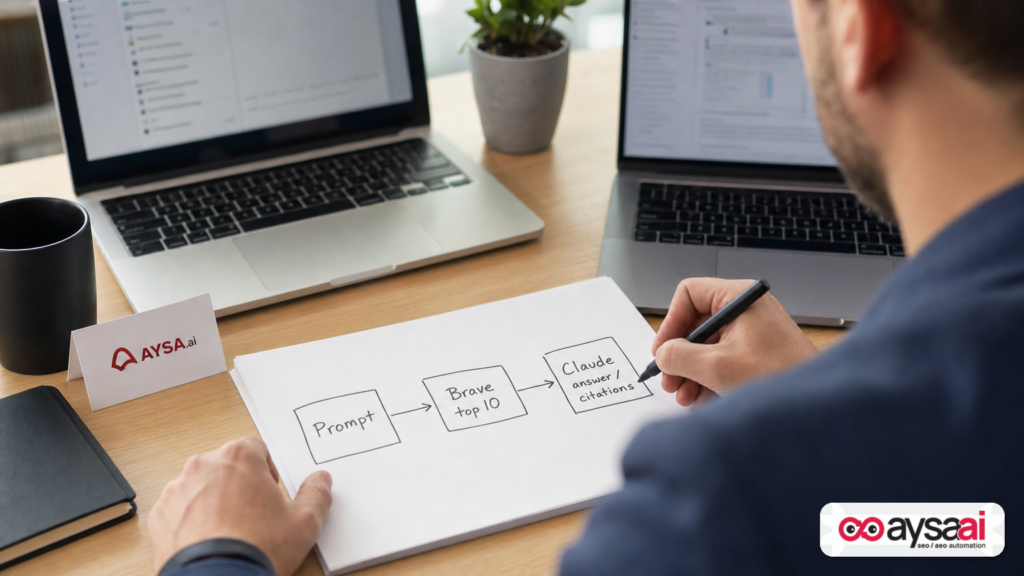
- Claude appears to use Brave Search results frequently for certain prompt types, and may rely closely on Brave’s top rankings rather than re-ranking them.
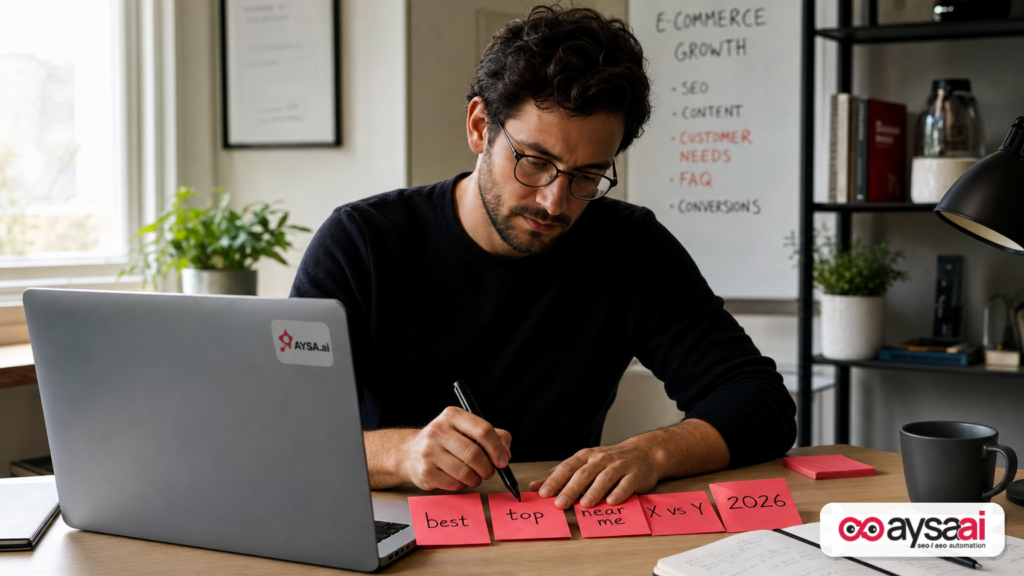
- Prompt intent matters. Queries that imply recency (“best”), rankings (“top”), location (“near me”), and comparisons (“X vs Y”) are more likely to trigger web search and citations.
- Visibility becomes more monitorable. If an AI assistant pulls from a known search engine’s top results, businesses can track rankings and correlate them with AI citations.
- The new playbook is operational: target the prompt patterns that trigger search, build content that deserves to rank, keep it fresh, and implement structured, technical foundations so your pages are easy to select and cite.
- AYSA.ai fits as an execution system that monitors, prepares recommended changes, asks for approval, and executes accepted improvements—turning “AI visibility” into a repeatable process rather than a one-off project.
Table of contents
- What changed: Claude may be using Brave’s top results more literally than you expect
- Why it matters: AI visibility is becoming an index-and-ranking problem again
- The prompt patterns that trigger web search (and why content teams should care)
- Retrieval vs. citation: the difference most teams are still missing
- If Brave is a major input, what does “rank in Brave” actually mean?
- The surprising implication: Google SEO may carry over to Claude more than you think
- The “year” effect and recency engineering (without spam)
- A practical SME scenario: the local clinic, the “best” query, and the visibility trap
- What can go wrong: failure modes, false confidence, and brand risk
- What to monitor now: a practical measurement framework for SMEs and agencies
- A 90-day action plan to earn AI citations that drive real business
- Where AYSA fits: from monitoring to approved execution (without breaking your site)
- What to do next
- Sources and further reading
What changed: Claude may be using Brave’s top results more literally than you expect

The core idea coming out of recent discussion in the search community is simple but powerful: Claude often pulls from Brave Search results, and in many cases may not do additional re-ranking of those results before using them in answers. The original reporting we’re working from is a Search Engine Land article summarizing observations shared by Jonathan Clark (Moving Traffic Media) from a “Zero Click by Profound” session.
Two practical implications fall out of that:
- AI visibility becomes legible. If a system is drawing from an identifiable top 10, you can measure your input position (ranking) instead of only measuring your output (did the AI mention me?).
- SEO becomes “closer” to the answer. Rather than an AI model synthesizing from a huge latent knowledge base, the answer can become a direct transformation of whatever the search engine surfaces.
Even if you treat the claims as directional (not absolute), the strategic shift is still real: many AI experiences are moving toward retrieval—pulling fresh sources from the web—especially for queries that imply timeliness, comparison shopping, or Local intent. That means search rankings are no longer just about Clicks. They’re about being selected as input data for AI answers.
Why it matters: AI visibility is becoming an index-and-ranking problem again
For the last two years, “AI visibility” has often felt like a black box. Brands ask:
- Why does one assistant cite Reddit threads while another cites Wikipedia?
- Why does my competitor show up when we have better content?
- Why do citations change from one day to the next?
If Claude is, in many cases, sourcing from Brave Search in a consistent way, that’s a partial answer: some AI visibility is simply downstream of a search index’s ranking behavior. That brings a few “old-school” truths back into focus:
- Rank matters more than ever—not because it drives a click, but because it earns you a seat at the AI’s table.
- Recency matters—because the prompt itself may cause a web search and bias toward up-to-date pages.
- Comparisons matter—because “X vs Y” prompts are exactly where users want a decision, and AI systems often retrieve sources to justify recommendations.
For SMEs, this is good news and bad news.
- Good news: you don’t need a massive brand to play. You need to be one of the most relevant, credible results for the intent.
- Bad news: if you’re invisible in the search engine the AI uses, you may never be seen—no matter how great your product is.
The prompt patterns that trigger web search (and why content teams should care)
One of the most useful parts of the Search Engine Land write-up is the emphasis on prompt patterns—the phrases people use that appear to make Claude more likely to search the web. The reported patterns include prompts that suggest:
- Recency: “best,” “top,” “latest,” “2026,” “updated”
- Rankings: “top 10,” “highest-rated,” “best reviewed”
- Location: “near me,” city names, “in Austin,” “close by”
- Comparison: “X vs Y,” “better than,” “alternatives”
If you’re a business owner, that list should sound familiar—because it matches how real customers shop:
- “Best running shoes for plantar fasciitis”
- “Top CRM for small law firm”
- “Best pizza near me”
- “Shopify vs WooCommerce for SEO”
Now the key insight: those are exactly the prompts where customers are closest to deciding. They’re not browsing definitions. They’re choosing a provider, product, or location. So the prompts most likely to trigger AI web search are also the prompts most likely to trigger revenue.
That changes content strategy. “What is…” content still matters for authority, but for many SMEs, the money is in:
- comparison pages that are actually fair and detailed,
- best-of pages that reflect real evaluation criteria,
- local pages that prove relevance and legitimacy,
- and updated pages that clearly signal what’s current.
Search Engine Land has also covered adjacent shifts in how people consume search without clicking—see Google zero-click searches hit 68% in early 2026: Study. Whether that specific number holds across your industry isn’t the point here—the direction is. More answers are being consumed directly in the interface. So the “why” behind creating these pages is evolving: it’s not only to earn traffic, but to earn selection.
Retrieval vs. citation: the difference most teams are still missing
There’s a mental model problem in the market: many teams treat “AI search” as one thing. In reality, there are (at least) two different layers:
- Retrieval: the system finds sources (often via a search engine index) to inform the answer.
- Citation: the system chooses which sources to show as references (and sometimes which to quote).
You can be retrieved and not cited. You can be cited and not clicked. And you can influence user perception even when the user never visits your site.
This distinction shows up directly in Search Engine Land’s coverage of strategy shifts: Retrieval vs. citation: How AI search changes content strategy. If you run marketing for an SME, this is the difference between “we ranked” and “we were recommended.”
My take: the near-term competitive advantage goes to teams that operationalize both layers:
- Build pages that can be retrieved (indexable, relevant, authoritative).
- Structure pages so they can be cited (clear claims, concise summaries, transparent criteria, scannable sections, and accurate statements).
In other words: rank to be considered; format to be used.
If Brave is a major input, what does “rank in Brave” actually mean?
“Rank in Brave” will sound foreign to most business owners because Brave isn’t the dominant consumer search engine in many markets. But if an AI assistant uses Brave as a Retrieval Layer, Brave becomes important even if your customers never open Brave themselves.
Here’s the practical framing:
- Brave rankings become an observable proxy for whether Claude is likely to see you as a source for certain web-search-triggering prompts.
- Rank tracking expands from Google-only to “indexes that AI assistants use.”
That doesn’t mean you should ignore Google. In fact, the reported overlap with Google rankings suggests the opposite (more on that below). But it does mean the SEO conversation should move from “Google vs AI” to “which indexes feed which AI answers.”
For agencies, this is also a deliverables shift. Historically, you reported:
- Google rank,
- Google Search Console clicks/impressions,
- GA4 sessions and conversions.
Now you may need to report:
- AI citations/share-of-voice for priority prompts,
- index-specific rankings where relevant (e.g., Brave),
- and content recency for pages tied to “best/top” and comparison queries.
This is exactly why we built monitoring-first workflows at AYSA: it’s hard to execute what you can’t observe. If AI assistants are pulling from different sources depending on intent, your monitoring needs to be intent-based too. (More on this in What to monitor now.)
The surprising implication: Google SEO may carry over to Claude more than you think
The Search Engine Land summary also notes that Claude’s results, in the dataset referenced, had higher overlap with Google rankings than with ChatGPT citations for the same prompts. That suggests a pragmatic takeaway: classic SEO investments may transfer into Claude visibility better than many teams expected.
Let’s be careful: we’re not claiming “rank in Google and Claude will cite you.” The web is messier than that. But if your content is already competitive in Google for “best/top/comparison” queries, you’re probably doing a lot of the fundamentals right:
- clear intent match,
- strong on-page structure,
- authority signals,
- and decent technical foundations.
So the strategic advice for most SMEs is not “start over for AI.” It’s:
- double down on the pages that already rank (and make them more cite-able),
- fill the comparison gaps where customers are deciding,
- refresh what’s stale so “best/top” prompts don’t bypass you.
Search Engine Land’s broader AI coverage supports this direction: there are multiple moving pieces (AI answer engines, ad products, schema adoption). For example, see Schema.org now shows you how many sites are using each schema type—a reminder that structured data adoption is measurable and competitive. While we shouldn’t assume any one AI system uses any one schema type in a specific way without direct confirmation, schema is still a durable best practice for machine readability and content clarity.
The “year” effect and recency engineering (without spam)
One of the more actionable observations in the Search Engine Land write-up is that Claude’s query expansions (fan-outs) often include years. This fits what we see in user behavior: people naturally add “2026” because they’re trying to avoid outdated advice.
Many marketers hear that and do the worst possible thing: change titles to “Best X (2026)” across the entire site without updating the content. That’s not recency; that’s cosmetic.
Recency engineering that holds up in both human review and AI synthesis usually includes:
- Real updates: new pricing, new features, current policies, current standards.
- Visible timestamps where appropriate: “Updated on…” plus a meaningful change log for important evergreen pieces.
- Fresh supporting evidence: updated references, updated screenshots (if you use them), and current examples.
- Clear scope statements: what changed since last year, and what stayed the same.
If you’re an SME, here’s the simplest safe version: pick your top 10 revenue-intent pages (product category pages, service pages, comparison pages, “best” guides) and commit to a quarterly refresh cycle. If your industry changes fast (software, marketing, healthcare policies), monthly may be better.
One important caution: Google has publicly said that LLMS.txt files won’t help or harm rankings (per Search Engine Land coverage: Google says LLMS.txt files won’t harm or help your search rankings). Whether other systems use such files differently is outside what we can verify from the provided research context—so treat this as a reminder not to chase “magic files” as a substitute for building genuinely useful, current pages.
A practical SME scenario: the local clinic, the “best” query, and the visibility trap
Let’s make this real.
Imagine a local physical therapy clinic in Phoenix. They rely on referrals, but they also get patients from search. Historically, their SEO goal was “rank top 3 for ‘physical therapy phoenix.’” That’s still valuable. But now consider how prospects actually search when they’re in pain and ready to book:
- “best physical therapy for runners Phoenix”
- “dry needling vs acupuncture which is better”
- “sports injury clinic near me open Saturday”
- “best PT clinic Phoenix 2026”
Those are recency, comparison, and location prompts—the exact kind that may trigger AI web search and citations. If Claude (or any assistant) searches the web for these and pulls from a limited set of top results, the clinic’s visibility becomes a ranking-and-coverage problem:
- Do they have a page specifically about runners’ injuries and rehab?
- Do they have a clear “services” page that defines dry needling, who it’s for, and how it compares?
- Do they have location/service-area signals and practical “open Saturday” details?
- Do they have credibility elements that a search engine (and an AI summarizing it) can trust?
The visibility trap is thinking: “We have a homepage and a services page; we’re done.” In AI search, thin pages are more likely to be ignored—even if you’re a great business—because retrieval systems need clear relevance signals and cite-able facts.
What would I do for this clinic?
- Build two comparison pages that answer the real questions patients ask (“dry needling vs acupuncture,” “PT vs chiropractor for X”) in a medically responsible way.
- Create a ‘best for’ hub that maps conditions and patient types (runners, desk workers, post-surgery) to services—without making exaggerated claims.
- Refresh local proof: practitioner bios, certifications, review policy, photos, hours, and “what to expect” details.
- Monitor rankings and AI citations for those high-intent prompts, then iterate.
This is not “content marketing.” It’s sales enablement for the AI layer of discovery.
What can go wrong: failure modes, false confidence, and brand risk
Whenever the market hears “AI uses top 10 results,” two instincts show up:
- Overconfidence: “Great, we’ll just rank and win.”
- Gaming: “Great, we’ll just manipulate titles and pump out comparison posts.”
Both can backfire. Here are the failure modes we see businesses fall into.
1) Treating AI visibility as a single metric
“Claude mentioned us once” is not a strategy. You need a prompt set tied to revenue (services, categories, alternatives), then measure share-of-voice over time. Otherwise, you’ll optimize for anecdotes.
2) Publishing shallow “best” lists without real criteria
If your “best” page is just affiliate-style fluff, you may not rank in any credible index—and even if you do temporarily, you risk brand damage. AI systems summarize what they retrieve; if what they retrieve is weak, your brand becomes associated with weak recommendations.
3) Chasing recency signals without updating substance
Slapping “2026” on the title without updating the body is a short-term move that can erode trust. Humans notice; algorithms often catch up.
4) Ignoring technical access
If your pages can’t be crawled reliably, have broken canonicals, or are blocked in ways you didn’t intend, none of the content work matters. AI retrieval is still built on crawling and indexing. The technical foundation is not optional.
5) Measuring the wrong outcome
Clicks are still important, but in AI search the new outcomes include:
- being cited for commercial prompts,
- being recommended as a category leader,
- being framed correctly (no hallucinated positioning),
- and converting brand demand downstream (direct, branded search, calls, demos).
Search Engine Land also points to a broader trust/visibility theme in AI search (see: What new AI search data reveals about visibility and trust). The operational lesson is that visibility and trust are now fused: you can’t “hack” your way into a trusted recommendation sustainably.
What to monitor now: a practical measurement framework for SMEs and agencies
If you’re an SME, you want a monitoring setup that is simple enough to run consistently and specific enough to drive decisions. Here’s a framework that works without requiring a data science team.
Layer 1: Prompt set (your “money questions”)
Create a list of 30–100 prompts tied to revenue. Put them in four buckets:
- Best/top: “best [category] for [use case]”
- Comparison: “[your category leader] vs [alternative]”
- Local: “near me,” city modifiers, “open now,” “emergency”
- Buyer intent: “pricing,” “reviews,” “trial,” “warranty,” “refund”
Layer 2: Index rankings where it matters
If Brave is a meaningful retrieval layer for Claude (as the Search Engine Land piece suggests), track:
- your ranking for those prompts in Brave (or Brave-powered results),
- your ranking in Google for the same prompts (because your overall SEO quality still matters),
- and which pages are ranking (not just whether your domain appears).
Layer 3: AI citations and framing
Track:
- whether you’re cited,
- which page is cited,
- what claim the AI associates with your brand (framing),
- and whether the recommendation is consistent across time.
Layer 4: Business outcomes
AI visibility that doesn’t move business metrics is vanity. Pick a small set:
- leads or purchases attributable to organic landing pages,
- branded search growth (as a proxy for demand),
- demo requests / calls / booking conversions,
- and assisted conversions (where possible).
AYSA helps teams run this as a system rather than a spreadsheet. Start with Monitoring, align it with your AI discovery goals via AI Search Visibility, then use recommendations and approved execution to close the loop.
A 90-day action plan to earn AI citations that drive real business
Here’s a practical plan you can run as an SME or agency. It’s intentionally operational—because in AI search, consistency beats cleverness.
Days 1–15: Build your “AI visibility map”
- Pick your prompt set: 30–100 queries across best/top, comparison, local, and buyer intent.
- Inventory your pages: which page should win each prompt? If you don’t have a page, that’s a gap.
- Baseline rankings: record where you stand (Google + any relevant index signals).
- Baseline AI visibility: check whether you’re cited and how you’re described.
If you need tooling and a guided workflow, start with AYSA’s resources at AI SEO tools and AI search visibility.
Days 16–45: Fix “retrieval blockers” and strengthen cite-ability
Focus on the fundamentals that help both rankings and AI selection:
- Technical clarity: ensure indexable pages, sane canonicals, clean internal linking, fast-enough performance.
- Intent match: rewrite introductions to answer the question in the first 5–10 lines.
- Scannable structure: use descriptive H2/H3s, decision criteria sections, pros/cons, and FAQ blocks where appropriate.
- Trust signals: show who wrote it, why they’re credible, and what evidence supports the claims.
This is also where structured data can help machines interpret your pages (without guaranteeing any specific AI outcome). Keep it honest: implement schema that reflects what’s on the page, not what you wish were true.
Days 46–75: Build the comparison and “best” assets your market is missing
Most SMEs underinvest here because it feels confrontational. But comparisons are where customers decide. Create:
- 1–3 “X vs Y” pages for the comparisons you already hear on sales calls.
- 1 “best for” guide that helps users self-select (best for beginners, best for enterprises, best for local delivery, etc.).
- 1 alternatives page that is fair, includes your weaknesses, and clarifies who you’re best for.
Search Engine Land has emphasized that content alone isn’t enough if it lacks real experience. Their coverage, AI can write SEO content, but it can’t replace real experience, aligns with what we see: AI can help draft, but only real operational detail earns trust and links—and gives AI systems something solid to summarize.
Days 76–90: Refresh, test, and lock in a cadence
- Refresh top pages that are close to ranking but not quite there (positions 4–15 are often the most leverage).
- Test titles responsibly for recency and clarity (“2026” only when the content truly reflects 2026 realities).
- Measure citations and framing across your prompt set, then iterate content sections that are being misinterpreted.
- Establish a cadence: monthly for fast-moving topics, quarterly for stable ones.
Where AYSA fits: from monitoring to approved execution (without breaking your site)
AI search visibility is not just a research problem. It’s an execution problem.
Most businesses can identify what they should do:
- refresh content,
- fix internal links,
- improve on-page structure,
- add comparison pages,
- tighten local relevance.
Where they fail is doing it consistently, safely, and fast—especially when stakeholders need oversight (founders, compliance, brand, dev teams).
AYSA is designed to turn that into an operating loop:
- Monitor what matters (rankings, AI citations, page health): AYSA Monitoring
- Prepare recommended improvements (content structure, technical fixes, internal linking plans) tied to business goals
- Ask for approval so changes are reviewed—no silent edits, no surprises
- Execute accepted website changes so momentum doesn’t die in a backlog
This matters more in AI search because the feedback loop is faster and more volatile. When citations shift with recency and prompt patterns, you need a system that can:
- spot the change,
- propose the fix,
- get it approved,
- ship it,
- and measure again.
If you want to explore how this fits your business size and workflow, see AYSA pricing and browse implementation ideas on the AYSA blog.
What to do next
- Pick 30 prompts that represent your highest-intent customer questions (best/top, comparison, local, pricing/reviews).
- Identify the “right page” for each prompt (or mark it as a content gap).
- Refresh your top 10 pages with real updates, not just new dates.
- Build one comparison asset you’ve been avoiding (the one prospects ask about on calls).
- Start monitoring rankings + AI citations weekly so you can correlate inputs (rank) to outputs (citations).
- Operationalize execution: assign owners, approval rules, and a monthly cadence.
Sources and further reading
- Search Engine Land: Claude visibility may depend heavily on Brave Search rankings, new data suggests
- Search Engine Land: Retrieval vs. citation: How AI search changes content strategy
- Search Engine Land: Google zero-click searches hit 68% in early 2026: Study
- Search Engine Land: Schema.org now shows you how many sites are using each schema type
- Search Engine Land: Google says LLMS.txt files won’t harm or help your search rankings
- Search Engine Land: What new AI search data reveals about visibility and trust
- Search Engine Land: AI can write SEO content, but it can’t replace real experience
Related AYSA resources:
Continue the AI search topic inside AYSA.
Use these pages to connect the article with AI SEO tools, AI visibility monitoring, AI Overviews and approved website execution.
Turn this topic into a website action plan.
Use these AYSA hubs to move from reading to technical fixes, AI visibility monitoring, research, glossary context and approval-first SEO execution.