
Google Ads Makes Target CPA and Target ROAS Standalone: Why This “Small” UI Change Will Reshape How SMEs Run Paid Search
Google Ads is surfacing Target CPA and Target ROAS as standalone Smart Bidding strategies instead of optional targets. That sounds cosmetic—but it changes how teams choose goals, evaluate performance, and scale budgets. Here’s what changed, what can break, and the practical playbook for SMEs and agencies.

Google Ads appears to be changing how it presents Smart Bidding choices during campaign setup—surfacing Target CPA and Target ROAS as standalone bidding strategies rather than optional targets layered onto “Maximize Conversions” and “Maximize Conversion Value.” The reporting and optimization logic may not be changing, but the decision flow for advertisers absolutely is.
As someone who’s spent a career watching “small” platform tweaks create big operational mistakes, I don’t see this as a cosmetic refresh. I see it as a nudge: Google wants more advertisers to make an explicit commitment to a target earlier—and to treat Target CPA/ROAS as a first-class choice, not an advanced setting.
This editorial breaks down what changed, why it matters, what can go wrong (especially for SMEs), and what I’d do next if I were running search for a local business, an ecommerce brand, or an agency managing dozens of accounts. I’ll also explain how AYSA fits into the execution side of this shift—because in 2026, the bottleneck is rarely strategy. It’s getting the right changes shipped across tracking, landing pages, and site quality without breaking things.
Concise summary
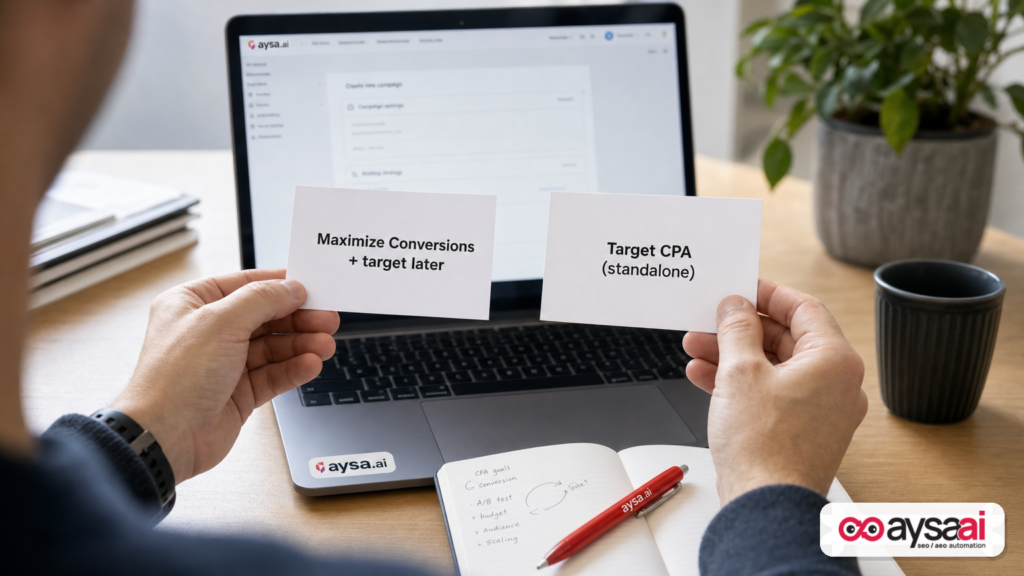
- What changed: Google Ads is reportedly listing Target CPA and Target ROAS as their own bidding strategies in the campaign setup menu.
- Why it matters: This changes advertiser behavior. More people will pick a target-based strategy earlier, which can improve clarity—but also increases the risk of setting unrealistic targets, misaligning measurement, or locking in too tight too soon.
- What to do: Re-validate Conversion tracking, value rules, and reporting; pick a target that reflects business reality; implement guardrails; monitor learning volatility; and ensure landing pages + site experience support the promise your ads make.
- Where AYSA fits: AYSA helps you monitor organic and AI Search visibility, prepare prioritized site fixes, request approval, and execute accepted changes—so paid traffic lands on pages that convert and build durable brand demand over time.
Table of contents

- What changed in Google Ads (and why UI changes are never “just UI”)
- Why Google would separate Target CPA and Target ROAS now
- The practical difference between Target CPA and Target ROAS (in plain English)
- Who benefits from the change: SMEs, in-house teams, and agencies
- What can go wrong: common failure modes after the change
- Measurement is the real bidding strategy: conversion tracking, values, and attribution limits
- How to choose a target without sabotaging performance
- The SME scenario: local clinic vs ecommerce store—who should pick which strategy?
- Agency operations: standardizing strategy selection without becoming cookie-cutter
- What to monitor weekly (and what to ignore)
- Where AYSA.ai fits: approved execution across organic + AI search + conversion readiness
- What to do next: a practical action list
- Sources and further reading
What changed in Google Ads (and why UI changes are never “just UI”)

According to reporting from Search Engine Land, advertisers are seeing a revised bidding strategy selection interface where Target CPA and Target ROAS appear as standalone options during campaign setup. Historically, many advertisers chose “Maximize Conversions” or “Maximize Conversion Value” first, then optionally applied a target constraint (CPA or ROAS).
This matters because the order of decisions shapes outcomes:
- If the workflow asks you to “maximize” first, you tend to start broad and tighten later.
- If the workflow asks you to choose “target-based” first, you tend to pick a number early—even when the business isn’t ready to defend that number.
In other words, Google is making target-based bidding feel like a primary decision, not an advanced tuning knob. That’s a big behavioral nudge.
Why Google would separate Target CPA and Target ROAS now
We should be cautious about assigning intent without an official product note. But we can make a grounded inference: Google Ads has been steadily pushing toward simplified automation choices that are easier to explain at setup time and easier to standardize across advertisers.
The Search Engine Land piece also points to speculation that this could connect to upcoming changes (with a date mentioned in that coverage). I won’t treat that as confirmed platform behavior here. The only safe conclusion is that Google is continuing to refine how advertisers interact with Smart Bidding—and the platform’s default “shape” influences how billions in spend gets configured.
From an operator perspective, this separation likely aims to:
- Reduce confusion for newer advertisers who don’t realize a target turns a “maximize” strategy into something materially different.
- Make strategy selection feel more explicit: cost goal vs value goal.
- Encourage adoption of target-based automation (which can work well when measurement is solid).
That last clause—measurement—decides whether this change helps or hurts your business.
The practical difference between Target CPA and Target ROAS (in plain English)
If you strip away the platform language, the difference is simple:
Target CPA: “Get me conversions at about this cost.”
Target CPA is generally the right mental model when:
- All conversions are roughly equal (e.g., a booked consultation, a lead form, a trial signup).
- You can’t reliably assign conversion value (or the value varies wildly and you don’t trust the numbers yet).
- You care about cost per outcome and you have enough conversion volume to support learning.
Target ROAS: “Get me revenue (value) efficiently.”
Target ROAS becomes compelling when:
- Order values vary and the business genuinely wants more of the higher-value outcomes.
- You can pass trustworthy conversion values into Google Ads (typically revenue, margin proxies, or qualified-lead value rules).
- You’re willing to accept fewer total conversions if the value is better.
Here’s the editorial truth: Target ROAS is only as good as your value design. If value inputs are wrong, ROAS optimization can become “optimize for nonsense at scale.” That’s how companies end up with campaigns that look profitable in-platform but don’t reconcile with cash in the bank.
Who benefits from the change: SMEs, in-house teams, and agencies
On paper, this UI change helps everyone. In practice, different groups will experience it differently.
SMEs and first-time advertisers
SMEs often want one thing: predictable acquisition cost. A standalone “Target CPA” option feels like a straightforward promise. That can be positive—if it pushes business owners to define what a lead is worth.
But it can also invite premature precision. Many SMEs don’t have stable conversion tracking or enough conversion volume for tight targets. If the UI nudges them to pick a specific number too early, they may choke the campaign, reduce reach, and conclude “Google Ads doesn’t work.”
In-house marketers
In-house teams benefit from clarity. Separating target-based strategies can reduce training overhead and help standardize internal playbooks: “Leads = CPA; revenue = ROAS.”
The risk: teams might treat it as a one-time setup choice instead of an ongoing tuning process. Targets often need to be adjusted as seasonality, competition, and conversion rates change.
Agencies
Agencies win if this reduces client confusion during onboarding: “We’re using Target CPA” is easier to explain than “We’re on Maximize Conversions with a tCPA constraint.”
But agencies also face a governance challenge: more explicit strategy options means more room for inconsistent configuration across accounts, especially if different team members interpret “Target ROAS” differently (revenue vs gross profit vs assigned value).
What can go wrong: common failure modes after the change
This is where the “small UI change” becomes expensive. When targets become more prominent, the following problems show up more frequently:
1) Choosing a target that reflects hope, not history
Many advertisers set a target based on what they want to pay, not what the market can deliver today. Smart Bidding can’t bend reality—if your offer, landing page, or competition doesn’t support that efficiency, the system will respond by buying less traffic.
2) Confusing business outcomes with platform conversions
If your conversion action is “page view,” “time on site,” or an unqualified lead form, Target CPA will optimize toward cheap events—not customers. That’s not a Google problem. That’s a definition problem.
3) Switching strategies too often
Advertisers under pressure tend to bounce between Maximize Conversions, Target CPA, Target ROAS, and back again. Each switch can disrupt learning and make weekly performance look chaotic. Strategy changes should be treated like controlled experiments, not emotional reactions.
4) Target ROAS with shaky value inputs
If values are inconsistent (e.g., duplicates, missing revenue, inflated values, or mixed currencies), ROAS becomes misleading. Even if the campaign “hits ROAS,” you may be optimizing toward faulty signals.
5) Reporting drift: the dashboard says “good,” the business says “bad”
This is the most common executive-level conflict: marketing reports one metric; finance sees another. That gap widens when the platform UI makes targets feel authoritative. Targets are only as trustworthy as the measurement pipeline behind them.
Measurement is the real bidding strategy: conversion tracking, values, and attribution limits
Before you debate Target CPA vs Target ROAS, answer a more important question: What exactly are we measuring—and what are we missing?
At a high level, Smart Bidding relies on conversion signals. If those signals are incomplete, delayed, or poorly defined, you’re asking the algorithm to steer with blurry vision.
What you should validate (without pretending perfection exists)
- Conversion definition: Does the conversion action represent meaningful intent (qualified lead, purchase, booked appointment), or is it a proxy?
- Duplication controls: Are conversions deduped across tags and platforms?
- Value logic: If you use ROAS, are values consistent and aligned to business value (not vanity)?
- Lag awareness: If your sales cycle is long, what you see today may not reflect what you sold today.
For deeper context on the broader measurement debate in paid media—what Attribution tells you vs what incrementality can validate—I recommend this related Search Engine Land piece: Attribution vs. incrementality: Why you need both. It’s a useful reminder that “platform-reported truth” is not the same as “business truth.”
Also, Google’s own guidance is typically the most authoritative place to confirm how bidding strategies and conversion measurement work. I’m not including specific Google help-center links here because they were not provided in the supplied research context, and I won’t pretend to have browsed them. If you’re reading this in a team setting, make “official Google Ads documentation review” part of your internal enablement.
How to choose a target without sabotaging performance
Targets are constraints. Constraints create tradeoffs. The platform won’t tell you which tradeoff you’re making—your business has to decide.
Step 1: Choose your north-star metric (cost or value)
- If your primary business constraint is cash flow and predictable lead cost, you’re likely in Target CPA land.
- If your constraint is profitability and scaling high-value orders, ROAS may be appropriate—if value measurement is real.
Step 2: Start with a target that leaves the system room to buy
The most common mistake is starting too tight. When you squeeze too hard, the system can respond by:
- Reducing auction participation
- Prioritizing only a narrow set of queries/audiences
- Over-optimizing toward low-risk traffic that doesn’t grow your business
Step 3: Don’t treat a target as permanent
Targets should be reviewed as conditions change:
- Seasonality (holidays, summer slowdowns)
- Competitive pressure
- Landing page Conversion rate improvements
- Offer changes (discounts, bundles, new services)
Step 4: Align reporting to the chosen target (and disclose what it can’t prove)
If you optimize to CPA, report CPA—plus lead quality downstream. If you optimize to ROAS, report value—plus refund rate, repeat purchase rate, or margin proxies where possible. The business should know what the metric doesn’t capture.
The SME scenario: local clinic vs ecommerce store—who should pick which strategy?
Let’s make this real with two businesses that show up in our world all the time.
Scenario A: a local clinic selling appointments
A clinic runs search ads for “sports injury doctor near me” and “physical therapy appointment.” Their best outcome is a booked appointment, but they may not have clean revenue attribution back to ads (especially if payment happens later, by insurance, or offline).
Likely best fit: Target CPA (or a maximize strategy until enough data exists), with a conversion action tied to a high-intent step (e.g., appointment booked or confirmed call). The clinic should also track lead quality: show rate, new patient rate, and downstream revenue—but not pretend that ROAS is reliable if values are fuzzy.
Scenario B: an ecommerce store with variable order values
An ecommerce brand sells products ranging from $20 accessories to $600 bundles. If they optimize only to conversions (or CPA), the system might prefer the cheaper products because they convert easily—even if they don’t grow profit.
Likely best fit: Target ROAS (or maximize conversion value) if revenue tracking is trustworthy and value signals are consistent. If values are wrong, they should fix measurement before trusting ROAS targets.
Both businesses should remember: bidding strategy cannot rescue a weak landing page. This is where paid search and organic/AEO/GEO execution converge—your site experience must deliver on the query’s promise.
Agency operations: standardizing strategy selection without becoming cookie-cutter
Agencies are going to see this UI change and do one of two things:
- Standardize responsibly with a decision framework that maps client economics → measurement maturity → bidding choice.
- Standardize lazily with “we always use Target CPA” or “we always use Target ROAS,” regardless of data quality.
The second approach is how churn happens.
A framework agencies can use
- Measurement maturity: Are conversions reliable? Are values reliable?
- Business model: Lead gen vs ecommerce vs subscription vs mixed.
- Volume reality: Enough conversions to learn?
- Offer strength: Are we selling something the market wants at a competitive price?
- Landing page readiness: Does the page match intent and remove friction?
If that sounds like “strategy,” good. But strategy without execution is theater. Agencies that win will operationalize these checks into onboarding, QA, and ongoing Monitoring.
What to monitor weekly (and what to ignore)
When targets become more prominent, teams can become overly reactive to daily fluctuations. You need a disciplined monitoring rhythm.
Weekly monitoring checklist (practical and non-nerdy)
- Conversion volume trend: Is the campaign still generating enough outcomes to learn?
- Cost efficiency vs target: Are you drifting far from target, and is that drift persistent?
- Value quality (if ROAS): Are you seeing value distribution changes (more low-value orders, fewer high-value orders)?
- Search intent drift: Are queries becoming less relevant? (This is often a targeting/keyword governance issue.)
- Landing page conversion rate: If it drops, bidding can’t fix it.
What to ignore (or at least de-emphasize)
- Single-day CPA/ROAS spikes unless you can tie them to a clear cause (site outage, promo, tracking break).
- Vanity engagement metrics that aren’t your conversion action.
This is also where organic search and AI search visibility play a role. If paid performance gets more volatile, strengthening your durable visibility channels reduces reliance on any one bidding configuration.
Where AYSA.ai fits: approved execution across organic + AI search + conversion readiness
This Google Ads change is happening in a world where search is not just “ten blue links.” Businesses now have to think about:
- Organic search visibility
- AI search visibility (AEO/GEO: how your brand appears in AI answers and summaries)
- Paid search efficiency and the landing experience that turns clicks into outcomes
AYSA is built for the execution gap that most SMEs and lean teams face. You don’t just need a recommendation—you need a system that:
- Monitors what’s changing and what’s slipping
- Prepares the right fixes with clear impact and priority
- Asks for approval so humans stay in control
- Executes accepted website changes safely and consistently
Here’s how that ties back to paid search bidding choices:
- If you choose Target CPA, your landing pages must convert reliably—AYSA can help improve content clarity, intent matching, and technical readiness that affects conversion rate. Start with Monitoring.
- If you choose Target ROAS, your site must communicate value clearly (product pages, pricing, shipping/returns, trust). AYSA supports ongoing improvements that reduce friction and improve conversion quality. Explore AI SEO tools.
- If you want less dependency on paid volatility, invest in durable visibility via AI search visibility—so you aren’t forced into target constraints that suffocate growth.
AYSA doesn’t replace your media buyer or your Google Ads account. It strengthens the foundation those campaigns land on—so Smart Bidding has a real chance to succeed.
If you’re evaluating whether that execution model fits your team, you can review Pricing and browse practical implementation ideas on the AYSA blog.
What to do next: a practical action list
If you opened Google Ads tomorrow and saw Target CPA/ROAS as standalone strategies, here’s the action plan I’d recommend.
1) Decide what you’re truly optimizing for
- Leads/appointments? Start with CPA thinking.
- Revenue/value? ROAS thinking—only if value measurement is trustworthy.
2) Audit conversion definitions before changing bidding
- Is the conversion action meaningful?
- Are you double-counting?
- If using ROAS, are values consistent?
3) Set realistic initial targets (avoid over-tightening)
- Avoid choosing the most aggressive number on day one.
- Give the system room to buy traffic and learn.
4) Create guardrails for your team
- Define when you’re allowed to change the target (and by how much).
- Define what counts as a “tracking emergency” vs normal volatility.
5) Improve the landing experience—because bidding can’t fix broken conversion paths
- Match landing page content to search intent.
- Reduce friction: speed, clarity, trust signals, forms.
- Coordinate paid messaging with organic/AEO pages so your brand story is consistent.
6) Add durable visibility so paid doesn’t carry the whole growth plan
- Invest in organic + AI search visibility improvements.
- Use AYSA to monitor, propose, approve, and execute ongoing site improvements: AYSA Monitoring
Sources and further reading
- Search Engine Land: Google Ads appears to separate Target CPA and Target ROAS bidding strategies
- Search Engine Land: Attribution vs. incrementality: Why you need both
- Search Engine Land: Putting Google Ads AI Max’s automated ad copy to the test
- Search Engine Land: Google rolls out AI content labels in asset studio
- Search Engine Land: ChatGPT Ads adds conversion bidding, geo exclusions and bulk campaign tools
Related AYSA resources:
Author: Marius Dosinescu / AYSA.ai
Continue the AI search topic inside AYSA.
Use these pages to connect the article with AI SEO tools, AI visibility monitoring, AI Overviews and approved website execution.
Turn this topic into a website action plan.
Use these AYSA hubs to move from reading to technical fixes, AI visibility monitoring, research, glossary context and approval-first SEO execution.

