
Google Delays DSA to AI Max: What Advertisers Should Do Now (and How to Control the Transition)
Google moved the automatic Dynamic Search Ads (DSA) migration deadline to February 2027 and briefly re-opened DSA creation. That sounds like a reprieve—but it’s really a transition window. Here’s what changed, why it matters, what can break during migration, and a practical plan for SMEs and agencies to test AI Max without losing control of performance.

Google just gave advertisers something rare in modern ad tech: time.
The automatic migration from Dynamic Search Ads (DSA) to AI Max for Search campaigns is now delayed until February 2027, and Google is temporarily restoring the ability to create new DSA campaigns (with creation expected to end again in January 2027). That’s the headline. The deeper story is that Google is still moving toward an AI-first Search workflow—and advertisers who treat this as a “DSA extension” rather than a transition window will get caught flat-footed.
This editorial is a practical playbook for business owners, in-house teams, and agencies: what changed, why it matters, what can go wrong, and how to test AI Max in a controlled way. I’ll also explain where AYSA.ai fits as an execution system—because the hardest part of this transition isn’t a campaign toggle. It’s the downstream operational work: landing pages, measurement, content, and approvals.
Concise summary
- Google delayed the automatic DSA upgrade to AI Max for Search by about five months, moving it from September 2026 to February 2027, while temporarily allowing new DSA creation again.
- This is not a reversal. Google is still making AI Max the default for new Search campaigns and is clearly steering advertisers toward automated matching + Smart Bidding.
- The delay is best used to run side-by-side tests and to fix the measurement and landing-page foundations that AI-driven campaigns depend on.
- SMEs and agencies should treat the next months as a migration program: audit DSAs, map pages/queries to business outcomes, and create a controlled rollout plan.
- AYSA.ai helps by continuously Monitoring site and search visibility, preparing recommended website changes, and executing only what you approve—useful when paid search changes force landing-page and content updates at scale.
Table of contents
- What changed: the DSA migration got delayed (and DSA creation is back—for now)
- Why Google delayed it: what advertiser feedback really signals
- A quick refresher: what DSAs actually do (and why they lasted so long)
- DSAs vs. AI Max: what you’re actually giving up—and what you might gain
- The bigger shift: AI Max becoming the default and what that means operationally
- The hidden risk: migration without measurement is how budgets get wasted
- A concrete SME scenario: local clinic + services pages + long-tail discovery
- A real testing plan (not a “let’s see how it goes” plan)
- Guardrails that keep AI automation from going off the rails
- What agencies should rethink: deliverables, reporting, and client trust
- Where AYSA fits: approved execution across SEO + paid search landing pages
- What to do next (action list)
- Sources and further reading
What changed: the DSA migration got delayed (and DSA creation is back—for now)

According to reporting from Search Engine Land, Google pushed back the automatic migration of Dynamic Search Ads to AI Max for Search campaigns to February 2027 (previously planned for September 2026). The same report notes Google is also restoring the ability to create new DSA campaigns starting mid-June 2026, reversing an earlier step in the phase-out.
Search Engine Land also cites Google Ads Liaison Ginny Marvin’s explanation that advertisers wanted more time—and that Google aimed to avoid disrupting Q4 planning. That’s critical: Q4 is when many businesses make or break their year. So, yes: the delay is meaningful.
But here’s the operational truth: if your DSAs are a meaningful revenue driver, you don’t “wait until 2027.” You use this runway to:
- Document what DSAs are doing for you today (queries, pages, conversion quality).
- Rebuild your structure and measurement so AI Max can succeed.
- Choose a migration moment you control (instead of being migrated by default).
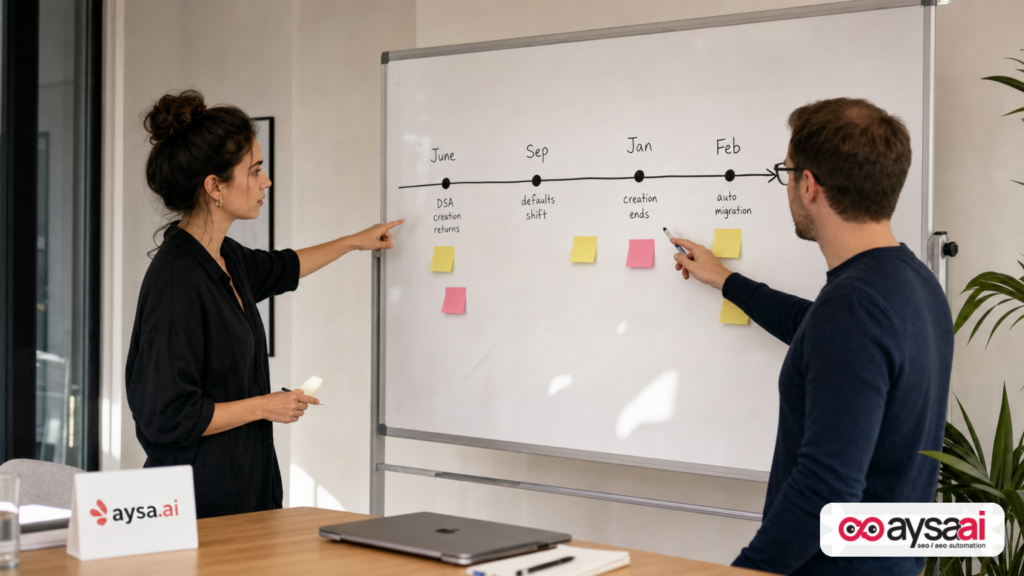
Timeline (as reported):
- June 2026: DSA campaign creation returns.
- June 2026 – January 2027: extended testing + voluntary migration period.
- January 2027: new DSA creation ends.
- February 2027: automatic migration begins for remaining campaigns.
Why Google delayed it: what advertiser feedback really signals
When Google delays an automation change, it’s almost never because the company is uncertain about the strategic direction. It’s because the market isn’t ready operationally.
Advertisers asking for time usually means one (or more) of these is true:
- They can’t reliably compare performance between DSA and AI Max due to tracking gaps or inconsistent Attribution.
- They need internal approvals (legal, brand, medical, finance) for new ad/asset behavior—especially where automated assets may generate or mix copy.
- They’re worried about query quality (brand safety, irrelevant demand, “cheap Clicks” that don’t become customers).
- They’re worried about landing pages—DSA often mapped neatly to site structure, while AI-first systems can expose weaknesses (thin pages, outdated inventory, confusing navigation).
In other words, the delay is an acknowledgement that “AI-first Search” requires more than flipping a switch. It requires system changes in how you build campaigns and how your website supports conversion.
A quick refresher: what DSAs actually do (and why they lasted so long)
Dynamic Search Ads have been one of the most pragmatic tools in Google Ads for years because they solve a real problem: most businesses don’t have perfect Keyword coverage.
In plain language, DSAs historically worked like this:
- You provide Google a target (usually your website or a set of URLs/categories).
- Google matches searches to relevant pages.
- Google dynamically generates parts of the ad (especially headlines) based on the query and page.
For many SMEs, DSAs became the “long-tail safety net”: they capture demand you didn’t think to target, especially when your site has many product or service pages.
They were particularly useful for:
- Ecommerce with deep catalog + frequent new products.
- Local services with dozens of location/service combinations.
- B2B with niche solution pages that don’t justify their own keyword builds.
But DSAs also have known downsides: less control over query matching, sometimes awkward headlines, and the risk that Google picks the “wrong” page if your Site architecture is messy.
DSAs vs. AI Max: what you’re actually giving up—and what you might gain
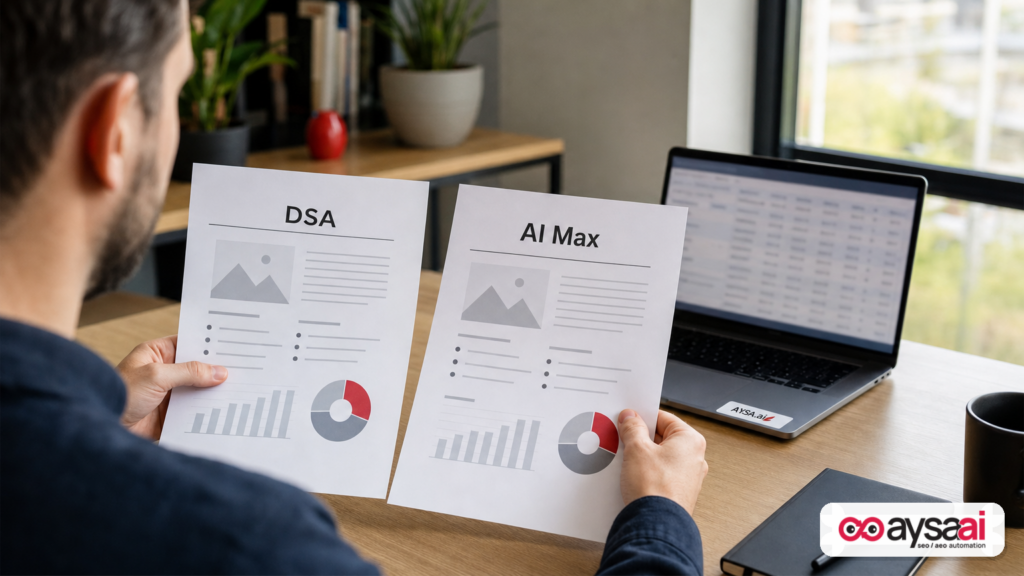
The easy framing is “DSA is retiring, AI Max is replacing it.” The more accurate framing is: Google is consolidating multiple search behaviors into a more automated, AI-led workflow—often involving broad match and Smart Bidding, and more reliance on assets.
Based on the Search Engine Land report, Google’s planned destination includes:
- AI Max for Search campaigns, and/or
- Search campaigns using broad match + Smart Bidding as the effective alternative.
What you may lose compared to DSAs:
- URL-first intent capture. DSAs often feel “site-structured.” AI-led matching can feel “intent-structured,” which isn’t the same thing.
- A clean mental model. DSAs: “Google uses my site to match.” AI Max: “Google uses more signals, more assets, and more automation.” Harder to debug.
- Predictability in edge cases. If you have thin pages, outdated pages, or overlapping categories, AI can amplify the confusion quickly.
What you may gain:
- Faster learning (Google claims AI Max as a default helps campaigns reach a first conversion sooner in early performance windows, per the Search Engine Land summary of Ginny Marvin’s comments).
- Broader coverage beyond your existing keyword lists, especially if your Conversion tracking is strong and you have enough volume for Smart Bidding to learn.
- More scalable campaign management when you can’t afford constant keyword pruning and expansion.
My view: the “gain” is real for teams with clean conversion signals and disciplined landing pages. For everyone else, the “gain” is theoretical until you fix fundamentals.
The bigger shift: AI Max becoming the default and what that means operationally
The delay is a DSA story, but the default setting change is the strategic story.
Search Engine Land reports Ginny Marvin said AI Max is now the default setting when creating new Search campaigns, based on testing that showed earlier first conversions in the first couple of weeks after launch.
Defaults matter because defaults create behavior:
- New hires and junior marketers will inherit AI Max as “normal.”
- Agencies will standardize around it to simplify delivery.
- Performance narratives will shift from “we built coverage” to “we fed the system good inputs.”
That’s not a moral judgment. It’s a management reality. AI-first advertising demands that you become excellent at:
- Conversion hygiene: the right events, deduplication, lead quality feedback loops.
- Landing page governance: relevance, speed, inventory accuracy, clarity.
- Message discipline: assets, offers, positioning, and what your brand will not say.
- Experimentation systems: test design, timelines, and rules for declaring winners.
The hidden risk: migration without measurement is how budgets get wasted
When campaign types change, the biggest danger is not “performance drops.” The biggest danger is performance becomes ambiguous. Ambiguity is where money leaks.
Common failure modes during AI-led transitions:
1) Conversion tracking that was “good enough” becomes catastrophic
DSA could sometimes work even with imperfect tracking because the intent was often anchored to specific pages. AI-led bidding is far less forgiving. If your primary Conversion event includes low-quality actions (e.g., unqualified form starts, spammy calls, duplicate purchases), Smart Bidding can optimize toward the wrong thing and look “successful” in-platform.
If you’re an SME, you don’t need a complex measurement stack—but you do need clarity about what is a real business outcome.
2) Weak landing pages become more expensive faster
AI Max and automated matching can route more traffic to your site more quickly. If your landing pages are thin, slow, confusing, or misaligned with the query intent, you don’t just lose conversions—you lose the learning signal that would have improved performance.
3) “It worked” becomes a story, not a fact
During migrations, teams often compare unlike periods (seasonality), change multiple things at once (bidding + matching + assets), and then declare victory or failure based on a two-week window. That’s not a test; it’s a vibe.
If you want the automation benefits, you have to earn them with disciplined measurement and experimentation.
A concrete SME scenario: local clinic + services pages + long-tail discovery
Let’s make this real.
Imagine a mid-sized local clinic with:
- 10+ service pages (sports rehab, back pain, post-surgery, dry needling, etc.)
- Multiple practitioner bios
- A “conditions we treat” section
Historically, DSAs helped this clinic capture long-tail searches like:
- “physical therapy for runner knee near me”
- “post ACL surgery rehab timeline”
- “dry needling for migraines”
Now, during the AI Max transition, two things can happen:
- Best case: The clinic upgrades tracking (calls + booking completions), tightens landing pages, and AI Max learns quickly which intents produce booked appointments. Cost per booked visit drops.
- Worst case: The clinic counts “contact page views” as conversions, has thin service pages, and sends mixed signals. AI Max optimizes toward cheap clicks and low-intent actions. The dashboard looks busy; the schedule stays empty.
The difference isn’t “AI Max vs DSA.” The difference is whether the business has a controlled system for measurement + landing-page execution.
A real testing plan (not a “let’s see how it goes” plan)
If you have DSAs today, you should assume you’ll be forced off them eventually. Use the delay as a structured testing window.
Step 1: Audit your DSAs like a revenue product
Before you test anything, you need to understand what DSAs are contributing:
- Which landing pages get the majority of DSA traffic?
- Which categories/services/products convert with acceptable margin?
- Which queries are “good weird” (valuable long-tail) vs “bad weird” (irrelevant)?
Document this in a simple spreadsheet: page → intent theme → conversion quality → margin. Don’t overcomplicate it.
Step 2: Establish a baseline window you’ll trust
Pick a recent period with stable seasonality (or use year-over-year comparisons if your business is seasonal). Your goal is to create a baseline you can defend in a meeting.
Baseline metrics to include:
- Spend
- Conversions (your best available “real” conversion)
- Cost per conversion
- Revenue or lead quality proxy (where possible)
If you cannot tie to revenue, say that explicitly and treat conclusions as directional, not definitive.
Step 3: Run side-by-side experiments with strict rules
Search Engine Land’s reporting suggests Google itself is encouraging side-by-side tests and voluntary migration tools. Take that advice—but do it with guardrails:
- Test one primary change at a time (matching/bidding/asset strategy), whenever feasible.
- Keep budgets stable during the learning window.
- Define success criteria before launch (e.g., cost per booked appointment within X% of baseline).
Don’t declare a winner after three days because the dashboard looks exciting.
Step 4: Use the test to find landing-page bottlenecks
This is where many teams miss the point. The campaign is not the only variable. Your website is part of the system.
During the test, identify:
- Pages with high spend and low Conversion rate
- Queries (or themes) that land on the wrong page
- Offer/CTA mismatch (“Call now” vs “Book online” vs “Get a quote”)
Then fix those pages—with controlled approvals and measurable rollouts.
Guardrails that keep AI automation from going off the rails
Automation is not the enemy. Unbounded automation is.
Here are practical guardrails SMEs and agencies can implement without building an enterprise process:
Guardrail 1: Define “primary conversions” like a CFO would
A primary conversion should represent a meaningful business outcome (purchase, booked appointment, qualified lead). If you’re optimizing for micro-actions, label them as secondary.
If you need more help on measurement thinking, Search Engine Land has broader reporting on how search is changing and why visibility and trust are shifting in AI contexts (useful context for why clicks and superficial metrics are less reliable). See: What new AI search data reveals about visibility and trust.
Guardrail 2: Asset governance (what your brand will and won’t say)
AI-first campaign formats tend to use more assets. That increases the surface area for brand and compliance risks—especially in regulated categories (health, finance, legal).
Set a lightweight governance policy:
- Approved value props
- Approved disclaimers
- Prohibited claims
- Offer rules (when discounts apply, exclusions)
Guardrail 3: Landing-page hygiene becomes a paid search skill
Historically, some PPC teams treated landing pages as “web team stuff.” That separation is expensive now.
AI-driven matching can surface any page that looks relevant. So you must maintain:
- Clear page intent (one page = one job)
- Fast load and mobile usability
- Accurate inventory/pricing (for ecommerce)
- Strong internal linking so users can self-correct
Guardrail 4: Account for shifting search behavior (zero-click, AI answers)
Even if this article is about paid search, the overall search environment matters. If more searches end without a click, acquisition strategy changes.
Search Engine Land has reported that zero-click searches have been increasing (as covered in their ecosystem). The takeaway for advertisers is not “paid is doomed.” It’s that you should invest in outcomes you can measure and influence—calls, bookings, purchases—while also strengthening brand demand and conversion paths.
What agencies should rethink: deliverables, reporting, and client trust
This transition is also a services transition.
When DSAs were common, an agency could “own” long-tail coverage by:
- Setting DSA targets
- Managing negatives
- Reporting on incremental query capture
In AI Max and automation-heavy environments, the agency’s value shifts toward:
- Measurement architecture (what counts as success)
- Experiment design (what changes, what stays constant, when to call a result)
- Creative and offer strategy (assets, positioning, differentiation)
- Landing-page execution (rapid fixes tied to paid performance)
That last point is where many agencies struggle: they can identify issues, but they can’t get them implemented quickly due to client bottlenecks.
This is exactly why “execution systems” matter. It’s not enough to have recommendations; you need a workflow that gets changes live safely.
Where AYSA fits: approved execution across SEO + paid search landing pages
AI Max is a paid search change, but the work you’ll do to succeed is deeply connected to your website and your organic visibility. This is where AYSA.ai is designed to help.
AYSA is an approved execution system: it monitors, prepares changes, asks for approval, and then executes accepted website changes so you don’t get stuck in a loop of “we should fix that” while your ad budget keeps spending.
Practical ways AYSA supports a DSA → AI Max transition:
- Monitor search visibility and site signals while you run tests, so you can correlate performance changes with real site changes. Start here: AYSA Monitoring.
- Improve AI and search visibility by keeping critical pages current and aligned to user intent (helpful as AI-driven matching sends broader traffic). See: AI Search Visibility.
- Operationalize SEO/AEO/GEO tasks that support paid landing pages—content updates, internal linking improvements, and other on-site fixes—through a controlled approval workflow. Explore: AYSA AI SEO Tools.
- Align stakeholders (founder, marketing lead, agency) because everyone can review and approve changes before they ship—no surprise edits.
If you’re evaluating process and budget, you can review AYSA pricing or browse implementation thinking and playbooks on the AYSA blog.
My perspective: in the next two years, the winners won’t be the teams with the most “AI settings.” They’ll be the teams with the fastest safe execution loop—measure → learn → update site and assets → re-test.
What to do next (action list)
- 1) Audit DSAs now: identify top landing pages, top intent themes, and where the conversions are actually coming from.
- 2) Fix measurement first: confirm primary conversions represent real outcomes; reduce noisy micro-conversions as optimization targets.
- 3) Build a migration calendar: pick a test window, avoid peak season if your business is seasonal, and document the plan.
- 4) Run a side-by-side test: stable budgets, clear success metrics, and a minimum learning period you’ll honor.
- 5) Upgrade landing pages: tighten intent, clarify CTAs, ensure pages are current; remove or update thin/outdated pages that automation might surface.
- 6) Create asset governance: approved claims, offers, disclaimers, and prohibited phrasing—especially if regulated.
- 7) Put execution on rails: use AYSA to monitor, propose, approve, and execute site changes so campaign learnings turn into real improvements.
Sources and further reading
- Search Engine Land: Google delays Dynamic Search Ads migration to AI Max
- Search Engine Land: Google zero-click searches hit 68% in early 2026: Study
- Search Engine Land: What new AI search data reveals about visibility and trust
- Search Engine Land: Retrieval vs. citation: How AI search changes content strategy
- Search Engine Land: Google expands Smart Bidding Exploration, adds Promotion Mode
AYSA internal resources:
Note: This editorial relies on the cited Search Engine Land reporting for specific timeline details and stated rationale. Where broader product specifications would require primary documentation from Google, we’ve avoided asserting details not present in the provided research context.
Continue the AI search topic inside AYSA.
Use these pages to connect the article with AI SEO tools, AI visibility monitoring, AI Overviews and approved website execution.
Turn this topic into a website action plan.
Use these AYSA hubs to move from reading to technical fixes, AI visibility monitoring, research, glossary context and approval-first SEO execution.

