The New Search Reality: Reddit Rising, Zero-Click Growing, and Local Data Moving Into GA4 (What SMEs Should Do Now)
After Google’s recent core updates, more top rankings are flowing to Reddit, more searches end without a website click, and Google Business Profile performance is landing inside GA4 (and even Gemini). Here’s what changed, why it matters, and an execution-ready plan for SMEs and agencies.

Search didn’t “change overnight.” It changed in three directions at the same time—and that’s what’s confusing business owners right now.
First, more top rankings are consolidating on big platforms (Reddit is the headline example). Second, even when you show up, more searches end without anyone clicking through to your site. Third, Google is pulling local performance data (Google Business Profile) into Google Analytics 4—and even into Gemini—so more of the workflow happens inside Google’s ecosystem.
This combination forces a practical question for every SME and agency:
What are you optimizing for if rankings don’t guarantee Clicks—and clicks don’t fully represent visibility?
This editorial is my point of view as Marius Dosinescu at AYSA.ai: the winners over the next 12–24 months won’t be the teams with the loudest “AI SEO” claims. They’ll be the teams that can (1) measure visibility beyond traffic, (2) build assets that AI and humans cite, and (3) execute site improvements continuously—without turning every change into a weeks-long internal negotiation.
Concise Summary
- Reddit visibility rose after Google’s May core update in a large Keyword sample, but the impact varies by niche. Treat “Reddit is winning” as a segmentation problem, not a universal truth.
- Zero-click behavior is now central to search measurement. Recent third-party clickstream-based research suggests a majority of Google searches end without a click, which changes how you set expectations and report value.
- Google Business Profile metrics are coming into GA4, closing a reporting gap for Local SEO—while Gemini is also gaining Business Profile management capabilities.
- Action for SMEs: shift to “be cited” optimization (AEO/GEO), upgrade your measurement stack, and build an execution cadence that ships improvements weekly.
Key Takeaways (For Busy Operators)
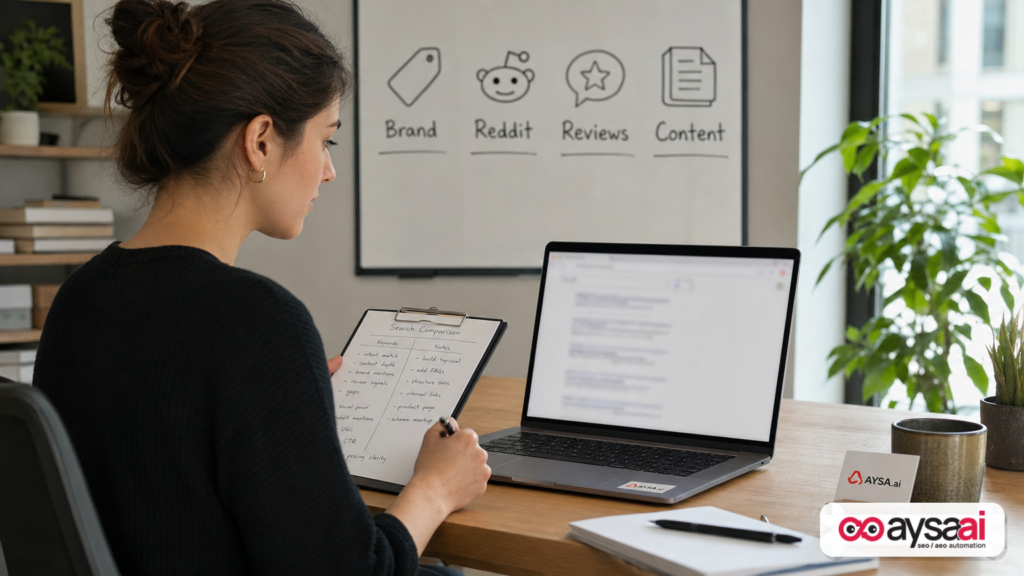
- Expect more platform competition (forums, marketplaces, social). You can’t “out-publish” them; you need to out-earn trust and citations.
- Stop using sessions as the only KPI. Add visibility metrics (impressions, SERP presence, AI presence) and business outcomes (calls, bookings, leads) to reporting.
- Local SEO reporting is improving as GBP data appears in GA4, but multi-location governance and access structure can still break the setup.
- Execution is the moat. The strategy is knowable; consistent implementation is rare.
Table of Contents

- What Changed (In Plain English): Three Shifts Happening At Once
- Reddit’s Post-Update Growth: What It Means (And What It Doesn’t)
- Zero-Click Search Is Not A Trend—It’s A Measurement Crisis
- Google’s Updated SEO Guidance: Why It’s Really About Trust, Tools, And Liability
- GBP Data In GA4 (And Gemini): Why Local Measurement Is Being Re-Wired
- The Real Theme: Search Work Is Moving Onto Big Platforms
- What Can Go Wrong (Common Failure Modes For SMEs And Agencies)
- What You Should Monitor Weekly Now
- Concrete SME Scenario: A Local Clinic With Great Care—and Shrinking Clicks
- A Practical 30/60/90-Day Action Plan
- Where AYSA.ai Fits: Approved Execution For SEO/AEO/GEO
- What To Do Next (Checklist)
- Sources And Further Reading
What Changed (In Plain English): Three Shifts Happening At Once
Search professionals often talk about updates like they’re separate stories. For operators, they land as one messy reality:
- The SERP is more platform-heavy. In many queries, Google is surfacing community answers and aggregators higher than brand sites.
- More searches end without a website click. People get answers directly in Google (features, AI summaries, knowledge panels, maps) or refine their search again.
- Google is centralizing tools and reporting. Local performance metrics (GBP) are being pulled into GA4; Gemini is getting Business Profile capabilities.
This matters because your “SEO motion” may have been built on a simple loop:
Rank → get clicks → get conversions → reinvest
That loop is breaking in two places:
- Ranking doesn’t reliably mean you’re the answer. You might rank “below the fold” while AI Overviews, local packs, and platforms absorb attention.
- Visibility doesn’t reliably mean a click. The search experience is increasingly designed to keep the user inside Google.
If you want one mental model: we’re moving from “SEO as traffic acquisition” to “SEO as influence and distribution.” That includes traffic, but it’s not limited to traffic.
Reddit’s Post-Update Growth: What It Means (And What It Doesn’t)
Search Engine Journal summarized third-party research indicating Reddit gained top positions across a wide set of niches after Google’s May core update, based on a large keyword sample and niche segmentation (Search Engine Journal).
The most important part isn’t “Reddit is up.” The important part is:
- It’s uneven by niche. Some niches are experience-led (pets, hobbies, consumer decisions). Communities naturally perform well there because the user’s intent is “I want real people’s experiences.”
- YMYL niches may behave differently. Healthcare and finance queries have different risk profiles and different quality expectations. Platform growth there may be more constrained.
- Core updates can reverse platform fortunes. SEJ noted that earlier analyses found Reddit-like platforms losing visibility, and then later gaining. If your strategy is “chase whatever won the last update,” you will whiplash your business.
Why Reddit (And Similar Platforms) Are Often Winning
Let’s not mystify it. Platforms can outperform SMEs for structural reasons:
- Scale: thousands of pages created daily, covering long-tail questions you didn’t know existed.
- Freshness: discussions update constantly, matching changing products and opinions.
- Behavior signals: users often spend time reading threads, which can correlate with perceived satisfaction.
- Natural language: people ask and answer in the same language other people search.
- Internal linking: platforms are built to keep users moving across related topics.
But here’s the part many brands miss:
Reddit ranking does not mean your site is “losing.” It means your site isn’t present in the conversation layer.
What To Do About Reddit Without Doing Anything Dumb
“Optimize for Reddit” can quickly become a brand and compliance problem. Instead, use a three-part approach:
- Find the recurring questions that generate Reddit visibility. These are often “best X for Y,” “is X worth it,” “X vs Y,” and “what should I avoid?”
- Create a better on-site answer asset. Not a generic blog post—an asset people can cite: comparison tables, selection guides, pricing explainers, risk/fit warnings, maintenance tips, buyer checklists.
- Earn citations where the conversation happens. That can include legitimate participation, partnerships, PR, and editorial mentions—without astroturfing or sockpuppets.
In other words: don’t “fight” communities. Build cite-worthy resources and become the brand that shows up as the reference point when people research.
Zero-Click Search Is Not A Trend—It’s A Measurement Crisis
SEJ also summarized new U.S. zero-click research published by SparkToro, using clickstream panel data from Similarweb for January through April, with a headline finding that a large share of Google searches end without a click (Search Engine Journal).
We need to be careful here:
- Clickstream panels are a model of reality, not reality itself. They can be directionally useful without being perfect.
- Definitions matter: “zero click” can include users who refine their search and then click later. Even SEJ highlighted debate from practitioners about how to count those behaviors.
But even with those caveats, the operational conclusion remains:
If your reporting still assumes 2019 click-through behavior, you are going to overpromise and underdeliver.
Why Zero-Click Is Growing (Even If You’re Doing “Good SEO”)
There are three engines behind zero-click outcomes:
- More SERP features: featured snippets, knowledge panels, local packs, “People also ask,” shopping modules.
- AI surfaces: AI Overviews and other generative answers can satisfy intent quickly, especially for informational queries.
- Google’s product incentives: keeping users in the ecosystem increases ad exposure and product stickiness. This is not a moral judgment; it’s a business model reality.
What To Measure Now (So You Don’t Lie With Analytics)
SMEs and agencies should move toward a measurement stack that matches modern search. That means adding layers:
- Visibility metrics: impressions, share of SERP features, brand presence for top intents, AI visibility where available.
- Demand metrics: branded search growth, repeat search behavior, direct traffic trends (with caution), and engaged visits.
- Outcome metrics: leads, calls, bookings, direction requests, quote submissions—tied to the user journey.
Google has been expanding reporting surfaces for AI-related visibility (SEJ references new Search Console AI reporting changes as part of the discussion). If impressions grow while sessions drop, your job is not to panic—it’s to explain the channel shift and validate outcomes.
In AYSA terms, this is exactly why we emphasize monitoring and execution rather than one-time “SEO projects.” You need continuous feedback loops. Start here: AYSA Monitoring.
Google’s Updated SEO Guidance: Why It’s Really About Trust, Tools, And Liability
SEJ reported that Google published a new Search Central page addressing third-party SEO tools, services, and advice, and updated its “Do you need an SEO?” page with multiple changes—including references to AEO/GEO and guidance that businesses can contact the FTC about fraudulent SEO services (Search Engine Journal).
I’m going to interpret this as a market signal, not just documentation housekeeping:
- Google is positioning its documentation as the baseline truth against which third-party advice should be evaluated.
- The market is flooded with AI SEO claims, and Google is warning business owners that tools/services can be misleading or fraudulent.
- AEO/GEO language is entering official guidance (at least at the terminology level), which matters because it changes boardroom conversations from “buzzword” to “recognized concept.”
What This Means For Agencies And Consultants
Two implications are uncomfortable but necessary:
- You must document your recommendations. Not just “best practice,” but why, what evidence supports it, what the risk is, and how you’ll measure success.
- You must be explicit about what your tools do and do not prove. Ranking tools, AI visibility tools, crawlers, and audits are models—useful, but not the SERP itself.
AYSA’s “approved execution” model is designed for this world: we monitor, prepare changes, ask for approval, and execute what’s accepted. That creates a change log and an accountability trail, not just a monthly deck. If you want the overview, start here: AYSA AI SEO Tools.
GBP Data In GA4 (And Gemini): Why Local Measurement Is Being Re-Wired
Another major shift in SEJ’s roundup: Google Business Profile (GBP) data is being connected into Google Analytics 4, and Google announced GBP-related capabilities for the Gemini app (Search Engine Journal).
For years, local SEO reporting was awkward:
- Your website outcomes lived in GA/GA4.
- Your local outcomes (calls, direction requests, profile views) lived in the GBP interface.
- Your reputation signals lived in reviews platforms and email threads.
Bringing GBP metrics into GA4 is a meaningful consolidation step. It won’t solve everything, but it reduces friction for single-location businesses and teams that already live in GA4.
The Practical Benefit: One Executive Report Instead Of Three Dashboards
If you’re a local operator, you don’t care what a “local impression” is in isolation. You care about:
- Calls
- Bookings
- Direction requests
- Website clicks (where applicable)
When these are visible alongside site conversions and paid campaigns, you can finally answer: Is local visibility creating real business outcomes—or just views?
The Catch: Multi-Location Governance Still Gets Messy
SEJ also highlighted practitioner commentary that some configurations (like listings grouped in manager account groups) may complicate linking.
This is the part SMEs underestimate: tooling consolidation doesn’t remove the need for clean structure. If you have 10–500 locations, you need:
- Consistent naming conventions
- Consistent UTM strategy
- Access governance (who can link what)
- A plan for rollups vs per-location accountability
From an “AI search” angle, GBP visibility also feeds discovery behaviors where users never touch your site. That’s why local visibility belongs in a broader AI visibility program: AYSA AI Search Visibility.
The Real Theme: Search Work Is Moving Onto Big Platforms
SEJ framed the week’s theme as workflows moving onto big platforms (Google surfaces, Reddit visibility, GBP inside GA4/Gemini). That’s the story beneath the story.
Here’s what I see happening at the business level:
- Discovery is increasingly platform-mediated. A user learns through Google features, Reddit threads, and map packs before they ever see your homepage.
- Trust is increasingly outsourced. Reviews, forum consensus, “best of” lists, and third-party mentions become your de facto sales copy.
- Distribution is increasingly rented. Even when you “earn” the visibility, you don’t control the interface or the click.
That’s why modern SEO strategy must include two tracks:
- Owned asset excellence: your site as the canonical source—fast, clear, structured, cite-worthy.
- Off-site presence: your brand as the trusted entity—mentioned, reviewed, cited, and consistent across platforms.
Ignore either track and you will feel like search is random. It isn’t random. It’s multi-surface.
What Can Go Wrong (Common Failure Modes For SMEs And Agencies)
When search changes, most businesses fail in predictable ways. Here are the patterns I see repeatedly.
1) Overreacting To A Single Update
If Reddit rises in one core update, you spin up a “Reddit strategy.” If it falls in the next update, you abandon it. That’s not strategy; that’s chasing noise.
Fix: segment your SERPs by query type and business value (informational vs commercial vs local intent). Build assets for each segment and measure over time.
2) Reporting Traffic Like It’s The Only Outcome
In a zero-click environment, traffic alone is an incomplete measure. You can be “winning” discovery while GA4 looks flat.
Fix: report visibility and outcomes. Use GA4 for outcomes; use Search Console for impressions; use local metrics for calls/directions; track branded demand.
3) Publishing Generic Content That No One Cites
AI surfaces and communities reward specificity. “10 Tips for X” is less useful than “X buyer checklist for Y scenario, with constraints.”
Fix: create decision assets: comparison frameworks, fit/misfit guidance, pricing transparency, and real-world FAQs.
4) Treating Local Like A Side Project
Local is often the highest-intent channel, but businesses treat GBP as a set-and-forget listing.
Fix: run local like a performance channel: weekly review replies, photo updates, service/menu updates, and category accuracy checks—then report outcomes in a single view.
5) Letting Execution Lag Kill Strategy
The biggest gap is not knowing what to do. It’s shipping it.
If your cycle is: audit → backlog → wait for dev → never implement, you will lose to teams that make small improvements every week.
Fix: use an approved execution system. That’s the core reason AYSA exists: prepare changes, request approval, execute accepted improvements, and keep the site compounding. See: Monitoring and Pricing.
What You Should Monitor Weekly Now
If you’re an SME owner, you don’t need a 40-metric dashboard. You need a small set of signals that tell you whether you’re becoming more discoverable and more trusted.
A) Visibility Signals
- Search Console impressions for your top query groups (brand, category, service)
- Presence on high-value SERPs (are you in the top results, the local pack, or absent?)
- Whether community/platform pages dominate your money terms (and which ones)
B) Local Outcome Signals
- Calls and bookings attributed to GBP
- Direction requests (for brick-and-mortar)
- Review velocity and rating stability
C) Business Signals
- Lead quality (not just lead count)
- Close rate (sales feedback loop)
- Repeat customers and retention (where applicable)
Then you align work to the biggest bottleneck. That’s strategy. Everything else is busywork.
Concrete SME Scenario: A Local Clinic With Great Care—and Shrinking Clicks
Let’s make this real.
Imagine a two-location dental clinic. They’ve invested in SEO for years:
- Service pages for implants, Invisalign, emergency dentistry
- Blog posts answering common questions
- Strong reviews and decent GBP presence
After a core update and AI-heavy SERPs, the owner notices:
- Website sessions are down 12–18% year-over-year (seasonality aside)
- Rankings look “okay” in a tool, but calls feel inconsistent
- Competitors appear in the local pack more often
- Reddit threads about “pain after implant” are ranking for informational queries
Diagnosis In The New Model
This is not necessarily “SEO failing.” It may be:
- More queries answered in SERP features (zero-click pressure)
- More top-of-funnel discovery happening in communities
- Local outcomes shifting toward GBP actions (calls/directions) rather than website clicks
Fix The System (Not Just The Content)
- Unify reporting: connect GBP metrics into GA4 where possible so the owner sees calls/directions alongside form fills.
- Rebuild service pages to be “citable”: add structured FAQs, risk/fit sections (“who is not a candidate”), recovery timelines, and cost factors—written for real patients.
- Local pack competitiveness: ensure categories/services, photos, attributes, and review reply cadence are consistent across both locations.
- Conversation capture: identify the top community questions, then create clinic-authored resources that can be referenced (not spammed) when patients research.
The goal is not “get the click back.” The goal is: increase qualified patient acquisition in a world where the click is optional.
A Practical 30/60/90-Day Action Plan
You don’t need a reinvention. You need a disciplined plan that acknowledges the new search surfaces.
Days 1–30: Rebuild Measurement And Priorities
- Define your query groups: brand, category/service, comparison, local intent.
- Baseline Search Console: impressions and clicks for those groups; note top pages and declining pages.
- Baseline local outcomes: calls, bookings, direction requests (and where they’re currently measured).
- Pick 10 SERPs that matter: document who dominates (brands vs platforms vs local pack).
Deliverable: a one-page “search reality map” you can explain to a non-marketer.
Days 31–60: Build Cite-Worthy Assets
- Upgrade the top 5 money pages: clarity, structure, internal linking, FAQs, decision support.
- Create 2–4 comparison/selection assets: “X vs Y,” “best for,” “how to choose,” “common mistakes.”
- Add structured data where appropriate (only where it’s accurate and supported by the page content).
Deliverable: a set of pages designed to be referenced—by humans and by AI summaries.
Days 61–90: Expand Distribution And Operational Cadence
- Local operations: weekly GBP updates (photos/posts if relevant), review replies, Q&A monitoring.
- Authority building: pursue legitimate mentions—industry directories, local press, partnerships, supplier pages, community organizations.
- Execution cadence: ship improvements weekly (not quarterly), and keep a change log tied to outcomes.
Deliverable: a repeatable operating system, not a one-time SEO push.
Where AYSA.ai Fits: Approved Execution For SEO/AEO/GEO
Most teams don’t fail because they lack ideas. They fail because implementation is slow, fragmented, or blocked.
AYSA is built for the reality described in SEJ’s roundup: more surfaces, more measurement complexity, and more need for continuous iteration.
The AYSA Operating Model
- Monitor: track visibility and site fundamentals continuously (Monitoring).
- Prepare: generate prioritized recommendations for SEO/AEO/GEO, including technical and content improvements.
- Ask for approval: you stay in control—no silent changes.
- Execute accepted changes: ship improvements that compound, not just audits that collect dust.
How This Helps In The “Reddit + Zero-Click + Local Consolidation” Era
- When platforms dominate: AYSA helps you build the authoritative on-site assets that earn citations and brand recall.
- When clicks decline: AYSA helps you strengthen presence and clarity so that when users do click, they convert—and when AI summarizes, it has a clean source to cite.
- When local reporting shifts: AYSA supports the broader strategy (local landing pages, service clarity, structured content) while GA4/GBP ties outcomes together.
If you want the conceptual starting point, read: AI Search Visibility. If you want to see ongoing thinking and playbooks, visit: AYSA Blog. If you want to evaluate fit quickly: Pricing.
What To Do Next (Checklist)
- Document 10 high-value queries and note: brand results, platforms (like Reddit), AI features, and local pack presence.
- Update your KPI dashboard to include visibility + outcomes (not just sessions).
- Connect GBP outcomes into your reporting workflow (and into GA4 where supported by your setup).
- Pick 5 pages to rebuild for “citable clarity”: decision support, FAQs, comparisons, and fit guidance.
- Establish a weekly execution cadence with a change log and approvals.
- Adopt an approved execution system so improvements ship continuously (see AYSA AI SEO Tools).
Sources And Further Reading
- Search Engine Journal: Reddit Climbs, Clicks Drop, GBP Comes To GA4 – SEO Pulse
- Search Engine Journal: SEO coverage
- Search Engine Journal: Latest marketing news
- Search Engine Journal: Google algorithm updates history (context)
- AYSA.ai: AI Search Visibility
- AYSA.ai: Monitoring
- AYSA.ai: AI SEO Tools
- AYSA.ai Blog
Note on sourcing: This editorial is based on the reporting and referenced research summarized by Search Engine Journal. Where primary documentation (e.g., Google Search Central pages or SparkToro’s original post) is not included directly in the provided research context, I’ve avoided adding unverified links or quoting text verbatim. If you want, we can expand the “Sources” list once primary URLs are confirmed.
Continue the AI search topic inside AYSA.
Use these pages to connect the article with AI SEO tools, AI visibility monitoring, AI Overviews and approved website execution.
Turn this topic into a website action plan.
Use these AYSA hubs to move from reading to technical fixes, AI visibility monitoring, research, glossary context and approval-first SEO execution.