
Prompt Patterns Are the New Keywords: How to Win AI Search Visibility by Industry
People don’t search like they used to. They ask AI systems for symptom triage, vendor shortlists, and “best under $X” recommendations—often in multi-step conversations. Here’s how prompt patterns vary by industry, why that changes what gets cited, and a practical execution plan SMEs can run with AYSA.

For most of SEO’s history, we treated search visibility like a Keyword-and-ranking game. Find the phrase, build the page, earn the links, climb the results. That mental model still matters—but it’s no longer the whole model.
Today, people increasingly ask AI systems to reason, compare, recommend, and triage. That shift changes the unit of search from a short query to a structured prompt—often a multi-step conversation. And it changes the unit of visibility from “ranking” to “retrieval and citation.”
This editorial is a practical guide to that new reality: how prompt patterns vary by industry, why that shapes what AI systems surface, and how small and mid-sized businesses can adapt without turning their websites into science projects.
Primary research lead: Search Engine Land’s analysis of how industry-specific prompt patterns influence AI Retrieval and citations is the jumping-off point for this guide. Read it here: How AI prompt patterns vary by industry and shape search visibility.
Concise summary

- Prompts are the new keywords. Users ask AI for outcomes (diagnosis-like triage, vendor selection, “best under $X”), not just definitions.
- Industries create predictable prompt patterns. Healthcare prompts are context-heavy and risk-aware; B2B prompts are comparison-driven; ecommerce prompts mix constraints (budget, reviews, use case) in one ask.
- AI systems reward “extractable proof.” Content that’s structured, specific, and easy to cite (tables, bullet lists, FAQs, clear constraints) is more likely to be used.
- Follow-up intent wins. Visibility often depends on the second and third question in a conversation, not the first query.
- Execution is the bottleneck. The advantage goes to teams that can monitor AI visibility, prepare changes, get approvals, and ship consistently—this is exactly where AYSA fits.
Table of contents
- The shift: from keywords to prompts (and from rankings to retrieval)
- What changed in search behavior—and why SMEs feel it first
- Industry prompt patterns (and what your content must do differently)
- Healthcare: narrative prompts + safety constraints
- B2B: comparison matrices, ROI, and implementation risk
- Ecommerce: “best + under $X + for my situation” clusters
- Local services: urgency, trust, and “near me” without saying “near me”
- Travel and hospitality: itinerary-building and preference stacking
- The prompt elements that decide whether you get cited
- The “next-question” problem: why you can’t optimize only the first ask
- What goes wrong: the 10 most common AI-visibility mistakes
- Measurement: what to track when clicks decline
- A concrete SME scenario: an ecommerce brand losing “best under $X” recommendations
- An execution plan that actually works (and doesn’t die in a spreadsheet)
- Where AYSA fits: monitor → prepare → approve → execute
- What to do next
- Sources and further reading
The shift: from keywords to prompts (and from rankings to retrieval)
The most important change isn’t that AI exists. It’s that AI changes how people express intent.
In classic search, a user compressed their needs into a few words because that’s what a search box demanded. In AI search, the interface invites detail: context, constraints, preferences, follow-up questions, and formatting requirements (“put it in a table”). That means:
- The query is longer and more specific. Users include age, budget, integrations, constraints, and “avoid these.”
- The search is iterative. The second prompt refines what the first prompt started.
- The system isn’t choosing a “top 10.” It’s assembling an answer and selecting sources to cite (or not cite).
So the goal evolves from “rank for keyword X” to “be retrievable and cite-worthy for prompt pattern Y.” That is AEO/GEO in practice: Answer Engine Optimization and Generative Engine Optimization, not as buzzwords, but as an operational discipline.
Search Engine Land makes this point clearly in its breakdown of prompt patterns by vertical and why those patterns influence what AI systems choose to surface (source). I agree—and I’ll push it further: prompt patterns aren’t merely “research.” They’re the blueprint for your information architecture, templates, and publishing cadence.
What changed in search behavior—and why SMEs feel it first
SMEs often experience platform shifts earlier than enterprises for one simple reason: they don’t have enough brand gravity to “coast.” When an interface changes, they see the impact immediately—in leads, calls, bookings, and sales.
Two dynamics are hitting at once:
- More answers happen on the results page or inside the AI interface. Even in traditional search, the industry is tracking a continuing move toward zero-click behavior. Search Engine Land highlighted a study claiming Google zero-click searches hit 68% in early 2026 (Read the source article on searchengineland.com). You don’t have to accept every number at face value to accept the trend: more sessions end without a website visit.
- AI systems cite sources differently than classic rankings. Search Engine Land also referenced third-party research indicating that AI citations can come from domains that aren’t top-10 organic results in traditional desktop search (via an Ahrefs study referenced in the article). The takeaway isn’t “rankings don’t matter.” It’s: retrieval and citation have their own rules.
If your business relies on organic traffic as a pipeline, this changes your risk profile. The new problem isn’t only “can we rank?” It’s “can we be the source that the AI system uses to answer?”
Industry prompt patterns (and what your content must do differently)
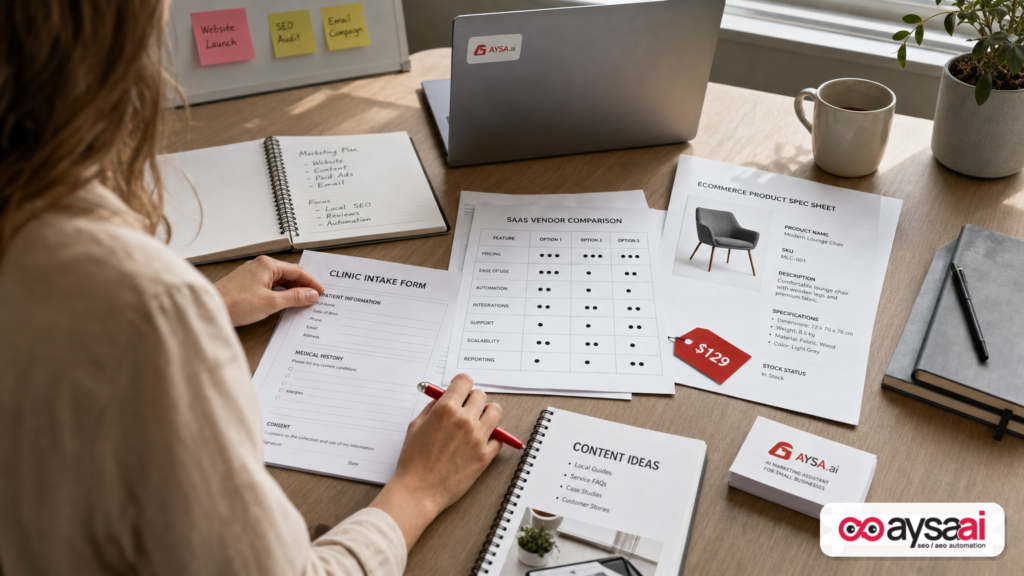
Prompt patterns differ by vertical because the outcome differs by vertical. A shopper wants a recommendation with constraints. A CFO wants a comparison table. A patient wants safety-aware triage language. A homeowner wants immediate availability and trust. AI systems respond to those patterns, and they select sources that match them.
Below are the practical implications for content and site structure. This expands on the industry framing in Search Engine Land’s piece (source) and adds execution guidance for SMEs and agencies.
Healthcare: narrative prompts + safety constraints
In healthcare-related queries, users commonly provide personal context and ask “should I worry?” That creates prompt patterns like:
- Symptoms + timeline (“started last week”)
- Medication interactions
- Age and risk factors
- Thresholds for urgent care
What AI tends to reward:
- Clear disclaimers and escalation guidance (what requires urgent care)
- Structured FAQs that mirror the prompt
- Specificity (not vague “talk to your doctor” without context)
What businesses should do (without overstepping medical advice):
- Create “symptom cluster” pages that focus on common combinations people describe, not just one keyword.
- Use headings that match how users ask (e.g., “When should I seek urgent care?” “What could cause X + Y together?”).
- Publish clinician-reviewed explainers and keep update timestamps honest.
Important note: If you’re in a regulated vertical, don’t chase AI visibility at the expense of compliance. The point is to be clear, structured, and safe—not sensational or overly definitive.
B2B: comparison matrices, ROI, and implementation risk
In B2B, prompts often ask for an executive-ready shortlist, including hidden costs, timelines, and tradeoffs. Search Engine Land’s example of a “compare Brand A vs Brand B, format as a table” prompt captures the core behavior (source).
What AI tends to reward:
- Transparent feature breakdowns
- Implementation requirements and constraints
- Pricing pages with actual ranges and what’s included
- Tables and bullet lists that can be re-used in a generated comparison
What businesses should do:
- Publish “vs” pages and “alternatives” pages that are honest and detailed.
- Move critical specs out of gated PDFs and into crawlable pages.
- Build integration pages that answer the follow-up prompt before it gets asked (“Does it integrate with X?” “What’s the API limit?”).
This is where many B2B marketing teams get uncomfortable: they’ve been trained to avoid specifics. In AI search, vagueness is invisibility.
Ecommerce: “best + under $X + for my situation” clusters
Ecommerce prompts blend constraints in a single ask: budget, use case, fit, durability, reviews, and exclusions (“avoid brands with known issues”). Search Engine Land notes that conversational shopping experiences often steer users toward pricing and comparison variables (source).
What AI tends to reward:
- Product pages with concrete specs (dimensions, materials, compatibility)
- Review content that is crawlable and specific (“runs small,” “good for wide feet,” “broke after 3 months”)
- Category pages that help the model apply constraints (filters that are represented in indexable content, not only client-side UI)
What businesses should do:
- Turn attribute data into language: “Under $150,” “for overpronation,” “for sensitive skin,” “for small bathrooms,” etc.
- Make sure critical attributes exist in structured data and on-page copy (not just inside images).
- Build “best for…” guides that cite your own product specs and real review patterns—carefully, without inventing claims.
If your ecommerce site only has “pretty” product pages and thin descriptions, AI systems don’t have enough verified material to confidently recommend you.
Local services: urgency, trust, and “near me” without saying “near me”
Local services prompts are rarely just “plumber near me.” They’re closer to:
- “My water heater is leaking—can I shut it off safely and who can come today?”
- “What should I ask a divorce lawyer in the first consult?”
- “Is $X reasonable for brake pads on a 2018 model?”
These prompts blend urgency, trust, pricing anxiety, and next steps. For local operators, the goal is to be the safest, clearest answer—not the most keyword-stuffed page.
What businesses should do:
- Publish “what to do now” pages (safety steps, what to document, what not to do) and then present your service as the next step.
- Make service-area and availability explicit and consistent.
- Use clean FAQ sections and visible policies (warranties, emergency fees, scheduling windows).
Travel and hospitality: itinerary-building and preference stacking
Travel prompts often look like planning requests: constraints, preferences, family composition, mobility needs, and a desired vibe. Search Engine Land also published a related piece on how travel brands can earn AI recommendations (Read the source article on searchengineland.com). The direction is clear: AI is becoming a planner, not just a search tool.
What businesses should do:
- Create pages that map “traveler types” to offerings (families, pet-friendly, remote work, accessibility).
- Make amenities and policies explicit, updated, and crawlable.
- Publish “itinerary-ready” content: nearby landmarks, seasonal considerations, transit, check-in constraints.
The prompt elements that decide whether you get cited
Prompt optimization is less about clever writing and more about matching constraints with verifiable content. Search Engine Land highlighted three structural elements that influence retrieval: contextual constraints, formatting requests, and multi-turn follow-ups (source). Here’s how to translate that into website decisions.
1) Contextual constraints (“under $150,” “for 500 users,” “safe for pregnancy”)
When a user includes a constraint, the AI system must filter options. If your page can’t confirm it meets the constraint, you’re easy to exclude.
Make constraints explicit:
- Pricing ranges and what’s included
- Compatibility lists
- Sizes, materials, and performance specs
- Service areas and turnaround times
This is where structured data and consistent on-page data matter. If your price only appears in an image or varies across templates, you create uncertainty. AI systems prefer certainty.
2) Formatting requests (“give me a pros/cons list,” “format as a table”)
When users ask for a table, the model looks for content that is easy to reformat. If your “comparison” is a narrative blob, you force the model to infer structure (and risk mistakes). If your page already has a table, bullet lists, and scannable headings, you become a safer source.
Practical tip: Don’t hide your best information behind interactive widgets that don’t render well to crawlers. A clean HTML table plus a short explanation often outperforms a fancy toggle UI.
3) Multi-turn conversations (the answer changes as the user refines)
AI search is a session, not a single query. Users start broad, then narrow:
- “Best project management tool for a small agency”
- “Okay, but we need time tracking and client portals”
- “We also need it to integrate with QuickBooks and be under $X”
If your content answers only the first prompt, you lose the final recommendation. More on that in the next section.
The “next-question” problem: why you can’t optimize only the first ask
One of the most underrated shifts in AI search is what I call decision migration: the user makes the real decision after two or three follow-ups, not on the initial prompt.
Search Engine Land has also covered this dynamic explicitly as “next-question intent” and why it matters for AI search visibility (Read the source article on searchengineland.com). That framing is useful because it pushes teams to stop thinking in single-page answers and start thinking in conversation arcs.
Here’s what this changes for your content strategy:
- Single pages must be deeper. Not longer for the sake of length—deeper in terms of constraints, comparisons, and proof.
- Clusters must be tighter. Your internal linking should reflect “what users ask next,” not just “related blog posts.”
- Templates should anticipate follow-ups. If every product page ends with three generic FAQs, you’re missing the chance to answer what the buyer asks next.
In other words, your goal is to become the source that survives the follow-up filter.
What goes wrong: the 10 most common AI-visibility mistakes
Most businesses don’t fail at AI search because they didn’t “do AI.” They fail because their website content and structure can’t satisfy the prompts people actually use. Here are the patterns I see repeatedly:
- Vague copy where users need hard constraints. “Affordable” isn’t a price. “Fast” isn’t a timeline. “Secure” isn’t a control.
- Critical data trapped in PDFs or images. If a model can’t reliably extract it, it can’t cite it.
- No comparison pages. If users ask “A vs B,” and you won’t address it, AI will use someone else who will.
- Thin FAQs that don’t match real questions. “What is your return policy?” is fine; it’s rarely the deciding prompt.
- Content that doesn’t survive follow-ups. You answer “best,” but not “best under $X,” “best for my constraint,” or “best with integration Y.”
- Over-optimized language that sounds like marketing. AI systems often prefer neutral, specific, explainable statements over hype.
- Inconsistent policies across pages. If your warranty differs in two places, you create uncertainty.
- JavaScript-only rendering for important info. If it doesn’t render cleanly, you lose extractability.
- No measurement loop. Teams publish and hope. They don’t track whether AI systems actually mention them.
- No execution rhythm. They do a “project,” then stop. AI visibility is a compounding game.
Notice what’s absent from the list: “buy more backlinks.” Authority still matters, but AI retrieval is disproportionately shaped by clarity + structure + proof aligned to prompt patterns.
Measurement: what to track when clicks decline
If more answers happen without a click, traditional SEO dashboards can lie to you. You might be “winning” visibility while losing traffic—or losing visibility while your branded demand masks it.
Search Engine Land has been publishing more on AI visibility and trust signals as this evolves (Read the source article on searchengineland.com). The broader implication: measurement must expand beyond sessions.
What SMEs should monitor now:
- AI mention share for your category (are you recommended at all?)
- Citation presence (are you linked or merely paraphrased?)
- Prompt coverage (do you have pages that satisfy the constraint-heavy prompts?)
- Conversion rate by landing page type (comparison pages, FAQs, product pages, service pages)
- Lead quality signals (calls that mention “ChatGPT said…” or “Google’s summary said…”) tracked in your CRM notes
Clicks still matter, but they’re becoming a downstream metric. In an AI-first journey, the upstream metric is: “Were we included?”
A concrete SME scenario: an ecommerce brand losing “best under $X” recommendations
Let’s make this real with a scenario that mirrors what many ecommerce SMEs are feeling.
Business: A niche ecommerce store selling premium home office chairs.
What used to work: Ranking for keywords like “ergonomic chair,” “office chair for back pain,” and a handful of “best chairs” blog posts.
What changed: Customers start using AI assistants and AI results to ask:
- “Best ergonomic chair under $400 for someone 6’2″ who sits 10 hours a day.”
- “Exclude models with common squeaking complaints.”
- “Compare top 3 and tell me which has the best warranty and easiest returns.”
Why the business loses visibility:
- Product pages say “premium build” but not materials and failure modes.
- Warranty info is buried in a PDF.
- Reviews exist, but they’re loaded behind scripts and not easily crawlable.
- No page explicitly addresses “under $400” recommendations or “tall users” fit.
What winning looks like:
- Add a “specs” table for each chair (dimensions, seat height range, weight limit, materials).
- Publish a comparison page: “Best ergonomic chairs under $400 (2026)” that references the spec tables and warranty terms.
- Create a FAQ module: “Is this chair good for tall users?” “What if it squeaks?” “How returns work in practice.”
- Ensure review snippets that mention real issues (“squeak,” “seat cushion,” “assembly time”) are visible and indexable.
The point isn’t to game AI. The point is to supply the proof that prompt-driven retrieval requires.
An execution plan that actually works (and doesn’t die in a spreadsheet)
Most companies don’t need a grand AI search “replatform.” They need a disciplined loop that turns prompt insight into shipped improvements.
Here’s the plan I recommend for SMEs and agencies.
Step 1: Build a prompt pattern map (not a keyword list)
Start with what you already have:
- Sales call transcripts
- Customer support tickets
- Live chat logs
- On-site search queries
- Product review language
Cluster these into prompt patterns:
- Constraint prompts: “under $X,” “for Y use case,” “compatible with Z.”
- Comparison prompts: “A vs B,” “best alternative,” “top 3.”
- Risk prompts: “is it safe,” “will it break,” “hidden fees,” “refund issues.”
- Format prompts: “table,” “pros/cons,” “checklist.”
This is your new “keyword research,” but it’s more valuable because it’s closer to the decision.
Step 2: Audit your site for extractable proof
Ask two blunt questions on your money pages:
- Can an AI system confirm our claims from the page itself? (price, warranty, constraints, specs)
- Is the structure reusable? (tables, lists, headings, FAQs)
Then fix the basics:
- Clean HTML structure (H2/H3 hierarchy that mirrors questions)
- Consistent policy blocks (returns, warranty, shipping, SLAs)
- Schema where appropriate (without spam)
Search Engine Land has been tracking schema adoption and tooling changes as part of the broader shift to machine-readable web data (Read the source article on searchengineland.com). You don’t need every schema type—you need the ones that make your constraints explicit.
Step 3: Publish “prompt-ready” templates
Most sites need a small set of templates that cover the bulk of prompt patterns:
- Comparison page template: “X vs Y,” “Best alternatives,” “Top options for [constraint].”
- Constraints guide template: “Best under $X,” “Best for [use case],” “Best for [industry].”
- Risk & compliance template: “Is it safe?” “What to avoid,” “When to seek help,” “Limitations.”
- Integration/compatibility template: “Works with X,” setup steps, known limitations.
- Pricing reality template: what’s included, what costs extra, typical ranges.
These aren’t blog posts. They’re retrieval assets.
Step 4: Create a follow-up intent cluster for every core page
For each product/service page, list the next five questions a buyer asks. Then either answer them on-page or link to the best supporting page. This is where many content teams stop too early.
If you want a dedicated framework for this, read Search Engine Land’s “next-question intent” piece (source) and implement it as a checklist in your editorial workflow.
Step 5: Make execution boring and consistent
The advantage isn’t in a one-time “AI content sprint.” It’s in compounding execution:
- Weekly prompt coverage review
- Monthly template rollout
- Quarterly refresh of policies/specs/pricing pages
This is where most teams need help—not with ideas, but with shipping.
Where AYSA fits: monitor → prepare → approve → execute
At AYSA, we treat AI search visibility as an execution problem.
Most SMEs don’t lack recommendations. They lack a system that turns recommendations into approved, measurable website changes. That’s why AYSA is built as an approved execution engine:
- Monitor visibility signals and site changes over time: AYSA Monitoring
- Assess where you appear (or don’t) in AI-driven journeys: AI Search Visibility
- Prepare specific content and technical updates aligned to prompt patterns and extractable proof
- Ask for approval before anything goes live (governance matters)
- Execute the accepted changes consistently, so momentum compounds
If you’re trying to operationalize AEO/GEO, AYSA’s tooling and workflow are designed for exactly that: turning prompt research into “done,” not “documented.” Start with our AI-focused tools overview: AYSA AI SEO Tools.
How AYSA supports the prompt-pattern workflow
- Prompt-aligned content planning: build and maintain a list of “prompt-ready” pages that map to real constraints and comparisons.
- Structured updates: prioritize tables, FAQs, headings, and data blocks that improve extractability.
- Change governance: nothing publishes without approval—critical for regulated industries and brand-sensitive pages.
- Ongoing iteration: keep improving based on what AI systems surface and what customers keep asking.
For teams that want predictable costs as they scale execution, pricing is here: AYSA Pricing. For ongoing guidance and playbooks, see: AYSA Blog.
What to do next
- Pick one vertical-specific prompt pattern you care about (e.g., “best under $X,” “X vs Y,” “is it safe,” “works with Z”).
- Identify the page type that should win it (comparison page, category page, service page, integration page).
- Make constraints explicit (prices, timelines, specs, policies) on-page and consistently across templates.
- Restructure for extractability: add clean tables, bullet lists, and question-style headings.
- Add follow-up coverage: answer the next 3–5 questions on-page or via a tight internal cluster.
- Measure AI visibility, not just clicks: track whether you’re being mentioned/cited for the prompts that matter.
- Operationalize execution with a weekly cadence—use a system like AYSA to monitor, prepare, request approval, and implement changes.
Sources and further reading
- Search Engine Land: How AI prompt patterns vary by industry and shape search visibility
- Search Engine Land: Why next-question intent matters for AI search visibility
- Search Engine Land: Google zero-click searches hit 68% in early 2026: Study
- Search Engine Land: Schema.org now shows you how many sites are using each schema type
- Search Engine Land: How travel brands can earn AI recommendations
- Search Engine Land: What new AI search data reveals about visibility and trust
- Search Engine Land: Google says LLMS.txt files won’t harm or help your search rankings
AYSA.ai editorial note
This article is written from the perspective of Marius Dosinescu / AYSA.ai. It uses Search Engine Land’s reporting as research input and links to it directly, but the structure, recommendations, and examples here are original and designed for practical SME execution.
Continue the AI search topic inside AYSA.
Use these pages to connect the article with AI SEO tools, AI visibility monitoring, AI Overviews and approved website execution.
Turn this topic into a website action plan.
Use these AYSA hubs to move from reading to technical fixes, AI visibility monitoring, research, glossary context and approval-first SEO execution.

