
Google’s New “Generative AI Search” Optimization Resource: What Changed, Why It Matters, and the Practical Playbook for SMEs
Google published a new resource on optimizing content for generative AI features in Search. That’s not a minor documentation update—it’s a signal that AI-driven discovery is now a first-class SEO surface. Here’s what changed, why it matters for SMEs, and an execution-first plan (with AYSA) to win visibility without guessing.

Generative AI is no longer a side quest inside SEO—it’s a new primary way people discover, compare, and decide. Google just made that explicit by publishing a dedicated resource for website owners, SEOs, and developers on how to optimize for appearance in generative AI features in Google Search.
This matters for one reason: when the interface changes, the playbook changes. Not because “SEO is dead,” but because the unit of value shifts. In classic search, the unit of value was a blue link click. In AI-driven search experiences, the unit of value increasingly becomes being selected: cited, summarized, recommended, and surfaced as the trusted source behind an answer.
In this editorial, I’ll break down what Google’s new resource signals, what businesses should do now (without chasing myths), what can go wrong if you optimize the wrong things, and how AYSA.ai fits as an execution system that monitors, prepares changes, asks for approval, and then ships what you accept.
Concise summary
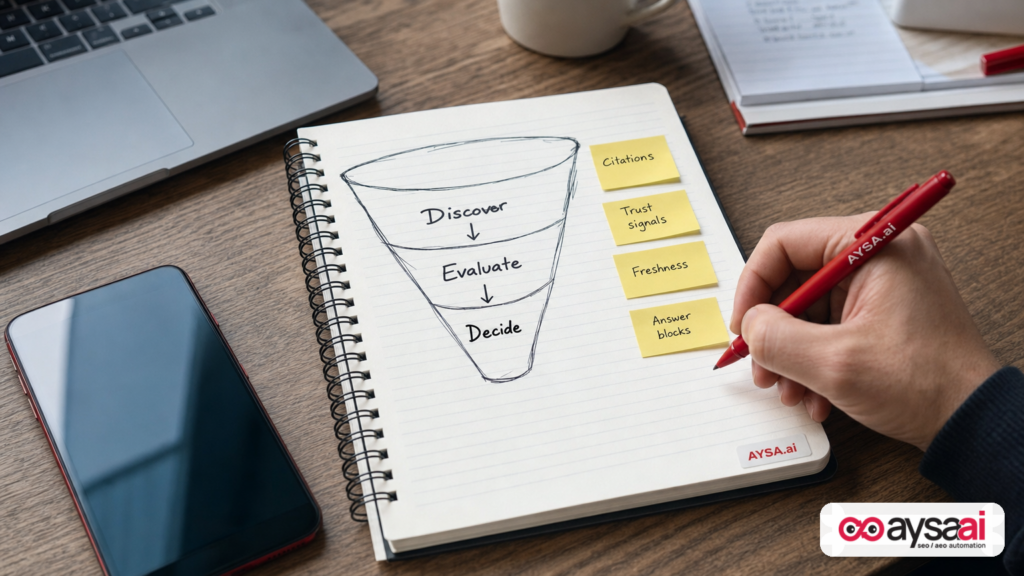
- Google has published a new official guide focused on optimizing for generative AI features in Search—an explicit sign that AI surfaces are now part of mainstream SEO.
- “Optimizing for AI Search” isn’t a trick. It’s the same core job—help users—plus stricter demands for clarity, structure, originality, and technical accessibility.
- The new target isn’t just ranking; it’s earning citations and being reliably used as a source.
- SMEs should prioritize: content that answers real questions, strong provenance (who wrote it, why trust it), clean Site architecture, and fast iteration.
- The biggest risk is execution drift: knowing what to do but not shipping it consistently. That’s the gap AYSA is built to close.
Key takeaways (print this)

- AI Search rewards “best answer” formatting. Clear sections, direct answers, and scannable structure make it easier for systems to understand and cite you.
- Authority is operational, not philosophical. The sites that win are the ones that can prove expertise and maintain quality across hundreds or thousands of pages.
- Technical SEO is still the floor. Crawlability, Indexing, Canonicalization, and page rendering are prerequisites for being used as a source.
- Brand becomes a ranking hedge. If people search for you by name and trust you, you’re more resilient when interfaces shift.
- Execution beats strategy decks. Fast feedback loops—monitor → adjust → publish—matter more than perfect one-time rewrites.
Table of contents
- What Google Actually Announced (And What It Signals)
- Why This Is Happening Now: Search Behavior Is Fragmenting
- The New Optimization Target: From “Ranking Pages” to “Winning Citations”
- The Non-Negotiables: Search Essentials Still Apply
- Content Strategy for AI Surfaces: Write So You Can Be Quoted
- Trust, Experience, and Provenance: The Hidden Ranking Surface
- Technical Readiness: Crawling, Indexing, and Rendering Still Decide Who’s Eligible
- Search Appearance Still Matters: Titles, Snippets, Images
- Measurement Reality: What to Monitor When Clicks Aren’t the Only Win
- A Practical SME Scenario: Local Clinic vs. AI Answers
- What Agencies Should Rethink: From Deliverables to Outcomes
- The Execution Gap: Why “Knowing” Isn’t the Same as “Shipping”
- Where AYSA Fits: Monitoring + Approved Execution for AI Search Visibility
- 90-Day Action Plan (SME-Friendly, No Guesswork)
- What to do next
- Sources and further reading
What Google Actually Announced (And What It Signals)
Google Search Central announced a new resource designed to help website owners, SEOs, and developers understand how to optimize content for appearance in generative AI features in Search—and, as Google frames it, improve Google Search overall.
Here’s the important subtext: Google doesn’t publish new documentation categories unless they expect the ecosystem to need stable guidance. This is a “we expect you to build for this” moment.
You can read the announcement and follow the official resource from Google Search Central here: A new resource for optimizing for generative AI in Google Search.
Google also links this topic into their broader documentation hierarchy, including Optimizing for generative AI search and foundational guidance like Search Essentials.
My read: Google is formalizing a new layer of search appearance where content can be used in AI-generated answers. That changes incentives for content, structure, and technical hygiene. It also raises the bar for sites that want consistent visibility—especially SMEs that don’t have a dedicated SEO engineering team.
Why This Is Happening Now: Search Behavior Is Fragmenting
For years, “search” meant a list of links with some enhancements: featured snippets, knowledge panels, local packs, images, video carousels. Now, generative AI experiences are introducing an additional layer: synthesized answers, multi-source explanations, and task completion flows.
Users increasingly want:
- Faster decisions (“Which one should I buy?”)
- Fewer tabs (comparison and summarization without clicking ten pages)
- More context (pros/cons, edge cases, “what if” scenarios)
- Personalized framing (budget, constraints, location, urgency)
When users want that, search engines adapt interfaces. When interfaces adapt, content must adapt.
But don’t miss the bigger implication: as search becomes more conversational and synthesized, the source selection step becomes more important. If the system doesn’t trust your page—or can’t parse it cleanly—you’re not in the candidate set.
The New Optimization Target: From “Ranking Pages” to “Winning Citations”
Classic SEO thinking (oversimplified) was: pick a keyword, create a page, get links, rank, earn clicks.
AI Search optimization adds a second outcome:
- Ranking (still important)
- Being used as a cited source in AI-generated responses (increasingly important)
That changes how you should evaluate content quality. The question isn’t only “will this rank?” It’s also:
- Is this quote-worthy (clear definitions, precise steps, unambiguous claims)?
- Is this source-worthy (credible author, clear evidence, updated, non-spammy)?
- Is this extractable (structured headings, lists, tables where appropriate)?
- Is this consistent across the site (no contradicting pages)?
Practical framing for SMEs: write pages so that if someone lifted one paragraph as a citation, it would still make sense, be accurate, and reflect well on your brand.
The Non-Negotiables: Search Essentials Still Apply
One of the more dangerous narratives around AI Search is that “the rules are different now.” The interface is different; the fundamentals are not optional.
Google’s Search Central docs remain the baseline, starting with Search Essentials. If your site violates basic quality, technical, or indexing requirements, you’re not going to be reliably surfaced—AI feature or not.
Three fundamentals I’d highlight for business owners:
- Accessibility to crawlers: If important content isn’t crawlable/indexable, you can’t be used as a source. Start with sitemaps and robots controls: Sitemaps and robots.txt.
- Clear canonical signals: Duplicate pages confuse systems. Consolidate, canonicalize, and redirect appropriately: Canonicalization and Redirects.
- Understand how Google processes content: If you’re relying heavily on JavaScript rendering or dynamically injected content, you need to know what Google can reliably see: How Google Search Works and JavaScript SEO basics.
Bottom line: AI optimization sits on top of technical SEO, not instead of it.
Content Strategy for AI Surfaces: Write So You Can Be Quoted
Most SMEs hear “optimize for AI” and assume it means generating more content faster. That’s how you create a landfill of pages that don’t deserve to be cited.
Instead, think like a publisher with standards. AI systems need content that is:
- Specific (not vague marketing language)
- Structured (clear H2/H3 sections, descriptive headings)
- Factual where it matters, and clearly opinion-based where it doesn’t
- Actionable (steps, checklists, decision criteria)
- Maintained (outdated advice becomes a liability)
A simple “answer-first” pattern that works
If you want to be cited, make it easy to extract the answer without misrepresenting you. A pattern I like for SMEs:
- One-paragraph direct answer (the executive summary)
- Decision framework (who this is for, who it isn’t for)
- Step-by-step (implementation)
- FAQs (edge cases, constraints)
- Proof and provenance (author, experience, sources, update date)
Notice what’s missing: filler. AI summarization punishes fluff because fluff is hard to cite.
Content types that tend to earn AI citations
Without inventing platform-specific behavior, we can infer the kinds of content most compatible with generative answers:
- Explainers: “What is X?” “How does X work?”
- Comparisons: “X vs Y for Z scenario”
- Checklists: “What to verify before buying/booking”
- Pricing/coverage clarity: transparent boundaries and options
- Troubleshooting guides: symptoms → causes → fixes
- Policy pages: shipping, returns, guarantees, service terms (often overlooked)
These are also the pages that reduce sales friction. Even if AI answers reduce some clicks, the clicks you do receive are more likely to be decision-stage.
Trust, Experience, and Provenance: The Hidden Ranking Surface
Generative answers raise the stakes for trust because the system is synthesizing information. If it cites you and you’re wrong, that degrades the user experience. So the system has incentives to prefer sources that look legitimate and consistent.
For SMEs, “trust” is not a branding exercise. It’s a set of on-site signals you can control:
- Clear authorship (who wrote this?)
- About and contact transparency (who runs this business?)
- Demonstrated experience (real photos, real processes, real constraints—not stock claims)
- Editorial hygiene (dates, revisions, accuracy)
- Consistency across pages (no contradictions)
This connects to a broader theme in Google’s guidance over time: systems and evaluators are incentivized to reward content that is helpful and grounded in real experience. I’m not going to pretend any single “E-E-A-T checklist” guarantees performance, but I will say this: generative AI makes sloppy content more expensive, not less.
Technical Readiness: Crawling, Indexing, and Rendering Still Decide Who’s Eligible
If your content can’t be crawled, it won’t be indexed. If it isn’t indexed, it won’t be selected. Simple chain.
SMEs often underestimate technical SEO because it’s not visible to customers—until it breaks revenue.
Control what gets crawled, indexed, and shared
Use Google’s documentation as your baseline for crawl and index management:
- Sitemaps to help discovery and prioritize important URLs.
- robots.txt to guide crawling (carefully; it’s easy to block the wrong thing).
- Meta tags to manage indexing behavior and snippet controls.
- Removals when you need content removed from Search.
Canonicalization is not optional anymore
Generative features intensify a classic SEO problem: duplicate and near-duplicate URLs. If your site has the same product/service described across multiple parameterized URLs, tags, tracking links, or faceted navigation paths, the system must decide which version is “the source.”
Start with Google’s canonicalization guidance: Consolidate duplicate URLs.
For SMEs, this typically shows up as:
- Ecommerce collections with filters producing indexable URLs
- Blog tags and categories generating thin archives
- Localized pages duplicating content without meaningful differentiation
- Multiple “service area” pages that are nearly identical
Fixing this is not glamorous. But if you want to be a source, you need one clean, authoritative version of each topic.
If your site is JavaScript-heavy, verify what Google sees
Modern sites frequently rely on client-side rendering. When that breaks, content can be invisible or partially visible to crawlers. Use Google’s foundational reference: JavaScript SEO basics.
SME rule-of-thumb: if your most important content appears only after scripts run (especially behind user interactions), you’re taking on risk. Make sure critical content is present in server-rendered HTML or reliably rendered for Google.
Search Appearance Still Matters: Titles, Snippets, Images
Even in an AI-forward world, classic search appearance impacts clicks, trust, and eligibility for enhanced surfaces. Google’s documentation around titles and snippets is still essential reading:
And don’t ignore image optimization—AI experiences and SERPs increasingly blend modalities:
The new title/snippet job: reduce ambiguity
For SMEs, the best practice is less about keyword stuffing and more about “unmistakable clarity.” Titles and headings should communicate:
- What the page is (guide, service, policy, comparison)
- Who it’s for (industry, customer segment, location if relevant)
- What outcome it supports (buy, book, learn, troubleshoot)
If an AI system (or a human) can’t quickly determine what your page is, it’s less likely to be selected or clicked.
Measurement Reality: What to Monitor When Clicks Aren’t the Only Win
AI features can change click behavior. That doesn’t mean measurement becomes impossible; it means measurement becomes more nuanced.
At minimum, SMEs should monitor:
- Query mix changes: Are you gaining visibility on informational queries but losing “ready-to-buy” ones?
- Landing page shifts: Are the wrong pages becoming the entry point?
- CTR changes by intent: Even if total clicks drop, are conversion rates improving?
- Indexing coverage: Are key pages being crawled and indexed consistently?
- Snippet/title rewrites: Are your titles being replaced in ways that hurt clarity?
Google offers tools and documentation that should remain in every operator’s toolkit:
In AYSA, we push this further into a workflow: monitor what changes, generate concrete recommendations, and then execute what you approve so monitoring actually turns into improvement. See: AYSA Monitoring.
A Practical SME Scenario: Local Clinic vs. AI Answers
Let’s make this real with a scenario I see constantly.
Business: A local clinic offering physical therapy and sports injury rehab.
Old SEO goal: Rank #1 for “physical therapy near me” and “sports injury clinic [city].”
New reality: Patients search with longer, question-based queries:
- “Do I need a referral for physical therapy in [state]?”
- “How many PT sessions for a sprained ankle?”
- “Physical therapy vs chiropractor for lower back pain?”
Generative AI features may summarize options and cite sources. If the clinic’s site has only short service pages and no high-quality answers, the system will cite medical portals, large directories, or competitors with better educational content.
What the clinic should do (without pretending to be a medical journal)
- Create an “Answers Hub” with practical patient questions and clear disclaimers (not diagnosing, but educating).
- Write pages that can be cited safely: direct answers, who it applies to, when to seek in-person evaluation.
- Show real-world experience: therapist bios, treatment approach, what a first visit includes, expected timelines.
- Reduce duplication: avoid publishing 25 near-identical “PT in [neighborhood]” pages.
- Make conversion frictionless: booking, insurance notes, what to bring, contact info.
What success looks like: The clinic becomes the trusted local source for patient questions. Even if not every query produces a click, the brand is repeatedly present as the cited answer and the eventual “book now” choice.
What Agencies Should Rethink: From Deliverables to Outcomes
Agencies are under pressure from two sides: AI tools make content production cheap, while clients expect results faster. If your model is “we deliver X blog posts per month,” you’re exposed.
AI Search forces a shift from deliverables to outcomes:
- Outcome: Owned visibility in AI answers for high-intent customer questions
- Outcome: More qualified leads even if overall clicks fluctuate
- Outcome: Reduced customer support load through better self-serve content
That requires capabilities many agencies struggle with operationally:
- Technical cleanup (canonicals, redirects, index management)
- Editorial governance (templates, quality checks, update workflows)
- Iteration speed (publishing changes without weeks of tickets)
This is where execution systems matter more than strategy decks.
The Execution Gap: Why “Knowing” Isn’t the Same as “Shipping”
Most businesses don’t lose because they picked the wrong strategy. They lose because they didn’t execute the right strategy consistently.
AI Search amplifies that gap. Why?
- There are more “search surfaces” to optimize for.
- Content needs more maintenance (accuracy, freshness, consistency).
- Technical issues block eligibility silently.
- Competitors can move faster with automation.
So the winning capability isn’t “having SEO knowledge.” It’s having a system that turns insights into shipped improvements on a weekly cadence.
Where AYSA Fits: Monitoring + Approved Execution for AI Search Visibility
AYSA.ai exists because the modern SEO bottleneck is not ideas—it’s shipping.
Here’s how we frame the workflow for AI Search visibility:
- Monitor: Track the pages and queries that matter, and detect when visibility or behavior changes. (Monitoring)
- Prepare: Generate specific, page-level recommendations: content structure, internal links, duplication cleanup, snippet improvements, and technical fixes.
- Ask for approval: You stay in control. Nothing changes on your site until you approve it.
- Execute: Once accepted, we implement changes so you don’t get stuck in ticket purgatory.
This model is especially relevant for AI Search because it’s not one optimization—it’s a continuous operating discipline.
If you want a deeper overview of the problem space, start here:
- AI Search Visibility
- AI SEO Tools
- Pricing (so you can evaluate ROI with real constraints)
- AYSA Blog (ongoing playbooks and updates)
90-Day Action Plan (SME-Friendly, No Guesswork)
This plan is designed for operators who need results and can’t afford endless theory.
Days 1–15: Eligibility and clarity (the foundation)
- Confirm crawl/index basics: sitemap presence, robots rules, meta tags on key pages. Use Google’s references: Sitemaps, robots.txt, Meta tags.
- Fix duplication and canonicals: pick the primary URL per topic/product/service. Reference: Canonicalization.
- Audit titles/snippets: remove ambiguity; align with intent. References: Title links, Snippets.
- Identify 20 “citation-worthy” questions your customers ask (sales calls, support tickets, returns, demos, objections).
Days 16–45: Build “source-ready” content (not mass content)
- Create 10 high-value answer pages using the answer-first pattern.
- Upgrade 10 existing pages that already get impressions but underperform (improve structure, add missing specifics, remove fluff).
- Add provenance blocks: author bio, business credentials, update dates where appropriate.
- Strengthen internal linking so related pages support each other and reduce orphan content.
Days 46–90: Iterate, consolidate, and operationalize
- Consolidate weak pages into stronger topic hubs (merge, redirect, canonicalize).
- Expand FAQs based on real queries you see in Search performance (don’t guess).
- Refresh key pages on a schedule (monthly for competitive topics, quarterly for stable topics).
- Set up ongoing monitoring with clear thresholds for action (e.g., impressions up but CTR down; wrong pages ranking; indexing anomalies). AYSA can run this loop continuously: Monitoring.
What to do next
- Read Google’s announcement and bookmark the new guide: Google Search Central blog post and Optimizing for generative AI search.
- Pick one revenue-critical category (one product line, one service, one location) and build an “answer hub” around the top customer questions.
- Clean duplication and canonicals before you publish at scale.
- Decide your execution system: If your team can’t reliably ship changes weekly, use a workflow that can. AYSA is built for that: AI Search Visibility.
- Operationalize monitoring so you aren’t guessing whether AI surfaces are helping or hurting: Monitoring.
Sources and further reading
- Google Search Central Blog: A new resource for optimizing for generative AI in Google Search
- Google Search Central: Optimizing for generative AI search
- Google Search Central: Search Essentials
- Google Search Central: How Google Search Works
- Google Search Central: Sitemaps
- Google Search Central: robots.txt
- Google Search Central: Meta tags
- Google Search Central: Canonicalization
- Google Search Central: Title links
- Google Search Central: Snippets
AYSA internal resources mentioned: AI SEO Tools, AI Search Visibility, Monitoring, Pricing, Blog.
Continue the AI search topic inside AYSA.
Use these pages to connect the article with AI SEO tools, AI visibility monitoring, AI Overviews and approved website execution.
Turn this topic into a website action plan.
Use these AYSA hubs to move from reading to technical fixes, AI visibility monitoring, research, glossary context and approval-first SEO execution.

